


Views: 0
What is ISO certification explained simply? Learn what ISO means, how it works, types of ISO certifications, who needs it, benefits, and how to get certified in India with GacoiCert.
Table of Contents
- 1 Introduction: What Exactly Is ISO Certification?
- 2 What Does ISO Stand For?
- 3 What Is an ISO Standard?
- 4 What Is ISO Certification — The Simple Explanation?
- 5 Who Issues ISO Certificates?
- 6 How Does ISO Certification Actually Work?
- 7 The Most Important ISO Standards for Businesses in India
- 8 What Is the Difference Between ISO Certification and ISO Accreditation?
- 9 What Are the Real Benefits of ISO Certification for Businesses?
- 10 Common Misconceptions About ISO Certification
- 11 How Much Does ISO Certification Cost in India?
- 12 Why Choose GacoiCert for ISO Certification in India?
- 13 Conclusion: ISO Certification Is Simpler Than You Think — and More Valuable Than You Might Expect
- 14 Frequently Asked Questions
- 15 Need ISO 27001 Certification
Introduction: What Exactly Is ISO Certification?
You have seen it on product packaging, company websites, business cards, and tender documents. The letters ISO appear everywhere in the business world — but what do they actually mean, and why do so many organizations pursue ISO certification?
If you have ever wondered what ISO certification really is, how it works, whether your business needs it, and what it actually takes to get certified — this guide answers every one of those questions in plain, straightforward language.
No jargon. No complexity. Just a clear, honest explanation of one of the most important business standards frameworks in the world — and what it means specifically for businesses operating in India today.
What Does ISO Stand For?
ISO stands for the International Organization for Standardization — an independent, non-governmental international organization headquartered in Geneva, Switzerland.
Founded in 1947, ISO has grown to become the world’s largest developer of voluntary international standards. It currently has 167 member countries and has published more than 24,000 international standards covering virtually every industry and business function imaginable — from quality management and food safety to information security, environmental management, occupational health, and medical devices.
One important note about the name: You might expect the abbreviation to be IOS rather than ISO — but ISO is derived from the Greek word isos, meaning equal. The founders chose ISO as a universal short form that works across all languages, avoiding different abbreviations in different countries.
What Is an ISO Standard?
Before understanding ISO certification, it is important to understand what an ISO standard actually is.
An ISO standard is a document — developed through international consensus by experts from around the world — that defines best practices, requirements, or specifications for a particular area of business activity. Think of it as a detailed, globally agreed-upon blueprint for how something should be done to achieve consistent, high-quality outcomes.
ISO standards are developed through a rigorous process involving technical committees composed of experts from industry, government, academia, and civil society from ISO’s member countries. Every standard goes through multiple rounds of review, comment, and revision before being published — ensuring it reflects genuine international best practice rather than any single country’s or organization’s preferences.
Standards are reviewed and updated periodically — typically every five years — to ensure they remain relevant as technology, best practices, and business environments evolve.
Examples of what ISO standards cover:
- How an organization should manage quality to consistently satisfy customers
- How a food business should manage food safety to prevent contamination
- How an organization should manage environmental impacts responsibly
- How a company should protect sensitive information from cyber threats
- How a business should manage workplace health and safety
- How products should be manufactured to meet specific technical specifications
What Is ISO Certification — The Simple Explanation?
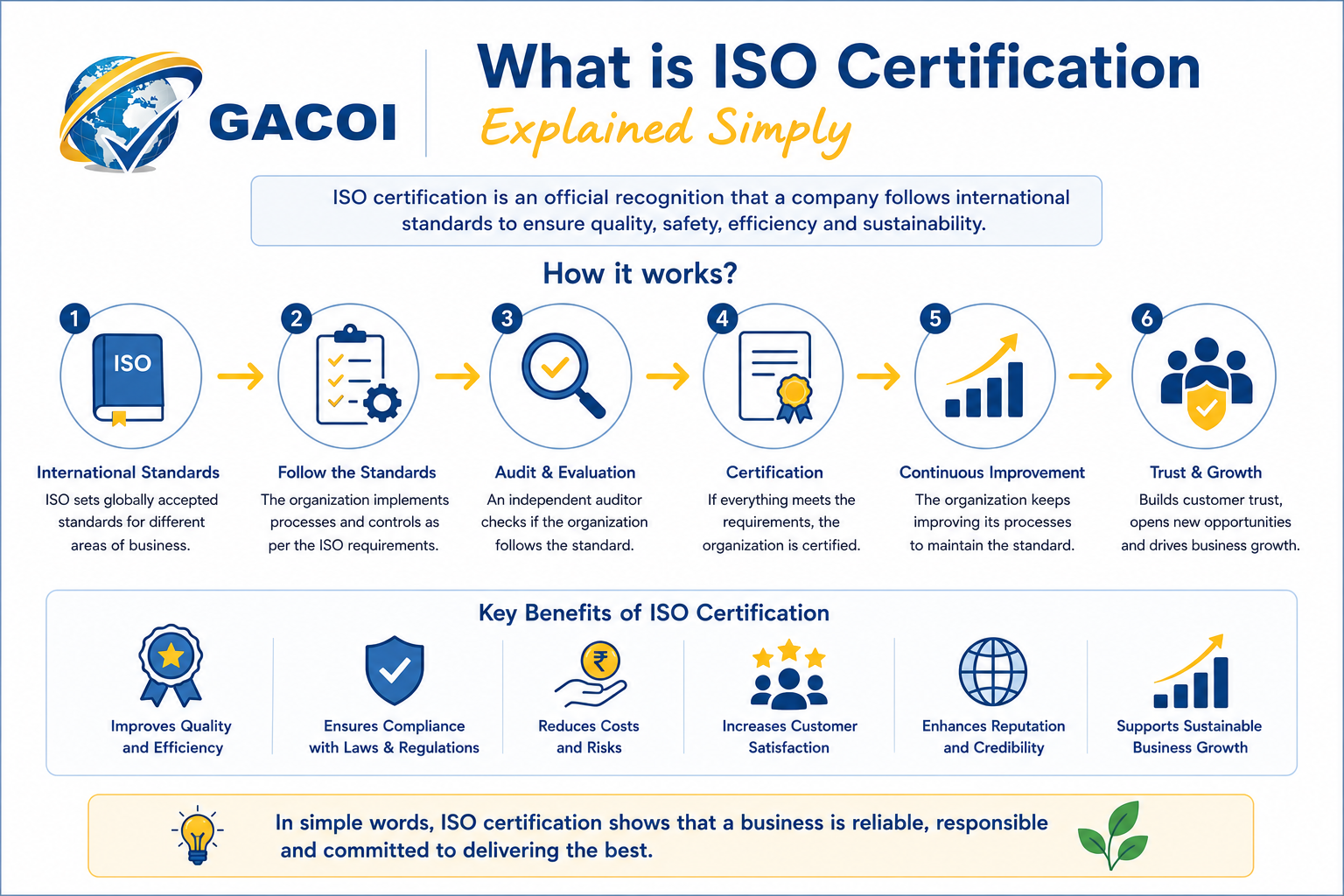
ISO certification — also called ISO registration — is the formal process through which an independent, accredited third-party organization verifies that your company’s management system, processes, or products meet the requirements defined in a specific ISO standard.
Here is the simplest way to understand it:
ISO writes the rules. Your company follows the rules. An accredited certification body independently checks that you are genuinely following the rules. If you are, they issue you a certificate confirming it.
That certificate is internationally recognized proof that your organization meets a globally respected standard — whether for quality, environmental management, food safety, information security, or any other area covered by the relevant standard.
What ISO certification is NOT:
- ISO does not certify companies itself — ISO only writes the standards
- ISO certification is not a product approval or product quality mark
- ISO certification is not a government license or legal requirement in most cases
- ISO certification is not a one-time event — it requires ongoing maintenance and periodic re-auditing
Who Issues ISO Certificates?
This is one of the most commonly misunderstood aspects of ISO certification.
ISO itself does not issue certificates. The International Organization for Standardization writes and publishes the standards but does not conduct audits or issue certifications to individual organizations.
ISO certificates are issued by independent certification bodies — also called registrars or conformity assessment bodies — that are themselves accredited by national or international accreditation bodies to conduct ISO audits and issue certificates.
This creates a three-tier structure:
Tier 1 — Accreditation Bodies: National or international bodies that assess and accredit certification bodies. Examples include NABCB (National Accreditation Board for Certification Bodies) in India, UKAS in the United Kingdom, DAkkS in Germany, and ANAB in the United States. Accreditation bodies are members of the International Accreditation Forum (IAF), which ensures global mutual recognition of accredited certifications.
Tier 2 — Certification Bodies: Independent organizations accredited by accreditation bodies to audit companies against ISO standards and issue certificates. GacoiCert is an example of an accredited certification body operating in India.
Tier 3 — Your Organization: The business or organization that implements the ISO standard and is audited by the certification body.
This structure ensures that ISO certificates carry genuine credibility — because the certification body issuing them has itself been independently assessed and accredited.
How Does ISO Certification Actually Work?
The ISO certification process follows a consistent pattern regardless of which specific standard is involved. Here is how it works in practice:
Stage 1 — Understand the Standard
Your organization obtains and studies the relevant ISO standard — for example, ISO 9001:2015 for quality management. You analyze its requirements and understand how they apply to your specific business context, operations, and industry.
Stage 2 — Implement the Management System
Your organization designs and implements a management system that meets the standard’s requirements. This involves documenting your processes, establishing policies and objectives, assigning responsibilities, training employees, and actually putting the system into operation in day-to-day business activities.
Stage 3 — Operate the System and Gather Evidence
The management system must be operational for a meaningful period — typically a minimum of three months — before the certification audit. During this time, you collect records and evidence demonstrating that the system is genuinely functioning.
Stage 4 — Internal Audit
Your organization conducts an internal audit — a systematic self-assessment checking that the management system meets the standard’s requirements and is effectively implemented. Internal audit findings are documented and any issues identified are corrected.
Stage 5 — Management Review
Senior leadership formally reviews the management system’s performance — examining data, audit results, customer feedback, and performance metrics — and makes decisions about improvements and resource allocation.
Stage 6 — Select an Accredited Certification Body
Your organization selects an accredited certification body — such as GacoiCert — to conduct the independent certification audit.
Stage 7 — Stage 1 Audit (Document Review)
The certification body’s auditor reviews your management system documentation to confirm it adequately addresses the standard’s requirements and assesses your readiness for the on-site assessment.
Stage 8 — Stage 2 Audit (On-Site Assessment)
The certification body’s auditors visit your premises and conduct a thorough assessment — reviewing records, interviewing employees at all levels, observing actual operations, and verifying that your documented system genuinely reflects how your organization operates.
Stage 9 — Certificate Issuance
If the audit is successful — and any nonconformities identified are satisfactorily addressed — the certification body issues your ISO certificate. Most ISO certificates are valid for three years, subject to annual surveillance audits.
Stage 10 — Ongoing Maintenance
Annual surveillance audits verify that your management system continues to meet the standard’s requirements. At the end of the three-year cycle, a full recertification audit renews your certificate.
The Most Important ISO Standards for Businesses in India
ISO has published more than 24,000 standards — but for most businesses, a relatively small number of management system standards are most relevant. Here are the most widely adopted and most important for Indian businesses:
ISO 9001 — Quality Management System
What it covers: A framework for managing quality across all business processes to consistently deliver products and services that meet customer requirements.
Who needs it: Any organization in any industry that wants to demonstrate quality commitment — manufacturing companies, IT firms, service providers, construction companies, healthcare organizations, educational institutions, and more.
Why it matters in India: ISO 9001 is the most widely required certification in Indian government tenders, corporate supplier qualification processes, and export market access requirements.
Current version: ISO 9001:2015
ISO 14001 — Environmental Management System
What it covers: A framework for identifying, managing, and continuously improving an organization’s environmental impacts — energy use, waste generation, water consumption, emissions, and regulatory compliance.
Who needs it: Any organization that wants to demonstrate environmental responsibility, meet green compliance requirements, access export markets with environmental requirements, or reduce resource costs.
Why it matters in India: With India’s environmental regulations becoming progressively more stringent and international buyers demanding environmental credentials, ISO 14001 is increasingly essential for Indian manufacturers and exporters.
Current version: ISO 14001:2015
ISO 45001 — Occupational Health and Safety Management System
What it covers: A framework for identifying workplace hazards, managing occupational health and safety risks, and preventing work-related injuries and illnesses.
Who needs it: Any organization with employees — particularly high-risk industries such as construction, manufacturing, mining, oil and gas, healthcare, and logistics.
Why it matters in India: Workplace accident rates in India remain high, regulatory enforcement is strengthening, and tender requirements increasingly include safety certification. ISO 45001 directly addresses all of these challenges.
Current version: ISO 45001:2018
ISO 22000 — Food Safety Management System
What it covers: A comprehensive framework for managing food safety throughout the entire food supply chain — incorporating HACCP principles, prerequisite programs, and management system requirements.
Who needs it: Any organization involved in the food supply chain — farmers, food processors, manufacturers, caterers, restaurants, distributors, retailers, and food packaging companies.
Why it matters in India: India is one of the world’s largest food producers and exporters. ISO 22000 is increasingly required by export market buyers, modern retail chains, and institutional food service customers.
Current version: ISO 22000:2018
ISO 27001 — Information Security Management System
What it covers: A framework for managing information security risks — protecting sensitive data, intellectual property, customer information, and business-critical systems from cyber threats and breaches.
Who needs it: IT companies, software developers, BPO and KPO firms, financial services companies, healthcare organizations, and any business handling sensitive customer or business data.
Why it matters in India: With India’s IT industry serving global clients and India’s Digital Personal Data Protection Act creating new data security obligations, ISO 27001 is rapidly becoming a critical certification for Indian technology businesses.
Current version: ISO 27001:2022
ISO 13485 — Medical Devices Quality Management System
What it covers: A quality management system specifically designed for organizations involved in the design, manufacture, installation, and servicing of medical devices.
Who needs it: Medical device manufacturers, component suppliers, distributors, and service organizations in the medical device sector.
Why it matters in India: India’s medical device industry is growing rapidly, and both domestic regulatory requirements and international market access require ISO 13485 certification.
Current version: ISO 13485:2016
What Is the Difference Between ISO Certification and ISO Accreditation?
These two terms are frequently confused — even by business professionals with some familiarity with ISO.
ISO Certification refers to an organization receiving a certificate from an accredited certification body confirming that its management system meets the requirements of a specific ISO standard. Your company gets ISO certified.
ISO Accreditation refers to a certification body receiving formal recognition from an accreditation body confirming that it is competent and meets the requirements to conduct ISO audits and issue certificates. The certification body gets accredited.
In simple terms: accreditation bodies accredit certification bodies. Certification bodies certify organizations.
This distinction matters enormously in practice. Only certificates issued by accredited certification bodies carry genuine international credibility. Certificates from non-accredited bodies — regardless of how official they may appear — are not recognized by government authorities, international buyers, or credible procurement departments.
Always ensure your certification body is accredited by a recognized accreditation body such as NABCB in India, UKAS in the UK, DAkkS in Germany, or any other IAF member body.
What Are the Real Benefits of ISO Certification for Businesses?
Understanding the benefits of ISO certification helps explain why over one million organizations worldwide maintain ISO certifications — and why the number grows every year.
Winning More Business and Tenders
ISO certification is frequently a prerequisite for government tenders, large corporate supplier approvals, and international contracts. In India, central government procurement, state government contracts, defense procurement, and infrastructure projects increasingly require or award preference to ISO certified vendors. A single major contract won through ISO certification typically returns the entire certification investment many times over.
Building Customer Trust and Confidence
An ISO certificate communicates to customers and prospects that your organization has been independently verified to meet international quality, safety, or environmental standards. This independently verified credibility is far more powerful than self-claimed quality assurances — and it consistently influences purchasing decisions in your favor.
Improving Operational Efficiency
ISO management systems require organizations to document, analyze, and systematically improve their processes. This discipline consistently reveals inefficiencies, redundancies, and improvement opportunities that were previously invisible. Organizations that implement ISO standards genuinely — not just for the certificate — consistently achieve measurable improvements in productivity, error rates, waste, and cost efficiency.
Accessing International Markets
Export markets — particularly in Europe, North America, and Japan — consistently prefer or require ISO certified suppliers. For Indian businesses targeting export growth, ISO certification removes a significant barrier to market entry and supplier qualification.
Reducing Risk
Whether it is quality risk, environmental risk, food safety risk, information security risk, or occupational health risk — ISO management systems provide structured frameworks for identifying, assessing, and controlling risks before they become costly incidents. This proactive risk management approach reduces insurance costs, regulatory penalties, customer complaints, and business disruption.
Motivating and Engaging Employees
ISO certification involves employees at all levels in understanding and improving the organization’s management systems. This participation builds awareness, accountability, and pride — contributing positively to workplace culture, employee engagement, and talent retention.
Supporting Continuous Improvement
Perhaps the most enduring benefit of ISO certification is the culture of continual improvement it creates. ISO management systems are designed not as static compliance exercises but as dynamic frameworks that drive progressive improvement in performance over time — making your business consistently better, year after year.
Common Misconceptions About ISO Certification
Misconception 1: ISO Certification Guarantees Product Quality
ISO management system certification — such as ISO 9001 — certifies that your quality management processes meet the standard’s requirements. It does not certify that individual products meet specific technical specifications. Product quality certification is a separate category of conformity assessment.
Misconception 2: ISO Certification Is Only for Large Companies
This is completely false. ISO standards are explicitly designed to be applicable to organizations of any size — from sole traders and micro-businesses to multinational corporations. Many small businesses find that ISO certification opens doors to clients and contracts that were previously inaccessible.
Misconception 3: ISO Certification Is Just Paperwork
While ISO management systems require documented information, the certification is fundamentally about how your organization actually operates — not how much paper you generate. Auditors specifically assess whether your documented system reflects genuine operational practice, not whether your filing cabinets are full.
Misconception 4: Once Certified, Nothing More Is Required
ISO certificates require active maintenance. Annual surveillance audits verify ongoing compliance, and a full recertification audit is required every three years. Organizations that treat certification as a one-time event consistently struggle to maintain their certificates.
Misconception 5: Any ISO Certificate Is Equally Valid
This is dangerously false in India’s certification market. Certificates issued by non-accredited bodies carry no international credibility and are not recognized by government authorities or serious commercial buyers. Always verify that your certification body is accredited by NABCB or another IAF member accreditation body.
How Much Does ISO Certification Cost in India?
ISO certification cost in India varies based on organization size, industry complexity, and which standard is being certified. As a general guide:
| Organization Size | Approximate Total Investment |
|---|---|
| Micro Business (1–5 employees) | ₹40,000 – ₹80,000 |
| Small Business (6–25 employees) | ₹80,000 – ₹2,00,000 |
| Medium Business (26–100 employees) | ₹1,80,000 – ₹4,00,000 |
| Large Business (100–300 employees) | ₹3,50,000 – ₹7,50,000 |
These figures include certification body fees, basic training, and minimal implementation support. Costs vary with consultant engagement, training depth, and infrastructure requirements.
The consistent finding across Indian businesses is that ISO certification investment delivers returns — through new business won, efficiency gains, and risk reduction — that significantly exceed the total cost.
Why Choose GacoiCert for ISO Certification in India?
GacoiCert is one of India’s trusted accredited certification bodies, helping businesses across all industries and sizes achieve internationally recognized ISO certifications.
Internationally accredited: GacoiCert’s certificates are globally recognized — accepted by government procurement authorities, international buyers, and investors worldwide.
All major ISO standards: ISO 9001, ISO 14001, ISO 45001, ISO 22000, ISO 27001, and more — all under one trusted certification partner.
Experienced auditors across all industries: Our auditors bring genuine sector-specific knowledge — manufacturing, IT, construction, healthcare, food processing, education, logistics, and beyond.
Transparent, competitive pricing: Complete quotations with no hidden fees. You know your full investment before committing.
Pan-India service: Delhi NCR, Mumbai, Bangalore, Chennai, Hyderabad, Pune, Kolkata, Ahmedabad, and all major industrial centers and cities across India.
Efficient, streamlined process: Thorough, credible certification without unnecessary delays or complexity.
Integrated Management System expertise: Pursue ISO 9001, ISO 14001, and ISO 45001 together through a combined audit — maximizing value and minimizing operational disruption.
Genuine partnership: Our relationship with clients extends beyond certificate issuance — we support your continuous improvement journey through every surveillance audit and recertification cycle.
Conclusion: ISO Certification Is Simpler Than You Think — and More Valuable Than You Might Expect
ISO certification, explained simply, is independent verification that your organization meets a globally recognized international standard — for quality, environmental management, food safety, information security, occupational health, or any other area covered by the relevant standard.
It is not complicated bureaucracy. It is not just paperwork. It is not only for large corporations. And it is certainly not an expense — it is one of the most consistently rewarding investments a business can make.
For Indian businesses in 2025, ISO certification is increasingly the difference between winning and losing tenders, between qualifying and being excluded from supply chains, between accessing export markets and remaining confined to domestic competition, and between being seen as a credible quality organization or just another uncertified vendor.
The process is clear. The benefits are real. The investment is proportionate. And with GacoiCert as your certification partner, every step of the journey is guided, transparent, and focused on delivering genuine value for your business.
Visit gacoicert.com today, request your free consultation, and take the first step toward ISO certification that opens doors, builds trust, and transforms your business.
Frequently Asked Questions
1. What is ISO certification?
ISO certification is a formal recognition that an organization complies with internationally recognized standards developed by the International Organization for Standardization (ISO). It demonstrates a commitment to quality, efficiency, safety, or environmental management, depending on the specific ISO standard.
2. Why is ISO certification important for businesses?
ISO certification helps businesses improve operational efficiency, enhance customer satisfaction, build trust, meet regulatory requirements, and gain a competitive advantage in domestic and international markets.
3. Who can apply for ISO certification?
Any organization—including startups, MSMEs, large enterprises, manufacturers, service providers, educational institutions, healthcare organizations, and NGOs—can apply for ISO certification, regardless of its size or industry.
4. How do I get ISO certification?
To obtain ISO certification, a business must implement the requirements of the relevant ISO standard, prepare the necessary documentation, conduct internal audits, and successfully complete an audit by an accredited certification body.
5. How long does it take to obtain ISO certification?
The time required for ISO certification depends on the type of standard, the organization’s size, and the level of preparedness. Small businesses may complete the process within a few weeks, while larger organizations may take several months.
6. Is ISO certification mandatory in India?
No. ISO certification is generally voluntary. However, many government tenders, corporate clients, and international buyers prefer or require suppliers to have ISO certification as proof of compliance with recognized standards.
7. What are the benefits of ISO certification?
The key benefits of ISO certification include improved quality management, increased customer confidence, better process efficiency, reduced operational risks, enhanced legal compliance, stronger brand reputation, and greater opportunities for business growth and global market access.
Need ISO 27001 Certification
🟡GACOI Cert provides globally recognized ISO certification, cybersecurity, privacy, AI governance, compliance, audit, and professional training services, helping startups, businesses, enterprises, laboratories, healthcare organizations, and government institutions achieve international standards and build lasting trust.
🟡For other Legal and Trademark related services Visit
👉 Money Recovery Cases
👉 Property Disputes
👉 Business & Licence Registrations
🟡 Protect Your Rights
👉 Domestic Violence Legal Support
👉 Stridhan Recovery
👉 Mutual Consent Divorce
👉 Contested Divorce Filing
👉 Child Custody and Maintenance
👉 Matrimonial Property Settlement
👉 NRI Divorce Services
👉 Alimony and Maintenance
📞 Call Now: +91 8595439395
🕐 Free Consultation: Monday to Saturday, 10 AM to 6 PM


