


Views: 2
Discover the complete ISO certification cost in India 2026 for all major standards — ISO 9001, ISO 14001, ISO 45001, ISO 22000, ISO 27001 and more. Transparent pricing guide by GacoiCert.
Table of Contents
- 1 Introduction: What Does ISO Certification Cost in India in 2026?
- 2 Why ISO Certification Cost Varies: The Key Factors
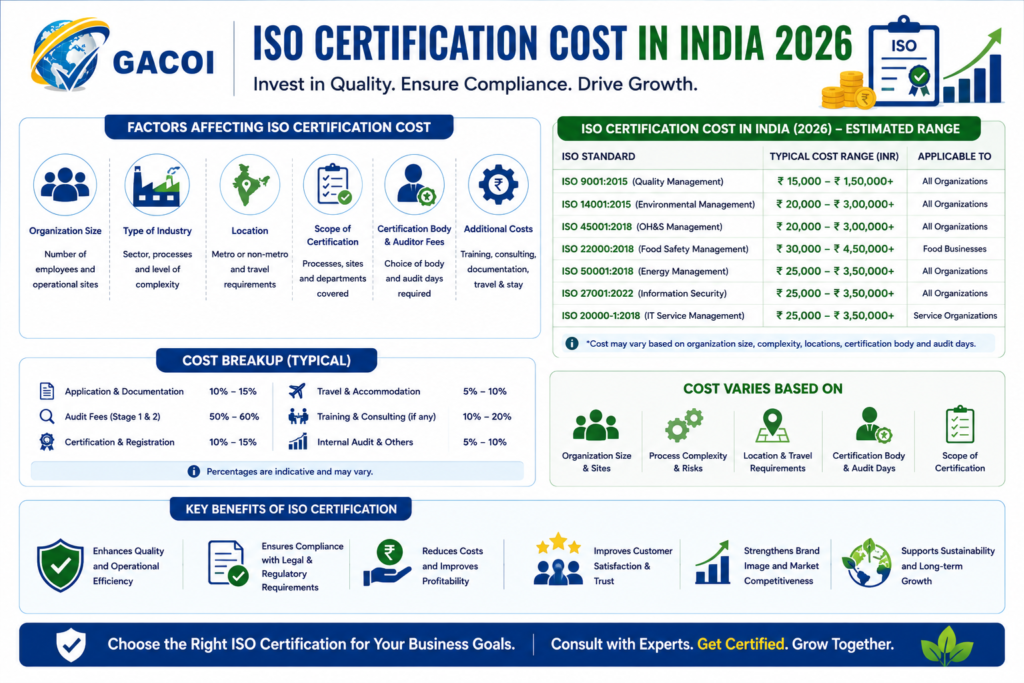
- 3 ISO Certification Cost Breakdown: All Major Standards in India 2026
- 4 Integrated Management System (IMS) Certification Cost: The Smart Investment
- 5 The Complete Cost Components: Beyond Certification Body Fees
- 6 The Critical Warning: Fake ISO Certificates in India
- 7 Three-Year Total Cost of ISO Certification in India 2026
- 8 Return on ISO Certification Investment: Why the Cost Is Always Justified
- 9 Why Choose GacoiCert for ISO Certification in India?
- 10 Conclusion: Plan Your ISO Certification Investment with Complete Confidence
- 11 Frequently Asked Questions
- 12 Need ISO Certification
Introduction: What Does ISO Certification Cost in India in 2026?
If you are an Indian business owner, quality manager, or senior executive exploring ISO certification, one question dominates your early research: how much does ISO certification cost in India in 2026?
It is the right question — and it deserves a complete, transparent, and honest answer. Not a vague “it depends” that leaves you no clearer than before, but a detailed, structured breakdown that gives you realistic numbers, explains what drives cost variation, covers every major ISO standard, and helps you plan your certification investment accurately.
The reality is that ISO certification cost in India varies across a meaningful range — depending on which standard you are pursuing, your organization’s size, your industry’s complexity, whether you engage external consultant support, which accredited certification body you choose, and how many sites are included in your certification scope.
However, complete cost transparency is entirely achievable. In this comprehensive guide, GacoiCert breaks down the certification costs for every major ISO management system standard — ISO 9001, ISO 14001, ISO 45001, ISO 22000, ISO 27001, ISO 50001, and ISO 13485 — covering certification body fees, consultant charges, training costs, and ongoing annual maintenance expenses. We also explain the critical difference between genuine accredited certification and the fraudulent cheap certificates that are unfortunately prevalent in India’s market — and why that difference matters enormously for the value your certificate delivers.
Why ISO Certification Cost Varies: The Key Factors
Before presenting specific numbers, understanding what drives cost variation enables accurate planning for your specific situation.
Factor 1: Organization Size — The Primary Cost Driver
ISO certification body fees are determined primarily by audit duration — the total time required for document review, on-site assessment, report preparation, and certificate issuance. Audit duration is calculated based on the number of effective employees using International Accreditation Forum mandatory document guidelines.
More employees means more audit time. More audit time means higher certification body fees. This relationship is consistent, proportionate, and objective across all legitimate accredited certification bodies.
Factor 2: Operational Complexity
Two organizations with the same number of employees can have very different certification costs if their operational complexity differs significantly. A single-service IT company with fifty employees has simpler processes than a manufacturer with fifty employees running multiple production lines, diverse product portfolios, and complex supply chains. The more complex operation requires more audit time and therefore higher fees.
Factor 3: Number of Sites
Single-site certifications are significantly less expensive than multi-site certifications. Each additional site included in the certification scope requires additional audit time — proportionate to the size and complexity of that site.
Factor 4: Industry and Standard-Specific Risk Profile
Some standards require more technically specialized assessment than others. ISO 22000 food safety audits require HACCP plan validation and food safety hazard assessment. ISO 27001 information security audits require cybersecurity risk assessment expertise. ISO 45001 high-risk industry audits require occupational safety technical knowledge. This technical depth influences audit duration and sometimes certification body fees.
Factor 5: Certification Body Choice
Certification body fees vary between legitimate accredited certification bodies — reflecting differences in auditor experience, market positioning, geographic presence, and service quality. However, all legitimate accredited certification bodies calculate fees based on the same IAF audit duration guidelines — meaning significant price differences between accredited bodies warrant scrutiny.
Factor 6: Integrated vs Separate Certification
Organizations pursuing multiple ISO standards simultaneously through an Integrated Management System approach consistently achieve significant cost savings — typically 25 to 40 percent reduction in combined certification fees — compared to pursuing each standard through separate, independent certification processes.
ISO Certification Cost Breakdown: All Major Standards in India 2026
ISO 9001:2015 — Quality Management System Certification Cost
ISO 9001 is the world’s most widely adopted management system standard and the most frequently required certification in Indian government tenders, corporate supplier qualifications, and international market access requirements.
ISO 9001 Certification Body Fees in India 2026:
| Organization Size | Number of Employees | Estimated Certification Fee |
|---|---|---|
| Micro Business | 1 – 5 employees | ₹18,000 – ₹35,000 |
| Very Small Business | 6 – 15 employees | ₹30,000 – ₹55,000 |
| Small Business | 16 – 30 employees | ₹45,000 – ₹80,000 |
| Small-Medium Business | 31 – 60 employees | ₹65,000 – ₹1,10,000 |
| Medium Business | 61 – 100 employees | ₹85,000 – ₹1,45,000 |
| Medium-Large Business | 101 – 175 employees | ₹1,20,000 – ₹1,90,000 |
| Large Business | 176 – 300 employees | ₹1,65,000 – ₹2,60,000 |
| Very Large Business | 301 – 500 employees | ₹2,20,000 – ₹3,20,000 |
| Enterprise | 500+ employees | ₹3,00,000 and above |
Annual Surveillance Audit Fees: ₹12,000 – ₹2,00,000 per year depending on size.
Total First-Year Investment Including Consultant and Training:
| Organization Size | Total Estimated First-Year Investment |
|---|---|
| Micro to Very Small | ₹40,000 – ₹95,000 |
| Small to Small-Medium | ₹85,000 – ₹2,10,000 |
| Medium to Medium-Large | ₹1,90,000 – ₹4,20,000 |
| Large to Enterprise | ₹3,60,000 and above |
ISO 14001:2015 — Environmental Management System Certification Cost
ISO 14001 is increasingly essential for Indian businesses targeting export markets, government environmental tenders, ESG investor confidence, and systematic compliance with India’s comprehensive environmental regulatory framework.
ISO 14001 Certification Body Fees in India 2026:
| Organization Size | Number of Employees | Estimated Certification Fee |
|---|---|---|
| Micro Business | 1 – 5 employees | ₹20,000 – ₹38,000 |
| Very Small Business | 6 – 15 employees | ₹32,000 – ₹58,000 |
| Small Business | 16 – 30 employees | ₹48,000 – ₹85,000 |
| Small-Medium Business | 31 – 60 employees | ₹70,000 – ₹1,15,000 |
| Medium Business | 61 – 100 employees | ₹90,000 – ₹1,50,000 |
| Medium-Large Business | 101 – 175 employees | ₹1,25,000 – ₹2,00,000 |
| Large Business | 176 – 300 employees | ₹1,70,000 – ₹2,60,000 |
| Very Large Business | 301 – 500 employees | ₹2,20,000 – ₹3,20,000 |
| Enterprise | 500+ employees | ₹3,00,000 and above |
Annual Surveillance Audit Fees: ₹13,000 – ₹2,00,000 per year depending on size.
Total First-Year Investment Including Consultant and Training:
| Organization Size | Total Estimated First-Year Investment |
|---|---|
| Micro to Very Small | ₹50,000 – ₹1,10,000 |
| Small to Small-Medium | ₹1,00,000 – ₹2,35,000 |
| Medium to Medium-Large | ₹2,10,000 – ₹4,75,000 |
| Large to Enterprise | ₹4,10,000 and above |
ISO 45001:2018 — Occupational Health and Safety Certification Cost
ISO 45001 is the international standard for workplace safety management — increasingly required in construction, manufacturing, infrastructure, mining, and any industry where worker safety is a regulatory and commercial priority.
ISO 45001 Certification Body Fees in India 2026:
| Organization Size | Number of Employees | Estimated Certification Fee |
|---|---|---|
| Micro Business | 1 – 5 employees | ₹22,000 – ₹40,000 |
| Very Small Business | 6 – 15 employees | ₹35,000 – ₹62,000 |
| Small Business | 16 – 30 employees | ₹50,000 – ₹90,000 |
| Small-Medium Business | 31 – 60 employees | ₹75,000 – ₹1,20,000 |
| Medium Business | 61 – 100 employees | ₹95,000 – ₹1,55,000 |
| Medium-Large Business | 101 – 175 employees | ₹1,30,000 – ₹2,10,000 |
| Large Business | 176 – 300 employees | ₹1,80,000 – ₹2,70,000 |
| Very Large Business | 301 – 500 employees | ₹2,30,000 – ₹3,30,000 |
| Enterprise | 500+ employees | ₹3,10,000 and above |
Annual Surveillance Audit Fees: ₹14,000 – ₹2,10,000 per year depending on size.
Total First-Year Investment Including Consultant and Training:
| Organization Size | Total Estimated First-Year Investment |
|---|---|
| Micro to Very Small | ₹55,000 – ₹1,25,000 |
| Small to Small-Medium | ₹1,10,000 – ₹2,70,000 |
| Medium to Medium-Large | ₹2,40,000 – ₹5,30,000 |
| Large to Enterprise | ₹4,65,000 and above |
ISO 22000:2018 — Food Safety Management System Certification Cost
ISO 22000 is the internationally recognized food safety standard — essential for Indian food processors, exporters, restaurant chains, catering companies, and any organization in the food supply chain targeting export markets, modern retail, or institutional buyers.
ISO 22000 Certification Body Fees in India 2026:
| Organization Size | Number of Employees | Estimated Certification Fee |
|---|---|---|
| Micro Business | 1 – 5 employees | ₹22,000 – ₹42,000 |
| Very Small Business | 6 – 15 employees | ₹36,000 – ₹65,000 |
| Small Business | 16 – 30 employees | ₹52,000 – ₹92,000 |
| Small-Medium Business | 31 – 60 employees | ₹78,000 – ₹1,25,000 |
| Medium Business | 61 – 100 employees | ₹98,000 – ₹1,60,000 |
| Medium-Large Business | 101 – 175 employees | ₹1,35,000 – ₹2,15,000 |
| Large Business | 176 – 300 employees | ₹1,85,000 – ₹2,80,000 |
| Very Large Business | 301 – 500 employees | ₹2,40,000 – ₹3,40,000 |
| Enterprise | 500+ employees | ₹3,20,000 and above |
Annual Surveillance Audit Fees: ₹14,000 – ₹2,15,000 per year depending on size.
Total First-Year Investment Including Consultant and Training:
| Organization Size | Total Estimated First-Year Investment |
|---|---|
| Micro to Very Small | ₹62,000 – ₹1,47,000 |
| Small to Small-Medium | ₹1,25,000 – ₹3,02,000 |
| Medium to Medium-Large | ₹2,62,000 – ₹5,90,000 |
| Large to Enterprise | ₹5,20,000 and above |
ISO 27001:2022 — Information Security Management System Certification Cost
ISO 27001 is the international standard for information security management — critical for Indian IT companies, software developers, BPO and KPO firms, financial services organizations, healthcare providers, and any business handling sensitive customer data. India’s Digital Personal Data Protection Act 2023 has significantly increased the business case for ISO 27001 in India.
ISO 27001 Certification Body Fees in India 2026:
| Organization Size | Number of Employees | Estimated Certification Fee |
|---|---|---|
| Micro Business | 1 – 5 employees | ₹25,000 – ₹45,000 |
| Very Small Business | 6 – 15 employees | ₹40,000 – ₹70,000 |
| Small Business | 16 – 30 employees | ₹58,000 – ₹1,00,000 |
| Small-Medium Business | 31 – 60 employees | ₹85,000 – ₹1,35,000 |
| Medium Business | 61 – 100 employees | ₹1,05,000 – ₹1,70,000 |
| Medium-Large Business | 101 – 175 employees | ₹1,45,000 – ₹2,30,000 |
| Large Business | 176 – 300 employees | ₹2,00,000 – ₹3,00,000 |
| Very Large Business | 301 – 500 employees | ₹2,60,000 – ₹3,70,000 |
| Enterprise | 500+ employees | ₹3,50,000 and above |
ISO 27001 certification fees are slightly higher than ISO 9001 fees at equivalent organization sizes — because information security audits require specialized cybersecurity risk assessment expertise and more technical depth in assessing controls across 93 Annex A control domains.
Annual Surveillance Audit Fees: ₹16,000 – ₹2,30,000 per year depending on size.
Total First-Year Investment Including Consultant and Training:
| Organization Size | Total Estimated First-Year Investment |
|---|---|
| Micro to Very Small | ₹70,000 – ₹1,60,000 |
| Small to Small-Medium | ₹1,40,000 – ₹3,20,000 |
| Medium to Medium-Large | ₹2,80,000 – ₹6,00,000 |
| Large to Enterprise | ₹5,50,000 and above |
ISO 50001:2018 — Energy Management System Certification Cost
ISO 50001 is the international standard for energy management — particularly valuable for energy-intensive Indian manufacturers, data center operators, cold chain logistics providers, and organizations subject to BEE’s Perform Achieve and Trade scheme obligations.
ISO 50001 Certification Body Fees in India 2026:
| Organization Size | Number of Employees | Estimated Certification Fee |
|---|---|---|
| Micro Business | 1 – 5 employees | ₹22,000 – ₹42,000 |
| Very Small Business | 6 – 15 employees | ₹35,000 – ₹62,000 |
| Small Business | 16 – 30 employees | ₹48,000 – ₹88,000 |
| Small-Medium Business | 31 – 60 employees | ₹72,000 – ₹1,18,000 |
| Medium Business | 61 – 100 employees | ₹92,000 – ₹1,52,000 |
| Medium-Large Business | 101 – 175 employees | ₹1,28,000 – ₹2,05,000 |
| Large Business | 176 – 300 employees | ₹1,75,000 – ₹2,65,000 |
| Very Large Business | 301 – 500 employees | ₹2,25,000 – ₹3,25,000 |
| Enterprise | 500+ employees | ₹3,05,000 and above |
Annual Surveillance Audit Fees: ₹14,000 – ₹2,05,000 per year depending on size.
ISO 13485:2016 — Medical Devices Quality Management System Certification Cost
ISO 13485 is the quality management standard specifically designed for medical device manufacturers, component suppliers, distributors, and service organizations. India’s rapidly growing medical device industry — and tightening Medical Devices Rules requirements — make ISO 13485 increasingly important for Indian medical device businesses.
ISO 13485 Certification Body Fees in India 2026:
| Organization Size | Estimated Certification Fee |
|---|---|
| Small Business (up to 30 employees) | ₹55,000 – ₹1,00,000 |
| Medium Business (31 – 100 employees) | ₹1,00,000 – ₹1,80,000 |
| Large Business (101 – 300 employees) | ₹1,80,000 – ₹3,00,000 |
| Enterprise (300+ employees) | ₹3,00,000 and above |
ISO 13485 certification fees tend to be higher than ISO 9001 fees at equivalent organization sizes — because medical device quality audits require auditors with specialized regulatory and technical knowledge of medical device design, manufacturing, and regulatory requirements.
Integrated Management System (IMS) Certification Cost: The Smart Investment
One of the most important cost insights for Indian businesses pursuing multiple ISO certifications is the significant savings available through Integrated Management System certification — where multiple standards are audited simultaneously through a single, coordinated audit process.
IMS Combined Certification Fees in India 2026:
| Standard Combination | Small Business | Medium Business | Large Business |
|---|---|---|---|
| ISO 9001 + ISO 14001 | ₹60,000 – ₹1,30,000 | ₹1,30,000 – ₹2,60,000 | ₹2,60,000 – ₹4,80,000 |
| ISO 9001 + ISO 45001 | ₹62,000 – ₹1,35,000 | ₹1,35,000 – ₹2,70,000 | ₹2,70,000 – ₹4,95,000 |
| ISO 9001 + ISO 14001 + ISO 45001 | ₹80,000 – ₹1,70,000 | ₹1,70,000 – ₹3,40,000 | ₹3,40,000 – ₹6,20,000 |
| ISO 9001 + ISO 14001 + ISO 45001 + ISO 50001 | ₹1,00,000 – ₹2,10,000 | ₹2,10,000 – ₹4,20,000 | ₹4,20,000 – ₹7,80,000 |
The IMS cost saving is substantial: Pursuing ISO 9001, ISO 14001, and ISO 45001 through three separate certification processes typically costs 35 to 50 percent more than pursuing all three simultaneously through GacoiCert’s integrated audit approach.
Beyond cost savings, IMS certification delivers operational advantages — a single coordinated audit causes less operational disruption than three separate audits, common management system elements are maintained once rather than three times separately, and the integrated approach creates a unified management culture around quality, environment, and safety.
The Complete Cost Components: Beyond Certification Body Fees
Certification body fees are the most visible cost component — but accurate budget planning requires accounting for all cost components.
Consultant Fees
External ISO implementation consultants help organizations with gap analysis, documentation development, employee training, internal audit support, and pre-certification preparation. While not mandatory, consultants significantly accelerate implementation and reduce the risk of major audit findings.
Typical consultant fees by organization size:
| Organization Size | Estimated Consultant Fee |
|---|---|
| Micro to Very Small | ₹15,000 – ₹50,000 |
| Small Business | ₹35,000 – ₹1,00,000 |
| Medium Business | ₹80,000 – ₹2,00,000 |
| Large Business | ₹1,50,000 – ₹4,00,000 |
| Enterprise | ₹3,00,000 and above |
Training Costs
Investment in ISO standard awareness training, lead implementer training, and internal auditor training for relevant team members.
Typical training costs per person:
| Training Type | Estimated Fee Per Person |
|---|---|
| ISO Awareness Training | ₹3,000 – ₹10,000 |
| ISO Lead Implementer Training | ₹15,000 – ₹45,000 |
| ISO Internal Auditor Training | ₹8,000 – ₹25,000 |
Standard Purchase Cost
The relevant ISO standard document — available from Bureau of Indian Standards (BIS) at approximately ₹5,000 to ₹8,000 per standard for most major management system standards.
Internal Resource Cost
The time invested by your employees in implementation — often the largest single cost component but frequently overlooked in budget planning. For small businesses, total internal time investment typically ranges from 100 to 300 hours. For medium businesses, 300 to 700 hours. Multiply by average employee cost per hour for a realistic internal resource cost figure.
Documentation and Software Tools
Basic documentation tools — Microsoft 365 or Google Workspace — are sufficient for most small and medium businesses at minimal incremental cost. Dedicated management system software ranges from ₹15,000 to ₹2,50,000 per year for larger organizations seeking more structured system management.
The Critical Warning: Fake ISO Certificates in India
This section is perhaps the most important in this entire guide.
India’s ISO certification market contains a substantial number of non-accredited and fraudulent certification bodies offering ISO certificates at prices far below legitimate market rates — sometimes ₹3,000 to ₹15,000 for any ISO standard, any organization size, with minimal or no genuine audit process.
These certificates are worthless. They are rejected by:
- Government tender evaluation committees across India
- Corporate supplier qualification teams
- International buyers and import authorities
- Banks and financial institutions
- Insurance companies
- FSSAI and other regulatory authorities
Worse than worthless — businesses that unknowingly hold fraudulent certificates and submit them in government tenders may face disqualification and potential legal consequences for submitting false documents.
How to identify fraudulent operators:
Price too low: Genuine accredited ISO 9001 certification starts from approximately ₹18,000 to ₹35,000 for the smallest micro-business. Any offer significantly below this is almost certainly from a non-accredited body.
Timeline too short: Legitimate certification requires minimum three months of management system operation before the audit. Offers of certification in 7 to 30 days are impossible under genuine certification processes.
Guaranteed outcomes: Legitimate accredited certification bodies cannot guarantee audit outcomes before assessment. Any guarantee of certification is a red flag.
Unverifiable accreditation: Fraudulent operators frequently display logos of invented accreditation bodies. Always verify accreditation through NABCB at nabcb.in or IAF at iaf.nu.
Not in IAF CertSearch: Genuine certificates from accredited bodies are verifiable at iafcertsearch.org. Fraudulent certificates cannot be found there.
The bottom line: A cheap fake certificate is not a discounted version of genuine certification. It is an entirely different and worthless product. Always choose an accredited certification body.
Three-Year Total Cost of ISO Certification in India 2026
Planning your ISO certification budget should cover the complete three-year certification cycle — including initial certification, two annual surveillance audits, and the recertification audit at the end of the cycle.
Three-Year Total Cost of Ownership by Standard and Organization Size:
| Standard | Small Business (3-Year Total) | Medium Business (3-Year Total) | Large Business (3-Year Total) |
|---|---|---|---|
| ISO 9001 | ₹1,20,000 – ₹3,00,000 | ₹2,80,000 – ₹5,50,000 | ₹5,20,000 – ₹9,50,000 |
| ISO 14001 | ₹1,30,000 – ₹3,20,000 | ₹3,00,000 – ₹5,80,000 | ₹5,50,000 – ₹9,80,000 |
| ISO 45001 | ₹1,40,000 – ₹3,40,000 | ₹3,20,000 – ₹6,10,000 | ₹5,80,000 – ₹10,20,000 |
| ISO 22000 | ₹1,50,000 – ₹3,60,000 | ₹3,40,000 – ₹6,40,000 | ₹6,20,000 – ₹11,00,000 |
| ISO 27001 | ₹1,70,000 – ₹4,00,000 | ₹3,80,000 – ₹7,20,000 | ₹7,00,000 – ₹12,50,000 |
| IMS (9001+14001+45001) | ₹2,20,000 – ₹5,00,000 | ₹5,00,000 – ₹9,50,000 | ₹9,50,000 – ₹17,50,000 |
These three-year totals include certification body fees for initial certification, two surveillance audits, and recertification — but exclude consultant and training costs which are primarily first-year investments.
Return on ISO Certification Investment: Why the Cost Is Always Justified
Every ISO certification cost discussion must be contextualized against the returns that certification delivers — because the investment case for genuine accredited certification is consistently and compellingly positive across every standard.
Government tender wins: A single government tender won through ISO certification qualification can return the entire three-year certification investment many times over. Central and state government contracts in construction, IT, manufacturing, healthcare, and infrastructure collectively represent enormous procurement value — with ISO certification as an increasingly common qualification requirement.
Export market access: For export-oriented Indian businesses, a single new international customer relationship — won through ISO certification supplier qualification — typically generates annual revenues that dwarf the total three-year certification cost.
Operational efficiency savings: ISO management system implementation consistently drives measurable efficiency improvements — reduced defects, improved processes, better resource utilization — that deliver recurring annual savings.
Regulatory penalty avoidance: Serious regulatory violations across quality, environmental, food safety, and information security domains carry penalties that can reach crores of rupees. Systematic compliance management through ISO certification dramatically reduces this financial exposure.
Insurance premium reductions: Risk-conscious insurers consistently recognize the lower risk profile of ISO certified organizations — translating into more favorable premium terms that partially offset ongoing certification costs.
ESG and financing advantages: ISO certifications — particularly ISO 14001, ISO 45001, and ISO 50001 — strengthen ESG credentials that support better financing terms, investor confidence, and SEBI BRSR compliance for listed companies.
Why Choose GacoiCert for ISO Certification in India?
When ISO certification cost is your planning focus, two things matter most: paying a fair, transparent price for genuinely accredited certification, and ensuring the certificate you receive delivers the full business value that legitimate accredited certification provides.
GacoiCert delivers both.
Internationally accredited: GacoiCert’s certificates for all major ISO standards are issued under internationally recognized accreditation — verifiable through NABCB and IAF databases, accepted by government procurement authorities, corporate buyers, international importers, and investors worldwide.
All major standards under one roof: ISO 9001, ISO 14001, ISO 45001, ISO 22000, ISO 27001, ISO 50001, ISO 13485, and Integrated Management Systems — comprehensive certification capability from a single trusted partner.
Transparent, competitive pricing: Complete itemized quotations covering every stage of the certification process with no hidden fees, no surprise charges, and no pricing that changes after the engagement begins.
Integrated Management System expertise: GacoiCert specializes in combining multiple ISO standards into single coordinated audit processes — delivering maximum cost efficiency for organizations pursuing multiple certifications.
Deep industry expertise across all sectors: Manufacturing, IT, construction, healthcare, food processing, education, logistics, professional services — our auditors bring genuine sector-specific knowledge to every audit engagement.
Pan-India service coverage: Delhi NCR, Mumbai, Pune, Ahmedabad, Surat, Bangalore, Chennai, Hyderabad, Kolkata, Ludhiana, Jaipur, Kochi, and all major cities and industrial centers across India.
Long-term certification partnership: GacoiCert’s commitment to clients extends through every surveillance audit and recertification cycle — providing consistent, reliable certification partnership as your organization grows and your certification portfolio expands.
Conclusion: Plan Your ISO Certification Investment with Complete Confidence
ISO certification cost in India in 2026 ranges from approximately ₹40,000 for the smallest micro-businesses pursuing a single standard to several lakhs for large enterprises pursuing multiple certifications — with the exact investment determined by standard choice, organization size, operational complexity, and whether you pursue integrated or separate certification.
What is consistent across every organization, every standard, and every industry is the fundamental investment case: the return on genuine, accredited ISO certification — through tender access, export market qualification, operational efficiency, regulatory compliance, and brand credibility — consistently and significantly exceeds the total cost of achieving and maintaining it.
The critical caveat is that these returns are available only through genuine, accredited certification. Cheap certificates from non-accredited bodies deliver none of these benefits and add significant risk. Always verify accreditation status before engaging any certification body — through NABCB at nabcb.in, IAF at iaf.nu, and IAF CertSearch at iafcertsearch.org.
GacoiCert is ready to provide your organization with internationally accredited ISO certification at transparent, competitive pricing across all major standards. Visit gacoicert.com today, request your free consultation, and receive a personalized ISO certification cost estimate tailored to your specific organization and certification objectives.
Frequently Asked Questions
1. What is the ISO Certification Cost in India in 2026?
The ISO Certification Cost in India depends on several factors, including the type of ISO standard, the size of the organization, the number of employees, business locations, and the certification body chosen. The overall cost varies from one business to another.
2. What factors affect the ISO Certification Cost in India?
The ISO Certification Cost in India is influenced by the scope of certification, industry type, documentation requirements, implementation support, audit duration, number of sites, and the complexity of the organization’s operations.
3. Does the ISO Certification Cost in India include implementation and audit charges?
Not always. Some service providers offer complete packages that include documentation, implementation, employee training, internal audits, and certification audits, while others charge separately. Always confirm what is included in the ISO Certification Cost in India before proceeding.
4. Is the ISO Certification Cost in India different for startups and MSMEs?
Yes. The ISO Certification Cost in India is generally lower for startups and MSMEs because they usually have fewer employees, simpler business processes, and a smaller certification scope than larger organizations.
5. How long does it take to obtain ISO certification?
The timeline depends on the type of ISO standard, the organization’s preparedness, documentation, implementation of the management system, and the certification body’s audit schedule. Most businesses complete the certification process within a few weeks to a few months.
6. Is ISO certification worth the investment?
Yes. Although the ISO Certification Cost in India requires an initial investment, certification helps improve operational efficiency, customer confidence, regulatory compliance, brand credibility, and access to government tenders and international business opportunities.
7. Are there any recurring costs after ISO certification?
Yes. Businesses may incur surveillance audit fees, recertification charges, and costs associated with maintaining and continually improving their management systems. These recurring expenses should be considered along with the ISO Certification Cost in India.
8. How can businesses reduce the ISO Certification Cost in India?
Businesses can optimize the ISO Certification Cost in India by preparing documentation in advance, implementing the required management system effectively, conducting internal audits before certification, and selecting an accredited certification body that offers transparent pricing and comprehensive support.
Need ISO Certification
🟡GACOI Cert provides globally recognized ISO certification, cybersecurity, privacy, AI governance, compliance, audit, and professional training services, helping startups, businesses, enterprises, laboratories, healthcare organizations, and government institutions achieve international standards and build lasting trust.
🟡For other Legal and Trademark related services Visit
👉 Money Recovery Cases
👉 Property Disputes
👉 Business & Licence Registrations
🟡 Protect Your Rights
👉 Domestic Violence Legal Support
👉 Stridhan Recovery
👉 Mutual Consent Divorce
👉 Contested Divorce Filing
👉 Child Custody and Maintenance
👉 Matrimonial Property Settlement
👉 NRI Divorce Services
👉 Alimony and Maintenance
📞 Call Now: +91 8595439395
🕐 Free Consultation: Monday to Saturday, 10 AM to 6 PM


