


Views: 1
Discover the top 10 ISO certification benefits for Indian businesses in 2026 — from winning government tenders and accessing export markets to reducing costs and building customer trust. Get certified with GacoiCert.
Table of Contents
- 1 Introduction: Why ISO Certification Is One of the Best Business Decisions You Can Make in India
- 2 Understanding ISO Certification in the Indian Context
- 3 Benefit 1: Winning Government Tenders and Public Sector Contracts
- 4 Benefit 2: Access to Export Markets and International Supply Chains
- 5 Benefit 3: Significant Operational Efficiency and Cost Reduction
- 6 Benefit 4: Enhanced Customer Satisfaction and Retention
- 7 Benefit 5: Stronger Brand Reputation and Market Credibility
- 8 Benefit 6: Effective Risk Management and Business Continuity
- 9 Benefit 7: Employee Engagement, Productivity, and Talent Attraction
- 10 Benefit 8: Regulatory Compliance and Legal Protection
- 11 Benefit 9: Financial Benefits — Reduced Costs, Better Insurance, and Improved Financing
- 12 Benefit 10: Foundation for Long-Term Business Growth and Scalability
- 13 The Combined Power of Multiple ISO Certifications
- 14 How GacoiCert Helps Indian Businesses Realize These Benefits
- 15 Conclusion: ISO Certification Benefits That Transform Indian Businesses
- 16 Frequently Asked Questions
- 17 Need ISO Certification
Introduction: Why ISO Certification Is One of the Best Business Decisions You Can Make in India
Every year, thousands of Indian businesses make the decision to pursue ISO certification — and the vast majority report that it was one of the most impactful investments they have ever made in their organization’s future.
But what exactly are the benefits? Why do businesses ranging from small manufacturing units in Ludhiana to large IT companies in Bangalore, from food processors in Gujarat to construction firms in Delhi NCR, consistently pursue and maintain ISO certification year after year?
The answer lies in a combination of immediate, practical business benefits and long-term strategic advantages that ISO certification delivers — benefits that are real, measurable, and consistently reported by certified organizations across every industry and size category.
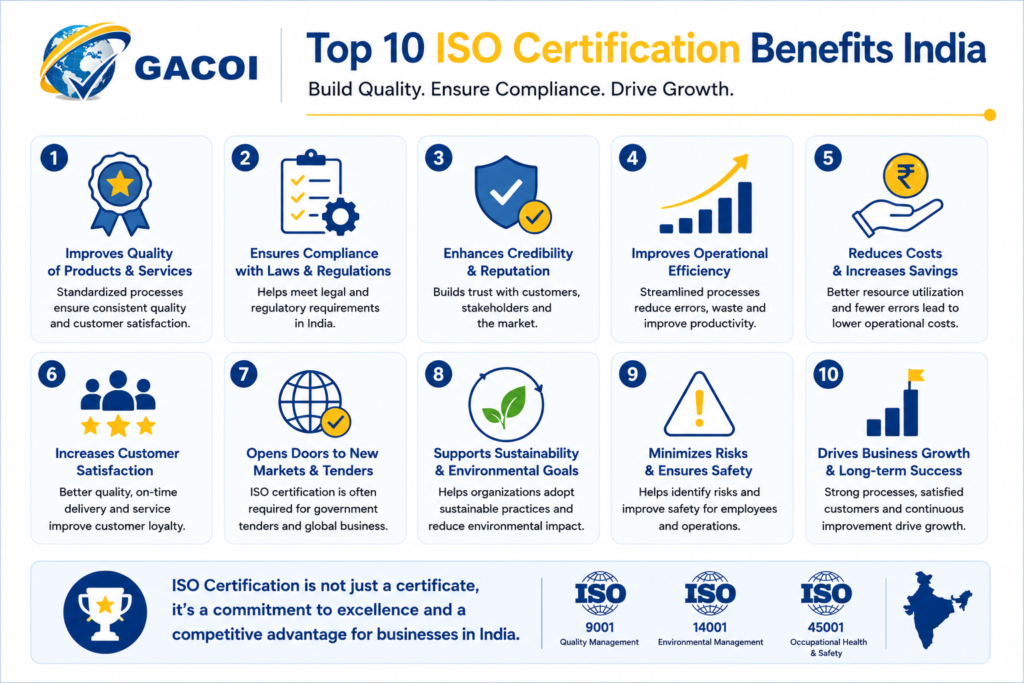
This comprehensive guide explores the top 10 ISO certification benefits for businesses in India — explaining not just what each benefit is, but how it specifically manifests in the Indian business environment and why it matters for your organization’s growth and sustainability.
Whether you are considering ISO certification for the first time, evaluating whether the investment is justified, or looking to understand the full scope of value that certification delivers, this guide provides the complete, honest picture.
Understanding ISO Certification in the Indian Context
Before exploring the specific benefits, it is worth briefly understanding what makes ISO certification particularly valuable in India’s specific business environment.
India’s economy is characterized by several dynamics that make ISO certification especially impactful:
Rapid regulatory evolution: Environmental laws, food safety regulations, occupational health requirements, and data protection legislation are all becoming progressively more stringent — creating compliance challenges that ISO management systems directly address.
Growing government procurement: India’s government is the world’s largest public procurement market. Central and state government tenders collectively represent trillions of rupees in annual contracts — and ISO certification is an increasingly common requirement or preference criterion.
Export ambitions: India’s manufacturing and services sectors have significant export growth aspirations — and international buyers consistently require or prefer suppliers with ISO certification.
Rising consumer expectations: Indian consumers are becoming more sophisticated, more quality-conscious, and more aware of international standards — creating market demand for verified quality credentials.
Intensifying competition: Both domestic and international competition in Indian markets is intensifying — making differentiation through verified quality, safety, and environmental credentials increasingly valuable.
In this context, ISO certification is not simply a compliance exercise or a certificate to display on a wall — it is a strategic business tool that delivers tangible competitive advantage.
Benefit 1: Winning Government Tenders and Public Sector Contracts
For any Indian business targeting government contracts — and given that government spending represents a massive portion of India’s GDP, this includes a very large number of businesses — ISO certification is perhaps the single most immediately impactful benefit available.
Across India, central government ministries, state government departments, public sector undertakings (PSUs), municipal corporations, defense procurement organizations, and infrastructure agencies increasingly incorporate ISO certification requirements into their tender evaluation frameworks.
This manifests in several ways:
Mandatory qualification criterion: Many tenders list ISO certification as a mandatory prerequisite — meaning uncertified businesses cannot even submit a bid, regardless of how competitive their pricing or how relevant their experience.
Evaluation scoring advantage: Even where ISO certification is not mandatory, tender evaluation matrices frequently award preference points to certified vendors — improving bid scores and winning probabilities for ISO certified businesses.
Empanelment requirements: Government vendor registration and empanelment processes — for approved supplier lists in sectors ranging from construction to IT services to healthcare supplies — commonly require ISO certification as a qualification condition.
Specific government schemes: Programs including Make in India, Startup India, and various MSME development initiatives provide preferential support to ISO certified businesses — including easier access to government orders and priority consideration in procurement processes.
The financial impact of this benefit alone consistently justifies the entire ISO certification investment. A single government tender won — or a single procurement empanelment achieved — on the basis of ISO certification can return the certification cost many times over in a matter of months.
For Indian MSMEs in particular, ISO certification frequently represents the key that unlocks access to government contracts that were previously inaccessible — transforming business scale and growth trajectory in ways that no other investment of comparable size can match.
Benefit 2: Access to Export Markets and International Supply Chains
India’s export sector — spanning manufacturing, IT services, pharmaceuticals, food products, textiles, engineering goods, automotive components, and more — represents one of the country’s most significant economic growth opportunities. ISO certification is one of the most consistent enablers of export market access.
International buyers — particularly in the European Union, United States, United Kingdom, Japan, Australia, and Gulf Cooperation Council countries — operate in regulatory and commercial environments where ISO certification is standard expectation rather than exceptional achievement.
How ISO certification enables export access:
Supplier qualification: International companies running supplier qualification processes routinely require ISO 9001 certification as a baseline condition of supplier approval. Without it, Indian vendors simply do not make it onto the approved supplier list — regardless of price competitiveness or technical capability.
Regulatory compliance demonstration: Export markets increasingly have regulatory requirements that ISO certification helps demonstrate compliance with. The EU’s supply chain due diligence requirements, food safety import standards, and environmental regulations all align with various ISO standards.
Buyer confidence: International buyers sourcing from India carry significant supply chain risk — geographic distance, cultural differences, and limited ability to directly supervise supplier operations all create uncertainty. ISO certification from an accredited body provides independent, internationally recognized assurance that reduces this uncertainty and builds buyer confidence.
Specific export sector examples:
- Food exports: ISO 22000 certification is increasingly required by European and North American food importers from Indian suppliers
- Automotive components: ISO 9001 (and IATF 16949 for automotive-specific certification) is required for automotive supply chain qualification
- IT and software services: ISO 9001 and ISO 27001 are commonly required by international IT clients
- Pharmaceutical exports: Quality management certifications support regulatory submissions in international markets
- Textile and garment exports: ISO 9001 and environmental certifications support qualification with international fashion brands committed to sustainable supply chains
For export-oriented Indian businesses, ISO certification is not a nice-to-have — it is a fundamental market access requirement.
Benefit 3: Significant Operational Efficiency and Cost Reduction
This benefit is frequently underappreciated by businesses evaluating ISO certification — yet it is consistently reported by certified organizations as one of the most tangible and financially significant outcomes of implementation.
ISO management system standards require organizations to document their processes, analyze performance data, identify inefficiencies, implement improvements, and systematically monitor results. This discipline — applied consistently across business operations — reliably reveals cost reduction and efficiency improvement opportunities that were previously invisible or unaddressed.
How ISO certification drives operational efficiency in practice:
Process documentation reveals inefficiencies: When processes are formally documented for the first time, redundant steps, unnecessary duplication, and inefficient workflows become visible — and can be eliminated.
Data-driven decision making: ISO standards require systematic measurement of key performance indicators. When organizations start tracking defect rates, customer complaint frequencies, delivery performance, energy consumption, and waste generation — they gain the data needed to make targeted, evidence-based improvements.
Waste and rework reduction: ISO 9001’s focus on nonconforming outputs and corrective actions drives systematic reduction of defects, errors, and rework — reducing the direct and indirect costs associated with quality failures.
Resource efficiency: ISO 14001 implementation specifically drives energy efficiency, water conservation, and waste reduction — delivering measurable reductions in utility bills, waste disposal costs, and raw material consumption.
Supplier performance improvement: ISO standards require systematic supplier management — which consistently improves supplier quality and delivery performance, reducing the costs associated with poor supplier performance.
The financial scale of these savings varies by organization but is typically significant relative to the certification investment. Many Indian manufacturers report annual savings from ISO-driven efficiency improvements that are multiple times the annual certification maintenance cost.
Benefit 4: Enhanced Customer Satisfaction and Retention
Customer satisfaction is the foundation of sustainable business growth — and ISO certification is specifically designed to drive systematic improvement in customer satisfaction performance.
ISO 9001, the world’s most widely adopted management system standard, places customer focus at the very center of its requirements. The standard requires organizations to determine customer requirements, consistently meet those requirements, measure customer satisfaction, analyze feedback, and use insights to drive improvement.
How this benefits Indian businesses practically:
Systematic customer feedback: ISO 9001 requires formal mechanisms for collecting and analyzing customer feedback — creating a structured loop between customer experience and operational improvement that many businesses lack without the standard’s discipline.
Consistent service and product quality: Documented processes and quality controls ensure that customers receive consistent quality — not excellent service one week and poor service the next, depending on which staff member handles their order.
Faster complaint resolution: ISO management systems require formal complaint handling procedures with defined responsibilities and response timelines — improving complaint resolution speed and customer recovery rates.
Proactive customer communication: ISO standards encourage proactive communication with customers about requirements, changes, and performance — building stronger relationships and reducing misunderstandings.
The business impact is direct and measurable. Organizations that systematically improve customer satisfaction consistently achieve higher customer retention rates, more repeat business, stronger referral rates, and premium pricing capability — all of which directly improve revenue and profitability.
Benefit 5: Stronger Brand Reputation and Market Credibility
In an era of increasing market sophistication and information availability, brand reputation and credibility have never been more important — or more difficult to build through self-promotion alone.
ISO certification provides Indian businesses with something uniquely valuable: independently verified credibility — confirmation from a trusted third party that your organization genuinely meets internationally recognized standards.
This independently verified credibility is qualitatively different from and significantly more persuasive than self-claimed quality assurances, self-written testimonials, or internally produced case studies. It carries the weight of international recognition and independent verification.
How ISO certification builds brand reputation:
Visible certification mark: The ISO certification mark displayed on your website, marketing materials, company letterhead, product packaging, and business cards immediately communicates quality commitment to every prospect, customer, and stakeholder who encounters it.
Tender and RFP credibility: In competitive tender responses, ISO certification demonstrates professional credibility and organizational maturity — differentiating your organization from uncertified competitors.
Media and PR value: ISO certification achievements are legitimate news — press releases announcing certification consistently generate positive media coverage, building brand awareness and positive associations.
Word of mouth and referrals: Certified organizations consistently report that customers mention ISO certification when referring their business to others — because certification provides an objective, verifiable reason to recommend.
Digital presence: ISO certification is a credible, substantive content theme for websites, social media, and digital marketing — supporting SEO performance and online brand building with genuine, valuable information.
Benefit 6: Effective Risk Management and Business Continuity
Every business faces risks — quality failures, environmental incidents, workplace accidents, food safety breaches, data security violations, supplier failures, and regulatory penalties can all cause serious operational and financial damage. ISO management systems provide structured frameworks for identifying, assessing, and controlling risks before they become costly incidents.
ISO 9001:2015 introduced risk-based thinking as a core requirement — ensuring that organizations proactively identify what could go wrong and implement preventive measures rather than simply reacting to problems after they occur.
ISO 14001:2015 requires systematic identification and management of environmental risks — including emergency preparedness planning for environmental incidents such as chemical spills or effluent treatment failures.
ISO 45001:2018 requires comprehensive hazard identification and occupational health risk assessment — preventing workplace accidents before they occur rather than investigating them afterward.
ISO 27001:2022 requires systematic information security risk assessment and treatment — protecting organizations from the increasingly sophisticated and costly threat of cyber attacks and data breaches.
Why risk management matters particularly for Indian businesses:
India’s regulatory environment for environmental violations, food safety failures, and workplace accidents carries significant financial penalty exposure — with National Green Tribunal fines, FSSAI enforcement actions, and labor law penalties all capable of causing serious financial damage. ISO management systems’ proactive risk management approach reduces the probability of violations and provides documented evidence of good faith compliance management that regulators and courts consider favorably.
Benefit 7: Employee Engagement, Productivity, and Talent Attraction
The connection between ISO certification and employee performance is frequently overlooked — yet it is one of the most consistently reported organizational benefits of management system implementation.
ISO standards require that employees understand the organization’s quality, environmental, safety, or food safety objectives and understand how their individual roles contribute to achieving those objectives. This requirement, when genuinely implemented, transforms the employee experience in meaningful ways.
How ISO certification improves employee performance:
Clarity of roles and responsibilities: ISO management systems require clear definition of roles, responsibilities, and authorities — eliminating the ambiguity and confusion that reduces productivity and causes errors.
Structured training and competence development: ISO standards require systematic identification of competence requirements and structured training — improving employee skills and confidence in their roles.
Employee involvement in improvement: ISO continual improvement requirements actively involve employees in identifying and implementing better ways of working — building engagement, ownership, and organizational pride.
Safer workplaces: ISO 45001 implementation directly improves workplace safety — reducing accidents, injuries, and the associated human and financial costs. Employees who feel safe at work are more engaged, productive, and loyal.
Environmental pride: ISO 14001 implementation engages employees in environmental improvement initiatives — building organizational pride around sustainability commitments that increasingly matter to India’s younger workforce.
Talent attraction: For Indian businesses competing for skilled professionals, ISO certification provides a credible signal of organizational maturity, professional management practices, and commitment to excellence — factors that increasingly influence career decisions among quality candidates.
Benefit 8: Regulatory Compliance and Legal Protection
India’s regulatory landscape across quality, environmental, food safety, occupational health, and information security domains is expanding and strengthening. The consequences of non-compliance — financial penalties, operational disruptions, reputational damage, and in serious cases criminal liability — have never been more significant.
ISO management systems address regulatory compliance through a structural requirement that is fundamental to all major standards: the requirement to identify all applicable legal and regulatory requirements and maintain documented evidence of compliance against each one.
Specific regulatory alignment for Indian businesses:
ISO 9001 aligns with Bureau of Indian Standards quality regulations, product quality orders, and sector-specific quality compliance requirements across industries including pharmaceuticals, medical devices, food, and electronics.
ISO 14001 aligns with India’s comprehensive environmental regulatory framework — the Environment Protection Act, Water Pollution Act, Air Pollution Act, Hazardous Waste Rules, EPR guidelines, and CPCB and SPCB consent conditions.
ISO 45001 aligns with the Factories Act, Building and Other Construction Workers Act, Mines Act, and the Occupational Safety, Health and Working Conditions Code, 2020.
ISO 22000 aligns with FSSAI food safety regulations and the Food Safety and Standards Act, 2006.
ISO 27001 aligns with India’s Digital Personal Data Protection Act, 2023 and IT Act, 2000 — both of which carry significant penalties for data security failures.
Beyond avoiding penalties, regulatory compliance evidence generated through ISO management systems protects organizations during inspections, enforcement actions, and legal proceedings — demonstrating organized, systematic compliance management that significantly influences regulatory and judicial outcomes.
Benefit 9: Financial Benefits — Reduced Costs, Better Insurance, and Improved Financing
The financial benefits of ISO certification extend well beyond the operational efficiency savings discussed earlier. Several specific financial mechanisms directly improve the economics of certified businesses.
Reduced insurance premiums: Insurance providers increasingly recognize that ISO certified organizations have lower risk profiles — better managed processes, safer workplaces, reduced environmental incident probability, stronger information security. This improved risk profile translates into more favorable insurance terms and in many cases directly lower premiums for certified organizations.
Better financing terms: Banks, financial institutions, and increasingly NBFCs in India recognize ISO certification as an indicator of organizational maturity and operational stability. Some lenders specifically include ISO certification as a positive factor in credit assessment — influencing loan approval decisions and interest rate terms.
ESG investment attractiveness: Environmental, Social, and Governance (ESG) criteria are increasingly incorporated into investment decisions by domestic institutional investors, foreign portfolio investors, and private equity firms operating in India. ISO 14001 and ISO 45001 certifications directly strengthen an organization’s ESG credentials — improving investor attractiveness and potentially reducing cost of equity capital.
Sustainability-linked financing: Green loans and sustainability-linked bonds — where financing terms improve as organizations meet defined sustainability targets — are growing in India. ISO 14001 certification provides the independently verified environmental management evidence that lenders require for these instruments.
Reduced cost of quality: ISO 9001 implementation consistently reduces the cost of quality — the combined costs of prevention, appraisal, internal failures (rework, scrap), and external failures (warranty claims, customer returns, complaint handling). Industry research consistently demonstrates that effective quality management systems reduce total quality costs by 20 to 30 percent over time.
Benefit 10: Foundation for Long-Term Business Growth and Scalability
Perhaps the most profound and enduring benefit of ISO certification is the organizational foundation it creates for sustained long-term growth — and this benefit is the one that most clearly distinguishes genuinely certified organizations from those that treat certification as a box-ticking exercise.
Scaling a business is fundamentally about being able to deliver consistent quality and performance as volume, complexity, and geographic reach increase. Without documented processes, systematic quality controls, and management systems that operate independently of individual personalities, scaling consistently produces quality degradation — the service that was excellent when the founder was personally involved becomes unreliable as the team grows.
ISO management systems solve this scaling challenge by creating organizational infrastructure — documented processes, clear responsibilities, training systems, quality controls, performance monitoring, and continuous improvement mechanisms — that enables consistent performance delivery regardless of organizational size or geographic distribution.
Specific growth-enabling benefits:
Onboarding efficiency: New employees can be effectively trained faster when processes are clearly documented — reducing time-to-competence and onboarding costs as the organization grows.
Multi-site consistency: Organizations expanding to multiple locations can maintain consistent quality and service standards across all sites through standardized processes and management system requirements.
Merger and acquisition readiness: ISO certified organizations with documented management systems are significantly easier to due diligence — and more attractive to acquirers — than organizations whose knowledge and processes reside primarily in key individuals’ heads.
Partnership and joint venture qualification: Strategic partnerships, joint ventures, and consortium arrangements — increasingly common in India’s infrastructure, IT, and manufacturing sectors — consistently favor ISO certified partners for the credibility and process maturity they demonstrate.
Franchise potential: For businesses with franchise growth ambitions, ISO management systems provide the documented, replicable processes that franchising requires — creating the foundation for scalable franchise models.
The Combined Power of Multiple ISO Certifications
Many Indian businesses maximize the value of ISO certification by pursuing multiple standards simultaneously or progressively — creating an Integrated Management System (IMS) that addresses quality, environmental, safety, and other management dimensions within a single coherent framework.
The benefits of integration are significant:
Reduced audit burden: Combined audits for ISO 9001, ISO 14001, and ISO 45001 require less total audit time than three separate audits — reducing operational disruption and certification cost.
Management system synergies: Common elements across standards — document control, internal audit, management review, corrective actions — are managed once rather than three times separately.
Comprehensive credibility: Organizations with multiple certifications demonstrate comprehensive management excellence — quality, environmental responsibility, and safety commitment simultaneously — which is more compelling to sophisticated buyers than any single certification alone.
Market differentiation: In competitive markets, an IMS-certified organization stands distinctly apart from competitors with a single certification or none at all.
How GacoiCert Helps Indian Businesses Realize These Benefits
Realizing the full benefits of ISO certification requires more than simply obtaining a certificate — it requires working with a certification body whose credentials, expertise, and approach genuinely add value to your organization.
GacoiCert is one of India’s trusted accredited certification bodies, helping businesses across all industries experience the complete range of ISO certification benefits.
International accreditation: GacoiCert’s certificates are internationally recognized — ensuring that every benefit described in this guide is fully accessible to our certified clients in domestic and international markets.
All major ISO standards: ISO 9001, ISO 14001, ISO 45001, ISO 22000, ISO 27001, and Integrated Management Systems — comprehensive certification capability under one trusted partner.
Deep industry expertise: Our auditors bring genuine sector-specific knowledge across manufacturing, IT and software, construction, healthcare, food processing, logistics, education, and professional services.
Pan-India service: Delhi NCR, Mumbai, Bangalore, Chennai, Hyderabad, Pune, Kolkata, Ahmedabad, and all major cities and industrial centers across the country.
Transparent pricing: Complete, itemized quotations with no hidden fees — ensuring you can plan your certification investment accurately from the outset.
Efficient certification process: Thorough, credible audits conducted professionally and efficiently — minimizing operational disruption while maintaining the highest assessment standards.
Long-term partnership: Our commitment to clients extends well beyond initial certificate issuance — through annual surveillance audits, recertification cycles, and ongoing guidance that ensures you continue to realize the full value of your certification.
Conclusion: ISO Certification Benefits That Transform Indian Businesses
The ten benefits explored in this guide — winning government tenders, accessing export markets, achieving operational efficiency, improving customer satisfaction, building brand reputation, managing risk, engaging employees, achieving regulatory compliance, gaining financial advantages, and creating a foundation for growth — collectively represent a transformation in how an organization operates, competes, and grows.
No other single business investment of comparable cost delivers such a comprehensive and enduring range of benefits across so many dimensions of organizational performance.
For Indian businesses in 2026, the question is not whether ISO certification is worth pursuing — the evidence is overwhelming that it is. The question is which standard to pursue first, which certification body to trust, and how quickly to begin realizing these benefits.
GacoiCert is ready to guide you through every step of the journey. Visit gacoicert.com today, request your free consultation, and take the first step toward ISO certification that genuinely transforms your business.
Frequently Asked Questions
1. What are the main ISO Certification Benefits for businesses in India?
The key ISO Certification Benefits include improved quality management, increased customer trust, better operational efficiency, stronger compliance, enhanced brand reputation, and greater business opportunities in domestic and international markets.
2. How do ISO Certification Benefits improve business credibility?
One of the biggest ISO Certification Benefits is increased credibility. ISO-certified businesses demonstrate their commitment to internationally recognized standards, making them more trustworthy to customers, investors, and business partners.
3. Can startups and MSMEs enjoy ISO Certification Benefits?
Yes. Startups and MSMEs can gain significant ISO Certification Benefits, such as improved business processes, higher customer confidence, better market positioning, and increased eligibility for government and corporate contracts.
4. Do ISO Certification Benefits help in winning government tenders?
Yes. Many government departments and large organizations prefer or require ISO-certified suppliers. One of the important ISO Certification Benefits is improved eligibility for tenders and procurement opportunities.
5. How do ISO Certification Benefits improve customer satisfaction?
ISO Certification Benefits include standardized processes, consistent product or service quality, effective complaint handling, and continuous improvement, all of which contribute to higher customer satisfaction.
6. Can ISO Certification Benefits reduce business costs?
Yes. By improving process efficiency, minimizing errors, reducing waste, and optimizing resource utilization, ISO Certification Benefits can help businesses lower operational costs over time.
7. Are ISO Certification Benefits useful for international business expansion?
Absolutely. One of the major ISO Certification Benefits is global recognition. ISO-certified businesses are often viewed as more reliable by international customers, helping them expand into overseas markets.
8. Which industries can benefit from ISO certification?
Almost every industry can enjoy ISO Certification Benefits, including manufacturing, IT, healthcare, education, logistics, construction, hospitality, retail, food processing, and professional services.
9. Is ISO certification mandatory to receive these benefits?
No. While ISO certification is generally voluntary, businesses that obtain certification can enjoy numerous ISO Certification Benefits, including improved efficiency, stronger compliance, and enhanced market competitiveness.
10. How can businesses maximize ISO Certification Benefits?
To maximize ISO Certification Benefits, organizations should implement ISO standards effectively, conduct regular internal audits, train employees, monitor performance, and continuously improve their management systems instead of treating certification as a one-time achievement.
Need ISO Certification
🟡GACOI Cert provides globally recognized ISO certification, cybersecurity, privacy, AI governance, compliance, audit, and professional training services, helping startups, businesses, enterprises, laboratories, healthcare organizations, and government institutions achieve international standards and build lasting trust.
🟡For other Legal and Trademark related services Visit
👉 Money Recovery Cases
👉 Property Disputes
👉 Business & Licence Registrations
🟡 Protect Your Rights
👉 Domestic Violence Legal Support
👉 Stridhan Recovery
👉 Mutual Consent Divorce
👉 Contested Divorce Filing
👉 Child Custody and Maintenance
👉 Matrimonial Property Settlement
👉 NRI Divorce Services
👉 Alimony and Maintenance
📞 Call Now: +91 8595439395
🕐 Free Consultation: Monday to Saturday, 10 AM to 6 PM


