


Views: 0
Discover the complete breakdown of ISO 9001 certification cost in India 2026 — certification fees, consultant charges, training costs, hidden expenses, and how to reduce your total investment with GacoiCert.
Table of Contents
- 1 Introduction: What Does ISO 9001 Certification Actually Cost in India?
- 2 Understanding the Components of ISO 9001 Certification Cost
- 3 1. Certification Body Fees — The Core Cost
- 4 2. ISO 9001 Consultant Fees
- 5 3. ISO 9001 Training Costs
- 6 4. Internal Resource Costs — The Often Overlooked Investment
- 7 5. ISO 9001:2015 Standard Purchase Cost
- 8 6. Documentation and Quality Management Tools
- 9 7. Infrastructure and Process Improvement Costs
- 10 8. Total ISO 9001 Certification Cost in India 2026 — Summary
- 11 Beware of Suspiciously which ISO 9001 Certification cost low
- 12 Factors That Influence ISO 9001 Certification Cost
- 13 How to Reduce ISO 9001 Certification Cost Without Compromising Quality
- 14 The Return on Investment: Why ISO 9001 Certification Pays for Itself
- 15 Ongoing Annual ISO 9001 Certification Cost
- 16 Why Choose GacoiCert for ISO 9001 Certification in India?
- 17 Conclusion: ISO 9001 Certification Is an Investment, Not an Expense
- 18 Frequently Asked Questions
- 19 Need ISO 9001 Certification
Introduction: What Does ISO 9001 Certification Actually Cost in India?
One of the first questions every business owner asks when considering ISO 9001 certification is straightforward: “How much will it cost?”
It is a fair and important question. Budgeting accurately for ISO 9001 certification helps you plan resources properly, avoid unexpected expenses, and make an informed decision about when and how to proceed.
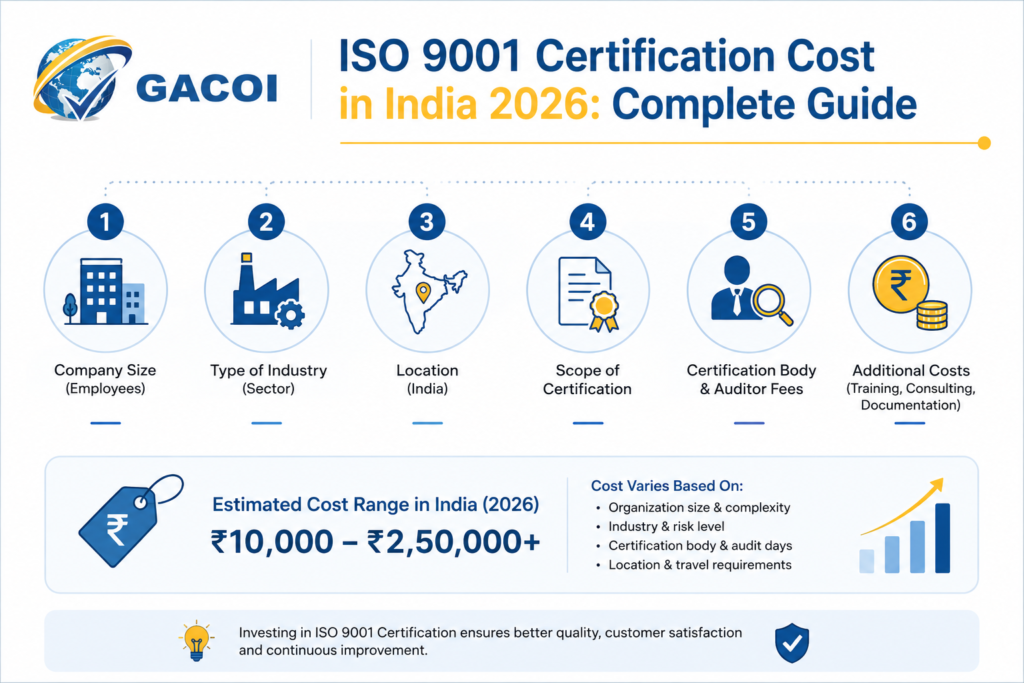
The honest answer is that ISO 9001 certification cost in India varies significantly — depending on your organization’s size, industry, complexity, the certification body you choose, and whether you hire external consultants. A small IT company with ten employees will invest a very different amount compared to a manufacturing plant with five hundred workers.
However, there is complete transparency to be had here. In this guide, we break down every single cost component involved in getting ISO 9001 certified in India in 2026 — from certification body fees and consultant charges to training costs, hidden expenses, and ongoing annual costs. We also explain how to maximize your return on investment and what to watch out for when evaluating pricing options.
By the end of this guide, you will have a clear, realistic picture of what ISO 9001 certification will cost your specific business — and why the investment consistently delivers returns that far exceed its price.
Understanding the Components of ISO 9001 Certification Cost
ISO 9001 certification cost is not a single number — it is a combination of multiple cost components. Understanding each one separately allows you to plan accurately and identify where you can optimize spending.
The main cost components are:
- Certification body fees (Stage 1 audit, Stage 2 audit, surveillance audits, recertification)
- Consultant or implementation support fees
- Employee training costs
- Internal resource costs — time invested by your team
- Documentation and quality management tools
- Standard purchase cost
- Infrastructure or process improvement costs
- Ongoing annual maintenance costs
Let us examine each component in detail.
1. Certification Body Fees — The Core Cost
The certification body fee is the most significant and non-negotiable component of ISO 9001 certification cost. This is what you pay to the accredited third-party organization — such as GacoiCert — that independently audits your Quality Management System and issues your internationally recognized certificate.
Certification body fees are primarily determined by audit duration, which is calculated based on the number of effective employees, the complexity of your operations, and the number of sites included in the certification scope.
The International Accreditation Forum (IAF) publishes mandatory document IAF MD5, which certification bodies must follow when calculating audit duration. This ensures that audit time is proportionate and objective.
Typical Certification Body Fees in India 2026
| Organization Size | Number of Employees | Estimated Certification Fee |
|---|---|---|
| Micro Business | 1 – 5 employees | ₹18,000 – ₹35,000 |
| Very Small Business | 6 – 15 employees | ₹30,000 – ₹55,000 |
| Small Business | 16 – 25 employees | ₹45,000 – ₹80,000 |
| Small-Medium Business | 26 – 45 employees | ₹65,000 – ₹1,10,000 |
| Medium Business | 46 – 65 employees | ₹85,000 – ₹1,40,000 |
| Medium-Large Business | 66 – 125 employees | ₹1,20,000 – ₹1,90,000 |
| Large Business | 126 – 175 employees | ₹1,60,000 – ₹2,40,000 |
| Very Large Business | 176 – 275 employees | ₹2,00,000 – ₹3,00,000 |
| Enterprise | 276 – 425 employees | ₹2,60,000 – ₹3,80,000 |
| Large Enterprise | 425+ employees | ₹3,50,000 and above |
What the certification body fee includes:
- Stage 1 audit — documentation review and readiness assessment
- Stage 2 audit — full on-site certification assessment
- Audit reports for both stages
- Certificate issuance (valid for three years)
- Certificate registration in the certification body’s database
- Use of the certification body’s logo on your marketing materials
What it does not include:
- Consultant fees
- Employee training
- Travel and accommodation expenses for auditors (charged separately for outstation locations)
- Annual surveillance audits (billed annually)
- Recertification audit after three years
Annual Surveillance Audit Fees
Your ISO 9001 certificate is valid for three years, but annual surveillance audits are mandatory to maintain validity. Surveillance audits are shorter than the initial certification audit — typically 50 to 67 percent of the initial audit duration.
| Organization Size | Estimated Annual Surveillance Fee |
|---|---|
| Micro to Very Small | ₹12,000 – ₹28,000 per year |
| Small to Small-Medium | ₹25,000 – ₹55,000 per year |
| Medium to Large | ₹50,000 – ₹1,20,000 per year |
| Very Large to Enterprise | ₹1,00,000 – ₹2,00,000 per year |
Recertification Audit Fees
At the end of the three-year certification cycle, a recertification audit is required. Recertification audit fees are typically similar to the original certification fee or slightly lower, depending on the certification body and the organization’s audit history.
2. ISO 9001 Consultant Fees
Many organizations — particularly those pursuing ISO 9001 certification for the first time — engage an external ISO 9001 consultant to guide the implementation process. A good consultant helps you understand the standard, conduct the gap analysis, develop documentation, train your team, and prepare for the certification audit.
Consultant fees vary widely in India depending on the consultant’s experience, reputation, the services included, and your organization’s size and complexity.
Consultant Fee Ranges in India 2026
| Organization Size | Estimated Consultant Fee |
|---|---|
| Micro to Very Small Business | ₹15,000 – ₹40,000 |
| Small Business | ₹35,000 – ₹80,000 |
| Medium Business | ₹70,000 – ₹1,50,000 |
| Large Business | ₹1,25,000 – ₹3,00,000 |
| Enterprise | ₹2,50,000 – ₹6,00,000+ |
Typical consultant services included:
- Initial gap analysis against ISO 9001:2015 requirements
- QMS documentation development — Quality Policy, procedures, process maps, work instructions, and records formats
- Employee awareness training
- Internal auditor training
- Internal audit support
- Pre-audit review and preparation guidance
- Corrective action support after audit findings
Is a consultant mandatory?
No — ISO 9001 does not require you to hire a consultant. Many organizations — particularly those with an experienced Quality Manager or Operations Lead — successfully implement ISO 9001 without external consultants.
However, for organizations with no prior quality management experience, a competent consultant significantly reduces the time required, avoids costly mistakes, and improves the quality of implementation.
Important warning: Be cautious of consultants who offer to guarantee certification or claim special relationships with certification bodies. Legitimate certification is based on independent assessment — no consultant can or should guarantee a specific audit outcome.
3. ISO 9001 Training Costs
Investing in ISO 9001 training for your team is an important component of successful implementation. While training is not always separately budgeted — particularly when a consultant is engaged who includes training as part of their service — it represents a real cost that should be planned for.
Common ISO 9001 Training Programs and Fees in India 2026
| Training Program | Who It Is For | Typical Fee Per Person |
|---|---|---|
| ISO 9001 Awareness Training | All employees | ₹3,000 – ₹8,000 |
| ISO 9001 Lead Implementer Training | QMS Project Lead, Quality Manager | ₹15,000 – ₹35,000 |
| ISO 9001 Internal Auditor Training | Internal audit team members | ₹8,000 – ₹20,000 |
| ISO 9001 Lead Auditor Training | Those pursuing auditor career | ₹25,000 – ₹55,000 |
For most organizations, the most important training investment is the ISO 9001 Internal Auditor Training — ensuring that your team can conduct effective internal audits, which is a mandatory ISO 9001 requirement.
GacoiCert offers ISO 9001 training programs specifically designed for Indian businesses across various formats — classroom, online, and in-house training — at competitive and transparent pricing.
4. Internal Resource Costs — The Often Overlooked Investment
The most significant cost that many businesses fail to account for when budgeting for ISO 9001 certification is internal resource time — the hours your employees invest in the implementation process.
This is a real cost. Your Quality Manager, department heads, and other team members will spend considerable time on:
- Participating in gap analysis workshops
- Developing and reviewing QMS documentation
- Attending training sessions
- Implementing new processes and procedures
- Conducting internal audits
- Preparing for and participating in certification audits
- Maintaining records and evidence
Estimated Internal Time Investment
| Organization Size | Estimated Total Internal Hours |
|---|---|
| Micro to Very Small | 80 – 150 hours |
| Small Business | 150 – 300 hours |
| Medium Business | 300 – 600 hours |
| Large Business | 600 – 1,200 hours |
To convert this into a rupee figure, multiply the hours by the average cost per hour of the employees involved. For a medium-sized business where the QMS lead earns ₹60,000 per month, 400 hours of their time represents approximately ₹1,40,000 in internal labor cost — a significant figure that should be included in the total cost calculation.
5. ISO 9001:2015 Standard Purchase Cost
To implement ISO 9001, you need access to the actual standard document. There are two options in India:
ISO 9001:2015 from ISO directly: Available for purchase at approximately CHF 118 (roughly ₹11,000 to ₹13,000 at current exchange rates) from iso.org.
IS/ISO 9001:2015 from Bureau of Indian Standards (BIS): The Indian adoption of the standard, available from bis.gov.in at approximately ₹5,000 to ₹8,000.
For most Indian businesses, the BIS version is the practical and cost-effective choice.
6. Documentation and Quality Management Tools
While ISO 9001 does not prescribe specific software or tools, most organizations invest in some form of document management and quality tracking solution to make QMS management practical and efficient.
Options and Approximate Costs
Free or low-cost options: Google Workspace (Google Drive, Google Docs, Google Sheets) or Microsoft 365 (SharePoint, Word, Excel) — tools most organizations already use and pay for — are sufficient for many small and medium businesses.
Dedicated QMS software: Purpose-built quality management platforms that offer document control, nonconformity tracking, corrective action management, audit scheduling, and performance dashboards.
| Tool Type | Approximate Annual Cost |
|---|---|
| Free tools (Google Workspace or Microsoft 365) | ₹0 – ₹15,000 (if not already owned) |
| Basic QMS software (cloud-based, small teams) | ₹15,000 – ₹60,000 per year |
| Mid-range QMS software (medium organizations) | ₹60,000 – ₹2,00,000 per year |
| Enterprise QMS platforms | ₹2,00,000 and above per year |
For small businesses, free or low-cost tools are entirely adequate. Investing in dedicated QMS software is more relevant for medium and large organizations with complex operations and multiple users.
7. Infrastructure and Process Improvement Costs
In some cases, achieving ISO 9001 certification requires physical improvements to facilities, equipment, or systems — particularly where the gap analysis reveals significant deficiencies in operational processes or infrastructure.
These costs are highly variable and entirely dependent on the current state of your operations. Common examples include:
- Upgrading calibration equipment and establishing a calibration management system
- Improving storage and record-keeping facilities
- Implementing customer relationship management (CRM) or enterprise resource planning (ERP) systems
- Upgrading production equipment to enable consistent quality output
- Improving supplier management and procurement systems
For organizations with reasonably mature operations, infrastructure improvement costs are typically minimal. For businesses with significant operational gaps, they can be substantial — but these improvements deliver direct business value beyond ISO 9001 certification.
8. Total ISO 9001 Certification Cost in India 2026 — Summary
Bringing all cost components together, here is a realistic total cost estimate for ISO 9001 certification in India in 2026:
| Organization Size | Certification Body Fee | Consultant Fee | Training | Tools and Misc | Total Estimated Investment |
|---|---|---|---|---|---|
| Micro (1–5 employees) | ₹18,000 – ₹35,000 | ₹15,000 – ₹35,000 | ₹5,000 – ₹15,000 | ₹2,000 – ₹8,000 | ₹40,000 – ₹93,000 |
| Small (6–25 employees) | ₹35,000 – ₹80,000 | ₹30,000 – ₹75,000 | ₹10,000 – ₹30,000 | ₹5,000 – ₹15,000 | ₹80,000 – ₹2,00,000 |
| Medium (26–100 employees) | ₹80,000 – ₹1,60,000 | ₹70,000 – ₹1,50,000 | ₹20,000 – ₹60,000 | ₹10,000 – ₹30,000 | ₹1,80,000 – ₹4,00,000 |
| Large (100–300 employees) | ₹1,60,000 – ₹2,80,000 | ₹1,25,000 – ₹3,00,000 | ₹40,000 – ₹1,00,000 | ₹20,000 – ₹60,000 | ₹3,45,000 – ₹7,40,000 |
| Enterprise (300+ employees) | ₹3,00,000 and above | ₹2,50,000 and above | ₹80,000 and above | ₹50,000 and above | ₹6,80,000 and above |
Beware of Suspiciously which ISO 9001 Certification cost low
This is perhaps the most important section of this entire guide.
In India, a significant number of non-accredited or fraudulent certification bodies offer ISO 9001 certificates at extremely low prices — sometimes as low as ₹5,000 to ₹15,000 — with minimal or no actual audit process. These offers are frequently encountered online and through aggressive sales calls.
Why these cheap certificates are worthless:
These certificates are issued by bodies that are not accredited by any recognized national or international accreditation body. They hold no international standing, are not recognized by government procurement departments, are rejected by serious corporate buyers, and are not accepted by international clients.
Businesses that purchase these certificates discover — often at a critical moment, such as during a major tender evaluation — that their certificate is not recognized and they have wasted their investment.
How to verify a legitimate certification body:
- Check that the certification body is listed on the NABCB website (nabcb.in) as an accredited body
- Or verify accreditation through IAF CertSearch (iafcertsearch.org) — a global database of legitimate ISO certifications
- Look for the accreditation body’s logo on the certificate alongside the certification body’s logo
GacoiCert is an accredited certification body whose certificates are internationally recognized and verifiable through accreditation databases — giving your certification genuine credibility in every market.
Factors That Influence ISO 9001 Certification Cost
Understanding what drives cost variation helps you anticipate your specific investment accurately.
Number of employees: Audit duration — and therefore cost — increases with the number of effective employees. This is the primary cost driver.
Operational complexity: Organizations with multiple product lines, complex manufacturing processes, or high-risk operations require more audit time than simple, single-service businesses.
Number of sites: Multi-site certifications require additional audit time at each location. Single-site certifications are inherently less expensive.
Current process maturity: Organizations that already have well-documented processes and strong quality practices require less consultant support and implement the standard faster — reducing total investment.
Industry type: Some industries require more technically specialized auditors, which can influence pricing. High-risk industries such as aerospace, medical devices, and nuclear require additional audit rigor.
Geographic location: Certification body travel and accommodation costs for auditors traveling to remote locations are typically charged separately and can add to total costs.
Integrated certification: Organizations pursuing ISO 9001 alongside ISO 14001 or ISO 45001 through an Integrated Management System audit typically achieve cost savings compared to pursuing each certification independently.
How to Reduce ISO 9001 Certification Cost Without Compromising Quality
There are several legitimate strategies to optimize your ISO 9001 certification investment:
Start with a thorough gap analysis: Understanding exactly what needs to change before beginning documentation and implementation prevents wasted effort and rework — saving significant time and consultant fees.
Leverage existing documentation: Many organizations already have process documents, work instructions, and records in some form. Adapting existing documentation to meet ISO 9001 requirements is faster and less expensive than creating everything from scratch.
Train your own internal auditors: Rather than relying on external auditors for every internal audit cycle, investing in training two or three internal auditors pays back quickly through reduced ongoing consulting costs.
Use free or low-cost documentation tools: For small businesses, Google Workspace or Microsoft 365 is completely adequate for QMS document management — dedicated QMS software is not necessary in the early stages.
Consider online training options: Online ISO 9001 training programs offer the same knowledge content as classroom training at significantly lower costs, with the added flexibility of self-paced learning.
Pursue integrated certification: If ISO 14001 or ISO 45001 certification is also on your roadmap, pursuing all certifications together through an Integrated Management System reduces total audit time and certification fees significantly.
Choose the right certification body the first time: Switching certification bodies mid-process or discovering that your chosen body’s certificates are not recognized by your target clients results in wasted investment. Research thoroughly and choose an accredited, reputable body like GacoiCert from the outset.
The Return on Investment: Why ISO 9001 Certification Pays for Itself
Every business decision must be evaluated not just on cost but on return. ISO 9001 certification consistently delivers returns that far exceed the initial investment.
Government tender access: A single government tender won on the basis of ISO 9001 certification can return the entire certification investment many times over. Across India, central and state government tenders in construction, manufacturing, IT, and services increasingly require or prefer ISO 9001 certified vendors.
Corporate supplier qualification: Large Indian corporations and multinational companies operating in India routinely require ISO 9001 certification from their suppliers. A single approved supplier relationship can generate annual revenues that dwarf the certification cost.
Export market access: International buyers — particularly in the EU, USA, Middle East, and Southeast Asia — consistently prefer ISO 9001 certified suppliers. For export-oriented businesses, certification is often the key that unlocks market entry.
Operational efficiency gains: Systematic process documentation, quality monitoring, and corrective action management consistently reduce errors, rework, waste, and customer complaints — delivering measurable cost savings year after year.
Customer retention: ISO 9001 certified organizations consistently report higher customer satisfaction and retention rates — translating directly into revenue stability and growth.
Reduced insurance costs: Some insurance providers offer better terms to ISO 9001 certified businesses due to their demonstrably lower operational risk profile.
Premium pricing capability: In competitive markets, ISO 9001 certification supports premium pricing by demonstrating verified quality assurance — allowing certified businesses to command higher prices than uncertified competitors.
Ongoing Annual ISO 9001 Certification Cost
Beyond the initial certification investment, plan for these ongoing annual costs to maintain your certificate:
| Cost Component | Estimated Annual Cost |
|---|---|
| Annual surveillance audit fee | ₹12,000 – ₹2,00,000 (size dependent) |
| Internal audit program (time cost) | ₹20,000 – ₹1,50,000 (size dependent) |
| QMS software subscription (if used) | ₹15,000 – ₹2,00,000 |
| Annual employee refresher training | ₹5,000 – ₹30,000 |
| Occasional external consultant support | ₹0 – ₹50,000 (as needed) |
For most small and medium businesses, total annual maintenance costs after the initial certification year fall in the range of ₹40,000 to ₹3,00,000 — a modest investment relative to the business benefits maintained.
Why Choose GacoiCert for ISO 9001 Certification in India?
When investing in ISO 9001 certification, the value of your certificate depends entirely on the credibility and accreditation status of the certification body that issues it.
GacoiCert offers Indian businesses:
International accreditation: GacoiCert’s certificates are internationally recognized — accepted by government authorities, corporate procurement teams, and international buyers across global markets.
Transparent, competitive pricing: No hidden fees, no surprise charges. You receive a complete, itemized quotation before any commitment is made.
Experienced auditors across all industries: Our auditors bring genuine sector-specific expertise to every audit — ensuring assessments are relevant, accurate, and practically valuable.
Pan-India service coverage: We serve businesses across all major cities and states — Delhi NCR, Mumbai, Bangalore, Chennai, Hyderabad, Pune, Kolkata, Ahmedabad, and beyond.
Multi-standard certification capability: ISO 9001, ISO 14001, ISO 45001, ISO 22000, and Integrated Management System certifications — all under one roof.
Efficient, streamlined process: Our certification process is designed to be thorough and credible without unnecessary complexity or delay.
Dedicated post-certification support: Our relationship with clients does not end at certificate issuance — we provide ongoing guidance through surveillance audits and beyond.
Conclusion: ISO 9001 Certification Is an Investment, Not an Expense
ISO 9001 certification cost in India in 2026 ranges from approximately ₹40,000 for the smallest micro-businesses to several lakhs for large enterprises — with the total investment depending on organization size, complexity, consultant engagement, and training requirements.
What is consistent across every organization is this: the return on ISO 9001 certification investment consistently and significantly exceeds the cost — through new business won, operational efficiency gained, customer confidence built, and market access achieved.
The question is not whether ISO 9001 certification is worth the investment. It clearly is. The question is whether you choose a certification partner whose certificate genuinely delivers that value — or whether you compromise on accreditation and end up with a certificate that no serious buyer will recognize.
Choose GacoiCert. Get certified right the first time. Visit gacoicert.com today to request your free consultation and receive a transparent, customized quotation for your ISO 9001 certification.
Frequently Asked Questions
Q1: What is the minimum cost to get ISO 9001 certified in India in 2026? For a very small business with fewer than five employees, the total investment including certification body fees, basic training, and minimal documentation support can start from approximately ₹40,000 to ₹60,000.
Q2: Can I get ISO 9001 certified without hiring a consultant? Yes. Organizations with experienced quality or operations managers can implement ISO 9001 without an external consultant. However, for first-time implementers with no prior quality management experience, a consultant significantly reduces risk and implementation time.
Q3: Are there cheap ISO 9001 certificates available for ₹5,000 to ₹10,000? Yes, but these are issued by non-accredited bodies and are not recognized by government authorities, corporate buyers, or international clients. They represent a waste of money and can damage your credibility when discovered. Always choose an accredited certification body.
Q4: Does ISO 9001 certification cost vary by industry? Yes. Complex or high-risk industries may require more audit time and specialized auditors, which can increase certification body fees. The nature and complexity of your processes also influences cost.
Q5: How can I verify that GacoiCert is a legitimate accredited certification body? You can verify GacoiCert’s accreditation status through the NABCB website at nabcb.in or through the IAF CertSearch database at iafcertsearch.org.
Q6: How do I get a precise cost quote for my business? Visit gacoicert.com and submit your inquiry with basic details about your organization — size, industry, and location. Our team will provide a complete, transparent, no-obligation quotation within one business day.
Need ISO 9001 Certification
🟡GACOI Cert provides globally recognized ISO certification, cybersecurity, privacy, AI governance, compliance, audit, and professional training services, helping startups, businesses, enterprises, laboratories, healthcare organizations, and government institutions achieve international standards and build lasting trust.
🟡For other Legal and Trademark related services Visit
👉 Money Recovery Cases
👉 Property Disputes
👉 Business & Licence Registrations
🟡 Protect Your Rights
👉 Domestic Violence Legal Support
👉 Stridhan Recovery
👉 Mutual Consent Divorce
👉 Contested Divorce Filing
👉 Child Custody and Maintenance
👉 Matrimonial Property Settlement
👉 NRI Divorce Services
👉 Alimony and Maintenance
📞 Call Now: +91 8595439395
🕐 Free Consultation: Monday to Saturday, 10 AM to 6 PM


