


Views: 1
ISO 50001 vs ISO 14001 — what is the difference? Complete comparison covering purpose, requirements, benefits, cost, and which standard your business needs in India 2026. Get certified with GacoiCert.
Table of Contents
- 1 Introduction: ISO 50001 vs ISO 14001 — Understanding Two of the Most Important Environmental Standards
- 2 What Is ISO 14001? A Clear Overview
- 3 What Is ISO 50001? A Clear Overview
- 4 ISO 50001 vs ISO 14001: Side-by-Side Comparison
- 5 ISO 50001 vs ISO 14001: Key Differences Explained in Depth
- 6 Key Similarities Between ISO 50001 and ISO 14001
- 7 Which Standard Does Your Business Need? A Practical Decision Guide
- 8 ISO 50001 vs ISO 14001: Cost Comparison in India 2026
- 9 Can ISO 50001 and ISO 14001 Be Implemented Together?
- 10 ISO 50001 and India’s Energy Regulatory Context
- 11 Why Choose GacoiCert for ISO 50001 and ISO 14001 Certification in India?
- 12 Conclusion: ISO 50001 and ISO 14001 Are Complementary, Not Competing
- 13 Frequently Asked Questions
- 14 Need ISO Certification
Introduction: ISO 50001 vs ISO 14001 — Understanding Two of the Most Important Environmental Standards
In today’s rapidly evolving business landscape, environmental responsibility and energy efficiency have moved from peripheral concerns to core strategic priorities for Indian businesses. Rising energy costs, tightening environmental regulations, increasing carbon disclosure requirements, and growing pressure from international buyers and ESG-focused investors are collectively driving organizations to implement structured, internationally recognized management frameworks.
Two ISO standards address these priorities directly — ISO 50001 for Energy Management and ISO 14001 for Environmental Management. Both are published by the International Organization for Standardization. Both share the same High Level Structure. Both address sustainability dimensions that are increasingly critical for Indian businesses in 2026. And both are frequently confused with each other or misunderstood as interchangeable alternatives.
They are not interchangeable. They address different — though related — management challenges, impose different specific requirements, deliver different primary benefits, and serve different strategic purposes. Understanding the precise differences between them is essential for making informed certification decisions that deliver maximum business value.
This comprehensive guide provides a complete, detailed comparison of ISO 50001 and ISO 14001 — covering their definitions, purposes, structures, specific requirements, key differences, overlaps, benefits, costs, and most importantly — which standard your business needs, and whether pursuing both simultaneously makes strategic sense.
What Is ISO 14001? A Clear Overview
ISO 14001 is the world’s most widely adopted Environmental Management System (EMS) standard. Published by ISO and currently in its 2015 version — ISO 14001:2015 — it provides organizations with a structured framework for identifying, managing, monitoring, and continuously improving their overall environmental performance across all dimensions of environmental impact.
ISO 14001 takes a broad, comprehensive view of environmental management. It requires organizations to identify every way in which their activities, products, and services interact with the natural environment — their environmental aspects — and evaluate which interactions have significant environmental impacts that require systematic control and improvement.
The scope of ISO 14001 is intentionally wide:
Energy consumption is one environmental aspect among many that ISO 14001 considers. Water use, waste generation, air emissions, effluent discharge, land contamination risk, biodiversity impact, chemical storage and handling, noise pollution, and packaging waste are all equally within ISO 14001’s scope. The standard requires organizations to manage all significant environmental aspects — not just energy.
ISO 14001 also places strong emphasis on legal compliance — requiring organizations to identify all applicable environmental laws and regulations, maintain evidence of compliance, and systematically address any compliance gaps. In India’s complex environmental regulatory landscape — covering the Environment Protection Act, Water Pollution Act, Air Pollution Act, Hazardous Waste Rules, EPR obligations, and CPCB and SPCB consent conditions — this legal compliance emphasis makes ISO 14001 particularly valuable.
Currently over 300,000 organizations across more than 170 countries hold ISO 14001 certification — making it the second most widely adopted ISO management system standard after ISO 9001.
What Is ISO 50001? A Clear Overview
ISO 50001 is the international standard for Energy Management Systems (EnMS). Currently in its 2018 version — ISO 50001:2018 — it provides organizations with a structured framework for systematically managing energy use, improving energy efficiency, reducing energy consumption, and lowering energy costs and carbon emissions.
Where ISO 14001 takes a broad view of environmental management across all environmental dimensions, ISO 50001 takes a deep, focused view of energy specifically. It requires organizations to establish a comprehensive energy management system that goes far beyond simply tracking energy bills — including detailed energy baseline establishment, energy performance indicator development, significant energy use identification, energy review processes, energy efficiency targets, and investment in energy performance improvement projects.
ISO 50001 is built on a simple but powerful premise: organizations that systematically manage energy — measuring it rigorously, understanding what drives consumption, setting improvement targets, and implementing efficiency measures — consistently achieve significant, sustained energy cost reductions that deliver strong financial returns.
ISO 50001:2018 is the current version, representing a significant update from ISO 50001:2011. The 2018 version adopted the High Level Structure shared by ISO 14001:2015 and ISO 9001:2015 — making integration between all three standards significantly more straightforward.
Globally, approximately 20,000 organizations hold ISO 50001 certification — a much smaller number than ISO 14001 but growing rapidly as energy costs escalate and carbon reduction commitments intensify worldwide.
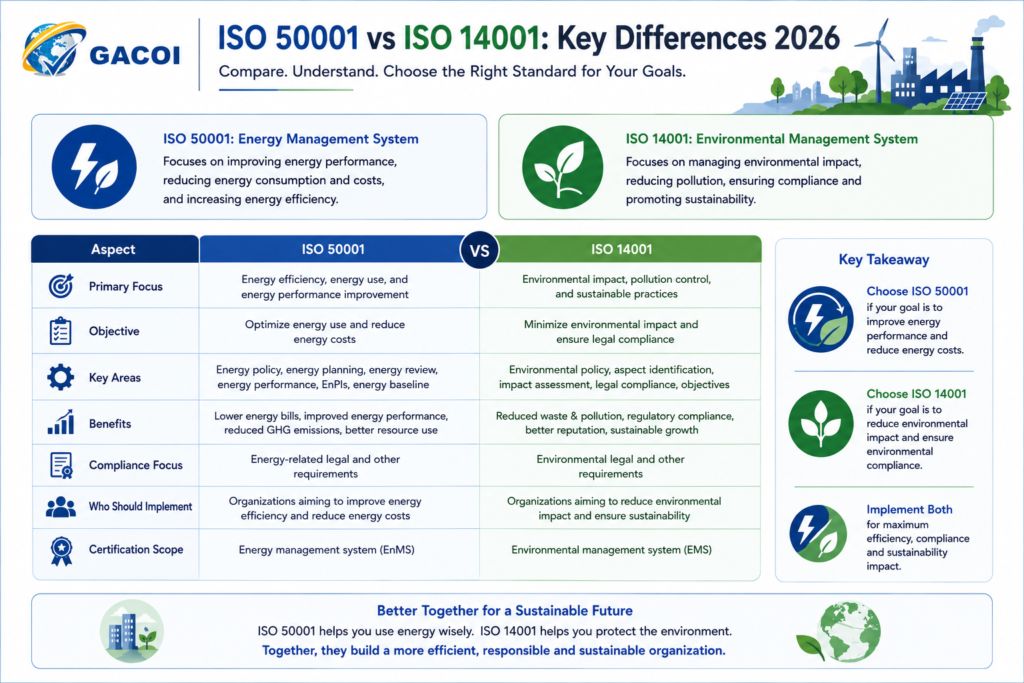
ISO 50001 vs ISO 14001: Side-by-Side Comparison
| Comparison Aspect | ISO 14001:2015 | ISO 50001:2018 |
|---|---|---|
| Full Name | Environmental Management System | Energy Management System |
| Primary Focus | All environmental impacts | Energy consumption and efficiency specifically |
| Current Version | ISO 14001:2015 | ISO 50001:2018 |
| Structure | High Level Structure (HLS) | High Level Structure (HLS) |
| Scope | Broad — all environmental aspects | Narrow and deep — energy only |
| Primary Beneficiary | Environment, society, regulators | Organization (cost savings) and environment (carbon) |
| Legal Compliance | Strong requirement | Limited — energy-specific regulations only |
| Energy Coverage | Included as one aspect among many | Central, comprehensive, deep focus |
| Water Management | Required | Not included |
| Waste Management | Required | Not included |
| Air Emissions | Required | Indirect — through energy reduction |
| Carbon Management | Indirect — through environmental aspects | Direct — through energy reduction |
| Global Certifications | 300,000+ | 20,000+ |
| Financial ROI | Moderate direct — cost savings secondary | High direct — energy cost reduction primary |
| India Regulatory Alignment | Strong — EPA, Water Act, Air Act, CPCB | Limited — BEE regulations, PAT scheme |
| Export Market Requirement | Increasingly required | Sector-specific — mainly energy-intensive industries |
| ESG Relevance | High — E component of ESG | High — carbon and energy intensity metrics |
| Integration Potential | Excellent — with ISO 9001, ISO 45001, ISO 50001 | Excellent — with ISO 14001, ISO 9001 |
ISO 50001 vs ISO 14001: Key Differences Explained in Depth
Difference 1: Scope — Broad Environmental vs Deep Energy Focus
This is the most fundamental difference between the two standards and the starting point for understanding everything else about how they compare.
ISO 14001 casts a wide net. It requires organizations to identify and manage every significant environmental aspect — energy consumption, water use, waste generation, air emissions, effluent discharge, chemical handling, land contamination, noise, biodiversity, packaging. No single environmental dimension dominates — the standard requires proportionate attention to all significant aspects based on their environmental impact.
ISO 50001 casts a narrow but very deep net focused exclusively on energy. It requires organizations to identify all forms of energy used — electricity, natural gas, diesel, furnace oil, compressed air, steam — understand exactly how and where energy is consumed, establish detailed energy baselines and performance indicators, identify the most significant energy-consuming processes and equipment, and systematically drive improvement in energy efficiency across the entire organization.
The practical implication of this scope difference is significant. An ISO 14001 certified organization has demonstrated that it manages its energy consumption as part of a broader environmental management framework — but the depth of energy management analysis may be relatively limited. An ISO 50001 certified organization has demonstrated that it manages energy with a level of rigor, measurement depth, and performance focus that goes substantially further than what ISO 14001 requires.
Conversely, an ISO 50001 certified organization may have excellent energy management but no systematic approach to water conservation, waste reduction, effluent control, or chemical hazard management — all of which are addressed comprehensively by ISO 14001.
Difference 2: Legal Compliance Requirements
ISO 14001 places legal compliance at the center of its requirements. The standard requires organizations to identify all applicable environmental laws and regulations — across every environmental dimension — maintain a comprehensive legal register, evaluate compliance status against each requirement, and maintain documented evidence of compliance. In India’s complex multi-layered environmental regulatory framework, this requirement is both demanding and enormously valuable.
ISO 50001 has much more limited legal compliance requirements. It requires awareness of legal and other energy-related requirements — such as India’s Energy Conservation Act, Bureau of Energy Efficiency (BEE) regulations, and Perform Achieve and Trade (PAT) scheme obligations for energy-intensive industries — but the breadth and depth of legal compliance management required is significantly narrower than ISO 14001’s comprehensive environmental compliance framework.
For Indian businesses operating under CPCB or SPCB consent conditions, NGT directions, or multiple environmental regulatory obligations, ISO 14001’s systematic legal compliance management provides substantially more regulatory risk reduction value than ISO 50001.
Difference 3: Energy Management Depth
While ISO 14001 includes energy consumption as an environmental aspect requiring management, the depth of energy management that ISO 50001 requires goes substantially further.
ISO 14001 requires organizations to identify energy consumption as a potential significant environmental aspect, set energy-related objectives if it is significant, and monitor energy consumption as part of overall environmental performance. The standard provides no specific guidance on how to conduct energy analysis, establish energy baselines, or develop energy performance indicators.
ISO 50001 requires a comprehensive energy review — systematic analysis of past and present energy use and consumption, identification of significant energy uses (SEUs) — those processes, systems, and equipment that account for a major portion of total energy consumption or offer significant improvement potential — development of energy baselines for each SEU, establishment of energy performance indicators (EnPIs) that enable meaningful energy performance measurement, setting of energy objectives and energy targets with defined improvement timelines, and implementation of action plans to achieve those targets.
This depth of energy analysis consistently delivers superior energy performance improvement compared to ISO 14001’s broader but shallower energy treatment. Organizations that need to demonstrate serious, measurable energy efficiency improvement — for carbon disclosure purposes, PAT scheme compliance, green financing requirements, or simply to manage escalating energy costs — need ISO 50001’s rigorous energy management framework.
Difference 4: Carbon and Climate Change Management
Both standards address carbon emissions — but in fundamentally different ways.
ISO 14001 addresses carbon as one of multiple air emission environmental aspects. If an organization’s carbon emissions are identified as a significant environmental aspect — which they typically are for energy-intensive organizations — ISO 14001 requires their systematic management and improvement. However, the standard does not prescribe specific carbon measurement methodologies, Scope 1/2/3 categorization, or climate-specific management approaches.
ISO 50001 addresses carbon indirectly but powerfully — through systematic reduction in energy consumption. Since the majority of industrial carbon emissions derive from energy use, ISO 50001’s rigorous energy efficiency improvements directly and quantifiably reduce carbon emissions. ISO 50001 certified organizations can credibly report measured energy consumption reductions and calculate corresponding carbon emission reductions — providing the quantitative carbon performance evidence that climate disclosure frameworks require.
For organizations with carbon neutrality commitments, Science Based Targets, or climate-related financial disclosure obligations — ISO 50001 provides more rigorous and credible carbon performance evidence than ISO 14001 alone.
Difference 5: Financial Return Profile
Both standards deliver financial returns — but through different mechanisms and with different return profiles.
ISO 14001’s primary financial returns include regulatory penalty avoidance, improved export market access and associated revenue, reduced waste disposal costs, water conservation savings, and improved ESG credentials supporting better financing terms. These returns are real and significant but are relatively diffuse across multiple benefit categories.
ISO 50001’s primary financial return is direct and straightforward: reduced energy costs. For energy-intensive industries — manufacturing, chemical processing, food processing, textiles, cement, steel, glass, ceramics — energy costs represent a major operating expense. ISO 50001 certified organizations consistently report energy consumption reductions of 10 to 30 percent within the first three to five years of implementation. For a medium-sized manufacturer spending ₹1 crore annually on energy, a 15 percent reduction represents ₹15,00,000 in annual savings — a compelling direct financial return.
This strong, direct financial return makes ISO 50001 particularly attractive to organizations in energy-intensive industries where energy cost management is a strategic business priority.
Difference 6: Worker and Community Dimension
ISO 14001 explicitly requires organizations to manage their environmental impacts on surrounding communities — noise, odors, visual impact, water contamination, air quality — and to communicate with external stakeholders about environmental performance. Community relations and social license to operate are genuine elements of ISO 14001’s scope.
ISO 50001 has essentially no community or social dimension. Its focus is entirely internal — improving the organization’s own energy efficiency and reducing its energy costs and carbon footprint. Stakeholder communication requirements in ISO 50001 are limited to internal communication about the energy management system.
Difference 7: Applicability Across Industries
ISO 14001 is genuinely universal — applicable and valuable for organizations in every industry, including those with relatively limited environmental footprints. Service businesses, IT companies, retailers, educational institutions, healthcare organizations, and office-based businesses all have environmental aspects that ISO 14001 addresses meaningfully.
ISO 50001 is most valuable for organizations with significant energy consumption — manufacturers, processors, data center operators, cold chain logistics providers, large commercial building operators, and energy-intensive service operations. For organizations with very small energy footprints, the investment in ISO 50001’s rigorous energy management framework may not be proportionate to the available efficiency improvement opportunities.
Key Similarities Between ISO 50001 and ISO 14001
Understanding the similarities is as important as understanding the differences — particularly for organizations considering pursuing both standards.
Shared High Level Structure
Both ISO 14001:2015 and ISO 50001:2018 follow the identical ten-clause High Level Structure used by all modern ISO management system standards. Clauses 1 through 10 cover the same topics — context of the organization, leadership, planning, support, operation, performance evaluation, and improvement — with standard-specific content in each.
This shared structure means that organizations implementing both standards simultaneously can develop common management system infrastructure — document control, internal audit program, management review process, corrective action system, competence management — once and apply it to both standards. This shared infrastructure significantly reduces the incremental effort and cost of implementing the second standard when the first is already in place.
Plan-Do-Check-Act Foundation
Both standards are built on the Plan-Do-Check-Act (PDCA) continuous improvement cycle. Organizations plan their environmental or energy management objectives, implement (do) the required management activities, check performance through monitoring and measurement, and act on findings to drive continual improvement. This shared philosophical foundation makes the management approaches complementary and mutually reinforcing.
Continual Improvement Requirement
Both standards explicitly require continual improvement — in environmental performance for ISO 14001 and in energy performance for ISO 50001. This shared improvement orientation means that certified organizations in both standards are committed to progressive, measurable performance enhancement over time rather than simply maintaining a static compliance position.
Top Management Leadership Requirements
Both standards require active, demonstrated top management commitment and involvement — not merely policy endorsement. Leaders must provide resources, establish objectives, promote awareness, and personally demonstrate commitment to environmental and energy management respectively. This shared leadership requirement reinforces the importance of genuine organizational commitment rather than superficial compliance.
Internal Audit and Management Review
Both standards require formal internal audit programs and periodic management reviews. These common requirements can be combined into integrated audit and review processes for organizations pursuing both certifications — reducing the administrative burden of maintaining two separate management systems.
Which Standard Does Your Business Need? A Practical Decision Guide
Choose ISO 14001 If:
You need broad environmental compliance management: Organizations operating under multiple environmental regulatory obligations — CPCB consent conditions, SPCB requirements, NGT directions, EPR obligations — benefit most from ISO 14001’s comprehensive environmental compliance framework.
You are targeting export markets with environmental requirements: ISO 14001 is the internationally recognized standard that export market buyers reference when requiring environmental certification from their suppliers. It is significantly more widely recognized as an export qualification requirement than ISO 50001.
Your environmental impacts span multiple dimensions: If water use, waste generation, chemical management, air emissions, and land contamination are all significant concerns alongside energy — ISO 14001’s comprehensive scope addresses all of them.
You are a service business or have a small energy footprint: ISO 14001 delivers value for organizations of all energy intensities. ISO 50001 is most valuable for energy-intensive operations.
You are pursuing your first environmental certification: ISO 14001 is the natural starting point for environmental management certification — with ISO 50001 as a subsequent specialization for energy-intensive organizations.
Choose ISO 50001 If:
Energy costs represent a significant operating expense: Organizations spending ₹50,00,000 or more annually on energy find ISO 50001’s systematic energy management framework delivers compelling financial returns through energy cost reduction.
You have carbon reduction commitments: Organizations with Science Based Targets, net zero commitments, or climate-related financial disclosure obligations benefit from ISO 50001’s rigorous, measurable energy and carbon performance management.
You are subject to BEE or PAT scheme obligations: India’s Bureau of Energy Efficiency Perform Achieve and Trade scheme requires designated energy-intensive industries to achieve specific energy reduction targets. ISO 50001 provides the management framework that supports PAT scheme compliance and target achievement.
Your customers or investors require carbon performance evidence: Organizations facing supply chain carbon disclosure requirements or ESG investor scrutiny of energy intensity benefit from ISO 50001’s structured energy performance measurement and reporting.
You want to differentiate on energy efficiency: In markets where energy efficiency is a commercial differentiator — for example, in selling to energy-conscious customers or qualifying for green building supply chains — ISO 50001 certification provides credible, independently verified evidence.
Pursue Both ISO 14001 and ISO 50001 If:
You are a large energy-intensive manufacturer: Major manufacturing organizations — particularly those in chemicals, textiles, food processing, steel, cement, glass, and ceramics — typically need both comprehensive environmental management (ISO 14001) and rigorous energy management (ISO 50001).
You want maximum sustainability credentials: The combination of ISO 14001 and ISO 50001 alongside ISO 9001 and ISO 45001 creates a comprehensive Integrated Management System that demonstrates excellence across quality, environment, energy, and safety — the most compelling sustainability credentials available.
You are building toward carbon neutrality: Organizations serious about carbon neutrality need both ISO 14001’s broad environmental management and ISO 50001’s deep energy efficiency framework — complementary tools for a comprehensive decarbonization strategy.
ISO 50001 vs ISO 14001: Cost Comparison in India 2026
| Standard | Small Business Certification Fee | Medium Business Certification Fee | Large Business Certification Fee |
|---|---|---|---|
| ISO 14001:2015 | ₹40,000 – ₹85,000 | ₹85,000 – ₹1,70,000 | ₹1,70,000 – ₹3,20,000 |
| ISO 50001:2018 | ₹45,000 – ₹92,000 | ₹92,000 – ₹1,85,000 | ₹1,85,000 – ₹3,40,000 |
| Both Combined (IMS) | ₹65,000 – ₹1,30,000 | ₹1,30,000 – ₹2,60,000 | ₹2,60,000 – ₹4,80,000 |
ISO 50001 certification fees are broadly comparable to ISO 14001 fees. The combined IMS approach delivers both certifications at 25 to 40 percent less than two separate certifications — making simultaneous pursuit of both standards financially efficient for organizations that need both.
Can ISO 50001 and ISO 14001 Be Implemented Together?
Absolutely — and for energy-intensive organizations that need both, integrated implementation is strongly recommended.
The shared High Level Structure makes integration straightforward. Common management system elements — context analysis, leadership commitment, risk and opportunity management, objectives framework, document control, competence management, internal audit, management review, corrective action — are developed once and applied to both standards simultaneously.
The specific requirements of each standard — environmental aspects and impacts for ISO 14001, significant energy uses and energy performance indicators for ISO 50001 — are developed in parallel as complementary components of a unified Integrated Management System.
GacoiCert specializes in integrated certification approaches that combine ISO 14001 and ISO 50001 — and ISO 9001 and ISO 45001 — into comprehensive Integrated Management Systems that deliver multiple certifications efficiently, cost-effectively, and with minimum operational disruption.
ISO 50001 and India’s Energy Regulatory Context
Understanding how ISO 50001 connects to India’s specific energy regulatory framework helps Indian businesses appreciate its practical compliance value.
Energy Conservation Act, 2001 and 2022 Amendment: India’s Energy Conservation Act mandates energy efficiency standards and requirements for designated consumers in energy-intensive sectors. The 2022 amendment significantly expanded the Act’s scope — adding new provisions for carbon trading, green hydrogen, and expanded BEE mandate.
Perform Achieve and Trade (PAT) Scheme: BEE’s PAT scheme requires designated energy-intensive industries — aluminum, cement, chlor-alkali, fertilizers, iron and steel, paper and pulp, textiles, and thermal power — to achieve specific energy reduction targets. ISO 50001 provides the management framework that helps PAT-designated industries achieve and demonstrate their energy reduction targets.
Carbon Trading Mechanism: India’s developing carbon market — being established under the Energy Conservation Amendment Act 2022 — will create financial incentives for measurable carbon emission reductions. ISO 50001’s rigorous energy measurement and performance tracking provides the verifiable energy reduction evidence that carbon trading mechanisms require.
SEBI BRSR Requirements: Listed companies’ BRSR disclosures require energy consumption data and energy intensity metrics. ISO 50001 certification generates exactly the structured energy management data that BRSR reporting requires — making ISO 50001 particularly relevant for listed Indian companies with BRSR obligations.
Why Choose GacoiCert for ISO 50001 and ISO 14001 Certification in India?
Whether you are pursuing ISO 14001, ISO 50001, or both standards together through an Integrated Management System — GacoiCert is your trusted accredited certification partner in India.
International accreditation: GacoiCert’s certificates for both ISO 14001 and ISO 50001 are internationally recognized — verifiable through NABCB and IAF databases, accepted by government procurement authorities, export market buyers, investors, and financial institutions worldwide.
Integrated Management System expertise: GacoiCert specializes in combining ISO 14001 and ISO 50001 — alongside ISO 9001 and ISO 45001 — into comprehensive integrated audits that deliver multiple certifications at maximum efficiency and minimum cost.
Deep industry expertise: Our auditors bring genuine environmental and energy management knowledge across manufacturing, textiles, chemicals, food processing, cement, steel, IT and data centers, logistics, and all other major Indian industries.
India-specific regulatory knowledge: CPCB standards, SPCB consent conditions, BEE regulations, PAT scheme requirements, BRSR reporting — our auditors understand India’s complete environmental and energy regulatory landscape.
Transparent competitive pricing: Complete itemized quotations for individual or combined certifications with no hidden fees.
Pan-India service coverage: All major cities and industrial centers across India — Delhi NCR, Mumbai, Pune, Surat, Ahmedabad, Bangalore, Chennai, Hyderabad, Kolkata, Ludhiana, and beyond.
Conclusion: ISO 50001 and ISO 14001 Are Complementary, Not Competing
The comparison between ISO 50001 and ISO 14001 reveals not two competing alternatives but two complementary standards that address different and equally important dimensions of environmental and energy management excellence.
ISO 14001 provides the comprehensive environmental management framework — addressing all environmental aspects, ensuring regulatory compliance, and building the social license to operate that Indian businesses increasingly need.
ISO 50001 provides the deep energy management framework — driving measurable energy efficiency improvements, reducing energy costs, and generating the quantifiable carbon performance evidence that climate-conscious markets and investors require.
Together, they create an organization that is comprehensively responsible across all environmental dimensions and rigorously efficient in energy management — positioning it for success in markets that increasingly demand both.
For Indian businesses in 2026, the question is not which of these standards matters — both clearly do. The question is which to prioritize first based on your specific market requirements, regulatory obligations, and strategic priorities — and how quickly to pursue both.
GacoiCert is ready to guide your organization through ISO 14001, ISO 50001, or both certifications together. Visit gacoicert.com today, request your free consultation, and discover how our integrated certification expertise delivers maximum value for your sustainability investment.
Frequently Asked Questions
1. What is the difference between ISO 50001 vs ISO 14001?
The primary difference between ISO 50001 vs ISO 14001 is their focus. ISO 50001 is an Energy Management System (EnMS) standard that helps organizations improve energy performance, while ISO 14001 is an Environmental Management System (EMS) standard that focuses on managing environmental impacts and improving environmental compliance.
2. Which businesses should choose ISO 50001 vs ISO 14001?
When comparing ISO 50001 vs ISO 14001, businesses with high energy consumption may benefit more from ISO 50001, whereas organizations aiming to reduce their overall environmental impact and improve sustainability should consider ISO 14001. Many companies implement both standards together.
3. Can a business obtain both ISO 50001 and ISO 14001 certifications?
Yes. Organizations can implement both standards simultaneously. Combining ISO 50001 vs ISO 14001 helps improve energy efficiency, environmental performance, regulatory compliance, operational efficiency, and long-term sustainability.
4. Which certification is easier: ISO 50001 vs ISO 14001?
In the comparison of ISO 50001 vs ISO 14001, neither certification is inherently easier. The level of effort depends on the organization’s size, existing management systems, operational complexity, and readiness to meet the requirements of each standard.
5. What are the benefits of ISO 50001 vs ISO 14001?
Comparing ISO 50001 vs ISO 14001, ISO 50001 helps reduce energy consumption, lower utility costs, and improve energy performance, while ISO 14001 focuses on pollution prevention, waste reduction, environmental compliance, and sustainable resource management.
6. Is documentation required for ISO 50001 vs ISO 14001?
Yes. Both ISO 50001 vs ISO 14001 require organizations to maintain documented management systems, establish policies and objectives, conduct internal audits, monitor performance, and demonstrate continual improvement during certification audits.
7. Can startups and MSMEs apply for ISO 50001 and ISO 14001?
Yes. Startups, MSMEs, manufacturers, and service providers can implement either or both standards. Choosing between ISO 50001 vs ISO 14001 depends on the organization’s business goals, energy usage, environmental objectives, and customer or regulatory requirements.
Need ISO Certification
🟡GACOI Cert provides globally recognized ISO certification, cybersecurity, privacy, AI governance, compliance, audit, and professional training services, helping startups, businesses, enterprises, laboratories, healthcare organizations, and government institutions achieve international standards and build lasting trust.
🟡For other Legal and Trademark related services Visit
👉 Money Recovery Cases
👉 Property Disputes
👉 Business & Licence Registrations
🟡 Protect Your Rights
👉 Domestic Violence Legal Support
👉 Stridhan Recovery
👉 Mutual Consent Divorce
👉 Contested Divorce Filing
👉 Child Custody and Maintenance
👉 Matrimonial Property Settlement
👉 NRI Divorce Services
👉 Alimony and Maintenance
📞 Call Now: +91 8595439395
🕐 Free Consultation: Monday to Saturday, 10 AM to 6 PM


