


Views: 0
Everything you need to know about ISO 50001 energy management certification in India — process, cost, timeline, certification bodies, and benefits, explained in one complete guide.
Introduction
Energy costs have become one of the biggest operational expenses across industries — whether you’re running a manufacturing plant, managing a commercial building, or operating a hospital or IT company. If you’re searching for “ISO 50001 certification” or “ISO 50001 energy management certification,” this guide covers everything you need — what the standard is, how to get certified in India, how much it costs, and why it matters for your business.
This blog is specifically India-focused and covers the latest ISO 50001:2018 requirements, certification bodies, and the real-world certification process.
Table of Contents
- 1 1. What Is ISO 50001?
- 2 2. Overview of the ISO 50001:2018 Standard
- 3 3. Why ISO 50001 Certification Matters in India
- 4 4. Industries That Benefit Most from This Certification
- 5 5. Benefits of ISO 50001 Certification
- 6 6. ISO 50001 Certification Process – Step by Step
- 7 7. ISO 50001 Certification Cost in India
- 8 8. Timeline – How Long Does Certification Take
- 9 9. Best ISO 50001 Certification Bodies in India
- 10 10. ISO 50001 vs ISO 14001 vs ISO 9001 – Key Differences
- 11 11. Common Challenges and How to Solve Them
- 12 12. ISO 50001 and Government Tenders / BEE PAT Connection
- 13 13. Certificate Validity and Surveillance Audits
- 14 14. Frequently Asked Questions (FAQs)
- 15 15. Conclusion
- 16 Need ISO Certification
1. What Is ISO 50001?
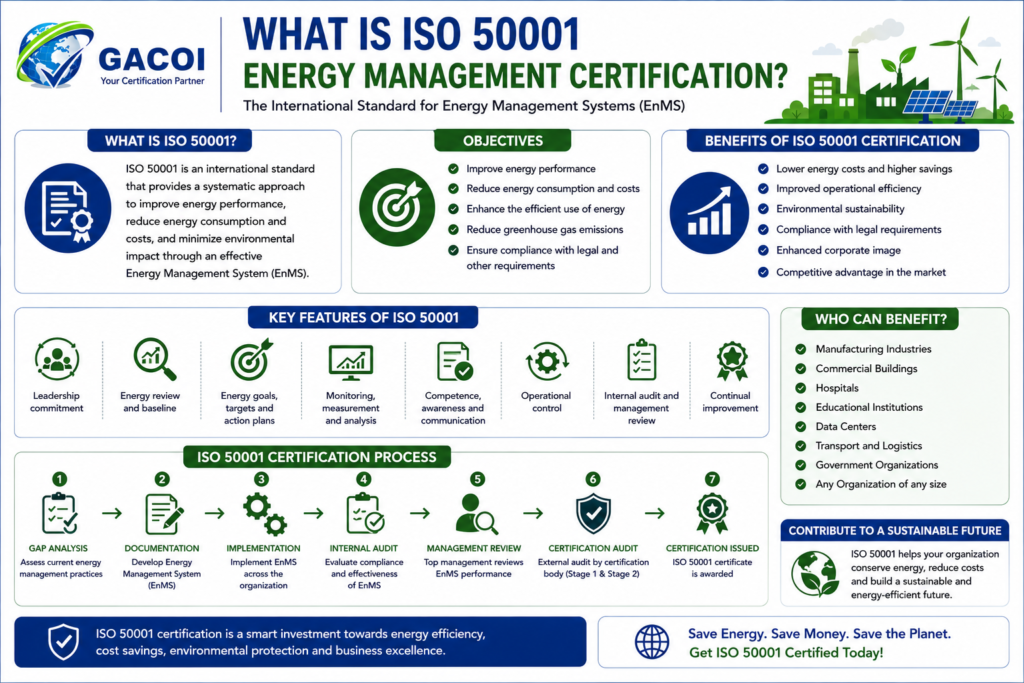
ISO 50001 is an international standard for Energy Management Systems (EnMS), published by the International Organization for Standardization (ISO). It gives organizations of any size or sector a structured framework to systematically improve their energy performance.
In simple terms, ISO 50001 helps you understand:
- How much energy your organization is consuming
- Where that energy is being wasted
- How to track, control, and reduce it
- How to maintain continuous improvement over time
The standard was first published in 2011, and its updated version — ISO 50001:2018 — was released in August 2018. This remains the current, globally applicable version of the standard.
2. Overview of the ISO 50001:2018 Standard
ISO 50001:2018 follows the High-Level Structure (HLS) used by ISO, which means it aligns closely with other popular management system standards like ISO 9001 (Quality Management) and ISO 14001 (Environmental Management). This makes it easier for companies to build an Integrated Management System (IMS), combining multiple ISO standards under a single audit cycle — saving both time and cost.
The standard focuses on:
- Energy Policy – Top management commitment
- Energy Planning – Identifying baselines and significant energy uses
- Energy Performance Indicators (EnPIs) – Measurable targets
- Operational Controls – Day-to-day energy-related processes
- Monitoring, Measurement & Analysis
- Internal Audit and Management Review
- Continual Improvement
The 2018 version places stronger emphasis on top management responsibility, ensuring energy management becomes part of the organizational culture rather than just a documentation exercise.
3. Why ISO 50001 Certification Matters in India
India is an energy-intensive economy, with sectors like manufacturing, textiles, cement, steel, chemicals, and data centers consuming large amounts of electricity and fuel. This is exactly why ISO 50001 certification is gaining momentum in India — whether for compliance, cost savings, or meeting global buyer requirements.
Key reasons include:
- Requirements from European and global buyers — Many export contracts now list ISO 50001 as a mandatory requirement.
- BEE PAT Scheme compliance — Designated Consumers under the Bureau of Energy Efficiency’s Perform, Achieve and Trade (PAT) scheme need a systematic approach to energy management.
- ESG and Sustainability Reporting — Investors and stakeholders increasingly demand ESG disclosures, and ISO 50001 provides a strong foundation for this.
- Government tenders and the GeM portal — Several tenders are beginning to include energy management certification as an eligibility criterion.
- LEED and IGBC green building credits — This certification offers additional credits for commercial real estate and hospitality projects.
4. Industries That Benefit Most from This Certification
ISO 50001 applies to virtually any organization that consumes energy — which means practically every industry. However, its impact is especially significant in:
- Manufacturing Units – Machinery, production lines, boilers, compressors
- Large Commercial Buildings – Lighting, HVAC systems
- Hospitals and Healthcare Institutions – Medical equipment, round-the-clock operations
- Hotels and the Hospitality Sector – Kitchens, heating, cooling
- Educational Institutions – Campus-wide energy consumption
- Data Centers – Cooling and server power are major cost drivers
- Government and Public Sector Undertakings
- Energy Utilities and Power Suppliers
If your organization’s electricity or fuel bill is a significant line item, ISO 50001 certification is directly relevant to you.
5. Benefits of ISO 50001 Certification
a) Reduction in Energy Costs
Systematic monitoring helps identify energy waste, leading to significant reductions in operational costs.
b) Regulatory Compliance
Makes it easier to align with the BEE PAT scheme and other environmental regulations.
c) Improved Brand Reputation
Certified companies appear more trustworthy to sustainability-conscious clients and investors.
d) Competitive Advantage in Exports
International buyers, especially in Europe, increasingly treat ISO 50001 as a baseline requirement.
e) Data-Driven Decision Making
Accurate energy data helps management make better strategic decisions.
f) Integration with Other Management Systems
The shared high-level structure with ISO 9001 and ISO 14001 makes implementation smoother.
g) LEED / IGBC Green Building Credits
Real estate developers and hospitality groups gain additional certification credits.
6. ISO 50001 Certification Process – Step by Step
Here’s how the ISO 50001 certification process typically works in India:
Step 1: Top Management Commitment
Leadership buy-in is essential first — for allocating resources, budget, and setting goals.
Step 2: Gap Analysis
A consultant or internal team compares current energy practices against ISO 50001 requirements and identifies gaps.
Step 3: Energy Review / Energy Audit
A detailed energy audit (often an ASHRAE Level 2-type audit) is typically conducted to establish an energy baseline and identify significant energy uses.
Step 4: EnMS Documentation
The Energy Policy, Manual, Procedures, and Work Instructions are developed to meet the standard’s requirements.
Step 5: Implementation
The EnMS is put into practice across operations — data collection, operational controls, and staff training.
Step 6: Internal Audit
Before the external audit, the organization conducts its own internal audit to catch gaps early.
Step 7: Management Review
Senior management reviews EnMS performance and decides on necessary corrective actions.
Step 8: Selecting a Certification Body
An organization selects an accredited certification body — ideally NABCB or UKAS-accredited (or any IAF-accredited body).
Step 9: Stage 1 Audit (Documentation Review)
Auditors review your documents to confirm readiness for the full audit.
Step 10: Stage 2 Audit (On-Site Audit)
This is the main certification audit — auditors visit the site to check actual implementation and interview staff.
Step 11: Certificate Issuance
If everything is satisfactory, the ISO 50001:2018 certificate is issued, typically valid for 3 years.
7. ISO 50001 Certification Cost in India
Costs vary widely based on organization size, number of locations, industry complexity, and the certification body chosen. Broadly, total cost breaks down into these components:
| Cost Component | Approximate Range |
|---|---|
| Gap Analysis + Consultant Fees | ₹50,000 – ₹3,00,000+ |
| Energy Audit (Baseline Assessment) | ₹50,000 – ₹2,00,000+ |
| Internal Auditor Training | ₹10,000 – ₹50,000 |
| Certification Body Fees (Stage 1 + Stage 2 + 3-year surveillance) | ₹1,00,000 – ₹5,00,000+ |
| Total Estimated Cost | ₹4,00,000 – ₹15,00,000 (medium-to-large facility) |
Note: Smaller offices or single-site companies can expect significantly lower costs, while multi-site manufacturing groups may face higher costs. These figures are indicative — always compare quotes from multiple consultants and certification bodies before deciding.
Important Tip: Always choose an IAF-accredited (NABCB or UKAS) certification body. Non-accredited certificates are often rejected by government tenders and international buyers, forcing costly re-certification later.
8. Timeline – How Long Does Certification Take
For a medium-sized organization, ISO 50001 implementation and certification typically takes 4 to 12 months, depending on:
- Current documentation readiness
- Number of sites/locations
- Availability and commitment of the internal team
- The consultant’s efficiency
Some smaller organizations with strong existing documentation practices can be ready in as little as 6-8 weeks.
9. Best ISO 50001 Certification Bodies in India
India hosts several major accredited certification bodies, including:
- Bureau Veritas
- TÜV SÜD
- DNV
- BSI (British Standards Institution)
- SGS
All of these hold international accreditations such as NABCB or UKAS, ensuring their certificates are globally recognized. When choosing a certification body, consider:
- Is it IAF-accredited?
- Do they have experience in your specific industry?
- Does your international buyer have a preferred certification body?
- What are their audit charges and turnaround time?
10. ISO 50001 vs ISO 14001 vs ISO 9001 – Key Differences
Many people get confused between these three standards. Here’s a simple breakdown:
- ISO 9001 – Quality Management System (product/service consistency and customer satisfaction)
- ISO 14001 – Environmental Management System (reducing overall environmental impact)
- ISO 50001 – Energy Management System (specifically focused on energy consumption and efficiency)
All three standards share a common High-Level Structure, which is why companies often implement them together as an Integrated Management System (IMS), reducing total audit days and cost by 30-40%.
11. Common Challenges and How to Solve Them
Challenge 1: Lack of Data Collection
Many Indian companies lack accurate energy metering data. Solution: Install sub-metering and use energy monitoring software.
Challenge 2: Top Management Engagement
Leadership sometimes doesn’t prioritize energy management. Solution: Present concrete cost-saving numbers and a clear ROI case.
Challenge 3: Documentation Burden
Documentation can feel overwhelming for smaller businesses. Solution: Hire an experienced consultant who can build on existing documents (like FSSAI or GST records) to speed up the process.
Challenge 4: Employee Awareness
An EnMS is only effective when the entire team is engaged. Solution: Conduct regular training and awareness sessions.
12. ISO 50001 and Government Tenders / BEE PAT Connection
Under the Bureau of Energy Efficiency’s (BEE) PAT (Perform, Achieve, Trade) scheme, large energy-intensive industries designated as “Designated Consumers” must systematically improve their energy efficiency. ISO 50001 implementation makes this compliance significantly easier, since the EnMS already tracks energy baselines and EnPIs.
In addition, several Central and State Government tenders (through the GeM portal, CPPP, and state procurement systems) are beginning to list energy-related certifications as a preference or eligibility criterion — particularly in construction, infrastructure, and manufacturing sectors.
13. Certificate Validity and Surveillance Audits
An ISO 50001 certificate is generally valid for 3 years. During this period:
- Annual Surveillance Audits are conducted (once a year) to confirm the system continues to operate effectively.
- At the end of the 3-year cycle, a Recertification Audit takes place to renew the certificate.
When budgeting, consider not just the initial certification cost but the surveillance costs across the full 3-year cycle.
14. Frequently Asked Questions (FAQs)
1. What is ISO 50001 Energy Management Certification?
ISO 50001 Energy Management Certification is an internationally recognized standard for Energy Management Systems (EnMS). It helps organizations establish processes to improve energy performance, reduce energy consumption, lower operating costs, and promote sustainable energy use.
2. Who should apply for ISO 50001 Energy Management Certification?
ISO 50001 Energy Management Certification is suitable for manufacturing companies, industrial plants, commercial buildings, hospitals, educational institutions, hotels, logistics companies, and any organization seeking to improve energy efficiency and reduce energy costs.
3. What are the benefits of ISO 50001 Energy Management Certification?
ISO 50001 Energy Management Certification helps organizations reduce energy consumption, lower utility costs, improve operational efficiency, enhance environmental performance, comply with energy regulations, and strengthen their reputation for sustainability.
4. What are the requirements for ISO 50001 Energy Management Certification?
To obtain ISO 50001 Energy Management Certification, an organization must implement an Energy Management System, establish an energy policy, identify significant energy uses, monitor energy performance, maintain documentation, conduct internal audits, and successfully complete a certification audit.
5. How long does it take to obtain ISO 50001 Energy Management Certification?
The timeline for ISO 50001 Energy Management Certification depends on the organization’s size, complexity, documentation readiness, and implementation of the Energy Management System. Most businesses complete the certification process within a few weeks to several months.
6. Is ISO 50001 Energy Management Certification mandatory in India?
ISO 50001 Energy Management Certification is generally voluntary. However, many organizations adopt it to improve energy efficiency, support sustainability initiatives, meet customer expectations, and gain a competitive advantage.
7. How much does ISO 50001 Energy Management Certification cost in India?
The cost of ISO 50001 Energy Management Certification depends on factors such as the size of the organization, number of employees, scope of certification, number of business locations, and the certification body selected.
8. Can startups and MSMEs apply for ISO 50001 Energy Management Certification?
Yes. Startups and MSMEs can obtain ISO 50001 Energy Management Certification if they want to improve energy performance, reduce operational expenses, and demonstrate their commitment to sustainable business practices.
9. What documents are required for ISO 50001 Energy Management Certification?
Common documents include the energy policy, energy objectives, energy performance records, operational procedures, monitoring and measurement records, internal audit reports, management review records, corrective action reports, and other documents required under the Energy Management System.
10. How can businesses prepare for ISO 50001 Energy Management Certification?
Businesses can prepare for ISO 50001 Energy Management Certification by conducting an energy review, implementing an Energy Management System, training employees, maintaining complete documentation, performing internal audits, correcting non-conformities, and working with an experienced certification consultant if required.
15. Conclusion
ISO 50001 energy management certification is not just a compliance document — it’s a strategic tool that helps Indian businesses cut energy costs, achieve sustainability goals, and strengthen global competitiveness. Whether you run a manufacturing unit, a commercial building, or an export-oriented business, investing in this certification delivers significant financial and reputational returns over the long term.
If you’re planning to pursue ISO 50001 certification in India, start by consulting an accredited certification body and an experienced consultant, understand your energy baseline, and build a structured implementation plan.
Need ISO Certification
🟡GACOI Cert provides globally recognized ISO certification, cybersecurity, privacy, AI governance, compliance, audit, and professional training services, helping startups, businesses, enterprises, laboratories, healthcare organizations, and government institutions achieve international standards and build lasting trust.
🟡For other Legal and Trademark related services Visit
👉 Money Recovery Cases
👉 Property Disputes
👉ISO Registration
👉ISO 22000 Certification
🟡 Protect Your Rights
👉 Domestic Violence Legal Support
👉 Stridhan Recovery
👉 Mutual Consent Divorce
👉 Contested Divorce Filing
📞 Call Now: +91 8595439395
🕐 Free Consultation: Monday to Saturday, 10 AM to 6 PM1


