


Views: 0
Discover the complete ISO 45001 certification cost and process in India 2026 — audit fees, consultant charges, step-by-step process, timeline, ROI, and how to get certified with GacoiCert.
Table of Contents
- 1 Introduction: Understanding ISO 45001 Certification Cost and Process in India
- 2 Why ISO 45001 Certification Matters More Than Ever in India in 2026
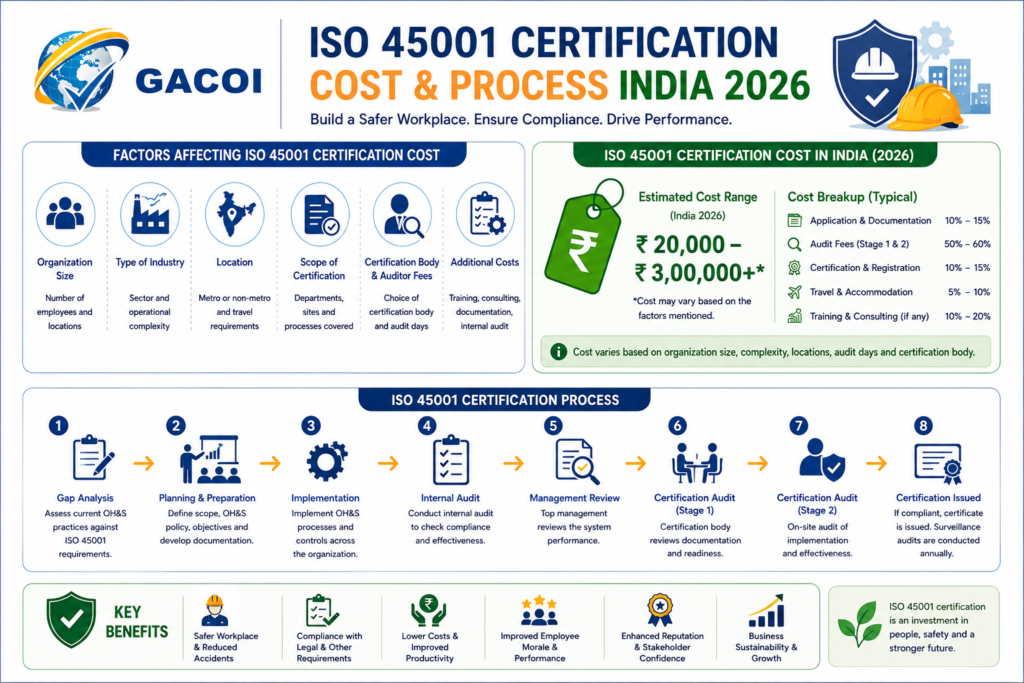
- 3 ISO 45001 Certification Cost in India 2026: Complete Breakdown
- 4 ISO 45001 Certification Process in India 2026: Complete Step-by-Step Guide
- 5 Complete ISO 45001 Certification Timeline in India 2026
- 6 Critical Warning: Beware of Fake ISO 45001 Certificates in India
- 7 The Return on ISO 45001 Investment: Why the Cost Is Always Justified
- 8 How to Reduce ISO 45001 Certification Cost Without Compromising Quality
- 9 Why Choose GacoiCert for ISO 45001 Certification in India?
- 10 Conclusion: ISO 45001 Certification Is Your Most Valuable Safety Investment in 2026
- 11 Frequently Asked Questions
- 12 Need ISO Certification
Introduction: Understanding ISO 45001 Certification Cost and Process in India
Every year, workplace accidents in India cause thousands of fatalities, hundreds of thousands of injuries, and billions of rupees in economic losses. Behind every statistic is a real person, a family affected, and a business that bears the human, legal, and financial consequences of inadequate workplace safety management.
ISO 45001:2018 — the international standard for Occupational Health and Safety Management Systems — provides Indian businesses with the most comprehensive, globally recognized framework available for systematically preventing workplace injuries, managing occupational health risks, and demonstrating safety commitment to employees, regulators, and business partners.
For Indian businesses in 2026, two questions dominate the ISO 45001 conversation: how much does it cost and what does the process involve? This comprehensive guide answers both questions completely and transparently — giving you everything you need to plan, budget for, and successfully achieve ISO 45001 certification through GacoiCert.
Why ISO 45001 Certification Matters More Than Ever in India in 2026
Before examining costs, understanding the business environment driving ISO 45001 demand in India in 2026 helps contextualize the investment.
Strengthening regulatory enforcement: India’s Occupational Safety, Health and Working Conditions Code 2020 has consolidated and strengthened occupational health and safety obligations across industries. Labor inspectorates are conducting more frequent inspections with greater technical capability. Penalties for safety violations are increasing significantly.
Government tender requirements: Central and state government infrastructure tenders, defense procurement, construction projects, and public sector manufacturing contracts are increasingly requiring ISO 45001 certification — or awarding significant preference scores to certified vendors.
Corporate supply chain demands: Large Indian corporations and multinational companies operating in India are incorporating occupational health and safety certification into supplier qualification requirements — making ISO 45001 a supply chain access imperative for many businesses.
International market requirements: Export-oriented businesses supplying to European, North American, and Japanese buyers face increasing supply chain due diligence requirements that include worker safety management verification. ISO 45001 certification provides the internationally recognized evidence these buyers require.
Insurance and liability management: Insurance providers are increasingly recognizing ISO 45001 certified organizations’ lower workplace incident risk — translating into more favorable premium terms and reduced liability exposure.
In this environment, ISO 45001 certification is not simply a compliance exercise — it is a strategic business investment that delivers measurable returns across multiple dimensions.
ISO 45001 Certification Cost in India 2026: Complete Breakdown
ISO 45001 certification cost comprises multiple distinct components. Understanding each component separately enables accurate budget planning and helps identify where investment can be optimized.
Component 1: Certification Body Fees
The primary and most significant cost component is the fee paid to an accredited certification body — such as GacoiCert — that independently audits your Occupational Health and Safety Management System and issues your internationally recognized ISO 45001 certificate.
Certification body fees are determined by audit duration — calculated based on the number of effective employees, operational complexity, number of sites, and industry hazard profile. For ISO 45001, industry hazard profile carries additional weight compared to ISO 9001 or ISO 14001 — because high-risk industries such as construction, mining, chemical manufacturing, and oil and gas require more thorough safety management system assessment.
ISO 45001 Certification Body Fees in India 2026:
| Organization Size | Number of Employees | Estimated Certification Fee |
|---|---|---|
| Micro Business | 1 – 5 employees | ₹22,000 – ₹40,000 |
| Very Small Business | 6 – 15 employees | ₹35,000 – ₹62,000 |
| Small Business | 16 – 25 employees | ₹50,000 – ₹90,000 |
| Small-Medium Business | 26 – 45 employees | ₹75,000 – ₹1,20,000 |
| Medium Business | 46 – 65 employees | ₹95,000 – ₹1,55,000 |
| Medium-Large Business | 66 – 125 employees | ₹1,30,000 – ₹2,10,000 |
| Large Business | 126 – 200 employees | ₹1,80,000 – ₹2,70,000 |
| Very Large Business | 201 – 300 employees | ₹2,30,000 – ₹3,30,000 |
| Enterprise | 300+ employees | ₹3,10,000 and above |
Why ISO 45001 certification fees may be slightly higher than ISO 9001:
ISO 45001 audits in high-risk industries require auditors with specific occupational health and safety technical expertise — construction safety, process safety, chemical hazard management, mining safety — and often require more thorough on-site assessment of physical hazard controls, emergency preparedness, and worker participation mechanisms. This technical depth is reflected in audit duration and therefore in certification fees for hazardous industry organizations.
Annual Surveillance Audit Fees:
ISO 45001 certificates are valid for three years with mandatory annual surveillance audits. Surveillance audit fees are approximately 50 to 67 percent of the initial certification audit fee.
| Organization Size | Estimated Annual Surveillance Fee |
|---|---|
| Micro to Very Small | ₹14,000 – ₹32,000 per year |
| Small to Small-Medium | ₹30,000 – ₹65,000 per year |
| Medium to Medium-Large | ₹58,000 – ₹1,15,000 per year |
| Large to Very Large | ₹1,10,000 – ₹2,10,000 per year |
| Enterprise | ₹1,90,000 and above per year |
Component 2: ISO 45001 Consultant Fees
Many organizations — particularly those in high-risk industries implementing ISO 45001 for the first time — engage experienced occupational health and safety management system consultants to guide the implementation process.
A competent ISO 45001 consultant helps with gap analysis, hazard identification and risk assessment, legal register development, OHSMS documentation, worker participation mechanism design, emergency response planning, internal auditor training, and pre-certification audit preparation.
ISO 45001 Consultant Fees in India 2026:
| Organization Size | Estimated Consultant Fee |
|---|---|
| Micro to Very Small Business | ₹20,000 – ₹48,000 |
| Small Business | ₹45,000 – ₹95,000 |
| Medium Business | ₹90,000 – ₹1,90,000 |
| Large Business | ₹1,75,000 – ₹3,75,000 |
| Enterprise | ₹3,50,000 – ₹7,50,000 and above |
Consultant fees for ISO 45001 implementations in high-risk industries — construction, chemical manufacturing, mining, oil and gas — tend toward the higher end of these ranges due to the greater technical complexity of hazard identification, risk assessment, and control specification.
Component 3: ISO 45001 Training Costs
Effective ISO 45001 implementation requires investment in training at multiple levels — ensuring implementation team competence, management awareness, worker safety knowledge, and internal audit capability.
ISO 45001 Training Programs and Fees in India 2026:
| Training Program | Target Audience | Typical Fee Per Person |
|---|---|---|
| ISO 45001 Awareness Training | All employees | ₹4,000 – ₹10,000 |
| ISO 45001 Lead Implementer Training | OHSMS Project Lead, Safety Manager | ₹20,000 – ₹42,000 |
| ISO 45001 Internal Auditor Training | Internal audit team | ₹12,000 – ₹25,000 |
| Hazard Identification and Risk Assessment Workshop | Department heads, supervisors | ₹10,000 – ₹20,000 per person |
| ISO 45001 Lead Auditor Training | Auditing career professionals | ₹30,000 – ₹60,000 |
The most critical training investment for most organizations is ISO 45001 Internal Auditor Training — without trained internal auditors, the mandatory internal audit requirement cannot be genuinely fulfilled.
Component 4: Safety Infrastructure and Control Implementation Costs
ISO 45001 implementation may reveal hazard control gaps that require physical infrastructure investment or process changes to address. These costs vary enormously based on current safety maturity and industry type.
Common safety infrastructure investments triggered by ISO 45001 gap analysis include:
- Machine guarding and safety device installation
- Emergency eyewash and shower station installation
- Fire detection and suppression system upgrades
- Personal protective equipment procurement and management systems
- Hazardous material storage area improvements
- Electrical safety upgrades and lockout-tagout systems
- Safety signage and visual management implementation
- First aid facility upgrades
- Worker welfare facility improvements
These infrastructure investments represent genuine business value beyond ISO 45001 certification — directly reducing accident probability, regulatory penalty risk, and associated financial liabilities.
Component 5: Internal Resource Costs
The time invested by your employees in ISO 45001 implementation is a real and often underestimated cost. Your Safety Manager, HR team, department heads, supervisors, and worker representatives will collectively invest hundreds of hours in hazard identification, documentation development, training participation, safety control implementation, internal audit conduct, and record maintenance.
Estimated Internal Time Investment:
| Organization Size | Estimated Total Internal Hours |
|---|---|
| Micro to Very Small | 120 – 200 hours |
| Small Business | 200 – 380 hours |
| Medium Business | 380 – 750 hours |
| Large Business | 750 – 1,500 hours |
Total ISO 45001 Certification Cost Summary 2026
| Organization Size | Certification Fee | Consultant Fee | Training | Infrastructure and Tools | Total Estimated Investment |
|---|---|---|---|---|---|
| Micro (1–5 employees) | ₹22,000 – ₹40,000 | ₹20,000 – ₹45,000 | ₹7,000 – ₹20,000 | ₹5,000 – ₹20,000 | ₹54,000 – ₹1,25,000 |
| Small (6–25 employees) | ₹40,000 – ₹90,000 | ₹40,000 – ₹90,000 | ₹15,000 – ₹40,000 | ₹15,000 – ₹50,000 | ₹1,10,000 – ₹2,70,000 |
| Medium (26–100 employees) | ₹90,000 – ₹1,80,000 | ₹90,000 – ₹1,90,000 | ₹30,000 – ₹80,000 | ₹30,000 – ₹80,000 | ₹2,40,000 – ₹5,30,000 |
| Large (101–300 employees) | ₹1,80,000 – ₹3,30,000 | ₹1,75,000 – ₹3,75,000 | ₹60,000 – ₹1,30,000 | ₹50,000 – ₹1,20,000 | ₹4,65,000 – ₹9,55,000 |
| Enterprise (300+ employees) | ₹3,10,000 and above | ₹3,50,000 and above | ₹1,10,000 and above | ₹1,00,000 and above | ₹8,70,000 and above |
ISO 45001 Certification Process in India 2026: Complete Step-by-Step Guide
Understanding the certification process is as important as understanding the cost — because how effectively you execute each step directly determines both the speed of certification and the quality of the safety management system you achieve.
Step 1: Top Management Commitment and Project Initiation
Every successful ISO 45001 implementation begins with genuine top management commitment — not a signature on a policy document, but active leadership involvement in safety management.
Top management must formally commit to providing resources for implementation, establishing an Occupational Health and Safety Policy, integrating OHS management into business strategy, and personally demonstrating safety leadership through visible behavior.
A formal project initiation — appointing a dedicated OHSMS Project Lead, assembling a cross-functional implementation team including worker representatives, defining the certification scope, and establishing a realistic implementation timeline and budget — sets the foundation for everything that follows.
Duration: One to two weeks.
Step 2: ISO 45001 Standard Training and Gap Analysis
Before implementation begins, your implementation team must thoroughly understand ISO 45001:2018 requirements and systematically assess how your current safety practices compare to those requirements.
ISO 45001 awareness and lead implementer training for your project team accelerates understanding and reduces misinterpretation risk — making this training investment one of the highest-return expenditures in the certification process.
The gap analysis systematically compares current OHS practices against every ISO 45001 clause — identifying what is already in place, what partially meets requirements, and what is entirely missing. Gap analysis output is a prioritized implementation action plan.
Common gaps found in Indian businesses:
- Absence of formal hazard identification and risk assessment processes
- No structured worker participation mechanism in OHS decisions
- Missing legal register covering applicable OHS regulations
- No formal incident investigation and near miss reporting system
- Inadequate emergency preparedness and response planning
- Missing competence and training records for safety-critical roles
Duration: One to two weeks.
Step 3: Hazard Identification and Risk Assessment
This is the most technically critical step in ISO 45001 implementation — and one that most clearly distinguishes ISO 45001 from other ISO management system standards.
Your implementation team must systematically identify all workplace hazards across every activity, process, location, and worker group within the certification scope. Hazards include physical, chemical, biological, ergonomic, and psychosocial hazard categories.
For each identified hazard, a formal risk assessment evaluates the likelihood of harm occurring and the severity of potential consequences — producing a prioritized risk rating that determines the urgency and nature of control measures required.
Controls are selected following the internationally recognized Hierarchy of Controls — prioritizing elimination, substitution, and engineering controls over administrative controls and personal protective equipment.
This hazard identification and risk assessment process must be documented comprehensively — creating the Hazard Register that forms the technical foundation of your entire OHSMS.
Duration: Two to four weeks depending on organization size and complexity.
Step 4: OHSMS Documentation Development
Based on gap analysis findings and hazard register outputs, develop the documented information that forms your OHSMS framework:
Mandatory documented information includes:
- OHS Policy — top management’s formal safety commitment
- OHS Objectives and targets — measurable safety performance improvement goals
- Hazard Register — all identified hazards with risk ratings and control assignments
- Legal Register — all applicable OHS laws, regulations, and compliance status
- Risk Assessment Records — detailed assessments for significant hazards
- Safe Work Procedures — step-by-step safety instructions for hazardous tasks
- Emergency Response Plans — fire, chemical spill, medical emergency, natural disaster
- Worker Participation Mechanism — formal process for worker safety involvement
- Competence and Training Matrix — who needs what safety training
- Incident Investigation Procedure — process for investigating accidents and near misses
- Corrective Action Procedure — process for addressing nonconformities
Duration: Three to eight weeks depending on organization size.
Step 5: OHSMS Implementation
Documentation must be translated into actual operational practice. Implementation activities include:
Employee training and awareness: All workers must be trained on the OHS Policy, their specific hazards and controls, safe work procedures for their tasks, emergency response procedures, and their rights and responsibilities under the OHSMS including the right to refuse unsafe work.
Worker participation activation: Establish safety committees, safety representatives, toolbox talk programs, hazard reporting systems, and worker feedback channels that genuinely involve workers in OHS decision-making — as explicitly required by ISO 45001.
Physical control implementation: Install or upgrade physical hazard controls identified during risk assessment — machine guards, safety devices, containment systems, emergency equipment, welfare facilities.
Incident reporting system: Establish a formal near miss and incident reporting system that encourages reporting without blame — and implement systematic investigation processes for all reported incidents.
Record keeping: Begin consistent, accurate maintenance of all required OHS records from the first day of OHSMS operation.
Minimum operation period: Most accredited certification bodies including GacoiCert expect at least three months of documented OHSMS operation before the certification audit — ensuring sufficient operational evidence exists.
Duration: Four to twelve weeks.
Step 6: Internal Audit
A formal internal audit is a mandatory ISO 45001 requirement that must be completed before the certification audit. Internal auditors — trained in ISO 45001 requirements and audit techniques — systematically assess whether the OHSMS meets the standard’s requirements and is effectively implemented.
The internal audit involves document review, employee interviews at all levels, physical workplace inspection, and records examination. All nonconformities identified must be investigated and corrective actions implemented before the Stage 2 certification audit.
Duration: One to two weeks including nonconformity resolution.
Step 7: Management Review
Top management conducts a formal review of OHSMS performance — examining incident data, safety objective achievement, legal compliance status, worker participation feedback, internal audit findings, and improvement opportunities. The management review must produce documented decisions about improvements, resource needs, and any required OHSMS changes.
Duration: Three to five days including preparation and documentation.
Step 8: Stage 1 Audit with GacoiCert
GacoiCert’s auditor conducts the Stage 1 documentation review — assessing whether your OHSMS documentation adequately addresses ISO 45001:2018 requirements and whether your organization is ready for the Stage 2 on-site assessment.
Stage 1 findings provide an opportunity to address documentation gaps before the main audit. The Stage 1 audit also confirms the Stage 2 audit schedule.
Duration: Half day to one day. Four to six weeks between Stage 1 and Stage 2.
Step 9: Stage 2 Audit with GacoiCert
The Stage 2 certification audit is the comprehensive on-site assessment where GacoiCert auditors verify that your OHSMS is genuinely implemented and effective throughout your organization.
Stage 2 activities include opening meeting, document and records review, physical workplace inspections across all relevant work areas, employee interviews at all organizational levels, emergency preparedness verification, worker participation mechanism assessment, and closing meeting presenting all findings.
Stage 2 audit duration by organization size:
| Organization Size | Typical Stage 2 Duration |
|---|---|
| Micro (1–5 employees) | 0.5 – 1 day |
| Small (6–25 employees) | 1 – 1.5 days |
| Medium (26–100 employees) | 1.5 – 2.5 days |
| Large (101–300 employees) | 2.5 – 4 days |
| Enterprise (300+ employees) | 4 days and above |
Step 10: Nonconformity Resolution and Certificate Issuance
Any nonconformities identified during Stage 2 must be addressed through documented root cause analysis and corrective action implementation before the certification decision is made.
Following satisfactory resolution of all nonconformities, GacoiCert’s certification committee reviews the audit report and issues your ISO 45001:2018 certificate — valid for three years with annual surveillance audits.
Complete ISO 45001 Certification Timeline in India 2026
| Organization Size | Total Certification Timeline |
|---|---|
| Micro Business (1–5 employees) | 8 – 12 weeks |
| Small Business (6–25 employees) | 10 – 16 weeks |
| Medium Business (26–100 employees) | 4 – 6 months |
| Large Business (101–300 employees) | 6 – 10 months |
| Enterprise (300+ employees) | 9 – 14 months |
Critical Warning: Beware of Fake ISO 45001 Certificates in India
India’s ISO certification market includes non-accredited and fraudulent operators offering ISO 45001 certificates at prices far below legitimate market rates — sometimes ₹5,000 to ₹15,000 — with minimal or no genuine audit process.
These certificates are worthless. They are rejected by government tender evaluation committees, corporate supplier qualification teams, international buyers, and insurance companies. Worse — a business that holds a fake safety certificate and suffers a workplace accident faces significantly compounded legal and reputational consequences.
Always verify accreditation:
- Check NABCB at nabcb.in for accredited certification bodies
- Check IAF at iaf.nu for recognized accreditation bodies
- Verify specific certificates at iafcertsearch.org
Genuine ISO 45001 certification from GacoiCert is internationally accredited, fully verifiable, and accepted everywhere that matters for your business.
The Return on ISO 45001 Investment: Why the Cost Is Always Justified
The financial case for ISO 45001 certification is compelling across every dimension:
Accident cost avoidance: A single serious workplace accident — fatality or permanent disability — can cost an Indian business ₹20,00,000 to several crores in compensation, legal fees, regulatory penalties, investigation costs, and productivity losses. ISO 45001’s systematic hazard control dramatically reduces accident probability.
Regulatory penalty avoidance: Occupational safety violations under India’s strengthened regulatory framework carry significant financial penalties and can result in operational suspension. Systematic legal compliance management through ISO 45001 reduces this exposure substantially.
Insurance premium reductions: ISO 45001 certified organizations consistently report more favorable workers’ compensation and liability insurance terms — with premium savings that can partially or fully offset annual surveillance audit costs.
Productivity improvements: Reduced accidents mean reduced production disruption, reduced absenteeism, and reduced replacement and retraining costs — all of which improve operational efficiency and profitability.
Tender and contract wins: A single major government or corporate contract won on the basis of ISO 45001 certification can return the entire certification investment many times over.
Employee retention and morale: Workers who feel genuinely safe at work are more engaged, more productive, and more loyal — reducing the significant costs of high employee turnover, particularly in skilled manufacturing and technical roles.
Three-year cost vs. benefit perspective: For a medium-sized manufacturing business investing ₹3,00,000 to ₹5,00,000 in ISO 45001 certification over three years, the combined benefit of a single avoided serious accident, one major tender win, and measurable productivity improvement typically delivers a return of ten times the investment or more.
How to Reduce ISO 45001 Certification Cost Without Compromising Quality
Pursue integrated certification: Combining ISO 45001 with ISO 9001 and ISO 14001 through GacoiCert’s Integrated Management System approach reduces total combined certification cost by 25 to 40 percent compared to three separate certifications.
Leverage existing safety documentation: Many Indian businesses already maintain accident records, safety training records, and regulatory compliance documents. Building on existing materials reduces documentation development time and consultant fees.
Train internal auditors early: Investing in internal auditor training before the first internal audit reduces reliance on external consultant support for internal audit conduct in every subsequent cycle.
Schedule audit dates with GacoiCert early: Securing audit slots early prevents scheduling delays that extend timelines and increase internal resource costs.
Conduct a thorough gap analysis first: Understanding exactly where gaps exist before implementation begins prevents wasted effort and focuses resources precisely where they are needed.
Why Choose GacoiCert for ISO 45001 Certification in India?
Internationally accredited: GacoiCert’s ISO 45001 certificates are issued under internationally recognized accreditation — verifiable through NABCB and IAF databases, accepted by government authorities, corporate buyers, and international clients worldwide.
Industry-specific safety expertise: Our auditors bring genuine occupational health and safety expertise across construction, manufacturing, healthcare, mining, chemicals, logistics, and all other major Indian industries.
Transparent competitive pricing: Complete itemized quotations with no hidden fees — enabling accurate budget planning from the outset.
Integrated Management System capability: ISO 45001 combined with ISO 9001 and ISO 14001 through a single coordinated audit — maximum efficiency, minimum cost.
Pan-India coverage: Delhi NCR, Mumbai, Pune, Bangalore, Chennai, Hyderabad, Kolkata, Ahmedabad, and all major cities and industrial centers across India.
Long-term certification partnership: GacoiCert supports your OHSMS through every surveillance audit and recertification cycle — providing consistent, reliable certification partnership as your safety management matures.
Conclusion: ISO 45001 Certification Is Your Most Valuable Safety Investment in 2026
ISO 45001 certification cost in India in 2026 ranges from approximately ₹54,000 for the smallest micro-businesses to several lakhs for large enterprises. The process involves ten clearly defined steps from management commitment through certificate issuance — achievable in eight to twelve weeks for small businesses and four to ten months for larger organizations.
What is consistent across every organization is the fundamental truth: the return on genuine, accredited ISO 45001 certification — through accident prevention, regulatory compliance, tender success, insurance savings, and employee engagement — far exceeds its total cost.
Worker safety is not just a moral obligation — it is a business imperative. And ISO 45001 certification is the internationally recognized proof that your organization takes that imperative seriously.
Visit gacoicert.com today, request your free consultation, and get a personalized ISO 45001 cost estimate and certification plan for your business.
Frequently Asked Questions
1. What is the ISO 45001 Certification Cost?
The ISO 45001 Certification Cost depends on several factors, including the size of the organization, number of employees, business locations, scope of certification, and the certification body selected. The total cost varies based on the organization’s requirements.
2. What factors affect the ISO 45001 Certification Cost?
The ISO 45001 Certification Cost is influenced by business size, industry type, complexity of operations, documentation requirements, implementation support, audit duration, and the number of sites covered under the certification.
3. Does the ISO 45001 Certification Cost include implementation and audit fees?
Not always. Some service providers offer complete packages that include documentation, implementation, employee training, internal audits, and certification audits, while others charge separately. It is advisable to confirm what is included in the ISO 45001 Certification Cost before proceeding.
4. Is the ISO 45001 Certification Cost different for startups and MSMEs?
Yes. The ISO 45001 Certification Cost is generally lower for startups and MSMEs because they usually have fewer employees, simpler operational processes, and a smaller certification scope than larger organizations.
5. How long does it take to obtain ISO 45001 certification?
The certification timeline depends on the organization’s preparedness, implementation of the Occupational Health and Safety Management System (OHSMS), documentation, and audit schedule. Most businesses complete the process within a few weeks to a few months.
6. Is ISO 45001 certification worth the investment?
Yes. Although the ISO 45001 Certification Cost requires an initial investment, the certification helps improve workplace safety, reduce occupational risks, enhance legal compliance, increase employee confidence, and strengthen business credibility.
7. Are there any recurring costs after ISO 45001 certification?
Yes. Businesses may incur surveillance audit fees, recertification charges, and costs associated with maintaining and continually improving their Occupational Health and Safety Management System. These ongoing expenses should be considered along with the ISO 45001 Certification Cost.
8. How can businesses reduce the ISO 45001 Certification Cost?
Businesses can optimize the ISO 45001 Certification Cost by preparing documentation in advance, implementing the management system effectively, conducting internal audits before the certification audit, and choosing an accredited certification body that offers transparent pricing.
Need ISO Certification
🟡GACOI Cert provides globally recognized ISO certification, cybersecurity, privacy, AI governance, compliance, audit, and professional training services, helping startups, businesses, enterprises, laboratories, healthcare organizations, and government institutions achieve international standards and build lasting trust.
🟡For other Legal and Trademark related services Visit
👉 Money Recovery Cases
👉 Property Disputes
👉 Business & Licence Registrations
🟡 Protect Your Rights
👉 Domestic Violence Legal Support
👉 Stridhan Recovery
👉 Mutual Consent Divorce
👉 Contested Divorce Filing
👉 Child Custody and Maintenance
👉 Matrimonial Property Settlement
👉 NRI Divorce Services
👉 Alimony and Maintenance
📞 Call Now: +91 8595439395
🕐 Free Consultation: Monday to Saturday, 10 AM to 6 PM


