


Views: 3
Learn the difference between ISO 22000 and FSSAI, their benefits, legal requirements, and which certification your food business needs in India in 2026.
Table of Contents
- 1 Introduction
- 2 What Is FSSAI?
- 3 What Is ISO 22000?
- 4 ISO 22000 vs FSSAI: Key Differences at a Glance
- 5 Which Businesses Must Have FSSAI?
- 6 Which Businesses Should Consider ISO 22000?
- 7 Do You Need Both FSSAI and ISO 22000?
- 8 Benefits of ISO 22000 Certification
- 9 Benefits of FSSAI License
- 10 Step-by-Step Certification Process
- 11 Documents Required
- 12 Cost Comparison: FSSAI vs ISO 22000
- 13 Common Mistakes Business Owners Make
- 14 How to Decide What Your Business Needs
- 15 Conclusion
- 16 Frequently Asked Questions (FAQs)
- 17 Get Expert Guidance for ISO Certification
Introduction
If you run a food business in India — whether it’s a small restaurant, a packaged food manufacturing unit, an export company, or a large-scale food processing plant — you have probably come across two very important terms: FSSAI and ISO 22000. Many business owners assume these two are the same thing, or that having one automatically covers the other. This is one of the most common misconceptions in the food industry, and it can lead to compliance issues, missed business opportunities, or even legal trouble.
The truth is, FSSAI and ISO 22000 serve two very different purposes. One is a mandatory government requirement that every food business in India must have to operate legally. The other is a globally recognized, voluntary certification that strengthens your food safety management system and opens doors to international markets.
In this comprehensive guide, we will break down everything you need to know about ISO 22000 vs FSSAI — what each one means, who needs them, how they differ, their benefits, costs, application processes, and most importantly, how to decide which certification (or combination of both) is right for your business.
What Is FSSAI?
FSSAI (Food Safety and Standards Authority of India) is a statutory body established under the Food Safety and Standards Act, 2006, and functions under the Ministry of Health and Family Welfare, Government of India.
FSSAI’s core responsibility is to regulate and supervise food safety in India, ensuring that every food product reaching consumers is safe, hygienic, and fit for human consumption. It sets science-based standards for food articles and regulates their manufacturing, storage, distribution, sale, and import to ensure the availability of safe and wholesome food.
Types of FSSAI Registration and License
FSSAI offers three categories of registration/license depending on the size, turnover, and nature of the business:
- FSSAI Basic Registration – For small businesses with an annual turnover of up to Rs. 12 lakh, such as small vendors, home-based food businesses, and petty food manufacturers.
- FSSAI State License – For medium-sized businesses with an annual turnover between Rs. 12 lakh and Rs. 20 crore, operating within a single state.
- FSSAI Central License – For large businesses, importers, exporters, and manufacturers with an annual turnover exceeding Rs. 20 crore, or those operating across multiple states.
Why Is FSSAI Mandatory?
Without an FSSAI license, no food business — whether involved in manufacturing, processing, packaging, storage, distribution, or sale — can legally operate in India. This is a mandatory legal requirement, and failure to comply can result in heavy penalties, license cancellation, and in serious cases, business closure or legal prosecution.
The FSSAI license number must also be printed on product packaging, which helps consumers verify that the product has been certified and approved by a recognized food safety authority.
What Is ISO 22000?
ISO 22000 is an international standard that defines the requirements for a Food Safety Management System (FSMS). It was developed and is maintained by the International Organization for Standardization (ISO), a global body headquartered in Geneva, Switzerland.
Unlike FSSAI, which is specific to India, ISO 22000 applies to any organization in the food supply chain — anywhere in the world. It follows a “farm to fork” approach, covering everyone involved in producing, processing, packaging, transporting, and distributing food.
Core Elements of ISO 22000
ISO 22000 is built around four key principles:
- Interactive Communication – Ensuring effective communication across all levels of the food supply chain, from suppliers to consumers.
- System Management – Establishing a structured, well-documented management system that is regularly reviewed and improved.
- Prerequisite Programs (PRPs) – Maintaining basic hygienic and operational conditions necessary to produce safe food.
- HACCP Principles – Applying Hazard Analysis and Critical Control Points methodology to identify, evaluate, and control food safety hazards.
Is ISO 22000 Mandatory or Voluntary?
This is an important distinction — ISO 22000 is a voluntary certification. It is not legally required by the Indian government. However, if your business goal is to compete internationally, export food products, or partner with large retail chains and multinational buyers, ISO 22000 certification often becomes a practical necessity, since many global buyers and retailers require it as a pre-condition for doing business.
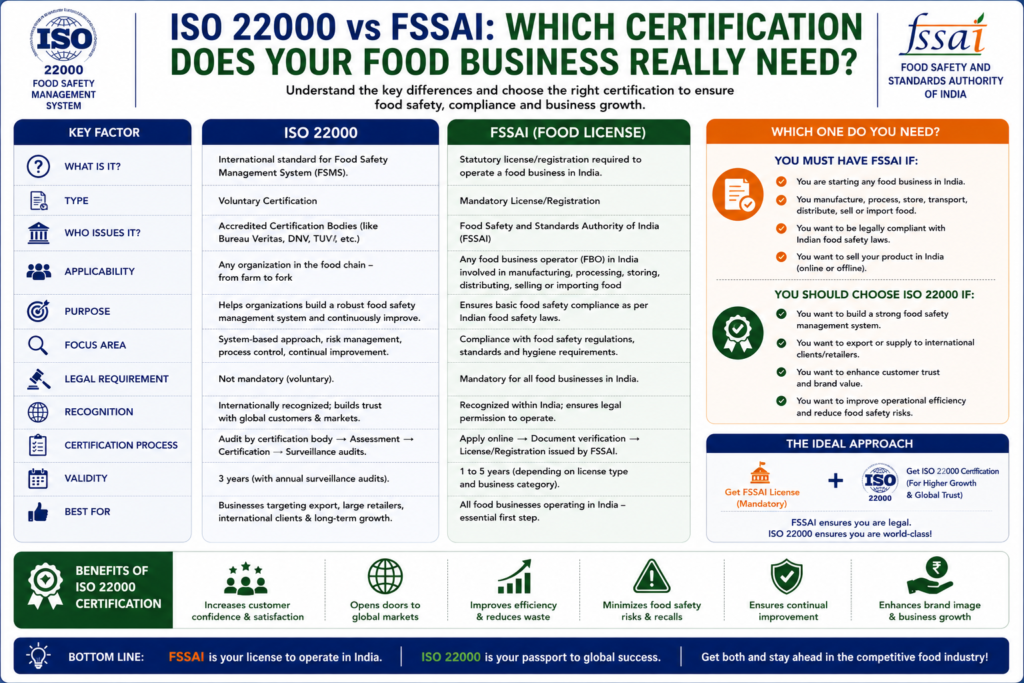
ISO 22000 vs FSSAI: Key Differences at a Glance
Let’s break down the core differences between the two in a simple comparison table.
| Parameter | FSSAI | ISO 22000 |
|---|---|---|
| Nature | Mandatory (legal requirement) | Voluntary (business choice) |
| Issuing Authority | Government of India | Accredited international certification bodies |
| Scope | Applicable only within India | Applicable globally, in any country |
| Focus | Basic food safety compliance | Comprehensive food safety management system |
| Applicability | Every food business, regardless of size | Mainly manufacturers, processors, and exporters |
| Validity Period | 1 to 5 years | Typically 3 years, with annual surveillance audits |
| Consequence of Non-Compliance | Penalties, license cancellation, legal action | No legal penalty, but reduced business opportunities |
| International Recognition | Valid only in India | Recognized and respected worldwide |
| Consumer/Buyer Trust | Basic-level trust | High-level trust, especially in B2B and export markets |
| Cost | Relatively lower | Higher, due to detailed audits and documentation |
Which Businesses Must Have FSSAI?
If your business falls under any of the following categories, FSSAI registration or license is legally mandatory:
- Restaurants, cafes, and cloud kitchens
- Food manufacturing and processing units
- Food packaging companies
- Food importers and exporters
- Grocery stores and supermarkets selling packaged food
- Dairy product businesses
- Meat and poultry processing units
- E-commerce food delivery and aggregator platforms
- Food storage and warehousing businesses
- Catering services and event food suppliers
In short, any entity involved in producing, processing, packaging, storing, distributing, or selling food must obtain an FSSAI license — the only variable is which category (Basic, State, or Central) applies based on turnover and scale.
Which Businesses Should Consider ISO 22000?
ISO 22000 is particularly valuable for businesses that:
- Are involved in export operations or plan to expand into international markets
- Operate large-scale food manufacturing units
- Want to become supply chain partners with multinational companies
- Supply products to retail chains and supermarkets that require quality certifications
- Want to enhance their brand credibility and consumer trust
- Are looking for a competitive edge in a crowded market
- Aim to secure large B2B contracts with corporate buyers
If your business currently operates only at a local level with no immediate export or large-scale B2B ambitions, FSSAI alone may be sufficient for now. However, if you’re focused on long-term growth, ISO 22000 is a smart, strategic investment.
Do You Need Both FSSAI and ISO 22000?
Here’s an important point that clears up a lot of confusion: FSSAI and ISO 22000 are not substitutes for one another — they complement each other.
This means:
- FSSAI gives you the legal permission to operate a food business in India.
- ISO 22000 helps you standardize and strengthen your food safety management system to a globally recognized level, boosting credibility and opening doors internationally.
That’s why many successful and growth-oriented food businesses maintain both certifications simultaneously — starting with FSSAI for legal compliance, and later pursuing ISO 22000 to strengthen internal systems and become globally competitive.
Benefits of ISO 22000 Certification
- Access to Global Markets – Makes it significantly easier to work with international buyers, importers, and retail chains.
- Stronger Food Safety Systems – A systematic, proactive approach to identifying and controlling food safety hazards.
- Increased Customer Confidence – Builds trust among consumers, partners, and stakeholders.
- Reduced Recalls and Wastage – Better process control leads to fewer product recalls and less wastage.
- Competitive Market Advantage – Differentiates your business from competitors who lack international certification.
- Improved Supplier Relationships – Enhances transparency and trust across the entire supply chain.
- Continuous Improvement – Regular audits ensure the system is consistently reviewed and improved.
- Easy Integration with Other Standards – Can be combined with ISO 9001 (Quality Management) and HACCP for a more robust management framework.
Benefits of FSSAI License
- Legal Compliance – Allows your business to operate legally without risk of penalties or shutdown.
- Consumer Trust – The FSSAI logo on packaging reassures customers that the product meets safety standards.
- Business Expansion – A valid license simplifies the process of scaling and expanding operations.
- Access to Loans and Funding – Banks and investors are more likely to support businesses with proper licensing.
- Eligibility for Government Schemes – Many government subsidies and support programs require a valid FSSAI license.
- Avoidance of Legal Penalties – Protects your business from fines, seizures, and forced closure.
Step-by-Step Certification Process
How to Get an FSSAI License
- Register on the official FSSAI portal (FoSCoS).
- Select the appropriate license category (Basic, State, or Central) based on your business turnover and scale.
- Upload the required documents, including identity proof, address proof, and business details.
- Pay the applicable government fee.
- The application is reviewed by the FSSAI department, and once approved, the license is issued.
How to Get ISO 22000 Certified
- Choose a reputable, accredited certification body.
- Conduct a gap analysis to assess how your current processes align with ISO 22000 requirements.
- Implement necessary documentation and process improvements, including a HACCP plan.
- Conduct an internal audit to identify and correct gaps before the external audit.
- Undergo an external audit by the certification body, usually in two stages (Stage 1 documentation review and Stage 2 on-site assessment).
- If the audit is successful, the ISO 22000 certificate is issued.
- Maintain certification through annual surveillance audits.
Documents Required
For FSSAI Registration/License
- Passport-size photograph
- Identity proof (Aadhaar, PAN, Voter ID)
- Business address proof
- Business registration certificate (if applicable)
- List of food products to be manufactured/sold
- No Objection Certificate (NOC) from local municipality (in certain cases)
- Water testing report (in certain cases)
For ISO 22000 Certification
- Business registration details
- Existing food safety policies and procedures
- HACCP plan (if already implemented)
- Process flow charts
- Employee training records
- Previous audit reports (if any)
Cost Comparison: FSSAI vs ISO 22000
FSSAI License Cost The cost of FSSAI registration/license varies based on the category:
- Basic Registration: Low cost, affordable for small businesses
- State License: Moderate cost
- Central License: Higher cost, applicable to large businesses
ISO 22000 Certification Cost The cost of ISO 22000 certification depends on several factors:
- Size of the business
- Number of employees
- Number of business locations
- Fees charged by the certification body
- Consultant fees (if a consultant is hired to assist with implementation)
Generally, ISO 22000 certification is more expensive than FSSAI licensing, due to the detailed audits, extensive documentation, and ongoing surveillance requirements. However, considering the long-term benefits — such as access to international markets and enhanced credibility — this investment is often well worth it, especially for businesses with growth and export ambitions.
Common Mistakes Business Owners Make
- Assuming FSSAI Alone Is Enough – Many businesses believe that having an FSSAI license is sufficient for all purposes. But if the goal is expansion, exports, or high-value B2B partnerships, this can be a costly oversight.
- Treating ISO 22000 as a Replacement for FSSAI – This is a common misunderstanding. ISO 22000 certification does not eliminate the legal requirement to hold an FSSAI license.
- Neglecting Proper Documentation – Both certifications require accurate and up-to-date documentation. Poor record-keeping can cause issues during renewal or audits.
- Missing Renewal Deadlines – Both FSSAI licenses and ISO certifications have validity periods. Failing to renew on time can lead to penalties or suspension of certification.
- Choosing the Wrong Certification Body – For ISO 22000, always select a certification body that is properly accredited and reputable to ensure your certificate holds real value in the market.
How to Decide What Your Business Needs
Ask yourself the following questions to determine the right path for your business:
Question 1: Are you operating only within India, or do you plan to expand internationally?
- If only in India → FSSAI is mandatory
- If planning international expansion → Consider ISO 22000 as well
Question 2: Do your buyers or retail partners require quality certifications?
- If yes → ISO 22000 may become essential for securing contracts
Question 3: Are you a small local business or a large-scale manufacturer?
- Small business → FSSAI is sufficient to start
- Large manufacturer → Both certifications are ideal
Question 4: Do you want to strengthen your brand’s credibility and market value?
- If yes → ISO 22000 is a powerful tool for building trust and reputation
Conclusion
In the end, the debate of ISO 22000 vs FSSAI isn’t really an “either-or” decision — it’s more accurately described as an “and” relationship. FSSAI licensing is a legal necessity for operating a food business in India; without it, you simply cannot run your business legally. ISO 22000, on the other hand, is a voluntary but highly valuable certification that elevates your business to global standards, builds stronger customer and partner trust, and prepares you for international opportunities.
If you’re running a small, local food business with no immediate plans for expansion, starting with an FSSAI license alone is a reasonable and practical choice. However, if your long-term vision includes growth, exports, or partnerships with major retail chains, pursuing both FSSAI and ISO 22000 certification together is a smart, forward-thinking investment that will pay off in credibility, market access, and business resilience.
If you need expert guidance in obtaining your FSSAI license or ISO 22000 certification, our team can assist you at every step — from documentation to final certification.
Frequently Asked Questions (FAQs)
What Is the Difference Between ISO 22000 and FSSAI?
FSSAI is a mandatory food safety license or registration required by law for eligible food businesses in India, while ISO 22000 is an international food safety management standard that helps businesses improve food safety processes and gain customer confidence.
Is FSSAI Mandatory for Every Food Business in India?
Most food businesses involved in manufacturing, processing, packaging, storage, distribution, or sale of food products must obtain the appropriate FSSAI registration or license based on their business size and turnover.
Is ISO 22000 Certification Mandatory in India?
No. ISO 22000 certification is voluntary. However, many businesses obtain it to strengthen food safety practices, meet customer expectations, and improve their market reputation.
Can a Food Business Have Both FSSAI and ISO 22000?
Yes. Many food businesses maintain both FSSAI compliance and ISO 22000 certification. FSSAI fulfills legal requirements, while ISO 22000 demonstrates a commitment to internationally recognized food safety management practices.
Which Is Better for a Food Manufacturing Company?
A food manufacturing company should first ensure compliance with FSSAI requirements. Adding ISO 22000 certification can further improve food safety management, operational efficiency, and customer trust.
Does ISO 22000 Replace an FSSAI License?
No. ISO 22000 does not replace an FSSAI license. Businesses that are legally required to obtain FSSAI registration or licensing must still comply with those regulations, even if they are ISO 22000 certified.
Who Should Apply for ISO 22000 Certification?
Food manufacturers, restaurants, catering companies, food processors, exporters, packaging companies, warehouses, and other businesses in the food supply chain can benefit from ISO 22000 certification.
Does ISO 22000 Help Food Businesses Win More Clients?
Yes. ISO 22000 certification enhances business credibility and is often preferred by corporate buyers, retailers, exporters, and international customers seeking reliable food safety management systems.
How Long Does It Take to Obtain ISO 22000 Certification?
The certification timeline depends on the organization’s size, documentation, and readiness for the audit. Most businesses complete the process within a few weeks to a few months.
How Do I Decide Whether My Food Business Needs ISO 22000, FSSAI, or Both?
If your business falls under Indian food regulations, FSSAI compliance is generally required. If you also want to improve food safety management, enhance customer confidence, and compete in larger markets, obtaining ISO 22000 certification alongside FSSAI is often the best approach.
Get Expert Guidance for ISO Certification
🟡GACOI Cert provides globally recognized ISO certification, cybersecurity, privacy, AI governance, compliance, audit, and professional training services, helping startups, businesses, enterprises, laboratories, healthcare organizations, and government institutions achieve international standards and build lasting trust.
🟡For other Legal and Trademark related services Visit
👉 Money Recovery Cases
👉 Property Disputes
👉ISO Registration
👉ISO 22000 Certification
🟡 Protect Your Rights
👉 Domestic Violence Legal Support
👉 Stridhan Recovery
👉 Mutual Consent Divorce
👉 Contested Divorce Filing
📞 Call Now: +91 8595439395
🕐 Free Consultation: Monday to Saturday, 10 AM to 6 PM


