


Views: 2
ISO 17025 vs ISO 9001 — complete difference explained. Discover key differences in scope, requirements, accreditation vs certification, and which standard your laboratory or business needs in India 2026. Get certified with GacoiCert.
Table of Contents
- 1 Introduction: ISO 17025 vs ISO 9001 — Why This Comparison Matters
- 2 At a Glance: ISO 17025 vs ISO 9001 Side by Side
- 3 What Is ISO 9001? A Focused Overview
- 4 What Is ISO 17025? A Focused Overview
- 5 Key Difference 1: Certification vs Accreditation — A Fundamental Distinction
- 6 Key Difference 2: Technical Competence Requirements
- 7 Key Difference 3: Impartiality Requirements
- 8 Key Difference 4: Proficiency Testing Requirements
- 9 Key Difference 5: Reporting Requirements
- 10 Key Difference 6: Scope of Application
- 11 Key Difference 7: International Recognition Framework
- 12 Which Standard Does Your Organization Need?
- 13 Cost Comparison: ISO 17025 vs ISO 9001 in India 2026
- 14 Why Choose GacoiCert as Your ISO 9001 and ISO 17025 Support Partner?
- 15 Conclusion: ISO 17025 and ISO 9001 Serve Different but Complementary Purposes
- 16 Frequently Asked Questions
- 17 Need ISO Certification
Introduction: ISO 17025 vs ISO 9001 — Why This Comparison Matters
If you operate a laboratory, testing facility, calibration center, or any organization involved in generating analytical results — you have almost certainly encountered both ISO 17025 and ISO 9001 in your quality management journey. Both are internationally recognized standards published or co-published by the International Organization for Standardization. Both require documented management systems, internal audits, management reviews, and corrective action processes. And both are pursued by Indian organizations as foundations of quality and technical excellence.
But beneath these surface similarities lie fundamental differences that determine which standard is appropriate for your organization, what credentials your clients and regulators require, and what value your quality investment delivers.
Getting this comparison wrong has real business consequences. A laboratory that pursues ISO 9001 certification believing it is equivalent to ISO 17025 accreditation will find its test reports rejected for regulatory submissions, export documentation, and legal proceedings that specifically require accredited results. An organization that pursues ISO 17025 accreditation when its primary need is commercial quality certification will invest in highly technical requirements that may not deliver proportionate business value.
This comprehensive guide from GacoiCert provides the complete, detailed comparison every laboratory manager, quality professional, and business owner needs — covering every key difference between ISO 17025 and ISO 9001, explaining the practical implications for Indian organizations, and providing clear guidance on which standard — or combination of both — is appropriate for your specific situation.
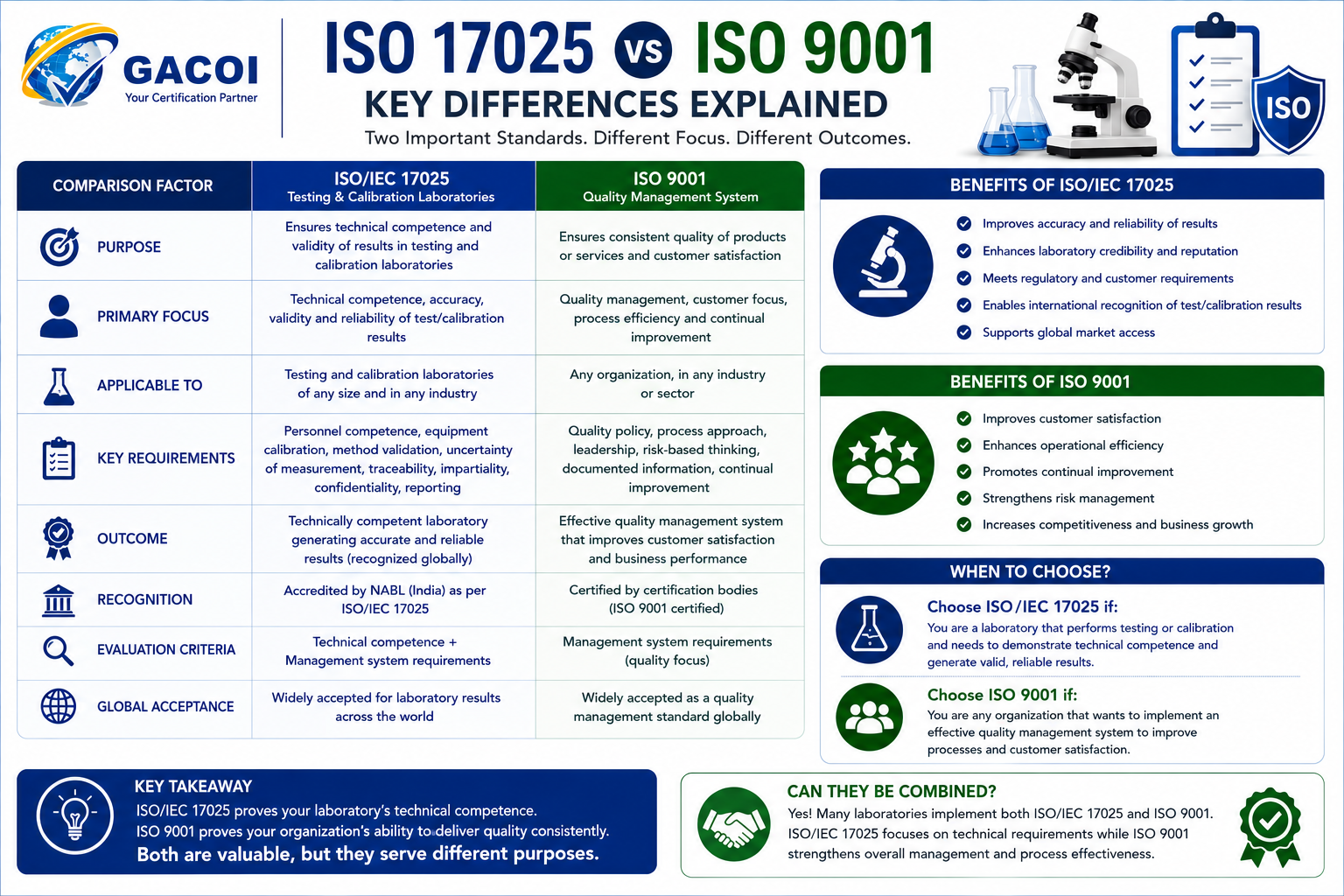
At a Glance: ISO 17025 vs ISO 9001 Side by Side
| Comparison Aspect | ISO/IEC 17025:2017 | ISO 9001:2015 |
|---|---|---|
| Full Name | General Requirements for Competence of Testing and Calibration Laboratories | Quality Management Systems — Requirements |
| Published By | ISO and IEC jointly | ISO |
| Current Version | ISO/IEC 17025:2017 | ISO 9001:2015 |
| Industry Scope | Testing and calibration laboratories only | Any organization in any industry |
| Primary Purpose | Demonstrate technical competence and result validity | Demonstrate quality management and customer satisfaction |
| Type of Recognition | Accreditation | Certification |
| India Governing Body | NABL | NABCB |
| International Framework | ILAC MRA | IAF MLA |
| Technical Requirements | Extensive and discipline-specific | General management system requirements |
| Assessors | Technical experts in specific disciplines | General management system auditors |
| Result Recognition | Test reports accepted globally without re-testing | Quality management certificates recognized globally |
| Impartiality | Formally required and assessed | Conflict of interest awareness required |
| Measurement Uncertainty | Mandatory evaluation and reporting | Not specifically addressed |
| Metrological Traceability | Mandatory for all measurements | Not specifically addressed |
| Proficiency Testing | Required participation | Not required |
| Method Validation | Formally required | General validation concepts |
| Customer Satisfaction | Not explicitly measured | Explicitly required |
| Continual Improvement | Implied through performance monitoring | Explicitly required |
| Mandatory in India | Required for regulatory testing submissions | Required for many tenders and supply chains |
What Is ISO 9001? A Focused Overview
ISO 9001 is the world’s most widely adopted quality management system standard — with over one million certified organizations across 170 countries. The current version, ISO 9001:2015, provides any organization in any industry with a structured framework for consistently delivering products and services that meet customer requirements and driving continual improvement in quality performance.
The philosophical foundation of ISO 9001 is customer focus. Every requirement — from leadership commitment and planning through process control and performance evaluation — serves the objective of understanding customer needs, consistently meeting customer requirements, measuring satisfaction, and improving the customer experience over time.
ISO 9001 is deliberately flexible and non-prescriptive in many areas — enabling applicability across every industry and context. A hospital, a construction company, an IT firm, a food manufacturer, and a transportation logistics provider can all implement ISO 9001 meaningfully — because the standard’s process-based framework adapts to any organizational context.
ISO 9001 certification is issued by accredited certification bodies such as GacoiCert — organizations independently assessed and recognized by national accreditation bodies like NABCB in India to conduct ISO audits and issue internationally recognized certificates.
What Is ISO 17025? A Focused Overview
ISO/IEC 17025 is the international standard specifying general requirements for the competence, impartiality, and consistent operation of testing and calibration laboratories. The current version, ISO/IEC 17025:2017, was published in November 2017 replacing the 2005 version. Key improvements in the 2017 version include a risk-based approach, strengthened impartiality requirements, updated management system options aligned with ISO 9001:2015, greater emphasis on measurement uncertainty, and stronger metrological traceability requirements.
The philosophical foundation of ISO 17025 is technical competence and result validity. Its requirements are designed to demonstrate that laboratories produce test and calibration results that are technically valid, metrologically traceable, appropriately uncertain, and generated by competent personnel using validated methods in suitable facilities — results that can be trusted and relied upon by regulators, clients, courts, and the public.
ISO 17025 accreditation in India is granted by NABL — the National Accreditation Board for Testing and Calibration Laboratories — which operates under the Quality Council of India and is a signatory to the ILAC Mutual Recognition Arrangement. NABL uses teams of technical assessors who are domain experts in specific laboratory disciplines — chemical testing, biological testing, mechanical testing, electrical testing, calibration — rather than general management system auditors.
Key Difference 1: Certification vs Accreditation — A Fundamental Distinction
This is the most foundational difference between ISO 9001 and ISO 17025 — and understanding it is essential before examining any other comparison point.
ISO 9001 leads to certification. Certification is a formal statement by an accredited certification body — such as GacoiCert — that an organization’s management system meets the requirements of ISO 9001. Certification demonstrates that quality management processes are in place and functioning — it is a management system credential.
ISO 17025 leads to accreditation. Accreditation is a formal statement by a national accreditation body — NABL in India — that a laboratory is competent to perform specific tests or calibrations. Accreditation is a technical competence credential — it goes beyond management systems to verify that the laboratory can actually produce valid, reliable results for defined measurement activities.
This distinction has profound practical implications:
Recognition scope: ISO 9001 certification is recognized across all industries for quality management purposes. ISO 17025 accreditation is specifically recognized by regulatory authorities, courts, customs, and procurement bodies that require technically verified test and calibration results — FSSAI for food safety, CPCB for environmental monitoring, BIS for product certification, DGFT for export documentation, courts for legal proceedings.
What is assessed: ISO 9001 certification auditors assess management system processes — documentation, planning, customer focus, internal audit, corrective action. ISO 17025 accreditation assessors assess technical competence — the ability of specific personnel using specific equipment and validated methods to produce results with demonstrated measurement uncertainty in defined measurement activities.
Scope specificity: ISO 9001 certification covers the organization’s entire scope of activities. ISO 17025 accreditation covers specific defined test methods, measurement matrices, and measurement ranges — a laboratory is accredited for particular activities, not generally.
Key Difference 2: Technical Competence Requirements
This is where ISO 17025 most dramatically diverges from ISO 9001 — in the extensive, discipline-specific technical requirements that have no parallel in the quality management standard.
ISO 9001 requires general competence management — identifying competence requirements for quality-relevant roles, providing appropriate training, evaluating training effectiveness, and maintaining records. These requirements are important but general — applicable to any business function in any industry.
ISO 17025 requires demonstration of specific technical laboratory competence across five interconnected dimensions:
Personnel competence: All personnel performing laboratory activities must demonstrate competence for specific tasks through formal evaluation covering education, training, technical knowledge, skills, and experience. Competence assessment must be specific to the measurements being performed — not general. Personnel performing method validation, uncertainty estimation, or technically critical activities must demonstrate specialized competence verified through specific assessment.
Equipment and calibration: All measurement equipment must be identified, calibrated, maintained, and managed with documented records covering identity, calibration status, calibration results, and calibration history. Equipment must be calibrated at defined intervals by competent calibration laboratories with traceable calibration certificates. Out-of-tolerance equipment must be removed from service with assessment of the effect on previous results.
Metrological traceability: Every measurement result must be traceable to the International System of Units through an unbroken, documented chain of calibrations — ultimately linking to national measurement standards maintained by CSIR-NPL in India or equivalent national metrology institutes internationally. This requirement has absolutely no equivalent in ISO 9001.
Method validation: Standard methods must be verified before use to confirm the laboratory can achieve required performance. Non-standard and laboratory-developed methods must be fully validated demonstrating fitness for purpose through evaluation of selectivity, linearity, range, detection limits, precision, trueness, and measurement uncertainty. Validation records must be documented and maintained.
Measurement uncertainty: Every test and calibration result must be accompanied by a statement of measurement uncertainty — a quantitative expression of the doubt associated with the measurement result. Uncertainty budgets must identify all uncertainty sources, evaluate their magnitude, and combine them into an expanded uncertainty at defined confidence level. This technically demanding requirement enables result users to make informed decisions about whether results are fit for their specific purpose.
Key Difference 3: Impartiality Requirements
ISO 9001 requires awareness of conflicts of interest affecting quality — but addresses this through general risk management rather than specific impartiality requirements. Organizations must identify risks that could affect their ability to meet quality objectives, including commercial conflicts, but the standard does not prescribe specific impartiality management structures.
ISO 17025 treats impartiality as a fundamental, non-negotiable requirement — formally assessed during every accreditation assessment. Laboratories must be structurally impartial — meaning their test and calibration results must not be influenced by commercial, financial, organizational, or personal pressures toward particular outcomes.
Impartiality requirements in ISO 17025 include:
- Formal impartiality policy documented and communicated
- Identification of all risks to impartiality from ownership, management, personnel, shared resources, finances, contracts, and marketing
- Actions to eliminate or minimize identified impartiality risks
- Prohibition on personnel being subject to undue commercial, financial, or other pressures that could compromise result integrity
- Structural separation of laboratory activities from commercial pressures where feasible
This rigorous impartiality requirement reflects the reality that test and calibration results are trusted because they are objective — and any influence on results undermines the fundamental value that laboratory accreditation provides to result users.
Key Difference 4: Proficiency Testing Requirements
ISO 9001 has no requirement for proficiency testing — inter-laboratory comparison exercises that independently verify whether a laboratory produces results consistent with peer laboratories. This is simply outside ISO 9001’s scope.
ISO 17025 requires laboratories to participate in proficiency testing schemes relevant to their accredited activities. Proficiency testing is a uniquely powerful quality assurance mechanism — providing external, independent verification of laboratory technical performance that no amount of internal quality control can substitute for.
Proficiency testing works by sending identical blind samples to multiple laboratories — each laboratory tests the sample independently and reports its result, which is then statistically compared against all participant results to produce a z-score indicating whether the laboratory’s result is acceptable, questionable, or unacceptable relative to peer performance.
Regular satisfactory proficiency testing participation is essential for:
- Demonstrating continued technical competence to NABL
- Identifying systematic bias or precision problems in laboratory measurement systems
- Providing objective evidence of result validity to laboratory clients
- Supporting laboratory claims of measurement uncertainty
Poor proficiency testing performance — z-scores outside acceptable limits — must be investigated through root cause analysis and corrective action. Persistent poor performance can lead to suspension of NABL accreditation for affected test methods.
Key Difference 5: Reporting Requirements
ISO 9001 requires that products and services meet defined requirements and that customer communication is appropriate — but does not specify technical content requirements for reports or certificates issued to customers. Report format and content are determined by customer requirements and industry practice.
ISO 17025 specifies mandatory minimum content requirements for test reports and calibration certificates. These requirements ensure that result users receive all information needed to interpret results correctly and assess their fitness for intended purposes.
Mandatory content in ISO 17025 compliant test reports includes:
- Laboratory name, address, and unique identification
- Client name and contact information
- Unique report identification and page numbering
- Description and unambiguous identification of test items
- Date of receipt and date of testing
- Identification of test method used
- Results with appropriate units of measurement
- Statement of measurement uncertainty where relevant
- Authorized signature of responsible person
- Statement that results relate only to tested items
Additional requirements apply to specific report types — calibration certificates must include measurement uncertainty for all calibration results. Sampling reports must include sampling information when laboratories perform sampling before testing.
Key Difference 6: Scope of Application
ISO 9001 is genuinely universal — the most broadly applicable management system standard in existence. Any organization that delivers products or services — manufacturing, healthcare, education, IT, construction, logistics, retail, government — can meaningfully implement ISO 9001. Its flexibility makes it applicable everywhere but means it does not address the specific technical requirements of specialized activities like laboratory measurement.
ISO 17025 is specifically scoped to testing and calibration laboratories — organizations whose primary activity is generating measurement results through testing or calibration. It applies to:
- Chemical and materials testing laboratories
- Biological and microbiological testing laboratories
- Mechanical and physical testing laboratories
- Electrical and electronic testing laboratories
- Environmental monitoring laboratories
- Food and agricultural testing laboratories
- Medical and clinical testing laboratories
- Calibration laboratories across all measurement disciplines
- Forensic testing laboratories
- Non-destructive testing organizations
For organizations that perform laboratory activities as a secondary function — manufacturers with in-house quality control laboratories, hospitals with diagnostic laboratories, universities with research laboratories — ISO 17025 applies specifically to the laboratory activities rather than the entire organization.
Key Difference 7: International Recognition Framework
Both standards have international recognition frameworks — but through different mechanisms serving different purposes.
ISO 9001 certificates are recognized through the IAF Multilateral Recognition Arrangement (MLA) — the framework through which national accreditation bodies recognize each other’s certification body accreditations. NABCB in India is a signatory to the IAF MLA — meaning ISO 9001 certificates issued by NABCB-accredited certification bodies like GacoiCert are recognized as equivalent to certificates from any other IAF MLA signatory country’s accreditation system.
ISO 17025 accreditation is recognized through the ILAC Mutual Recognition Arrangement (MRA) — the framework through which laboratory accreditation bodies recognize each other’s laboratory accreditations. NABL is a signatory to the ILAC MRA — meaning test reports from NABL-accredited Indian laboratories are accepted in all ILAC MRA signatory countries without re-testing.
The practical implication of ILAC MRA recognition for Indian laboratories is enormously significant for export support. When an Indian food exporter needs test reports for European import authorities, NABL-accredited laboratory reports are accepted without European re-testing — saving time, cost, and complexity. When an Indian pharmaceutical manufacturer needs analytical certificates for US FDA submissions, NABL-accredited laboratory reports are recognized. This global mutual recognition of accredited test reports is a unique benefit of ISO 17025 accreditation with no equivalent in ISO 9001 certification.
Which Standard Does Your Organization Need?
You Need ISO 9001 If:
You are a manufacturing or service organization seeking quality management certification: Any business targeting government tenders, corporate supplier qualification, export market access, or customer confidence — that is not a laboratory — needs ISO 9001 as its primary quality management credential.
Your laboratory needs a quality management foundation: Many laboratories implement ISO 9001 as a starting point before progressing to ISO 17025 accreditation — building quality management discipline before adding the technical accreditation layer.
Your laboratory serves only internal customers: In-house quality control laboratories serving purely internal purposes — where results are used only for internal production decisions rather than regulatory submissions or external client reports — may find ISO 9001 sufficient for their specific context.
You Need ISO 17025 If:
You issue test reports or calibration certificates to external clients: Any laboratory whose reports are used by external clients for regulatory submissions, product certification, legal proceedings, export documentation, or commercial decisions needs ISO 17025 accreditation — because clients require the technical credibility that accreditation provides.
Regulatory submissions require accredited results: FSSAI food safety testing, CPCB environmental monitoring, BIS product certification testing, DCGI pharmaceutical testing, court-admissible forensic results — all specifically require test reports from NABL-accredited laboratories. ISO 9001 certification does not satisfy these regulatory requirements.
You want international test report recognition: Laboratories supporting Indian exporters need NABL accreditation to provide test reports recognized in destination country markets through ILAC MRA — enabling export documentation without re-testing.
You Need Both If:
Your laboratory needs both commercial credibility and regulatory acceptance: Many Indian laboratories pursue both ISO 9001 certification and ISO 17025 accreditation — using ISO 9001 as the management system foundation and ISO 17025 as the technical competence overlay. ISO 17025:2017 explicitly provides Option B allowing laboratories with ISO 9001 certification to use it as their management system component.
Your organization includes both laboratory and non-laboratory functions: Manufacturing companies with product testing laboratories, hospitals with diagnostic facilities, and research organizations with analytical laboratories often implement ISO 9001 for the parent organization and ISO 17025 for the laboratory function — providing appropriate quality credentials for each activity type.
GacoiCert provides ISO 9001 certification that complements NABL ISO 17025 accreditation — supporting laboratories in building comprehensive, internationally recognized quality credentials.
Cost Comparison: ISO 17025 vs ISO 9001 in India 2026
| Cost Aspect | ISO 9001 Certification | ISO 17025 Accreditation |
|---|---|---|
| Small organization fees | ₹35,000 – ₹80,000 | ₹30,000 – ₹80,000 (NABL fees) |
| Medium organization fees | ₹80,000 – ₹1,60,000 | ₹80,000 – ₹2,00,000 (NABL fees) |
| Consultant fees | ₹35,000 – ₹2,00,000 | ₹50,000 – ₹5,00,000 |
| Equipment calibration | Minimal | ₹50,000 – ₹10,00,000 annually |
| Method validation | Not required | ₹30,000 – ₹3,00,000 per method |
| Proficiency testing | Not required | ₹20,000 – ₹2,00,000 annually |
| Reference materials | Minimal | ₹30,000 – ₹5,00,000 |
| Total first-year investment | ₹80,000 – ₹4,00,000 | ₹2,00,000 – ₹20,00,000+ |
ISO 17025 accreditation total investment is substantially higher than ISO 9001 certification — reflecting the technical infrastructure requirements of equipment calibration, method validation, proficiency testing participation, and reference material procurement that have no equivalent in ISO 9001 implementation.
Why Choose GacoiCert as Your ISO 9001 and ISO 17025 Support Partner?
Internationally accredited ISO 9001 certification: GacoiCert provides internationally recognized ISO 9001 certification under NABCB accreditation — verifiable through IAF databases, accepted by government procurement authorities, corporate buyers, and international importers worldwide.
ISO 17025 preparation and support: GacoiCert supports laboratories preparing for NABL ISO 17025 accreditation through gap analysis consulting, ISO 9001 Option B foundation certification, internal auditor training, measurement uncertainty workshops, method validation guidance, and pre-assessment readiness reviews.
ISO 9001 as Option B foundation: Laboratories choosing ISO 17025:2017 Option B — implementing ISO 9001 as their management system — benefit from GacoiCert’s ISO 9001 certification providing the recognized management system foundation that NABL assessors expect.
Training programs: ISO 9001 and ISO 17025 awareness training, internal auditor training, measurement uncertainty workshops, and method validation training — delivered in classroom, online, and in-house formats across India.
Pan-India coverage: Delhi NCR, Mumbai, Pune, Bangalore, Chennai, Hyderabad, Kolkata, Ahmedabad, and all major laboratory and industrial centers across India.
Transparent pricing: Complete itemized quotations for ISO 9001 certification and support services with no hidden fees.
Conclusion: ISO 17025 and ISO 9001 Serve Different but Complementary Purposes
The comparison between ISO 17025 and ISO 9001 reveals not competing alternatives but complementary standards serving fundamentally different purposes — technical laboratory competence demonstration versus organizational quality management excellence.
ISO 9001 is the universal quality management credential — appropriate for any organization delivering products or services, essential for government tender qualification and general commercial market access, and the right foundation for any organization committed to quality management excellence.
ISO 17025 is the laboratory technical competence credential — appropriate specifically for testing and calibration laboratories, essential for regulatory test report acceptance and ILAC MRA international recognition, and the right standard for any organization whose core business is generating valid, reliable, and metrologically traceable measurement results.
For Indian laboratories in 2026, the most powerful quality credential portfolio combines both — ISO 9001 certification demonstrating management excellence and ISO 17025 accreditation demonstrating technical competence — providing comprehensive credibility to every stakeholder that matters.
GacoiCert is ready to support your organization with ISO 9001 certification and ISO 17025 accreditation preparation. Visit gacoicert.com today, request your free consultation, and build the quality credentials your laboratory needs.
Frequently Asked Questions
Q1: What Is the Main Difference Between ISO 17025 and ISO 9001?
The main difference is their purpose and scope. ISO 9001 is a quality management system standard applicable to any organization — focusing on customer satisfaction and quality process management. ISO 17025 is a laboratory competence standard specifically for testing and calibration laboratories — focusing on technical competence, result validity, measurement uncertainty, metrological traceability, and impartiality. ISO 9001 leads to certification while ISO 17025 leads to accreditation — a technically deeper and more specific form of recognition.
Q2: Can ISO 9001 Certification Replace ISO 17025 Accreditation for Laboratories?
No. ISO 9001 certification cannot replace ISO 17025 accreditation for laboratories whose test reports must be accepted for regulatory submissions, legal proceedings, export documentation, or any purpose requiring technically validated results. FSSAI, CPCB, BIS, DCGI, courts, and export inspection authorities specifically require reports from ISO 17025 accredited laboratories — ISO 9001 certification does not satisfy these requirements.
Q3: Can a Laboratory Have Both ISO 9001 Certification and ISO 17025 Accreditation?
Yes — and many Indian laboratories pursue both. ISO 17025:2017 explicitly provides Option B allowing laboratories with ISO 9001 certification to use it as their management system component within the ISO 17025 framework. GacoiCert provides ISO 9001 certification that serves as an effective Option B foundation for laboratories also pursuing NABL ISO 17025 accreditation.
Q4: Which Standard Is More Difficult to Achieve — ISO 17025 or ISO 9001?
ISO 17025 accreditation is significantly more demanding than ISO 9001 certification — because it requires demonstration of actual technical measurement competence through method validation, equipment calibration, measurement uncertainty evaluation, proficiency testing participation, and metrological traceability establishment. These technical requirements demand substantial investment in laboratory infrastructure, personnel training, and ongoing quality assurance activities that ISO 9001 certification does not require.
Q5: How Much Does ISO 17025 Accreditation Cost Compared to ISO 9001 Certification in India?
ISO 17025 accreditation total investment is substantially higher. ISO 9001 certification total first-year investment ranges from approximately ₹80,000 to ₹4,00,000 depending on organization size. ISO 17025 accreditation total first-year investment ranges from approximately ₹2,00,000 for small single-discipline laboratories to ₹20,00,000 or more for large multi-discipline laboratories — with the higher cost driven by equipment calibration programs, method validation studies, proficiency testing participation, and reference material procurement.
Q6: How Does GacoiCert Support Laboratories Pursuing ISO 17025 Accreditation?
GacoiCert supports laboratories through ISO 9001 Option B foundation certification, ISO 17025 gap analysis and implementation consulting, internal auditor training, measurement uncertainty and method validation workshops, and pre-NABL assessment readiness reviews. Visit gacoicert.com to request a free consultation and discover how GacoiCert can support your laboratory’s complete quality credential journey — from ISO 9001 certification through NABL ISO 17025 accreditation readiness.
Need ISO Certification
🟡GACOI Cert provides globally recognized ISO certification, cybersecurity, privacy, AI governance, compliance, audit, and professional training services, helping startups, businesses, enterprises, laboratories, healthcare organizations, and government institutions achieve international standards and build lasting trust.
🟡For other Legal and Trademark related services Visit
👉 Money Recovery Cases
👉 Property Disputes
👉ISO Registration
👉ISO 22000 Certification
🟡 Protect Your Rights
👉 Domestic Violence Legal Support
👉 Stridhan Recovery
👉 Mutual Consent Divorce
👉 Contested Divorce Filing
📞 Call Now: +91 8595439395
🕐 Free Consultation: Monday to Saturday, 10 AM to 6 PM1]


