


Views: 2
Looking for ISO 17025 certification requirements in India 2026? Get a complete step-by-step guide on NABL accreditation, documents, eligibility, cost, timeline, and benefits for testing and calibration labs.
Table of Contents
- 1 Introduction
- 2 What is ISO 17025 Certification?
- 3 Understanding NABL: India’s Official Accreditation Body
- 4 Why ISO 17025 / NABL Accreditation Matters in India in 2026
- 5 Who Needs ISO 17025 / NABL Accreditation?
- 6 Eligibility Criteria for NABL Accreditation
- 7 Documents Required for ISO 17025 / NABL Certification in India (2026)
- 8 Step-by-Step NABL Accreditation Process in India (2026)
- 9 Timeline: How Long Does ISO 17025 Certification Take in India?
- 10 Cost of ISO 17025 / NABL Certification in India (2026)
- 11 Validity, Surveillance, and Renewal
- 12 Common Challenges Laboratories Face During Accreditation
- 13 Key Benefits of ISO 17025 / NABL Accreditation
- 14 How Gacoi Cert Can Help Your Laboratory Get ISO 17025 Certified
- 15 Frequently Asked Questions (FAQs)
- 16 Conclusion
- 17 Know more about ISO 17025 Certification Requirements
Introduction
If you run a testing, calibration, or research laboratory in India, you have probably heard one phrase repeated by every regulator, client, and competitor in your industry — “Is your lab ISO 17025 certified?”
In 2026, this question has become more important than ever. Government departments, export houses, pharmaceutical companies, food manufacturers, environmental agencies, and even hospitals now insist on working only with laboratories that hold valid ISO/IEC 17025 accreditation through India’s official accreditation body, NABL (National Accreditation Board for Testing and Calibration Laboratories).
But what exactly does it take to get certified? What documents are required? How long does the process take? And how much does it really cost in 2026?
This comprehensive guide answers every one of these questions in detail. Whether you are a lab owner just starting your accreditation journey, a quality manager preparing for an audit, or a business researching ISO 17025 requirements India, this blog will walk you through everything — from eligibility to the final certificate.
What is ISO 17025 Certification?
ISO/IEC 17025 is the international standard titled “General Requirements for the Competence of Testing and Calibration Laboratories.” It was developed by the International Organization for Standardization (ISO) specifically for laboratories that carry out testing, calibration, and sampling activities.
Unlike general quality management standards such as ISO 9001, which focus mainly on documentation and process consistency, ISO 17025 goes a step further. It evaluates the actual technical competence of a laboratory — its equipment, staff expertise, testing methods, measurement traceability, and the reliability of its results.
In simple terms: ISO 9001 tells you a lab has a good quality system. ISO 17025 tells you a lab can actually produce technically accurate and trustworthy test or calibration results.
The standard is built around two broad categories of requirements:
- Management Requirements – covering document control, quality policy, internal audits, corrective actions, and management review, similar in spirit to ISO 9001.
- Technical Requirements – covering personnel competence, environmental conditions, equipment and calibration, method validation, measurement uncertainty, and reporting of results.
Understanding NABL: India’s Official Accreditation Body
In India, ISO 17025 certification is not issued directly by ISO. Instead, laboratories are assessed and accredited by NABL — the National Accreditation Board for Testing and Calibration Laboratories, which functions as an autonomous body under the Quality Council of India (QCI).
A few important facts about NABL that every applicant should know in 2026:
- NABL is the sole authorized accreditation body recognized by the Government of India for testing and calibration laboratories.
- NABL accredits laboratories against ISO/IEC 17025 (testing and calibration labs), ISO 15189 (medical laboratories), ISO/IEC 17043 (proficiency testing providers), and ISO 17034 (reference material producers).
- NABL is a signatory to the ILAC Mutual Recognition Arrangement (MRA), which means test and calibration reports issued by NABL-accredited labs are accepted internationally, eliminating the need for re-testing in many countries.
- As of 1 January 2026, the international frameworks of ILAC (International Laboratory Accreditation Cooperation) and IAF (International Accreditation Forum) have merged into a single global body, further strengthening the international recognition value of NABL accreditation.
- NABL operates its accreditation system in line with ISO/IEC 17011, the standard that governs accreditation bodies themselves.
Because NABL accreditation is technically demanding and evidence-based, it is considered a much higher level of recognition than a simple ISO 9001 certificate.
Why ISO 17025 / NABL Accreditation Matters in India in 2026
The demand for accredited laboratories has grown sharply across sectors. Here’s why 2026 has become a turning point for many labs deciding to pursue accreditation:
1. Regulatory Mandates Are Tightening
Government bodies such as the Food Safety and Standards Authority of India (FSSAI), Bureau of Indian Standards (BIS), Central Pollution Control Board (CPCB), and various state pollution control boards increasingly require test reports only from NABL-accredited laboratories for licensing, product approval, and compliance reporting.
2. Export Competitiveness
Indian exporters need their products tested by internationally recognized labs to meet the quality expectations of overseas buyers. Because of the ILAC MRA, a NABL-accredited lab’s report is trusted well beyond India’s borders, removing costly retesting requirements abroad.
3. Customer and Market Trust
In a market where quality claims are easy to make but hard to prove, accreditation is verifiable third-party evidence of technical competence. Clients — from pharmaceutical companies to construction firms — increasingly shortlist vendors based on accreditation status alone.
4. Reduced Liability and Legal Risk
Test results from an accredited lab carry more weight in legal disputes, insurance claims, and regulatory audits, reducing the laboratory’s own exposure to liability from disputed or inaccurate results.
5. Access to Government Tenders and CGHS Empanelment
Many government tenders and schemes — including CGHS empanelment for diagnostic laboratories — now give preference or even mandate NABL accreditation, and some schemes offer accredited labs higher reimbursement rates than non-accredited ones.
Who Needs ISO 17025 / NABL Accreditation?
ISO 17025 accreditation is relevant to a wide range of laboratories, including:
- Chemical and materials testing laboratories
- Microbiology and food testing labs
- Environmental and water testing labs
- Electrical, electronics, and mechanical testing labs
- Calibration laboratories (instruments, weighing equipment, measuring devices)
- Non-destructive testing (NDT) labs
- Construction material and civil engineering testing labs
- Pharmaceutical and clinical research labs
- Forensic laboratories
- Radiological and photometry testing centers
Essentially, any laboratory that generates data used for regulatory compliance, product certification, quality control, research, or legal purposes should consider pursuing accreditation.
Eligibility Criteria for NABL Accreditation
Before applying, a laboratory (referred to as a Conformity Assessment Body or CAB in NABL terminology) must meet certain baseline eligibility conditions:
- Legal Identity – The laboratory must be a legally identifiable entity capable of being held responsible for its activities. This is established through documents like a company registration certificate, partnership deed, GST registration, or PAN card.
- Established Quality Management System (QMS) – The lab must have a documented QMS aligned with ISO/IEC 17025:2017 clauses, implemented and running for a reasonable period before assessment (typically 2–3 months minimum).
- Defined Scope of Accreditation – The laboratory must clearly specify the tests, calibrations, or measurements for which it seeks accreditation, including methods, standards, and measurement ranges.
- Competent and Trained Personnel – Staff performing tests or calibrations must have documented qualifications, training records, and demonstrated competence.
- Calibrated Equipment – All measuring and testing equipment must be calibrated, with traceability to national or international measurement standards, using NABL-accredited calibration laboratories wherever applicable.
- Participation in Proficiency Testing (PT) – Applicant laboratories must satisfactorily participate in at least one relevant Proficiency Testing or Inter-Laboratory Comparison (ILC) program before or during the accreditation process.
- Location-Specific Accreditation – NABL accreditation applies to a specific physical location. Laboratories with multiple branches or sites generally need to apply separately for each location.
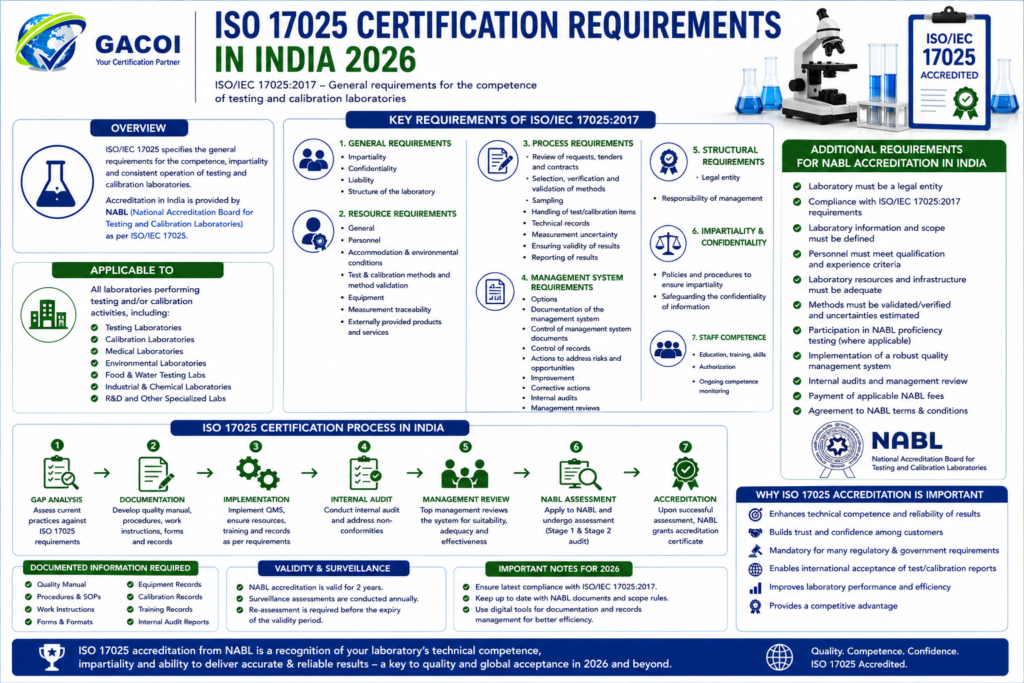
Documents Required for ISO 17025 / NABL Certification in India (2026)
Proper documentation is the backbone of a successful NABL application. Based on the latest NABL guidelines, the key documents required include:
A. Legal and Administrative Documents
- Certificate of incorporation / registration (company, partnership, proprietorship, trust, or society)
- GST registration certificate
- PAN card of the organization
- Proof of address of the laboratory premises
- Organizational chart showing reporting structure
B. Quality System Documents
- Quality Manual (Level 1 document) – outlining the laboratory’s quality policy, objectives, and compliance approach to each clause of ISO/IEC 17025:2017
- Standard Operating Procedures (SOPs) and Work Instructions (Level 2 & 3 documents) – covering sample receipt, handling, testing/calibration methodology, reporting, and administrative processes
- Document control procedures and records of document revisions
- Internal audit reports and management review minutes
C. Technical Documents
- Master list of equipment with make, model, serial number, and unique identification codes
- Valid calibration certificates for all measuring equipment, issued by NABL-accredited calibration labs
- Method validation and verification records
- Measurement uncertainty calculation worksheets
- Staff qualification certificates, training records, and competency assessment reports
- Proficiency testing / inter-laboratory comparison participation reports
D. Application Forms
- NABL Form 1 (Application Form) for testing/calibration laboratories, or NABL 153 for medical laboratories
- Duly filled scope of accreditation document, specifying exact parameters, methods, and ranges
- Application fee payment proof, as per the current NABL fee structure published in NABL 100 “General Information Brochure”
Step-by-Step NABL Accreditation Process in India (2026)
Here is the complete process laboratories should expect when pursuing ISO 17025 / NABL accreditation:
Step 1: Gap Analysis and Readiness Assessment
Before applying, most laboratories conduct an internal or consultant-led gap analysis against ISO/IEC 17025:2017 requirements. This identifies weaknesses in documentation, equipment calibration, staff competency, or technical processes that need correction before the formal audit.
Step 2: Quality Management System (QMS) Development
The laboratory develops a complete QMS, including the Quality Manual, SOPs, work instructions, and formats/records required to demonstrate compliance. This stage typically also includes:
- Calibrating all equipment through NABL-accredited calibration laboratories
- Validating test methods
- Calculating measurement uncertainty for each test/calibration parameter
- Training staff on the new documentation and procedures
Step 3: Implementation and Internal Audit
The QMS must be implemented in daily laboratory operations for a reasonable period — generally 2 to 3 months — before the external assessment. During this time, the lab conducts:
- At least one internal audit covering all clauses of the standard
- A management review meeting to evaluate the QMS’s effectiveness and address any gaps
- Corrective actions for any non-conformities identified internally
Step 4: Application Submission to NABL
The laboratory registers on the NABL web portal, completes the online application (Form 1), attaches the required documents, defines its scope of accreditation precisely, and pays the applicable application fee. Upon receipt, NABL issues a Unique Identification Number (UIN) for tracking the application.
Step 5: Document Review
An NABL-appointed assessor reviews all submitted quality system documents. If discrepancies or missing information are found, the laboratory is typically given about seven days to respond and make corrections.
Step 6: Pre-Assessment Visit (Optional but Recommended)
Many first-time applicants opt for a pre-assessment visit, where an NABL assessor visits the lab informally to identify potential issues before the final assessment. This step, while optional, significantly reduces the risk of major non-conformities during the official audit.
Step 7: On-Site Assessment
A team of NABL assessors — including a lead assessor and technical experts covering the relevant disciplines — visits the laboratory. During this visit, they:
- Verify implementation of the documented QMS
- Assess the technical competence of staff
- Review calibration records and measurement traceability
- Witness live demonstrations of testing or calibration procedures
- Record any non-conformities in a formal assessment report
Step 8: Corrective Actions
If non-conformities are identified, the laboratory must submit corrective action plans and supporting evidence, usually within 90 days. In cases of major non-conformities, a follow-up visit may be required to verify the corrections.
Step 9: Accreditation Committee Review
The assessment report, along with the laboratory’s corrective actions, is reviewed by NABL’s accreditation committee, which makes the final recommendation to grant, defer, or reject accreditation.
Step 10: Grant of Accreditation Certificate
Once approved and all fees are cleared, NABL issues the accreditation certificate bearing a unique certificate number, QR code, and detailed scope of accreditation. The laboratory can now use the NABL symbol on its test/calibration reports within the approved scope.
Timeline: How Long Does ISO 17025 Certification Take in India?
The complete process — from initial gap analysis to receiving the accreditation certificate — generally takes 3 to 6 months, depending on:
- How prepared the laboratory’s documentation and QMS already are
- The complexity and number of parameters in the scope of accreditation
- The number and severity of non-conformities found during assessment
- NABL’s assessment scheduling and administrative processing time
Laboratories that invest time in thorough internal preparation, staff training, and pre-assessment audits typically move through the process faster than those that apply without adequate groundwork.
Cost of ISO 17025 / NABL Certification in India (2026)
There is no single fixed fee for NABL accreditation — the total cost depends on the size of the laboratory, the number of testing/calibration disciplines, and the scope applied for. Broadly, the cost components include:
- NABL Application Fee – as prescribed in the NABL 100 “General Information Brochure,” which is updated periodically
- Assessment Fee – covering assessor visits, travel, and evaluation charges
- Calibration Costs – for getting equipment calibrated by NABL-accredited calibration labs
- Proficiency Testing Fees – for mandatory participation in PT/ILC programs
- Consultancy and Training Costs (optional) – if the laboratory engages external consultants for documentation and gap analysis
- Annual Surveillance and Renewal Fees – ongoing costs after accreditation is granted
For a small to mid-sized laboratory, the total investment for first-time accreditation typically ranges from approximately ₹3 lakh to ₹6 lakh, though this figure can vary significantly based on the laboratory’s size, scope complexity, and existing level of QMS maturity. Larger labs with multiple disciplines or multi-location operations should expect proportionately higher costs.
Validity, Surveillance, and Renewal
Once granted, NABL accreditation is not a one-time achievement — it requires ongoing compliance:
- According to NABL’s official policy, the accreditation certificate carries a defined validity period, after which renewal assessment is required.
- Annual surveillance visits are conducted by NABL to confirm that the laboratory continues to meet ISO/IEC 17025 requirements and its own quality policies.
- Re-assessment is conducted periodically (as per NABL’s four-year accreditation cycle policy) to ensure the laboratory’s full scope of accreditation remains compliant.
- Laboratories are advised to begin their renewal application at least six months before expiry to avoid any lapse in accreditation status.
- Non-compliance identified during surveillance can lead to suspension, scope reduction, or withdrawal of accreditation.
Because requirements and specific NABL documents (such as NABL 100, NABL 131, and NABL 160A) are updated periodically, laboratories should always refer to the latest versions published on the official NABL website before preparing their documentation.
Common Challenges Laboratories Face During Accreditation
Based on frequent findings across the industry, laboratories often face setbacks in the following areas:
- Inadequate measurement uncertainty calculations for testing or calibration parameters
- Incomplete calibration records or use of non-accredited calibration providers
- Insufficient documentation of staff competency assessments
- Weak method validation data, especially for non-standard or lab-developed methods
- Poor control of technical records, including illegible or improperly authorized records
- Delayed or incomplete corrective actions after non-conformities are raised
- Underestimating the time needed to implement and stabilize the QMS before assessment
Addressing these issues proactively — ideally through a pre-assessment audit — significantly increases the chances of a smooth accreditation on the first attempt.
Key Benefits of ISO 17025 / NABL Accreditation
Achieving accreditation delivers measurable, long-term value:
- International Recognition – Reports are accepted globally due to NABL’s ILAC MRA signatory status, reducing the need for costly re-testing abroad
- Regulatory Compliance – Meets mandatory requirements set by FSSAI, BIS, CPCB, and other regulators
- Enhanced Business Credibility – Builds trust with clients, partners, and regulatory authorities
- Competitive Advantage – Positions the laboratory ahead of non-accredited competitors in tenders and contracts
- Operational Improvement – The disciplined QMS improves internal consistency, reduces errors, and strengthens staff accountability
- Reduced Retesting and Disputes – Reliable, traceable results reduce disputes with clients and regulators
- Access to Government Schemes – Eligibility for tenders, empanelment programs, and preferential treatment under certain government schemes
How Gacoi Cert Can Help Your Laboratory Get ISO 17025 Certified
Navigating the ISO 17025 / NABL accreditation process on your own can be time-consuming and technically demanding — from drafting a compliant Quality Manual to preparing for a rigorous on-site assessment. This is where Gacoi Cert can support your laboratory at every stage:
- Conducting a detailed gap analysis against ISO/IEC 17025:2017
- Assisting with Quality Manual and SOP development
- Coordinating equipment calibration through NABL-accredited labs
- Supporting measurement uncertainty calculations and method validation
- Providing staff training on documentation, internal audits, and NABL compliance
- Guiding you through application submission, document review, and assessment preparation
- Helping with corrective action management and follow-up assessments
Whether you are applying for accreditation for the first time or renewing an existing certificate, Gacoi Cert’s team can help you move through the process efficiently and with fewer surprises.
Frequently Asked Questions (FAQs)
1. What is the difference between ISO 9001 and ISO 17025?
ISO 9001 certifies an organization’s quality management system and focuses on customer satisfaction, continual improvement, and process consistency. ISO 17025, on the other hand, is specifically designed for testing and calibration laboratories and evaluates their technical competence, equipment, personnel, testing methods, and the accuracy and reliability of test or calibration results.
2. Who grants NABL accreditation in India?
NABL accreditation in India is granted by the National Accreditation Board for Testing and Calibration Laboratories (NABL), an autonomous body under the Quality Council of India (QCI). NABL is the authorized accreditation body responsible for assessing the technical competence of testing and calibration laboratories across the country.
3. Is NABL accreditation mandatory for all laboratories?
No. NABL accreditation is generally voluntary. However, laboratories working in sectors such as food testing, environmental monitoring, pharmaceuticals, healthcare, and government-regulated industries often require or strongly benefit from NABL accreditation to meet regulatory requirements, participate in government tenders, and enhance client confidence.
4. How long does it take to obtain NABL accreditation in India?
The time required to obtain NABL accreditation usually ranges from 3 to 6 months, depending on the laboratory’s preparedness. Factors such as complete documentation, calibrated equipment, trained personnel, internal audits, and timely corrective actions can significantly affect the overall timeline.
5. What is the approximate cost of NABL accreditation in India?
The total cost of NABL accreditation varies depending on the laboratory’s size, scope of testing or calibration, and readiness for assessment. For a small to medium-sized laboratory, the overall investment typically ranges from approximately ₹3 lakh to ₹6 lakh, including application fees, assessment charges, equipment calibration, proficiency testing, and consultancy services where applicable.
6. Can a laboratory with multiple locations obtain a single NABL accreditation?
Generally, no. NABL accreditation is location-specific. Each laboratory site is assessed independently, and separate accreditation is usually required for every location where testing or calibration activities are performed.
7. What happens if non-conformities are identified during a NABL assessment?
If the assessment team identifies non-conformities, the laboratory must implement appropriate corrective actions and submit evidence of compliance within the specified timeframe, typically within 90 days. Depending on the nature and severity of the findings, NABL may conduct a follow-up assessment before granting accreditation.
8. Is proficiency testing mandatory for NABL accreditation?
Yes. Participation in a relevant Proficiency Testing (PT) or Inter-Laboratory Comparison (ILC) program is an important requirement for NABL accreditation. Successful participation demonstrates the laboratory’s ability to produce accurate, reliable, and technically valid test or calibration results.
Conclusion
ISO 17025 / NABL accreditation is no longer just an optional badge of quality — in 2026, it has become a fundamental requirement for laboratories that want to remain competitive, regulator-compliant, and internationally credible. From strengthening customer trust to opening doors to government tenders and export markets, the benefits of accreditation far outweigh the effort required to achieve it.
The process demands careful documentation, technical rigor, and sustained commitment to quality — but with the right preparation and expert guidance, it is entirely achievable for laboratories of any size.
If your laboratory is ready to start its ISO 17025 accreditation journey, Gacoi Cert is here to guide you through every step — from gap analysis to final certification. Reach out to our team today to make your accreditation process smoother, faster, and stress-free.
Know more about ISO 17025 Certification Requirements
🟡GACOI Cert provides globally recognized ISO certification, cybersecurity, privacy, AI governance, compliance, audit, and professional training services, helping startups, businesses, enterprises, laboratories, healthcare organizations, and government institutions achieve international standards and build lasting trust.
🟡For other Legal and Trademark related services Visit
👉 Money Recovery Cases
👉 Property Disputes
👉ISO Registration
👉ISO 22000 Certification
🟡 Protect Your Rights
👉 Domestic Violence Legal Support
👉 Stridhan Recovery
👉 Mutual Consent Divorce
👉 Contested Divorce Filing
📞 Call Now: +91 8595439395
🕐 Free Consultation: Monday to Saturday, 10 AM to 6 PM1


