


Views: 0
Learn how ISO 14001 benefits Indian businesses to meet green compliance requirements, reduce environmental impact, and gain competitive advantage. Get certified with GacoiCert
Table of Contents
- 1 Introduction: Green Compliance Is No Longer Optional for Indian Businesses
- 2 What Is ISO 14001 and What Does Green Compliance Mean in India?
- 3 How ISO 14001 Systematically Addresses Green Compliance in India
- 4 Specific Benefits of ISO 14001 for Indian Businesses
- 5 ISO 14001 and India’s Key Environmental Regulations — Direct Alignment
- 6 The ISO 14001 Certification Process with GacoiCert
- 7 Why Choose GacoiCert for ISO 14001 Certification in India?
- 8 Conclusion: ISO 14001 Is India’s Most Powerful Green Compliance Tool
- 9 Frequently Asked Questions
- 10 ISO 14001 Certification Benefits
Introduction: Green Compliance Is No Longer Optional for Indian Businesses
India is at a defining environmental crossroads. With rapid industrialization, expanding urban infrastructure, and a growing manufacturing base, the country’s environmental challenges have never been more pressing. Air pollution, water scarcity, industrial waste, and carbon emissions are not abstract concerns — they directly affect communities, ecosystems, and the long-term viability of businesses operating across every sector.
In response, India’s environmental regulatory framework has become progressively more stringent. The Central Pollution Control Board (CPCB), State Pollution Control Boards (SPCBs), the Ministry of Environment, Forest and Climate Change (MoEFCC), and various sector-specific regulators are enforcing environmental laws with greater rigor than ever before. Penalties for non-compliance have increased, public scrutiny of corporate environmental behavior has intensified, and international buyers and investors are demanding verifiable proof of environmental responsibility from their Indian partners and suppliers.
In this rapidly evolving landscape, ISO 14001 Environmental Management System (EMS) certification has emerged as one of the most powerful tools available to Indian businesses for meeting green compliance requirements — systematically, credibly, and sustainably.
This comprehensive guide explains exactly how ISO 14001 helps Indian businesses navigate green compliance, what specific benefits it delivers, how it aligns with India’s environmental laws, and why GacoiCert is the trusted partner for businesses pursuing this internationally recognized certification.
What Is ISO 14001 and What Does Green Compliance Mean in India?
Understanding ISO 14001
ISO 14001 is an internationally recognized standard published by the International Organization for Standardization (ISO) that defines the requirements for an Environmental Management System (EMS). The current version, ISO 14001:2015, provides organizations with a structured framework to identify, manage, monitor, and continuously improve their environmental performance.
ISO 14001 does not prescribe specific environmental targets — instead, it provides the systematic framework through which organizations define their own environmental objectives, control their significant environmental impacts, and demonstrate compliance with applicable environmental laws and regulations.
What Green Compliance Means in India
Green compliance in the Indian context refers to an organization’s ability to consistently meet all applicable environmental laws, regulations, permits, and obligations. This includes:
- Compliance with the Environment Protection Act, 1986
- Adherence to the Water (Prevention and Control of Pollution) Act, 1974
- Compliance with the Air (Prevention and Control of Pollution) Act, 1981
- Meeting requirements under Hazardous and Other Wastes (Management and Transboundary Movement) Rules, 2016
- Compliance with E-Waste Management Rules, 2022
- Meeting Plastic Waste Management Rules, 2016 and amendments
- Adherence to Environmental Impact Assessment (EIA) Notification, 2006
- Compliance with Extended Producer Responsibility (EPR) guidelines
- Meeting CPCB and SPCB consent conditions and standards
- Adherence to National Green Tribunal (NGT) orders and directions
Green compliance is no longer merely about avoiding penalties — it has become a prerequisite for business growth, market access, investor confidence, and long-term operational sustainability.
How ISO 14001 Systematically Addresses Green Compliance in India
1. Building a Legal Compliance Register — Knowing Every Applicable Law
The foundation of green compliance is knowing exactly which environmental laws and regulations apply to your specific business operations. This sounds straightforward but is surprisingly complex in practice — India’s environmental regulatory framework spans central legislation, state-level rules, sector-specific notifications, and consent conditions that vary by location and industry.
ISO 14001 requires every certified organization to establish and maintain a Legal Register — a comprehensive, living document that identifies all applicable environmental legal requirements, tracks compliance status against each requirement, and ensures the register is regularly updated as laws change.
For Indian businesses, this means systematically cataloguing obligations under central laws, state pollution control board consent conditions, EPR obligations, EIA clearance conditions, and any NGT-specific directions — and maintaining documented evidence of compliance against each.
This systematic approach transforms legal compliance from a reactive scramble into a proactive, managed process. Organizations consistently know their compliance status, identify gaps before regulators do, and maintain documentation that demonstrates compliance to inspectors and auditors.
Practical benefit for Indian businesses: Companies with ISO 14001 certified Legal Registers consistently perform better during CPCB and SPCB inspections — because they have already identified and addressed potential compliance gaps before inspectors arrive.
2. Identifying and Controlling Significant Environmental Aspects
Every business activity, product, and service interacts with the environment in some way — consuming energy, generating waste, discharging effluents, emitting air pollutants, or using water. ISO 14001 requires organizations to systematically identify all these environmental aspects and evaluate which ones have significant environmental impacts.
For an Indian manufacturing plant, significant environmental aspects might include:
- Industrial effluent discharge into water bodies
- Stack emissions of particulate matter, SOx, and NOx
- Hazardous waste generation and disposal
- High energy consumption contributing to carbon emissions
- Water extraction from groundwater sources
- Chemical storage and spill risk
For an IT company, significant aspects might include data center energy consumption, e-waste generation from hardware disposal, and paper consumption.
Once significant aspects are identified, ISO 14001 requires organizations to establish operational controls — specific procedures, engineering controls, monitoring requirements, and management practices that ensure these aspects are managed within legal limits and in line with the organization’s environmental objectives.
This structured approach ensures that no significant environmental impact goes unmanaged — a critical element of genuine green compliance in India’s increasingly vigilant regulatory environment.
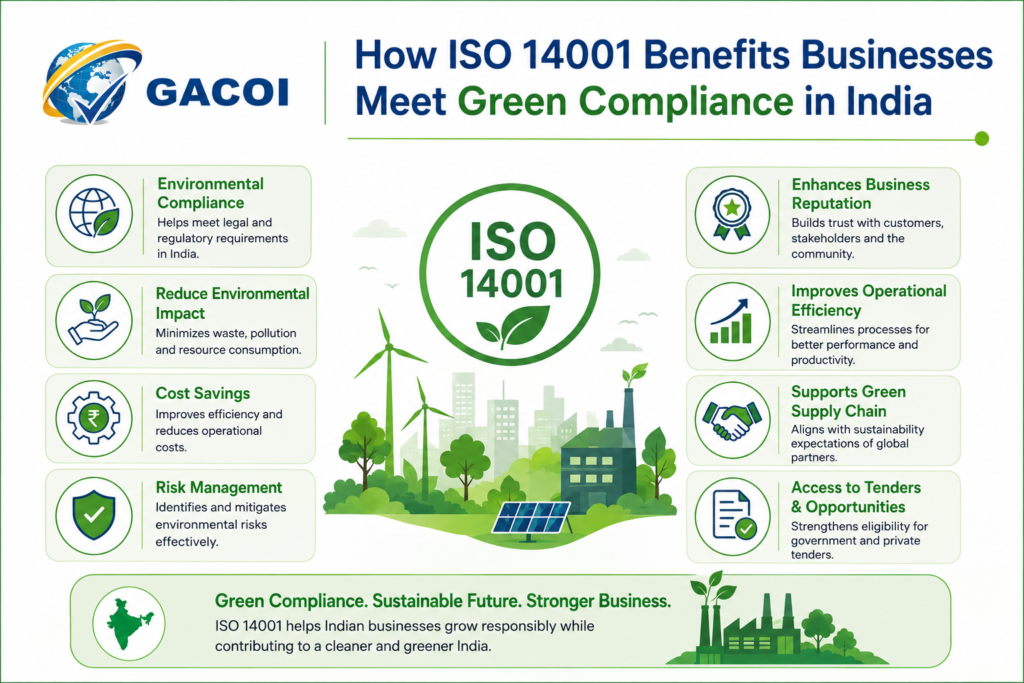
3. Proactive Risk Management — Preventing Environmental Incidents Before They Occur
India’s National Green Tribunal has demonstrated a consistent willingness to impose significant financial penalties and even order closures for serious environmental violations. CPCB and SPCBs have increasing technical capability to detect violations. In this environment, reactive environmental management — addressing problems only after they occur — is genuinely dangerous for business continuity.
ISO 14001:2015’s risk-based thinking approach requires organizations to proactively identify potential environmental risks — chemical spills, effluent treatment plant failures, uncontrolled emissions events, hazardous waste mismanagement — and implement preventive measures before incidents occur.
This includes establishing Emergency Preparedness and Response plans specifically for environmental emergencies — documented procedures, trained response teams, emergency equipment, and regular drills that ensure organizations can respond effectively to environmental incidents and minimize their impact.
Why this matters for Indian businesses: A single serious environmental incident — a chemical spill reaching a water body, an uncontrolled emission event affecting a neighboring community — can result in NGT penalties, SPCB directions for closure, reputational damage, and legal liability. ISO 14001’s proactive risk management approach dramatically reduces the probability of such incidents occurring.
4. Structured Environmental Monitoring and Measurement
Demonstrating green compliance requires data — accurate, consistent, and well-documented measurements of environmental performance. ISO 14001 requires organizations to establish systematic monitoring and measurement programs covering all significant environmental aspects.
For Indian businesses, this typically includes:
- Regular effluent quality testing against CPCB/SPCB discharge standards
- Stack emission monitoring against ambient air quality standards
- Energy consumption tracking by source and process
- Water consumption monitoring and groundwater level tracking where applicable
- Waste generation quantification by category — recyclable, hazardous, general
- Noise level measurements in applicable industrial settings
- Groundwater quality monitoring where contamination risk exists
This monitoring data serves multiple critical purposes: it provides evidence of compliance for regulatory submissions, enables trend identification and early warning of deteriorating performance, supports evidence-based environmental objective-setting, and demonstrates to external stakeholders that environmental performance is being actively managed.
Alignment with Indian regulatory requirements: CPCB and SPCB consent conditions typically require regular environmental monitoring and reporting. ISO 14001’s monitoring requirements directly align with and support these regulatory obligations — making compliance reporting more systematic and reliable.
5. Driving Continuous Environmental Improvement
Green compliance in India is not a static target — regulations become more stringent, community expectations rise, and international market requirements evolve. What meets compliance requirements today may fall short of tomorrow’s standards.
ISO 14001’s core philosophy of continual improvement — built into the standard through the Plan-Do-Check-Act cycle — ensures that certified organizations do not simply meet current compliance thresholds but progressively improve their environmental performance over time.
This manifests through ISO 14001’s requirement for organizations to set environmental objectives and targets — specific, measurable improvement goals that go beyond mere compliance. Examples for Indian businesses include:
- Reducing total water consumption by 20 percent over two years through process optimization and recycling
- Achieving zero hazardous waste to landfill through approved recycling and co-processing channels
- Reducing Scope 1 and Scope 2 carbon emissions by 30 percent within three years through energy efficiency and renewable energy adoption
- Reducing industrial effluent volume by 25 percent through in-process water conservation measures
- Achieving 80 percent waste diversion from landfill through segregation and recycling programs
These improvement objectives, tracked and reviewed through the ISO 14001 management system, ensure that organizations are consistently moving toward better environmental performance — building resilience against future regulatory tightening.
6. Supply Chain Green Compliance — Managing Environmental Risk Beyond Your Gates
Modern green compliance increasingly extends beyond an organization’s own operations to encompass the environmental practices of its suppliers and contractors. This is particularly relevant for Indian businesses supplying to multinational companies, European buyers, or large Indian corporations with established sustainability commitments.
ISO 14001 requires organizations to consider the life cycle perspective of their products and services — understanding and influencing environmental impacts upstream in the supply chain and downstream in product use and end-of-life disposal.
Practically, this means:
- Evaluating suppliers on environmental criteria — not just price and delivery
- Including environmental requirements in supplier contracts and purchase orders
- Conducting supplier environmental audits or assessments for high-risk suppliers
- Working collaboratively with suppliers to reduce supply chain environmental impacts
- Ensuring contractors working on your premises comply with your environmental standards
For Indian exporters, this is especially valuable. European and North American buyers increasingly require their Indian suppliers to demonstrate not only their own environmental compliance but evidence of supply chain environmental management — a requirement that ISO 14001 directly addresses.
7. Strengthening Stakeholder Communication and Transparency
Green compliance in India increasingly requires not just regulatory compliance but transparent communication with a broader set of stakeholders — local communities, NGOs, investors, lenders, employees, and customers who all have legitimate interests in an organization’s environmental performance.
ISO 14001 establishes structured requirements for both internal and external environmental communication — ensuring that the organization’s environmental policy, performance data, and improvement initiatives are communicated effectively to relevant stakeholders.
For listed Indian companies, this aligns directly with SEBI’s Business Responsibility and Sustainability Reporting (BRSR) framework — which requires disclosure of environmental performance data for the top 1,000 listed companies by market capitalization. ISO 14001 certification and the data it generates significantly support BRSR compliance.
For companies seeking green financing — sustainability-linked loans, green bonds, or ESG-focused investment — ISO 14001 certification provides credible, independently verified environmental management evidence that lenders and investors increasingly require.
Specific Benefits of ISO 14001 for Indian Businesses
Regulatory Penalty Avoidance and Legal Protection
Environmental violations in India carry significant financial consequences. NGT penalties can reach crores of rupees for serious violations. CPCB and SPCB enforcement actions can result in consent withdrawal, production suspension, or closure directions. ISO 14001’s systematic compliance management dramatically reduces the risk of violations and provides documented evidence of good faith environmental management — which courts and tribunals consider favorably when assessing penalties.
Access to Export Markets and International Supply Chains
European Union import regulations are tightening significantly — the EU Corporate Sustainability Due Diligence Directive (CSDDD) and Carbon Border Adjustment Mechanism (CBAM) are creating new environmental compliance requirements for exporters to European markets. ISO 14001 certification is one of the most widely recognized mechanisms for demonstrating environmental management capability to international buyers and regulators.
Indian exporters in sectors including textiles, leather, chemicals, engineering goods, food processing, and automotive components are increasingly finding that ISO 14001 certification is either required or strongly preferred by their European and North American customers.
Winning Government Tenders and Public Sector Contracts
Central and state government procurement policies in India are progressively incorporating environmental criteria into tender evaluation frameworks. Infrastructure projects, defense procurement, public sector manufacturing contracts, and smart city projects increasingly award preference or mandatory points to bidders with ISO 14001 certification. For businesses targeting government contracts, certification directly improves competitive positioning.
Significant Cost Reduction Through Resource Efficiency
One of the most immediately tangible benefits of ISO 14001 implementation is cost reduction through improved resource efficiency. When organizations systematically track and analyze energy consumption, water use, raw material efficiency, and waste generation — which ISO 14001 requires — they consistently identify significant cost reduction opportunities.
Indian businesses that have implemented ISO 14001 consistently report measurable financial benefits including reduced electricity bills through energy efficiency projects, lower water costs through conservation and recycling initiatives, reduced waste disposal costs through waste minimization and recycling programs, and lower raw material costs through process efficiency improvements.
These savings are real, measurable, and recurring — and for many organizations they significantly exceed the annual cost of maintaining ISO 14001 certification.
ESG Performance and Investor Relations
Environmental, Social, and Governance (ESG) investing is growing rapidly in India. Institutional investors, foreign portfolio investors, and private equity firms are increasingly incorporating ESG criteria into investment decisions. ISO 14001 certification provides credible, independently verified evidence of environmental management that directly strengthens an organization’s ESG credentials — improving investor confidence and potentially reducing the cost of capital.
For companies pursuing sustainability-linked financing — where loan interest rates are tied to ESG performance metrics — ISO 14001 certification can directly translate into financial savings through lower borrowing costs.
Building Community Trust and Social License to Operate
Industrial facilities in India face increasing community scrutiny and activism around environmental impacts. NGT public interest litigations, community protests, and media coverage of industrial pollution have affected operations and reputations of numerous companies. ISO 14001 certification — with its requirements for transparency, community communication, and genuine environmental performance improvement — helps organizations build and maintain the social license to operate that is increasingly critical for uninterrupted business continuity.
Employee Engagement and Talent Attraction
Environmental responsibility has become an important factor in employee engagement — particularly among younger professionals who prioritize working for organizations with genuine sustainability commitments. ISO 14001 implementation involves employees at all levels in environmental awareness and improvement initiatives — building organizational pride and environmental ownership that positively impacts morale, engagement, and retention.
ISO 14001 and India’s Key Environmental Regulations — Direct Alignment
Understanding how ISO 14001 specifically aligns with India’s environmental regulatory framework helps businesses appreciate its practical compliance value:
Environment Protection Act, 1986: ISO 14001’s legal register and compliance evaluation requirements directly address EPA obligations across all applicable environmental standards and regulations.
Water Pollution Act, 1974: ISO 14001’s effluent monitoring, discharge control procedures, and emergency response planning directly support compliance with consent conditions for water discharge.
Air Pollution Act, 1981: Stack emission monitoring, operational controls on combustion processes, and vehicle fleet emission management within ISO 14001 directly address air quality compliance requirements.
Hazardous Waste Rules, 2016: ISO 14001’s hazardous material management procedures, waste tracking, and authorized disposal requirements align directly with hazardous waste management obligations.
EPR Guidelines: ISO 14001’s life cycle perspective and supply chain environmental management requirements directly support Extended Producer Responsibility compliance for applicable product categories.
BRSR Framework (SEBI): ISO 14001’s environmental monitoring, data collection, and reporting processes directly generate the environmental performance data required for BRSR disclosure.
NGT Directions: ISO 14001’s systematic legal tracking and compliance evaluation helps organizations stay current with applicable NGT orders and maintain documented compliance evidence.
The ISO 14001 Certification Process with GacoiCert
Getting ISO 14001 certified through GacoiCert follows a clear, structured pathway:
Initial Consultation and Scoping: GacoiCert’s environmental experts review your business operations, applicable regulations, and environmental aspects to define the appropriate certification scope and provide a transparent quotation.
Gap Analysis Support: Understanding where your current environmental management practices stand relative to ISO 14001:2015 requirements — identifying what is already in place and what needs to be developed.
Stage 1 Audit — Documentation Review: GacoiCert auditors review your Environmental Management System documentation to confirm it adequately addresses ISO 14001 requirements and that your organization is ready for the on-site assessment.
Stage 2 Audit — On-Site Assessment: GacoiCert auditors conduct a thorough on-site evaluation — reviewing environmental monitoring records, inspecting operational controls, verifying legal compliance evidence, and interviewing employees across all relevant levels.
Certificate Issuance: Upon successful completion of the audit process, GacoiCert issues your internationally recognized ISO 14001:2015 certificate — valid for three years with annual surveillance audits.
Ongoing Partnership: GacoiCert’s relationship with certified clients continues through annual surveillance audits, providing ongoing independent verification of your environmental management performance.
Why Choose GacoiCert for ISO 14001 Certification in India?
GacoiCert is one of India’s trusted accredited certification bodies for ISO 14001 environmental management certification.
International accreditation: GacoiCert’s ISO 14001 certificates are internationally recognized — accepted by export market buyers, government procurement authorities, and investors.
Deep India-specific regulatory knowledge: Our auditors understand India’s environmental regulatory landscape in detail — CPCB standards, SPCB consent conditions, NGT requirements, BRSR obligations, and EPR frameworks.
Cross-industry environmental expertise: Manufacturing, IT and data centers, construction, hospitality, healthcare, logistics, food processing — our auditors bring genuine sector-specific environmental knowledge.
Transparent pricing: Complete, itemized quotations with no hidden fees or surprise charges.
Pan-India service coverage: Delhi NCR, Mumbai, Bangalore, Chennai, Hyderabad, Pune, Kolkata, Ahmedabad, and all major industrial centers across India.
Integrated Management System capability: ISO 14001 combined with ISO 9001 and ISO 45001 through a single integrated audit — maximizing value and minimizing disruption.
Genuine audit partnership: Our auditors provide objective, constructive assessments that help your organization achieve real environmental improvement — not just compliance paperwork.
Conclusion: ISO 14001 Is India’s Most Powerful Green Compliance Tool
Green compliance in India is no longer a peripheral concern for businesses — it is a central operational, legal, financial, and reputational imperative. Regulatory enforcement is intensifying, export markets are demanding environmental credentials, investors are incorporating ESG into every decision, and communities are holding businesses accountable for their environmental impacts.
ISO 14001 certification provides Indian businesses with the most comprehensive, internationally recognized, and practically effective framework available for meeting these green compliance demands — systematically, credibly, and continuously.
From building a robust legal compliance register to controlling significant environmental impacts, from driving measurable cost savings through resource efficiency to unlocking export markets and government tenders, the benefits of ISO 14001 for Indian businesses are concrete, measurable, and enduring.
The question for Indian business leaders is not whether environmental management matters — it clearly and increasingly does. The question is whether your organization will manage it reactively, exposed to regulatory risk and market exclusion, or proactively through a world-class Environmental Management System that turns compliance into competitive advantage.
GacoiCert is ready to guide your organization through ISO 14001 certification. Visit gacoicert.com today, request your free consultation, and take the first step toward verified environmental excellence.
Frequently Asked Questions
1. What is ISO 14001 and why is it important for businesses?
ISO 14001 is an international standard for Environmental Management Systems (EMS). It helps businesses identify, manage, monitor, and reduce their environmental impact while improving compliance with environmental regulations and promoting sustainable business practices.
2. How does ISO 14001 help businesses meet green compliance in India?
ISO 14001 provides a structured framework for managing environmental responsibilities, including waste management, pollution control, resource conservation, and legal compliance. This helps businesses align with India’s environmental regulations and sustainability goals.
3. Which businesses should obtain ISO 14001 certification?
Businesses of all sizes—including manufacturers, construction companies, logistics firms, healthcare organizations, educational institutions, and service providers—can benefit from ISO 14001 by improving their environmental performance and demonstrating their commitment to sustainability.
4. Does ISO 14001 improve business reputation?
Yes. ISO 14001 enhances a company’s reputation by demonstrating its commitment to environmental responsibility. Customers, investors, and business partners often prefer working with organizations that follow internationally recognized environmental management standards.
5. Can ISO 14001 help reduce operational costs?
Yes. By improving energy efficiency, reducing waste, optimizing resource usage, and preventing environmental incidents, ISO 14001 can help businesses lower operational costs and improve overall efficiency.
6. Is ISO 14001 certification mandatory in India?
No. ISO 14001 certification is generally voluntary. However, many government projects, multinational corporations, and environmentally conscious clients prefer or require suppliers to maintain an effective Environmental Management System.
7. What are the key benefits of ISO 14001 for Indian businesses?
The major benefits of ISO 14001 include improved environmental compliance, reduced environmental risks, better resource management, enhanced legal compliance, stronger brand credibility, increased customer confidence, easier access to global markets, and support for long-term sustainable growth.
ISO 14001 Certification Benefits
🟡GACOI Cert provides globally recognized ISO certification, cybersecurity, privacy, AI governance, compliance, audit, and professional training services, helping startups, businesses, enterprises, laboratories, healthcare organizations, and government institutions achieve international standards and build lasting trust.
🟡For other Legal and Trademark related services Visit
👉 Money Recovery Cases
👉 Property Disputes
👉 Business & Licence Registrations
🟡 Protect Your Rights
👉 Domestic Violence Legal Support
👉 Stridhan Recovery
👉 Mutual Consent Divorce
👉 Contested Divorce Filing
👉 Child Custody and Maintenance
👉 Matrimonial Property Settlement
👉 NRI Divorce Services
👉 Alimony and Maintenance
📞 Call Now: +91 8595439395
🕐 Free Consultation: Monday to Saturday, 10 AM to 6 PM


