


Views: 2
Learn the complete ISO 13485 certification process in India step by step — requirements, timeline, cost, CDSCO alignment, and how GacoiCert helps medical device manufacturers get certified in 2026.
Table of Contents
- 1 Introduction: Why Understanding the ISO 13485 Certification Process Matters
- 2 Understanding ISO 13485 Before Beginning: Key Concepts
- 3 Step 1: Top Management Commitment and Project Initiation
- 4 Step 2: ISO 13485 Standard Training and Gap Analysis
- 5 Step 3: Define Risk Management Framework Under ISO 14971
- 6 Step 4: Develop the Quality Management System Documentation
- 7 Step 5: Design and Development Control Implementation
- 8 Step 6: Supplier Qualification and Control System
- 9 Step 7: Production Process Validation
- 10 Step 8: Post-Market Surveillance System Establishment
- 11 Step 9: Internal Audit and Management Review
- 12 Step 10: Select GacoiCert as Your ISO 13485 Certification Body
- 13 Step 11: Submit Certification Application to GacoiCert
- 14 Step 12: Stage 1 Audit — Documentation Review
- 15 Step 13: Stage 2 Audit — On-Site Certification Assessment
- 16 Step 14: Nonconformity Resolution
- 17 Step 15: Certificate Issuance and Ongoing Maintenance
- 18 Complete ISO 13485 Certification Timeline in India 2026
- 19 ISO 13485 Certification Cost in India 2026
- 20 Why Choose GacoiCert for ISO 13485 Certification in India?
- 21 Conclusion: Your ISO 13485 Certification Journey Starts Today
- 22 Frequently Asked Questions
- 23 Get Expert Guidance for ISO Certification
Introduction: Why Understanding the ISO 13485 Certification Process Matters
India’s medical device industry is experiencing extraordinary growth — with market size exceeding USD 11 billion, manufacturing capabilities expanding rapidly across diagnostics, surgical instruments, implantable devices, and hospital equipment, and export ambitions driving Indian manufacturers toward international regulatory markets that demand the highest quality management standards.
At the center of this quality landscape sits ISO 13485:2016 — the internationally recognized Quality Management System standard specifically designed for medical device manufacturers and their supply chains. ISO 13485 is not merely a quality credential — it is a regulatory compliance tool that determines access to EU markets requiring CE marking, Canadian markets requiring Health Canada licensing, Japanese markets aligned with QMS Ordinance requirements, and increasingly the Indian domestic market where CDSCO regulatory expectations are strengthening.
For Indian medical device businesses — manufacturers, component suppliers, contract manufacturers, distributors, sterilization service providers — understanding the ISO 13485 certification process is essential. Not in abstract terms, but in practical, step-by-step detail: what needs to happen at each stage, in what sequence, with what resources, over what timeline, and at what cost.
This comprehensive guide from GacoiCert provides exactly this practical roadmap — walking Indian medical device organizations through every step of the ISO 13485 certification process from initial commitment through certificate issuance and ongoing maintenance — with specific guidance relevant to India’s medical device regulatory environment, CDSCO requirements, and commercial landscape.
Understanding ISO 13485 Before Beginning: Key Concepts
Before starting the certification process, medical device organizations need to clearly understand several concepts that shape how ISO 13485 implementation works.
ISO 13485 Is a Regulatory Tool, Not Just a Quality Standard
Unlike ISO 9001 — which focuses on customer satisfaction — ISO 13485 is explicitly designed to help organizations demonstrate the ability to consistently provide medical devices that meet both customer requirements and applicable regulatory requirements. This regulatory focus shapes every aspect of implementation — from risk management integration through design control documentation to post-market surveillance systems.
ISO 14971 Risk Management Is Inseparable from ISO 13485
ISO 13485 references ISO 14971 — the international standard for risk management application to medical devices — extensively throughout its requirements. Implementing ISO 13485 effectively requires simultaneously implementing ISO 14971 risk management methodology. Organizations that treat these as separate activities consistently struggle during certification audits.
Exclusions Require Justification
ISO 13485 allows organizations to exclude certain requirements that are not applicable based on the activities they perform — but exclusions must be justified and documented. A distributor that does not design or manufacture devices can exclude design and development requirements. However, exclusion scope must be carefully determined and documented.
The Quality Manual Is Mandatory
Unlike ISO 9001:2015 which no longer requires a Quality Manual, ISO 13485:2016 explicitly requires a Quality Manual — making it a mandatory deliverable in the implementation process.
Step 1: Top Management Commitment and Project Initiation
Duration: 1 – 2 weeks
Every successful ISO 13485 certification journey begins with genuine, active top management commitment — and in the medical device sector, this commitment carries greater weight than in most other industries because the consequences of inadequate quality management extend to patient safety.
What top management must formally commit to:
- Providing adequate financial resources, personnel time, and infrastructure for QMS implementation and maintenance
- Establishing and communicating the organization’s Quality Policy covering both quality and regulatory compliance commitments
- Defining organizational structure with clear roles, responsibilities, and authorities for all QMS functions
- Integrating medical device regulatory requirements into core business strategy — not treating them as peripheral compliance activities
- Actively participating in management reviews and quality governance
- Demonstrating personal accountability for quality and safety outcomes
Project initiation activities:
- Appoint a QMS Project Lead — typically a Quality Manager, Regulatory Affairs Manager, or senior technical professional with medical device industry knowledge
- Define the certification scope — which products, activities, processes, and locations will be included
- Assemble a cross-functional implementation team drawing from quality, regulatory, design, manufacturing, procurement, and other relevant functions
- Establish a realistic implementation timeline with milestone dates
- Approve implementation budget covering consultant fees, training, documentation tools, and certification body fees
- Select external ISO 13485 consultant if external support is being engaged
Common mistake to avoid: Appointing the QMS Project Lead without providing adequate protected time for implementation. ISO 13485 implementation is a substantial project — a project lead managing it as a minor part-time addition to a full existing workload will extend timelines and compromise implementation quality.
Step 2: ISO 13485 Standard Training and Gap Analysis
Duration: 2 – 3 weeks
Before implementation can begin meaningfully, your implementation team must thoroughly understand ISO 13485:2016 requirements — and your organization must systematically assess how current practices compare to those requirements.
ISO 13485 training for the implementation team:
Invest in ISO 13485 lead implementer training for your QMS Project Lead and key implementation team members. ISO 13485 has specific requirements — particularly in design controls, risk management, post-market surveillance, sterilization validation, and regulatory reporting — that require thorough understanding before documentation development begins. Misunderstanding requirements at this stage leads to rework later.
Conducting the gap analysis:
A systematic gap analysis examines every clause and sub-clause of ISO 13485:2016 against your current practices:
Clause 4 — Quality Management System: Does a Quality Manual exist? Are processes defined and their interactions described? Are medical device files maintained for each product?
Clause 5 — Management Responsibility: Is a quality policy established and communicated? Are roles, responsibilities, and authorities formally defined? Are management reviews conducted with required inputs?
Clause 6 — Resource Management: Are competence requirements defined for all roles? Are training records maintained? Is infrastructure adequate and documented?
Clause 7 — Product Realization: Do design controls exist and are they followed? Are supplier qualification processes formal and documented? Are production processes validated? Is traceability maintained to required levels?
Clause 8 — Measurement, Analysis, and Improvement: Is a post-market surveillance system established? Are complaint handling procedures documented with regulatory reporting linkage? Are corrective and preventive action processes systematic?
Gap analysis output:
A prioritized implementation action plan identifying every gap, assigning responsibility, estimating resources, and setting completion timelines. This plan becomes the master implementation schedule for the entire certification journey.
Step 3: Define Risk Management Framework Under ISO 14971
Duration: 2 – 4 weeks
ISO 14971 risk management must be integrated into ISO 13485 implementation from the beginning — not added as an afterthought after other elements are established.
Establishing the ISO 14971 risk management system:
Risk management policy: Top management establishes a formal policy defining the organization’s approach to medical device risk management — including risk acceptability criteria that determine when residual risks are acceptable.
Risk management plan: For each product or product family, a risk management plan is developed defining the scope, responsibilities, risk management activities to be performed, and criteria for reviewing risk management activities.
Hazard identification: Systematic identification of all potential hazards associated with each device — using structured techniques such as Failure Mode and Effects Analysis (FMEA), Fault Tree Analysis (FTA), and hazard checklists specific to the device type.
Risk estimation and evaluation: For each identified hazard, estimate the probability of harm occurring and the severity of the potential harm. Combine these to produce a risk estimate. Evaluate whether the risk is acceptable according to defined criteria.
Risk control: For risks requiring treatment, implement controls following the defined hierarchy — inherent safety by design first, then protective measures, then information for safety. Evaluate residual risk after control implementation.
Risk management file: Maintain a risk management file for each device — documenting all risk management activities, decisions, and outcomes throughout the product life cycle.
Why early risk management integration matters:
Risk management outputs feed into design inputs, operational controls, supplier requirements, and post-market surveillance — making it foundational to everything that follows. Organizations that try to add risk management documentation after design and manufacturing processes are already documented consistently find that risk management feels disconnected from actual operations — which CDSCO inspectors and ISO 13485 auditors quickly identify.
Step 4: Develop the Quality Management System Documentation
Duration: 4 – 10 weeks depending on organization size
ISO 13485 documentation development is more extensive than most other ISO management system standards — reflecting the standard’s regulatory tool role and the medical device sector’s documentation culture.
Mandatory documented information under ISO 13485:
Quality Manual: Scope of the QMS including any exclusions and their justification. References to documented procedures or their direct inclusion. Description of QMS processes and their interactions. Organization chart showing quality-relevant functions and their relationships.
Quality Policy: Formal statement of quality and regulatory commitment — communicated to all personnel and publicly available.
Medical Device Files: For each type or family of medical devices — specifications, manufacturing specifications, quality control specifications, and post-market surveillance data organized in a structured file maintained throughout the product life cycle.
Device Master Record: For manufactured devices — design specifications, manufacturing specifications, quality assurance procedures, packaging and labeling specifications, and installation and servicing procedures.
Device History Record: For each manufactured lot or unit — records demonstrating that the device was manufactured in accordance with the device master record.
Mandatory procedures under ISO 13485:
- Document control procedure
- Record control procedure
- Risk management procedure referencing ISO 14971
- Design and development procedure
- Supplier evaluation and control procedure
- Production and process control procedure
- Validation procedure for production processes
- Identification and traceability procedure
- Customer property control procedure
- Product preservation procedure
- Monitoring and measurement of product procedure
- Control of nonconforming product procedure
- Complaint handling and adverse event reporting procedure
- Internal audit procedure
- Corrective action procedure
- Preventive action procedure
- Post-market surveillance procedure
- Advisory notice procedure
Documentation practical guidance:
Write procedures that reflect how your organization actually operates — not how a generic template suggests. ISO 13485 auditors specifically verify that documented procedures match observed practice. Generic, copy-pasted procedures that do not reflect actual operations are immediately identified during certification audits and result in major nonconformities.
Step 5: Design and Development Control Implementation
Duration: 4 – 12 weeks — concurrent with documentation development
For organizations that perform design activities, implementing formal design controls is typically the most complex and time-consuming element of ISO 13485 implementation — and the area where most certification audit major nonconformities occur in first-time implementations.
Design and development planning:
Develop a design and development plan for each new or significantly modified device — defining design stages, review points, verification and validation activities, responsibilities, and resources.
Design input management:
Formally document design inputs for each device — functional requirements, performance requirements, usability requirements, safety requirements from risk management, applicable regulatory requirements for intended markets, and standards applicable to the device type.
Design output documentation:
Specify design outputs in a form enabling verification against inputs — including product specifications, manufacturing specifications, and characteristics essential for safe and proper use.
Design review, verification, and validation:
Conduct formal design reviews at defined stages with records of attendees, findings, and actions. Conduct design verification — confirming outputs meet inputs through testing and analysis. Conduct design validation — confirming the device meets user needs under actual or simulated use conditions. Maintain formal design history files documenting all design activities.
Design transfer:
Establish and document procedures ensuring that device designs are correctly translated into production specifications — preventing design-to-manufacturing translation errors that could affect device safety.
Design change control:
Implement a formal change control process for all design changes — including evaluation of how changes affect risk management, biocompatibility, sterilization validation, and regulatory approval status.
Step 6: Supplier Qualification and Control System
Duration: 3 – 6 weeks
ISO 13485’s supplier qualification requirements are among the most demanding of any ISO management system standard — reflecting the patient safety implications of supplier quality failures in medical device manufacturing.
Supplier qualification process:
Approved supplier list: Establish and maintain a formal approved supplier list — identifying all qualified suppliers for critical materials, components, and services.
Supplier evaluation criteria: Define evaluation criteria for qualifying suppliers — covering quality management system maturity, technical capability, regulatory compliance, financial stability, and delivery reliability. Risk-proportionate criteria — more demanding for higher-risk suppliers.
Supplier qualification records: Maintain formal qualification records for each approved supplier — including evaluation evidence, qualification decision, and any conditions or limitations on qualification.
Supplier agreements: Establish quality agreements with critical suppliers — defining quality requirements, change notification obligations, regulatory requirement flow-down, and audit rights.
Incoming inspection: Define and implement incoming inspection procedures for purchased materials — with inspection scope and intensity proportionate to supplier qualification status and product risk.
Supplier performance monitoring: Establish ongoing supplier performance monitoring — tracking quality, delivery, and compliance performance with defined review frequency and re-evaluation triggers.
Step 7: Production Process Validation
Duration: 4 – 8 weeks — can run concurrently
ISO 13485 requires validation of production processes where the resulting output cannot be fully verified by subsequent inspection — a requirement that affects many critical manufacturing processes in medical device production.
Processes requiring validation:
- Sterilization processes — ethylene oxide, gamma radiation, steam, dry heat, or hydrogen peroxide plasma
- Welding processes — ultrasonic, laser, radiofrequency, or adhesive bonding of device components
- Molding processes — injection molding, compression molding for device components
- Coating processes — protective coatings, antimicrobial coatings, biocompatible surface treatments
- Software-controlled production processes — where software behavior directly affects product characteristics
- Aseptic processing — for products assembled or processed in cleanroom environments
Validation protocol elements:
Installation Qualification (IQ) — verifying that equipment is installed correctly and meets defined specifications. Operational Qualification (OQ) — demonstrating that the process operates within defined parameters across the operating range. Performance Qualification (PQ) — demonstrating that the process consistently produces conforming product under actual production conditions.
Step 8: Post-Market Surveillance System Establishment
Duration: 2 – 4 weeks
ISO 13485 requires a systematic post-market surveillance system — ongoing collection and analysis of experience from devices already in the market. This is a unique requirement that has no equivalent in ISO 9001 and represents one of ISO 13485’s most important patient safety protection mechanisms.
Post-market surveillance system components:
Complaint handling: Documented procedure for receiving, recording, investigating, and responding to all complaints about marketed devices — with determination of whether complaints require reporting to regulatory authorities.
Adverse event reporting: Procedures for notifying regulatory authorities — CDSCO in India, EU Competent Authorities, FDA, and others — of serious adverse events and field safety corrective actions within applicable reporting timelines.
Field safety corrective actions: Procedures for implementing corrective actions in the field — recalls, product corrections, advisory notices — when safety issues are identified in marketed devices.
Proactive surveillance: Systematic review of published literature, regulatory authority databases, complaint trend analysis, and clinical data to identify previously unidentified safety signals.
Periodic safety update reports: For EU market access — periodic documentation of post-market safety performance summarizing surveillance data analysis and benefit-risk conclusions.
Step 9: Internal Audit and Management Review
Duration: 2 – 3 weeks
Before applying to GacoiCert for certification, your QMS must have completed at least one full internal audit cycle and one management review covering all required inputs.
ISO 13485 internal audit:
Internal audits must cover all clauses of ISO 13485 — not just management system elements but technical quality requirements including design controls, production process validation status, supplier qualification completeness, and post-market surveillance system effectiveness.
Internal auditors must be independent of the areas they audit and must have sufficient ISO 13485 knowledge to evaluate compliance meaningfully. For small organizations, arranging qualified external internal auditors for technically complex areas may be necessary.
Every nonconformity identified must receive a documented corrective action — with root cause analysis, corrective action implementation, and effectiveness verification before the certification audit.
Management review:
Top management conducts a formal review covering all required ISO 13485 inputs:
- Quality policy and quality objectives achievement
- Results of audits — internal and regulatory
- Post-market surveillance data including complaint trends
- Feedback from regulatory authorities
- Process performance and product conformity data
- Status of corrective and preventive actions
- Changes affecting the QMS including regulatory changes
- Recommendations for improvement
- Resource adequacy
Management review outputs must include documented decisions and actions on improvement, QMS changes, and resource needs.
Step 10: Select GacoiCert as Your ISO 13485 Certification Body
Duration: 1 – 2 weeks
Choosing the right certification body for ISO 13485 is a critical decision — because the credibility of your certificate depends entirely on the accreditation status and industry expertise of the body that issues it.
What to verify when selecting a certification body:
Accreditation status: The certification body must be accredited by a recognized accreditation body — NABCB in India, UKAS in UK, DAkkS in Germany, or another IAF member body. ISO 13485 certificates from non-accredited bodies are not recognized by EU Notified Bodies, Health Canada, TGA, or CDSCO.
Medical device sector expertise: ISO 13485 auditors must have genuine medical device industry knowledge — understanding regulatory frameworks, risk management under ISO 14971, design control expectations, sterilization validation requirements, and post-market surveillance systems.
Why GacoiCert for ISO 13485 certification:
GacoiCert is an internationally accredited certification body with deep medical device sector expertise. Our ISO 13485 auditors bring genuine knowledge of CDSCO Medical Devices Rules 2017, EU MDR requirements, FDA QMS Regulation alignment, and the specific technical requirements of different device categories — from Class A consumables to Class D implantable devices.
GacoiCert provides transparent, competitive pricing, pan-India audit capability, and efficient certification processes that minimize operational disruption while maintaining the highest audit standards.
Step 11: Submit Certification Application to GacoiCert
Duration: 1 week
Submit your formal ISO 13485 certification application to GacoiCert with:
- Organization details — legal name, addresses, contact information
- Defined certification scope — specific device types, manufacturing activities, locations
- Number of employees — total and quality-relevant
- Device categories — class of devices being manufactured or supplied
- Applicable regulatory markets — India, EU, USA, Canada, etc.
- Existing certifications — ISO 9001 or other relevant certifications
GacoiCert reviews the application, confirms scope, calculates audit duration, provides a transparent quotation covering all certification stages, and schedules audit dates.
Step 12: Stage 1 Audit — Documentation Review
Duration: 1 – 2 days audit; 2 – 4 weeks gap before Stage 2
GacoiCert’s medical device auditor conducts a comprehensive documentation review — assessing whether your QMS documentation adequately addresses ISO 13485:2016 requirements.
Stage 1 focus areas:
- Quality Manual completeness and accuracy
- Quality policy and objectives appropriateness
- Risk management documentation — risk management plans, risk assessment records, SOA where applicable
- Design and development documentation — design history files, validation records
- Supplier qualification documentation — approved supplier list, qualification records
- Post-market surveillance documentation — complaint handling procedures, adverse event reporting procedures
- Production process validation documentation
Stage 1 findings:
Issues identified during Stage 1 must be addressed before Stage 2 proceeds. Stage 1 findings are normal for first-time certifications — they provide valuable opportunity to correct gaps before the more intensive on-site assessment.
Step 13: Stage 2 Audit — On-Site Certification Assessment
Duration: 2 – 5 days depending on organization size
The Stage 2 audit is the comprehensive on-site assessment where GacoiCert’s medical device auditors verify that your QMS is genuinely implemented and effective throughout your organization.
Stage 2 assessment activities:
Opening meeting: Audit scope, plan, and process confirmed.
Document and record review: Design history files, device master records, device history records, supplier qualification records, validation records, calibration records, complaint records, corrective action records, internal audit records, and management review minutes.
Process observation: Auditors observe actual manufacturing, quality control, and administrative processes — verifying that documented procedures reflect actual practice and that process controls are effectively implemented.
Production floor inspection: Physical inspection of manufacturing areas — equipment condition, environmental controls, contamination prevention measures, labeling and traceability systems, in-process quality controls.
Personnel interviews: Technical discussions with quality personnel, design engineers, production supervisors, regulatory affairs staff, and other key roles — assessing understanding of requirements and effective implementation.
Traceability exercise: Tracing specific devices or device lots through all records — from incoming component receipt through production and testing to dispatch documentation — verifying traceability system completeness.
Closing meeting: All findings presented, nonconformities explained, next steps confirmed.
Stage 2 audit duration by organization size:
| Organization Size | Typical Stage 2 Duration |
|---|---|
| Small (up to 25 employees) | 2 – 2.5 days |
| Medium (26 – 100 employees) | 2.5 – 3.5 days |
| Large (101 – 300 employees) | 3.5 – 5 days |
| Enterprise (300+ employees) | 5 days and above |
Step 14: Nonconformity Resolution
Duration: 2 – 8 weeks depending on findings
Nonconformities identified during Stage 2 must be systematically addressed before the certification decision is made.
For each nonconformity:
- Conduct root cause analysis — identify the underlying systemic cause, not just the symptom
- Implement immediate correction — address the specific nonconformity instance
- Implement corrective action — address the root cause to prevent recurrence
- Collect objective evidence of correction and corrective action implementation
- Submit response to GacoiCert within the agreed timeframe
Nonconformity categories:
Major nonconformities: Significant failures requiring resolution before certification can be granted — typically requiring additional audit evidence or site visit before certificate issuance.
Minor nonconformities: Isolated failures requiring documented corrective actions with evidence — resolved through document submission without additional audit visit.
Step 15: Certificate Issuance and Ongoing Maintenance
Duration: 1 – 2 weeks post-audit
Following satisfactory nonconformity resolution and GacoiCert’s positive certification decision, your ISO 13485:2016 certificate is issued — valid for three years with annual surveillance audits.
Certificate displays:
- Organization name and certified address
- Certification scope — specific activities and device types covered
- Standard — ISO 13485:2016
- Certificate number
- Issue and expiry dates
- GacoiCert logo and accreditation body logo
Ongoing maintenance requirements:
Annual surveillance audits verify continued QMS compliance and effectiveness. The recertification audit at the end of the three-year cycle is a comprehensive re-assessment of the complete QMS.
Between audits, organizations must maintain all QMS elements — conducting internal audits, management reviews, complaint investigations, corrective actions, and post-market surveillance activities — with records available for surveillance audit review.
Complete ISO 13485 Certification Timeline in India 2026
| Organization Size | Total Certification Timeline |
|---|---|
| Small (up to 25 employees) | 5 – 8 months |
| Medium (26 – 100 employees) | 7 – 12 months |
| Large (101 – 300 employees) | 10 – 16 months |
| Enterprise (300+ employees) | 14 – 20 months |
ISO 13485 Certification Cost in India 2026
| Cost Component | Estimated Cost |
|---|---|
| GacoiCert certification body fees (small) | ₹60,000 – ₹1,10,000 |
| GacoiCert certification body fees (medium) | ₹1,10,000 – ₹2,20,000 |
| GacoiCert certification body fees (large) | ₹2,20,000 – ₹3,60,000 |
| ISO 13485 consultant fees | ₹80,000 – ₹5,00,000 |
| ISO 13485 training | ₹30,000 – ₹1,50,000 |
| Process validation studies | ₹50,000 – ₹3,00,000 |
| Total first-year investment (small) | ₹1,80,000 – ₹4,00,000 |
| Total first-year investment (medium) | ₹4,00,000 – ₹8,00,000 |
| Total first-year investment (large) | ₹7,50,000 – ₹15,00,000 |
Why Choose GacoiCert for ISO 13485 Certification in India?
Internationally accredited: GacoiCert’s ISO 13485 certificates are recognized by CDSCO, EU Notified Bodies, international medical device buyers, and global regulatory authorities — accepted in every market that matters for Indian medical device businesses.
Medical device regulatory expertise: Our auditors understand CDSCO Medical Devices Rules 2017, EU MDR 2017/745, FDA QMS Regulation, ISO 14971 risk management, design control expectations, sterilization validation, and post-market surveillance requirements — bringing genuine medical device regulatory knowledge to every audit.
Transparent competitive pricing: Complete itemized quotations covering every certification stage with no hidden fees.
Pan-India service: Delhi NCR, Mumbai, Pune, Bangalore, Chennai, Hyderabad, Kolkata, Ahmedabad, and all major medical device manufacturing centers across India.
Combined certification capability: ISO 13485 combined with ISO 9001 through coordinated audit — delivering both certificates at reduced combined cost.
Long-term partnership: GacoiCert supports medical device organizations through every surveillance audit and recertification cycle.
Conclusion: Your ISO 13485 Certification Journey Starts Today
The fifteen-step process outlined in this guide — from top management commitment through certificate issuance — provides the complete practical roadmap for ISO 13485 certification in India. Organizations that follow this process systematically, invest adequately in risk management integration, design controls, and post-market surveillance, and choose an experienced accredited certification body like GacoiCert consistently achieve certification that delivers genuine regulatory compliance value and market access in India and internationally.
GacoiCert is ready to guide your medical device organization through every step of ISO 13485 certification. Visit gacoicert.com today, request your free consultation, and take the first step toward the internationally recognized medical device quality management certification that opens regulatory markets, qualifies supply chain relationships, and demonstrates your commitment to patient safety.
Frequently Asked Questions
What Is ISO 13485 Certification?
ISO 13485 is an internationally recognized quality management system standard designed specifically for organizations involved in the design, manufacture, installation, distribution, and servicing of medical devices.
Who Should Apply for ISO 13485 Certification in India?
Medical device manufacturers, component suppliers, sterilization service providers, distributors, importers, exporters, and organizations involved in the medical device supply chain can apply for ISO 13485 certification.
What Is the First Step in the ISO 13485 Certification Process?
The first step is to understand the requirements of ISO 13485, assess your existing quality management system, and identify any gaps that need to be addressed before implementation.
What Documents Are Required for ISO 13485 Certification?
Common documents include a quality manual, standard operating procedures (SOPs), quality policy, risk management records, design and development documents, training records, internal audit reports, and corrective action records.
How Long Does the ISO 13485 Certification Process Take?
The certification timeline depends on the size of the organization, the complexity of operations, and the readiness of the quality management system. Most organizations complete the process within a few months.
What Are the Main Stages of ISO 13485 Certification?
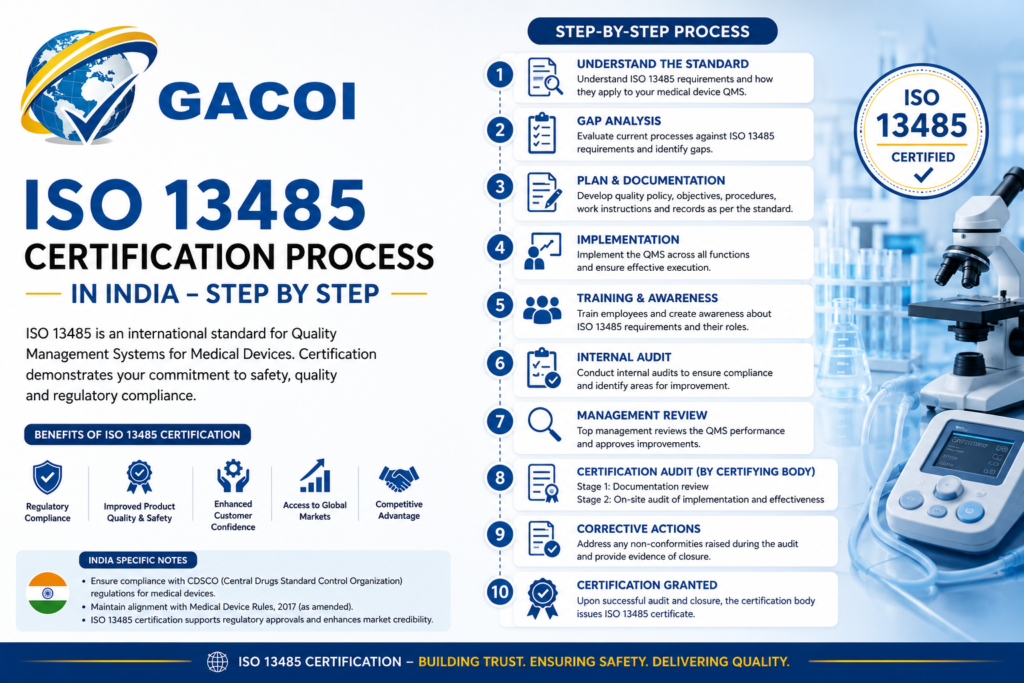
The process generally includes gap analysis, documentation, implementation of the quality management system, employee training, internal audits, management review, certification audit, and issuance of the certificate after successful compliance.
What Are the Benefits of ISO 13485 Certification?
ISO 13485 helps improve product quality, ensure regulatory compliance, enhance customer confidence, reduce operational risks, strengthen process control, and increase opportunities in domestic and international markets.
Is ISO 13485 Certification Mandatory in India?
ISO 13485 certification is generally voluntary, but many healthcare organizations, medical device buyers, regulators, and international customers prefer or require suppliers to be ISO 13485 certified.
How Much Does ISO 13485 Certification Cost in India?
The certification cost depends on factors such as the organization’s size, number of employees, operational locations, scope of activities, and the certification body’s audit requirements.
How Often Does ISO 13485 Certification Need to Be Renewed?
ISO 13485 certification is typically valid for three years, subject to periodic surveillance audits. A recertification audit is required before the certificate expires to maintain certification.
Get Expert Guidance for ISO Certification
🟡GACOI Cert provides globally recognized ISO certification, cybersecurity, privacy, AI governance, compliance, audit, and professional training services, helping startups, businesses, enterprises, laboratories, healthcare organizations, and government institutions achieve international standards and build lasting trust.
🟡For other Legal and Trademark related services Visit
👉 Money Recovery Cases
👉 Property Disputes
👉ISO Registration
👉ISO 22000 Certification
🟡 Protect Your Rights
👉 Domestic Violence Legal Support
👉 Stridhan Recovery
👉 Mutual Consent Divorce
👉 Contested Divorce Filing
📞 Call Now: +91 8595439395
🕐 Free Consultation: Monday to Saturday, 10 AM to 6 PM


