


Views: 0
Learn How to Win Tenders with ISO Certification. Discover eligibility, benefits, and the complete process in this 2026 guide.
Table of Contents
- 1 Introduction
- 2 Why ISO Certification Has Become Central to Tender Eligibility
- 3 Understanding the Difference Between Eligibility Criteria and Scoring Criteria
- 4 Which ISO Standards Matter Most for Which Categories of Tenders
- 5 Why Accreditation Status Determines Whether a Certificate Is Actually Accepted
- 6 The Format of an Effective ISO Certification Strategy for Tender Success
- 7 How ISO Certification Interacts With Other Tender Evaluation Factors
- 8 Common Mistakes That Undermine an ISO Certification-Based Tender Strategy
- 9 Frequently Asked Questions
- 10 Conclusion
- 11 Know How to Win Tenders with ISO Certification
Introduction
Winning a government or large corporate tender in India today is rarely just a matter of quoting the lowest price. Tender evaluation committees increasingly use eligibility filters and technical scoring criteria that reward vendors who can demonstrate a documented, independently verified quality, safety, or management system. ISO certification is one of the most widely recognised ways to demonstrate exactly this, and it has moved from being a “nice to have” credential to, in many tenders, an outright eligibility requirement without which a bid is rejected before price is even considered.
Businesses that treat ISO certification as a checkbox to obtain quickly and cheaply, rather than as a genuine credibility asset built through a properly implemented management system and an accredited certification body, frequently discover the hard way that their certificate is not accepted by a tender-issuing authority, or that it fails to meaningfully improve their technical evaluation score even when it is accepted. This guide explains, in detail, how ISO certification actually functions within the Indian tendering process, which standards matter most for which categories of tenders, how tender evaluation committees typically weigh ISO certification, and the specific steps a business should take to make sure its certification genuinely strengthens its tender-winning capability rather than existing only as a certificate on a wall.
For complete ISO certification support tailored specifically to tender eligibility and scoring requirements, GacoiCert provides specialised ISO certification services for businesses preparing to bid on government and corporate tenders.
Why ISO Certification Has Become Central to Tender Eligibility
Government procurement in India, at both the central and state level, has moved steadily toward standardised, criteria-based evaluation frameworks designed to reduce discretion and ensure that awarded contracts go to vendors capable of reliably delivering the goods or services being procured. ISO certification fits naturally into this shift because it provides an independently verified, internationally recognised signal of a vendor’s operational discipline, without requiring the procuring authority to conduct its own detailed technical audit of every bidder.
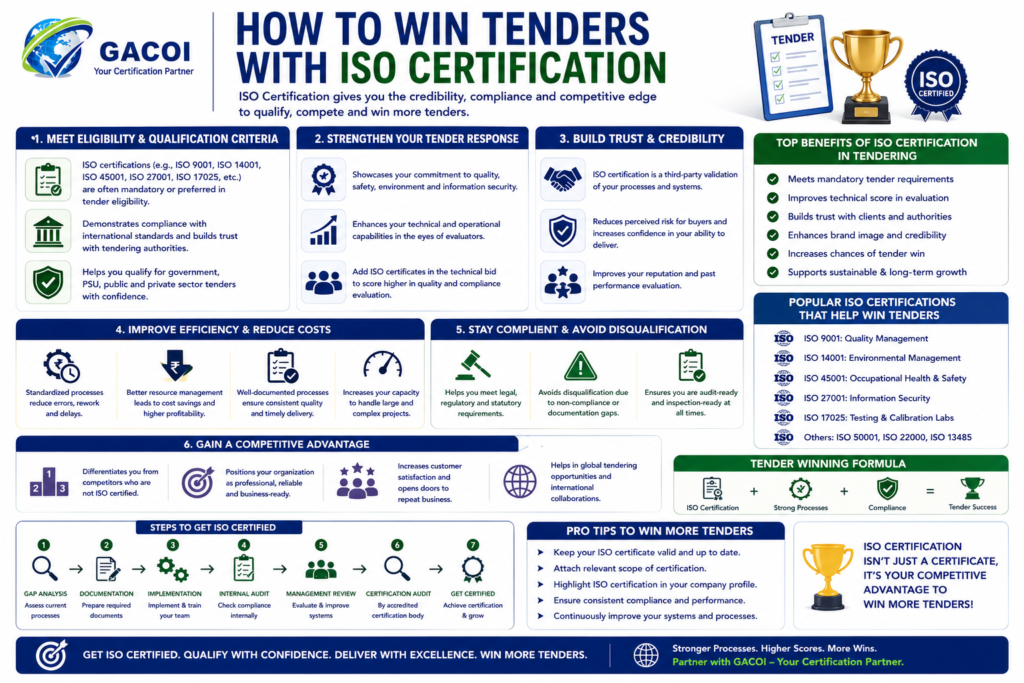
Tenders issued by public sector undertakings, government departments, defence and infrastructure agencies, and increasingly by large private corporates running structured vendor empanelment processes, commonly include ISO certification either as a mandatory eligibility criterion (meaning a bid without the required certification is disqualified outright) or as a scored technical criterion (meaning certified bidders receive additional marks that improve their overall ranking against competitors). Understanding which of these two roles ISO certification plays in a specific tender, discussed further below, is the first and most important step in building a tender strategy around it.
Understanding the Difference Between Eligibility Criteria and Scoring Criteria
Before pursuing ISO certification specifically for tendering purposes, a business should carefully read the tender document to determine exactly how the certification requirement is framed, since the two most common framings call for a different strategic response.
ISO Certification as a Mandatory Eligibility Criterion
Where the tender document states that bidders must hold a valid, specified ISO certification as a precondition for their bid to be considered at all, this is a mandatory eligibility criterion. In this scenario, a bidder without the required certification at the time of bid submission is generally disqualified regardless of price competitiveness or other qualifications, and there is no partial credit for being “in process” of obtaining certification unless the tender document specifically allows for this (which some do, particularly for newer businesses, by accepting an undertaking to obtain certification within a defined period after contract award). A business that anticipates bidding on tenders where this type of mandatory criterion is common should obtain the relevant certification well in advance of an actual tender opportunity, since the certification process itself, discussed later in this guide, takes time and cannot be compressed into the days remaining before a submission deadline.
ISO Certification as a Scored Technical Criterion
Where the tender document instead awards additional technical evaluation marks for holding a specified ISO certification, rather than making it an absolute precondition, a bidder without the certification can still submit a valid bid, but will score lower on the technical evaluation relative to a certified competitor, all else being equal. In highly competitive tenders where technical and financial scores are combined, this scoring gap can be the deciding factor between winning and losing the tender even where the uncertified bidder’s price is lower. Businesses bidding regularly in a specific sector should assess, over several tender cycles, how frequently ISO certification appears as a scored criterion and how heavily it is weighted, to determine whether the investment in certification is likely to pay off across their expected pipeline of tender opportunities.
Which ISO Standards Matter Most for Which Categories of Tenders
Different categories of tenders commonly specify different ISO standards depending on the nature of the goods or services being procured, and a business should identify which standards are actually relevant to the tenders it intends to pursue rather than pursuing certification generically.
ISO 9001: Quality Management Systems
ISO 9001 is by far the most commonly requested certification across the widest range of Indian government and corporate tenders, spanning manufacturing supply, construction and infrastructure works, general services contracts, and equipment supply tenders. It demonstrates that the bidder operates a documented, consistent quality management system, and its broad relevance across sectors makes it the single most valuable ISO certification for a business intending to bid across a diverse range of tender categories.
ISO 14001: Environmental Management Systems
ISO 14001 is frequently specified in tenders relating to construction, manufacturing, infrastructure, and any procurement where environmental compliance is a specific concern of the procuring authority, such as tenders issued by environmental or pollution control agencies, or large infrastructure tenders subject to environmental clearance conditions. Businesses regularly bidding in these sectors benefit from holding ISO 14001 alongside ISO 9001, since some tenders in this category specifically require both together.
ISO 45001: Occupational Health and Safety Management Systems
ISO 45001 is commonly required in tenders for construction, infrastructure, manufacturing, and any works involving on-site labour where worker safety is a significant regulatory and reputational concern for the procuring authority, such as government construction and public works tenders. Its presence as a requirement has grown in recent years as procuring authorities have increasingly built worker safety compliance directly into their vendor qualification criteria.
ISO 27001: Information Security Management Systems
ISO 27001 has become an increasingly common requirement in tenders for IT services, software development, data processing, and any procurement involving the handling of sensitive government or citizen data, reflecting growing government emphasis on data security in outsourced digital services contracts. A business bidding for IT or data-handling government contracts without this certification is increasingly likely to find itself excluded from an expanding category of tenders that now specify it as a mandatory requirement.
ISO 22000: Food Safety Management Systems
ISO 22000 is specified in tenders relating to food supply, catering services (including institutional catering for government hospitals, schools, or defence establishments), and food processing equipment or facility contracts, and is essential for any business intending to bid regularly in this sector.
Sector-Specific and Combined Requirements
Many tenders specify more than one ISO standard together, reflecting the specific combination of quality, safety, environmental, or data security concerns relevant to that particular procurement. A construction tender, for example, may require both ISO 9001 and ISO 45001 together, while an IT services tender for a government department may require both ISO 9001 and ISO 27001. A business with a genuine, ongoing pipeline of tender opportunities in a specific sector should map out, over several past tender documents in that sector, which combination of standards recurs most consistently, and prioritise obtaining that specific combination rather than pursuing standards in isolation.
Why Accreditation Status Determines Whether a Certificate Is Actually Accepted
One of the most costly mistakes a business can make when pursuing ISO certification for tendering purposes is obtaining a certificate from a certification body that is not properly accredited, only to discover during the tender evaluation process that the certificate is rejected or given no weight by the evaluating authority.
In India, the National Accreditation Board for Certification Bodies (NABCB), operating under the Quality Council of India, accredits certification bodies for issuing ISO certificates that carry recognised weight with government departments and public sector undertakings. Certificates issued by a certification body accredited by NABCB, or by another accreditation body that is itself a signatory to the International Accreditation Forum’s multilateral recognition arrangement, are generally accepted across Indian government tenders without further question. A certificate issued by an unaccredited certification body, even where it correctly references a genuine ISO standard number and appears professionally formatted, carries no such assurance, and tender-issuing authorities increasingly scrutinise the accreditation status of the issuing body specifically because a market of unaccredited, low-cost certification providers has grown alongside the increased demand for ISO certification driven by tender requirements.
A business should verify a certification body’s accreditation status directly through the NABCB’s published list of accredited bodies, or through the relevant international accreditation body’s public register, before engaging that body for certification intended for tender use, rather than relying solely on the certification body’s own claims about its accreditation status. For assistance identifying a properly accredited certification pathway suited specifically to tender requirements, see GacoiCert’s ISO certification for tenders service.
The Format of an Effective ISO Certification Strategy for Tender Success
Building ISO certification into a genuine tender-winning strategy, rather than obtaining it reactively at the last minute, involves a structured sequence of steps.
Step One: Map the Certification Requirements Across Your Target Tender Pipeline
Before beginning the certification process, review a representative sample of past and currently active tenders in your target sector to identify which specific ISO standards recur as mandatory eligibility criteria or scored technical criteria. This mapping exercise prevents a business from investing in a certification that is rarely requested in its actual target sector while overlooking one that is consistently required.
Step Two: Confirm Udyam (MSME) Registration Where Relevant
Many Indian government tenders provide specific relaxations, price preferences, or reserved procurement categories for MSMEs, and separately, government subsidy schemes exist to reimburse a portion of ISO certification costs specifically for MSME-registered businesses. A business that has not yet obtained Udyam registration should generally do so before pursuing certification, both to access these tender-related relaxations directly and to preserve eligibility for certification cost reimbursement schemes.
Step Three: Select a Properly Accredited Certification Body With Realistic Timelines
As discussed above, accreditation status is non-negotiable for a certificate intended for tender use. Equally important is realistic timeline planning: the full certification process, from initial gap assessment through documentation, internal audit, and the two-stage external certification audit, genuinely takes time, and a business should begin this process well in advance of any specific tender deadline rather than attempting to compress it once a tender opportunity has already been identified.
Step Four: Implement a Genuine, Not Superficial, Management System
Where the goal is only to obtain a certificate for a specific tender submission, without genuinely implementing the underlying management system, businesses expose themselves to a serious risk beyond the ethical concern: certification bodies and, in some cases, tender-issuing authorities conduct surveillance audits and, in the case of major public contracts, may conduct their own vendor verification, and a superficial system that does not reflect actual practice is likely to fail these subsequent checks, potentially resulting in certificate suspension mid-contract, which can trigger serious contractual and reputational consequences far more damaging than never having bid on the tender at all.
Step Five: Prepare the Certificate and Supporting Documents for Tender Submission
Once certification is obtained, the certificate itself, along with the certification body’s accreditation credentials, should be organised and readily available for inclusion in every relevant tender submission, since tender documents commonly require the certificate to be submitted in a specific format (such as a self-attested copy, or in some cases requiring notarisation), and delays in preparing this documentation correctly can jeopardise an otherwise strong bid at the submission stage.
Step Six: Maintain the Certification Through the Life of Any Awarded Contract
Where a tender is awarded on the basis of holding a specific ISO certification, the awarding authority frequently requires the certification to remain valid throughout the contract period, and a lapse in certification during an active contract, whether through a failed surveillance audit or a missed renewal, can constitute a breach of the contract’s terms. Businesses should build ongoing certification maintenance into their contract management processes, not treat certification as a one-time requirement satisfied only at the bidding stage.
How ISO Certification Interacts With Other Tender Evaluation Factors
ISO certification typically operates alongside, not instead of, other technical and financial evaluation criteria in most tender frameworks, and a business should understand how it fits into the broader evaluation picture rather than treating it as a standalone guarantee of success.
Technical evaluation scoring in most structured tenders combines multiple factors, including past project experience, financial turnover thresholds, technical personnel qualifications, and, where applicable, ISO certification, into a composite technical score, which is then combined with the financial bid according to a defined weighting formula (commonly a quality-cum-cost based selection method in Indian government procurement). A business with strong ISO certification but weak past project experience, or vice versa, may still lose to a competitor with a more balanced overall profile, which means certification should be pursued as part of a broader effort to strengthen overall tender competitiveness, not as an isolated fix expected to compensate for weaknesses elsewhere in the bid.
Common Mistakes That Undermine an ISO Certification-Based Tender Strategy
Several recurring mistakes reduce the effectiveness of an ISO certification-based tender strategy and are worth avoiding explicitly.
Obtaining certification from an unaccredited or improperly accredited certification body specifically to save cost or time, only to have the certificate rejected or discounted during tender evaluation, wastes both the certification expense and the time that could have been used to obtain a properly accredited certificate before the relevant deadline. Beginning the certification process only after a specific tender opportunity has already been identified, without allowing sufficient time for genuine implementation and the full audit process, frequently results in either missing the tender deadline entirely or rushing the process in a way that produces a superficial, audit-vulnerable management system. Pursuing a broad range of ISO certifications without first mapping which standards actually recur in the business’s target tender sector wastes certification budget on credentials that provide little practical benefit for the tenders the business actually intends to pursue. Allowing certification to lapse during an active contract period, through neglecting the required surveillance audits, exposes the business to contractual breach risk on a contract that was specifically awarded on the strength of that certification.
Frequently Asked Questions
1. Is ISO certification mandatory to participate in government tenders?
No. ISO certification is not mandatory for every government tender. However, many government departments, PSUs, and large private organizations either require or give preference to ISO-certified businesses during the evaluation process.
2. Which ISO certification is most commonly required for tenders?
The most commonly requested standard is ISO 9001 for Quality Management Systems. Depending on the nature of the tender, organizations may also require ISO 14001, ISO 45001, ISO 27001, ISO 22000, or other industry-specific ISO certifications.
3. How does ISO certification improve my chances of winning tenders?
ISO certification demonstrates that your organization follows internationally recognized management standards. It enhances credibility, improves compliance, strengthens quality assurance, and can increase your evaluation score in technical bid assessments.
4. Can startups apply for tenders with ISO certification?
Yes. Startups can significantly improve their competitiveness by obtaining ISO certification. Many public and private sector tenders consider ISO certification as an advantage when evaluating suppliers and service providers.
5. Which industries benefit the most from ISO certification for tenders?
Industries such as construction, manufacturing, IT services, healthcare, education, food processing, logistics, engineering, security services, and consulting frequently benefit from ISO certification when bidding for contracts.
6. How long does it take to obtain ISO certification before applying for a tender?
The certification timeline depends on the selected ISO standard and the organization’s readiness. Most businesses can complete the certification process within a few weeks to a few months after implementing the required management system.
7. Can a small business win government tenders with ISO certification?
Yes. ISO certification helps small businesses build trust, demonstrate compliance, and compete more effectively with larger companies. While certification does not guarantee contract award, it strengthens the overall tender application.
8. Do private companies also require ISO certification in tenders?
Yes. Many private companies and multinational organizations include ISO certification as a vendor qualification requirement to ensure suppliers maintain consistent quality, safety, information security, or environmental management standards.
9. Which documents should be submitted along with an ISO certificate in a tender?
Along with a valid ISO certificate, organizations may need to submit the certification scope, certificate validity details, company registration documents, technical credentials, financial records, previous work experience, and any additional documents specified in the tender.
10. Does ISO certification guarantee that I will win a tender?
No. ISO certification does not guarantee contract award. However, it improves your organization’s credibility, demonstrates compliance with international standards, and can significantly enhance your chances of qualifying and scoring better during the technical evaluation process.
Conclusion
ISO certification has become a genuinely important, and in a growing number of cases a decisive, factor in winning government and large corporate tenders in India. Businesses that succeed with this strategy are those that identify precisely which ISO standards recur as requirements in their specific target tender sector, obtain certification from a properly accredited certification body with realistic lead time well before a specific tender deadline, implement a genuine and functioning management system rather than a superficial one built only to pass a single audit, and maintain that certification diligently throughout the life of any contract awarded on its strength. Businesses that instead treat certification as a last-minute checkbox, obtained from an unaccredited provider or without genuine implementation, frequently discover that the certificate fails to deliver the tender advantage it was meant to provide, and in some cases actively exposes them to contractual risk after an award is made.
Know How to Win Tenders with ISO Certification
🟡GACOI Cert provides globally recognized ISO certification, cybersecurity, privacy, AI governance, compliance, audit, and professional training services, helping startups, businesses, enterprises, laboratories, healthcare organizations, and government institutions achieve international standards and build lasting trust.
🟡For other Legal and Trademark related services Visit
👉 Money Recovery Cases
👉 Property Disputes
👉ISO Registration
👉ISO 22000 Certification
🟡 Protect Your Rights
👉 Domestic Violence Legal Support
👉 Stridhan Recovery
👉 Mutual Consent Divorce
👉 Contested Divorce Filing
📞 Call Now: +91 8595439395
🕐 Free Consultation: Monday to Saturday, 10 AM to 6 PM


