


Views: 1
Discover how ISO 45001 protects your workforce in India — preventing accidents, managing health risks, ensuring compliance, building safety culture, and delivering business benefits. Get certified with GacoiCert.
Table of Contents
- 1 Introduction: Why Workforce Protection Has Never Been More Critical for Indian Businesses
- 2 Understanding ISO 45001: Built Specifically to Protect Workers
- 3 Protection Mechanism 1: Systematic Hazard Identification — Finding Every Risk Before It Causes Harm
- 4 Protection Mechanism 2: The Hierarchy of Controls — Most Effective Protection First
- 5 Protection Mechanism 3: Worker Participation — The People Who Know the Hazards Best
- 6 Protection Mechanism 4: Legal Compliance Management — Protecting Workers Through Regulatory Adherence
- 7 Protection Mechanism 5: Occupational Health Management — Protecting Long-Term Worker Wellbeing
- 8 Protection Mechanism 6: Emergency Preparedness — Protecting Workers When Incidents Occur
- 9 Protection Mechanism 7: Incident Investigation — Learning from Near Misses Before Accidents Occur
- 10 Protection Mechanism 8: Top Management Leadership — Creating a Culture Where Safety Is Genuinely Valued
- 11 The Business Benefits of Protecting Your Workforce Through ISO 45001
- 12 Why Choose GacoiCert for ISO 45001 Certification in India?
- 13 Conclusion: ISO 45001 Is the Most Powerful Tool Available for Protecting Indian Workers
- 14 Frequently Asked Questions
- 15 Get Expert Guidance for ISO Certification
Introduction: Why Workforce Protection Has Never Been More Critical for Indian Businesses
Every working day in India, thousands of workers go to work and do not return home safely. Some suffer injuries from machinery accidents, chemical exposures, falls, or electrical incidents. Some develop occupational diseases from chronic exposure to dust, chemicals, noise, or extreme temperatures. Some lose their lives entirely — leaving families devastated and businesses facing consequences that extend far beyond the immediate tragedy.
India’s workplace safety statistics tell a sobering story. According to government data and independent research, India reports tens of thousands of workplace fatalities and hundreds of thousands of serious injuries annually — with the actual numbers believed to be significantly higher when informal and unreported incidents are included. In manufacturing, construction, mining, chemical processing, and other high-risk sectors, the probability that a worker will experience a serious incident during their working life is disturbingly high.
The human cost of this reality is immeasurable. But the business cost — in compensation claims, regulatory penalties, production disruption, insurance premiums, legal battles, reputational damage, and the permanent loss of skilled workers — runs into thousands of crores of rupees annually across India’s economy.
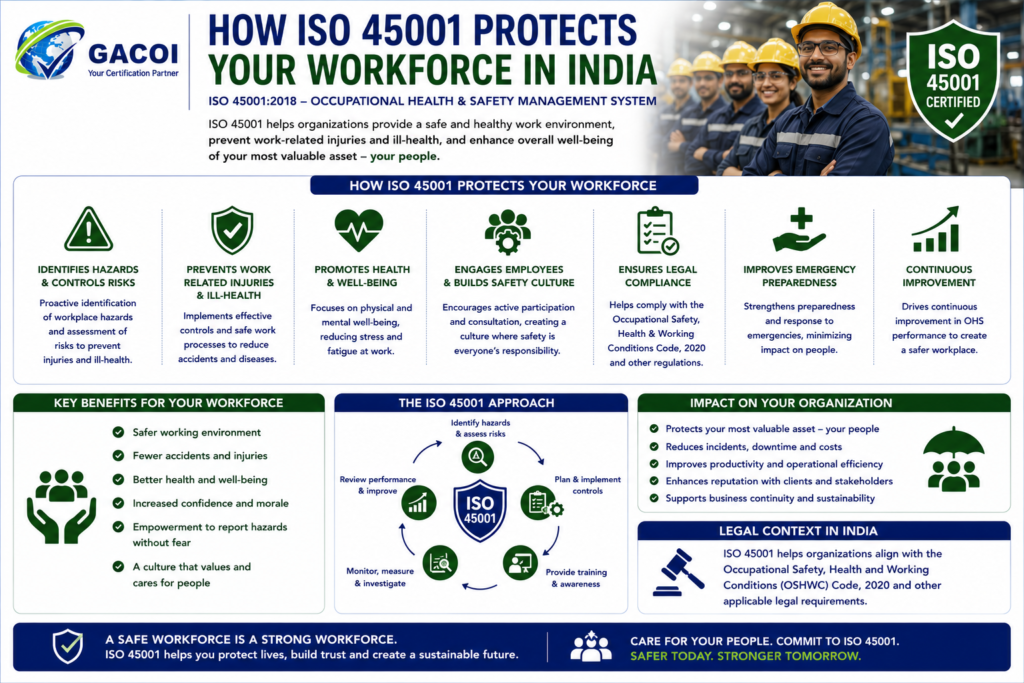
ISO 45001:2018 — the international standard for Occupational Health and Safety Management Systems — provides Indian businesses with the most comprehensive, systematically rigorous, and internationally recognized framework available for genuinely protecting their workforce. Not through compliance paperwork or safety posters — but through systematic, evidence-based management of the hazards and risks that actually cause workers to be harmed.
This comprehensive guide from GacoiCert explains exactly how ISO 45001 protects your workforce in India — covering every mechanism through which the standard prevents harm, manages health risks, builds protective safety culture, and creates the organizational conditions where workers can do their jobs safely every single day.
Understanding ISO 45001: Built Specifically to Protect Workers
ISO 45001:2018 was developed through a rigorous international consensus process — bringing together occupational health and safety experts, worker representatives, employer organizations, government authorities, and standards professionals from around the world. Its requirements reflect decades of accumulated evidence about what actually works to prevent workplace injuries and occupational illnesses.
The standard’s fundamental purpose is captured in its stated goal: eliminating hazards and minimizing OHS risks through effective preventive and protective measures. Every requirement in ISO 45001 ultimately serves this purpose — creating a management system that systematically identifies what could harm workers, implements controls that prevent harm from occurring, monitors the effectiveness of those controls, and continuously improves protection over time.
What makes ISO 45001 different from simply following safety rules:
Many Indian businesses comply with basic factory safety requirements — installing machine guards, providing PPE, displaying safety signs — without achieving systematic worker protection. These isolated measures address visible, obvious hazards but leave many significant risks unmanaged and fail to create the organizational conditions where safety is genuinely embedded in daily operations.
ISO 45001 requires something fundamentally different: a comprehensive, systematic management system that identifies all significant hazards, implements proportionate controls following a defined hierarchy of effectiveness, verifies that controls actually work, involves workers as active participants in safety management, holds top management accountable for safety outcomes, and drives continuous improvement in worker protection over time.
Protection Mechanism 1: Systematic Hazard Identification — Finding Every Risk Before It Causes Harm
The first and most fundamental way ISO 45001 protects workers is by requiring organizations to systematically identify every significant hazard in their workplace — before accidents occur rather than in response to them.
What ISO 45001 requires for hazard identification:
Organizations must establish, implement, and maintain processes for ongoing hazard identification that considers:
All workers and their activities: Routine activities — daily production operations, standard maintenance tasks, normal material handling. Non-routine activities — infrequent maintenance operations, startup and shutdown procedures, emergency situations. Activities of all workers — employees, contractors, visitors, and others who may be present at the workplace.
Human factors: How task design, physical workload, mental workload, working hours, workplace layout, and human error probability affect the likelihood of incidents.
Infrastructure and equipment: Machinery, vehicles, electrical systems, pressure systems, chemical storage, structural elements, and environmental conditions that could cause harm.
Physical, chemical, biological, and psychosocial hazards: The full spectrum of workplace hazards — not just obvious physical risks but chemical exposures, biological agents, ergonomic hazards, noise and vibration, extreme temperatures, and psychosocial factors including workplace stress, bullying, and violence.
Why this systematic approach protects workers:
In workplaces without structured hazard identification, the hazards that cause accidents are frequently hazards that were known or knowable — but were never formally assessed, never assigned to anyone for management, and never the subject of systematic control implementation. ISO 45001’s comprehensive hazard identification process closes these gaps — ensuring that every significant risk receives management attention before it results in worker harm.
In Indian manufacturing, construction, and chemical processing environments — where multiple significant hazard categories exist simultaneously — this systematic identification is particularly valuable. Chemical plants where process safety hazards, manual handling hazards, electrical hazards, and heat stress hazards all exist simultaneously cannot be safely managed through informal approaches. ISO 45001’s structured hazard identification provides the comprehensive visibility that effective multi-hazard management requires.
Protection Mechanism 2: The Hierarchy of Controls — Most Effective Protection First
Identifying hazards is only the first step. The critical question is what to do about them — and ISO 45001 provides a definitive answer through its requirement to apply the internationally recognized Hierarchy of Controls in selecting and implementing hazard controls.
The Hierarchy of Controls ranks control measures from most effective to least effective — and ISO 45001 explicitly requires organizations to work through the hierarchy from top to bottom, implementing the highest-level controls that are reasonably practicable before relying on lower-level measures.
The complete Hierarchy of Controls as required by ISO 45001:
Level 1 — Elimination: Remove the hazard entirely from the workplace. This is the most effective protection because it means the hazard no longer exists. Examples include eliminating a hazardous chemical process by redesigning the product, removing trip hazards through layout redesign, or automating a task that exposes workers to harmful conditions.
Level 2 — Substitution: Replace the hazardous element with a less hazardous alternative. Examples include replacing a highly toxic solvent with a less toxic alternative, substituting a heavy manual process with mechanized handling, or using water-based paints instead of solvent-based alternatives.
Level 3 — Engineering Controls: Physical controls that reduce exposure to hazards through design — without relying on worker behavior. Examples include machine guards preventing contact with moving parts, local exhaust ventilation systems capturing chemical emissions at source, noise enclosures reducing worker noise exposure, and interlocks preventing equipment operation when safety conditions are not met.
Level 4 — Administrative Controls: Management procedures and systems that reduce hazard exposure — such as safe work procedures, permit-to-work systems for hazardous tasks, job rotation to reduce cumulative exposure, safety training, warning signs, and emergency procedures.
Level 5 — Personal Protective Equipment: Physical protection worn by workers — helmets, gloves, respirators, safety shoes, eye protection. PPE is the last resort in the hierarchy — used when higher-level controls cannot adequately reduce risk — not the first response to hazards.
Why the Hierarchy of Controls protects workers more effectively than PPE-first approaches:
Many Indian workplaces default to PPE as the primary response to workplace hazards — providing workers with helmets, gloves, and masks without implementing the engineering and administrative controls that would actually protect them if PPE fails, is worn incorrectly, or is not worn at all. ISO 45001’s requirement to apply the hierarchy — working from elimination down to PPE — ensures that the most reliable, most effective controls are implemented first, with PPE serving its appropriate supplementary role rather than being relied upon as primary protection.
Protection Mechanism 3: Worker Participation — The People Who Know the Hazards Best
One of the most distinctive and practically important ways ISO 45001 protects workers is through its strong requirements for worker participation and consultation in safety management — an area where ISO 45001 substantially exceeds its predecessor OHSAS 18001.
What ISO 45001 requires for worker participation:
The standard dedicates a specific clause to worker participation — requiring organizations to establish, implement, and maintain processes for workers to participate in and be consulted on OHS matters. This includes:
- Involvement in hazard identification, risk assessment, and determination of controls
- Participation in incident investigation
- Involvement in development and review of OHS policies and objectives
- Consultation on changes that affect their OHS
- Involvement in identifying training needs
- Access to clear and understandable safety information
- Freedom to report hazards, incidents, and near misses without fear of retaliation
Why worker participation is essential for worker protection:
The workers performing specific jobs in manufacturing plants, construction sites, chemical facilities, and other hazardous environments possess irreplaceable knowledge about the actual hazards they face — knowledge that managers and safety professionals working at a distance from frontline operations cannot fully replicate.
A machine operator knows the specific positions in which contact with moving parts is possible — positions that a hazard assessment conducted by an engineer who has never operated the machine might miss. A chemical process worker knows the specific conditions under which unexpected reactions occur — conditions that laboratory-based risk assessment might not fully capture. A construction worker knows the specific situations where standard safe work procedures are difficult or impossible to follow — situations that a procedure written in an office might not anticipate.
ISO 45001’s worker participation requirements create formal mechanisms for this frontline safety knowledge to systematically inform hazard identification, risk assessment, control selection, and safety improvement — consistently producing more comprehensive and effective worker protection than management-only approaches achieve.
Protection from retaliation: ISO 45001 explicitly requires organizations to ensure that workers can report incidents, hazards, and concerns without fear of retaliation — recognizing that cultures where workers fear punishment for reporting safety concerns suppress the information flow that effective safety management requires.
Protection Mechanism 4: Legal Compliance Management — Protecting Workers Through Regulatory Adherence
India’s occupational health and safety regulatory framework — anchored by the Occupational Safety, Health and Working Conditions Code 2020 and implemented through state-level enforcement — creates extensive legal obligations for employers. These legal obligations exist specifically to protect workers — minimum safety standards, health surveillance requirements, exposure limits, welfare facility requirements, and accident reporting obligations that collectively establish the floor of worker protection that law requires.
How ISO 45001 ensures systematic legal compliance:
ISO 45001 requires organizations to maintain a comprehensive legal register — identifying all applicable OHS laws and regulations, consent conditions, permit requirements, and other obligations relevant to their specific operations. This register must be kept current as laws change, and compliance status against each requirement must be evaluated and evidenced.
Specific Indian OHS regulatory requirements that ISO 45001 supports:
OS&H Code 2020 obligations: Safety officer appointment requirements, safety committee establishment, written safety statement preparation, worker health surveillance, and welfare facility standards — all systematically addressed through ISO 45001’s resource, competence, and operational control requirements.
Factories Act provisions (where still applicable): Working hour limits, rest period requirements, health provisions, welfare requirements, and safety requirements for specific hazards — tracked and managed through ISO 45001’s legal compliance system.
State SPCB requirements: For manufacturing facilities with environmental safety interfaces — chemical plants, tanneries, electroplating facilities — SPCB consent conditions include safety-relevant requirements that ISO 45001’s legal register captures and manages.
Exposure limit compliance: Chemical exposure limits specified in Schedule to Factories Act and IS standards for specific hazardous chemicals — monitored and controlled through ISO 45001’s occupational health monitoring requirements.
Why legal compliance protects workers: Regulatory requirements represent minimum standards below which worker protection is legally and ethically unacceptable. ISO 45001’s systematic compliance management ensures these minimum standards are consistently met — protecting workers from the hazards that regulation specifically addresses.
Protection Mechanism 5: Occupational Health Management — Protecting Long-Term Worker Wellbeing
Worker protection is not limited to preventing acute accidents — it extends to protecting workers from the occupational diseases and long-term health impairments that develop from chronic workplace exposures. This dimension of worker protection is frequently underemphasized in Indian workplaces but represents an enormous burden of work-related ill health.
Occupational health hazards that ISO 45001 addresses:
Occupational noise-induced hearing loss: One of India’s most prevalent but least recognized occupational diseases — affecting workers in manufacturing, construction, mining, and textile industries. ISO 45001 requires systematic noise exposure assessment, engineering noise controls, audiometric surveillance, and PPE provision where engineering controls cannot adequately reduce exposure.
Chemical exposure and occupational disease: Chemical exposures — to solvents, heavy metals, pesticides, mineral dusts, and reactive chemicals — cause occupational cancers, respiratory diseases, neurological impairment, and reproductive health effects. ISO 45001’s comprehensive chemical hazard management requirements protect workers from both acute chemical incidents and chronic exposure health effects.
Dust-related lung diseases: Silicosis from crystalline silica dust, coal workers’ pneumoconiosis, asbestosis from asbestos exposure, and byssinosis from cotton dust — occupational lung diseases that are preventable through engineering controls and exposure monitoring. ISO 45001 requires systematic identification and control of dust hazards.
Ergonomic disorders and musculoskeletal injury: Repetitive strain injuries, back injuries from manual handling, and work-related upper limb disorders affect enormous numbers of Indian workers — particularly in manufacturing, construction, and service industries. ISO 45001’s comprehensive hazard identification includes ergonomic hazards, and its hierarchy of controls approach drives implementation of ergonomic engineering solutions rather than relying exclusively on worker training.
Heat stress and thermal hazards: Workers in foundries, glass manufacturing, bakeries, outdoor construction, and agricultural operations face significant heat stress risks — particularly important in India’s climate. ISO 45001 requires systematic assessment and control of thermal environment hazards.
Psychosocial hazards and mental health: Workplace stress, burnout, harassment, and workplace violence are recognized occupational health hazards under ISO 45001’s comprehensive hazard identification requirements — extending worker protection into the domain of mental health and psychological wellbeing.
Health surveillance: ISO 45001 supports health surveillance programs — systematic medical monitoring of workers exposed to specific occupational health hazards — enabling early detection of health effects before they become serious and providing data for evaluating control effectiveness.
Protection Mechanism 6: Emergency Preparedness — Protecting Workers When Incidents Occur
Even the most comprehensive preventive safety management cannot guarantee that no incidents will ever occur. ISO 45001 therefore requires organizations to prepare systematically for emergencies — ensuring that when unexpected incidents do occur, they are responded to effectively and their consequences to workers are minimized.
ISO 45001 emergency preparedness requirements:
Organizations must establish, implement, and maintain processes for potential emergency situations — identifying credible emergency scenarios, developing documented response plans, establishing emergency response teams with defined roles, providing emergency equipment and first aid resources, communicating emergency procedures to all relevant workers and others on site, and testing emergency preparedness through periodic drills and exercises.
Emergency scenarios requiring preparedness in Indian industrial settings:
- Fire and explosion — particularly critical in chemical, textile, food processing, and manufacturing environments
- Chemical spill or toxic release — essential for chemical manufacturers, pharmaceutical producers, and any facility storing significant quantities of hazardous chemicals
- Medical emergency response — cardiac events, serious trauma, chemical exposure — requiring trained first aid responders and established emergency services contact protocols
- Natural disaster response — flooding, earthquake, cyclone — particularly relevant for facilities in geographically vulnerable locations
- Power failure and process upset — for facilities where power loss creates safety hazards through loss of ventilation, process control, or emergency systems
Why emergency preparedness protects workers:
Research on industrial disaster outcomes consistently demonstrates that the difference between a serious incident that injures a few workers and a catastrophic event that kills many is frequently the quality of emergency response in the first minutes after the incident begins. ISO 45001’s emergency preparedness requirements — trained responders, available equipment, practiced procedures, established evacuation routes — directly determine how quickly and effectively workers are protected when preventive controls fail.
Protection Mechanism 7: Incident Investigation — Learning from Near Misses Before Accidents Occur
Every serious workplace accident is preceded by warning signs — near misses, minor incidents, and hazard conditions that indicate system failures before those failures result in worker harm. ISO 45001’s incident investigation requirements create systematic mechanisms for identifying and responding to these warnings before they escalate.
ISO 45001 incident investigation requirements:
Organizations must establish processes for reporting, investigating, and taking action on incidents — including accidents that cause worker harm, near misses where harm did not occur but could have, and dangerous occurrences that reveal systemic hazard control failures.
Investigations must determine root causes — not just immediate causes — using systematic investigation methodologies that identify the underlying organizational, management, and system factors that contributed to the incident alongside the immediate physical causes.
Investigation findings must be communicated to relevant workers. Corrective actions addressing root causes must be implemented and their effectiveness verified.
Why near miss investigation protects workers:
Heinrich’s Triangle — the classic model of accident causation — suggests that for every serious accident there are many more near misses and minor incidents that share the same underlying causes. Organizations that systematically investigate near misses identify and address hazard control failures before they result in serious worker harm — consistently achieving significantly lower serious accident rates than organizations that only investigate after harm has occurred.
Protection Mechanism 8: Top Management Leadership — Creating a Culture Where Safety Is Genuinely Valued
All of the technical protection mechanisms described above — hazard identification, hierarchy of controls, worker participation, legal compliance, health management, emergency preparedness, and incident investigation — only deliver their full worker protection potential in organizations where top management genuinely leads safety rather than merely administering it.
ISO 45001’s leadership requirements for worker protection:
Top management must demonstrate visible, active leadership in OHS — not merely endorse a policy document. Specific requirements include:
- Taking overall accountability for preventing work-related injury and ill health — not delegating this accountability entirely to safety professionals
- Ensuring OHS requirements are integrated into core business processes — not treated as a separate compliance activity
- Protecting workers who report safety concerns from retaliation — creating psychological safety for open safety communication
- Promoting a culture that values safety alongside productivity — not communicating through words or decisions that production always takes priority over safety
- Providing the resources — financial, human, and time — necessary for effective safety management
- Actively participating in safety activities — workplace safety walks, safety committee meetings, incident reviews
Why leadership protection of workers is fundamental:
Research on organizational safety culture consistently identifies leadership behavior as the single most important determinant of safety performance. Workers in organizations where senior leaders visibly and genuinely prioritize safety — where leaders stop production for safety concerns, where safety concerns are taken seriously regardless of production pressure, where leaders are seen on the shop floor engaging with safety issues — achieve dramatically lower accident rates than equivalent organizations where safety is formally required but culturally undervalued.
ISO 45001’s strengthened leadership requirements create the conditions for the genuine safety culture that ultimately protects workers more effectively than any technical control measure alone.
The Business Benefits of Protecting Your Workforce Through ISO 45001
Workforce protection through ISO 45001 is not only the right thing to do — it is the smart business decision. The returns on investment in systematic worker protection are compelling:
Reduced accident costs: Every serious accident avoided saves tens of lakhs to crores of rupees in direct and indirect costs — medical expenses, compensation, legal fees, investigation costs, production disruption, and insurance impact.
Lower insurance premiums: ISO 45001 certified organizations consistently receive more favorable workers’ compensation and liability insurance terms — with premium reductions that partially or fully offset annual certification costs.
Improved productivity: Fewer accidents mean less production disruption, less absenteeism, and more consistent workforce availability — directly improving manufacturing output and service delivery.
Better employee retention: Workers who feel genuinely safe and valued are more loyal — reducing the significant recruitment and training costs associated with high turnover.
Tender and contract access: Government tenders, corporate supply chain qualifications, and international export relationships increasingly require ISO 45001 certification — making workforce protection investment directly revenue-generating.
ESG and investor confidence: ISO 45001 certification strengthens the Social component of ESG credentials — improving investor confidence, supporting sustainability-linked financing, and demonstrating the corporate responsibility that SEBI BRSR reporting requires.
Why Choose GacoiCert for ISO 45001 Certification in India?
Internationally accredited: GacoiCert’s ISO 45001 certificates are issued under internationally recognized accreditation — verifiable through NABCB and IAF databases, accepted by government authorities, corporate buyers, and international clients worldwide.
Deep OHS expertise: Our auditors bring genuine occupational health and safety management knowledge across manufacturing, construction, healthcare, chemical processing, logistics, and all other major Indian industries.
India-specific regulatory knowledge: OS&H Code 2020, Factories Act, CPCB interface requirements — our auditors understand India’s complete occupational safety regulatory landscape.
Integrated Management System capability: ISO 45001 combined with ISO 9001 and ISO 14001 through a single coordinated audit — maximum efficiency and minimum cost.
Transparent competitive pricing: Complete itemized quotations with no hidden fees.
Pan-India service coverage: Delhi NCR, Mumbai, Pune, Bangalore, Chennai, Hyderabad, Kolkata, Ahmedabad, Ludhiana, and all major cities and industrial centers across India.
Conclusion: ISO 45001 Is the Most Powerful Tool Available for Protecting Indian Workers
The eight protection mechanisms explored in this guide — systematic hazard identification, hierarchy of controls, worker participation, legal compliance management, occupational health management, emergency preparedness, incident investigation, and top management leadership — collectively create a comprehensive, multilayered system of worker protection that goes far beyond compliance paperwork or safety signage.
ISO 45001 protects workers by identifying every significant hazard before it causes harm, implementing the most effective controls available, involving workers as active safety partners, ensuring legal obligations are systematically met, managing long-term occupational health risks, preparing organizations to respond effectively to emergencies, learning from near misses before accidents occur, and creating the leadership-driven safety culture where all of these mechanisms operate effectively.
For Indian businesses in 2026, the moral case for protecting workers through ISO 45001 is clear. The business case — in accident cost avoidance, regulatory compliance, market access, insurance savings, productivity improvement, and talent retention — is equally compelling. And the human case — the workers who go home safely to their families every evening because systematic safety management identified and controlled the hazard that would otherwise have harmed them — is the most important case of all.
GacoiCert is ready to help your organization protect its workforce through ISO 45001 certification. Visit gacoicert.com today, request your free consultation, and take the first step toward a workplace where every worker is genuinely safe every day.
Frequently Asked Questions
What Is ISO 45001 and How Does It Protect Your Workforce?
ISO 45001 is an international occupational health and safety management standard that helps organizations identify workplace hazards, reduce risks, and create a safer working environment for employees.
How Does ISO 45001 Help Reduce Workplace Accidents?
ISO 45001 requires organizations to assess risks, implement preventive measures, provide employee training, and continuously monitor workplace safety to minimize accidents and injuries.
Which Industries Benefit the Most from ISO 45001?
Industries such as manufacturing, construction, healthcare, logistics, mining, engineering, and oil and gas benefit significantly because they involve higher occupational health and safety risks.
Can ISO 45001 Improve Employee Health and Well-Being?
Yes. ISO 45001 promotes safe working conditions, employee participation, health protection measures, and continuous improvement, helping organizations support the overall well-being of their workforce.
Does ISO 45001 Help Employers Meet Legal Safety Requirements?
Yes. ISO 45001 provides a structured framework that helps businesses identify applicable health and safety regulations and maintain better compliance with legal obligations.
How Does ISO 45001 Encourage Employee Participation?
The standard encourages employees to report hazards, participate in safety discussions, contribute to risk assessments, and take an active role in improving workplace safety.
Can Small Businesses Implement ISO 45001?
Yes. ISO 45001 is suitable for organizations of all sizes, including startups, MSMEs, and large enterprises, regardless of industry.
What Are the Business Benefits of ISO 45001 Beyond Employee Safety?
In addition to protecting workers, ISO 45001 helps improve productivity, reduce downtime, lower workplace incident costs, strengthen business reputation, and increase customer confidence.
How Long Does It Take to Implement ISO 45001?
The implementation timeline varies depending on the organization’s size, existing safety practices, and documentation, but many businesses complete the process within a few weeks to a few months.
Why Should Organizations Invest in ISO 45001 Certification?
Investing in ISO 45001 demonstrates a commitment to employee safety, reduces occupational risks, supports regulatory compliance, improves operational efficiency, and builds trust with customers, employees, and business partners.
Get Expert Guidance for ISO Certification
🟡GACOI Cert provides globally recognized ISO certification, cybersecurity, privacy, AI governance, compliance, audit, and professional training services, helping startups, businesses, enterprises, laboratories, healthcare organizations, and government institutions achieve international standards and build lasting trust.
🟡For other Legal and Trademark related services Visit
👉 Money Recovery Cases
👉 Property Disputes
👉ISO Registration
👉ISO 22000 Certification
🟡 Protect Your Rights
👉 Domestic Violence Legal Support
👉 Stridhan Recovery
👉 Mutual Consent Divorce
👉 Contested Divorce Filing
📞 Call Now: +91 8595439395
🕐 Free Consultation: Monday to Saturday, 10 AM to 6 PM


