


Views: 1
Learn exactly how to get ISO 9001 certified in India with this complete step-by-step guide for 2026. Understand the process, timeline, cost, and how GacoiCert makes certification simple and fast.
Table of Contents
- 1 Introduction: Why ISO 9001 Certification Matters for Indian Businesses
- 2 What Is ISO 9001:2015 Certification?
- 3 Who Can Get ISO 9001 Certified in India?
- 4 Step-by-Step Guide to Getting ISO 9001 Certified in India
- 5 ISO 9001 Certification Timeline in India
- 6 ISO 9001 Certification Cost in India
- 7 Common Mistakes to Avoid
- 8 Why Choose GacoiCert for ISO 9001 Certification in India?
- 9 Conclusion: Your ISO 9001 Certification Journey Starts Today
- 10 Frequently Asked Questions
- 11 Need ISO 9001 Registration
Introduction: Why ISO 9001 Certification Matters for Indian Businesses
In today’s competitive Indian business landscape, simply offering a good product or service is no longer sufficient. Customers, government procurement bodies, and international buyers demand verified proof of quality — proof that is globally recognized and independently verified.
This is precisely where ISO 9001:2015 certification becomes a critical business asset.
ISO 9001 is the world’s most widely adopted Quality Management System (QMS) standard, with over one million certified organizations across 170 countries. In India, ISO 9001 certification is increasingly becoming a mandatory requirement for government tenders, corporate supplier approvals, export market access, and major B2B contracts.
Whether you are a small business owner looking to win your first major tender, a manufacturing company aiming to enter export markets, or an IT service provider wanting to build credibility with enterprise clients — ISO 9001 certification is a powerful step forward.
This comprehensive, step-by-step guide will walk you through the entire ISO 9001 certification process in India — from the very first decision to receiving your certificate and maintaining it long-term. With GacoiCert as your certification partner, this journey is simpler, faster, and more rewarding than you might expect.
What Is ISO 9001:2015 Certification?
ISO 9001 is an internationally recognized standard published by the International Organization for Standardization (ISO) that defines the requirements for a Quality Management System (QMS).
When your organization achieves ISO 9001 certification, it means that an accredited third-party certification body — such as GacoiCert — has independently verified that your Quality Management System consistently meets the requirements defined in ISO 9001:2015.
The certification demonstrates that your organization:
- Consistently delivers products or services that meet customer requirements
- Has documented, systematic, and repeatable processes in place
- Actively monitors quality performance and drives continuous improvement
- Is committed to customer satisfaction at every level of the organization
The current version, ISO 9001:2015, introduced risk-based thinking, stronger leadership involvement, and a more flexible, process-oriented approach compared to earlier versions.
Who Can Get ISO 9001 Certified in India?
One of the greatest strengths of ISO 9001 is its universal applicability. Any organization — regardless of size, industry, or type — can pursue and achieve ISO 9001 certification.
This includes:
- Manufacturing companies of all sizes
- IT and software development companies
- Construction and infrastructure firms
- Healthcare providers and diagnostic labs
- Educational institutions and training centers
- Logistics and transport companies
- Hospitality and food service businesses
- Consulting and professional service firms
- Government and public sector bodies
- Startups and micro-enterprises
There is no minimum employee count, no minimum turnover requirement, and no industry restriction. If your organization has processes, delivers products or services, and serves customers — ISO 9001 certification is achievable and valuable for you.
Step-by-Step Guide to Getting ISO 9001 Certified in India
Step 1: Secure Genuine Top Management Commitment
Every successful ISO 9001 certification journey begins at the top. This is not a formality — it is the single most critical factor that determines whether your implementation will be genuinely effective or merely cosmetic.
Top management must formally commit to:
- Providing the necessary resources — time, budget, and personnel
- Establishing and communicating the organization’s Quality Policy
- Integrating the QMS into core business operations and strategy
- Promoting a culture of quality throughout the organization
- Actively participating in management reviews and quality decisions
Practical Action: Conduct a formal leadership meeting where the ISO 9001 certification decision is officially endorsed, a project budget is approved, and a senior leader is appointed to lead the initiative.
If top management views ISO 9001 as merely a paperwork exercise or a box to tick, the implementation will inevitably fail to deliver real value. Genuine leadership commitment is non-negotiable.
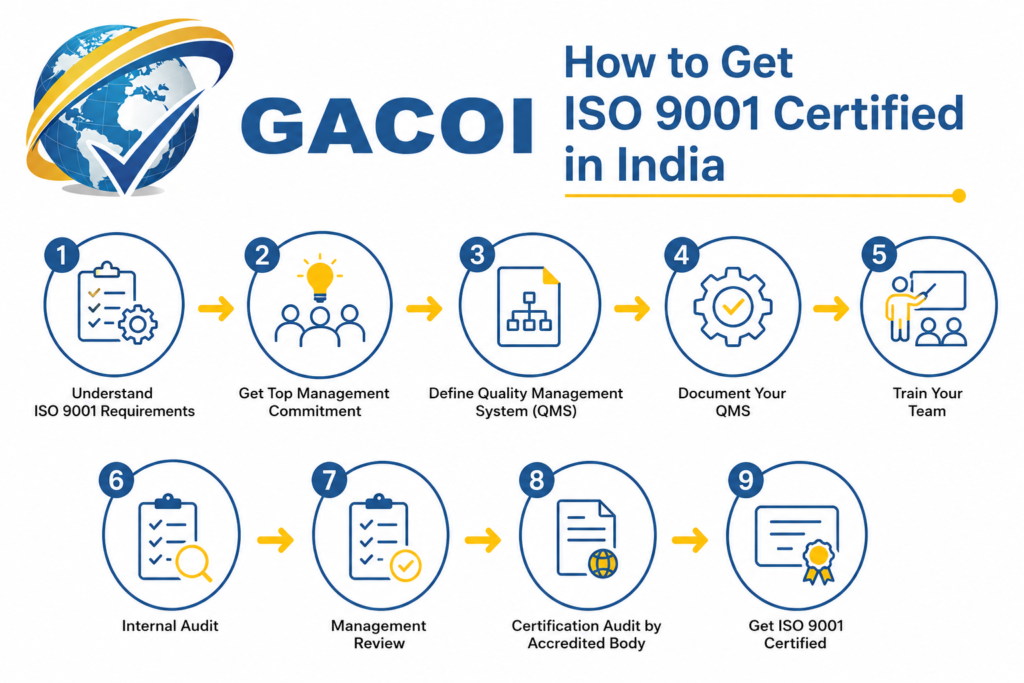
Step 2: Assemble Your ISO 9001 Implementation Team
ISO 9001 certification is not a one-person project. Build a cross-functional implementation team that represents all major areas of your business.
Key roles include:
Management Representative (MR) / QMS Project Lead: A senior individual — typically a Quality Manager, Operations Head, or Senior Manager — who coordinates the entire implementation, liaises with the certification body, and ensures the project stays on track.
Department Representatives: At least one representative from each key function — Sales, Operations or Production, Human Resources, Finance, Procurement, and IT — who can document their department’s processes and drive implementation within their teams.
Top Management Sponsor: The CEO, MD, or Owner who provides final authority, resources, and strategic direction.
For small businesses with fewer than 10 employees, a team of two to three people is perfectly sufficient. What matters is clarity of roles and genuine commitment to the project.
Step 3: Understand the ISO 9001:2015 Standard
Before you can implement ISO 9001, your team must thoroughly understand what the standard requires. Reading the standard carefully and understanding how its requirements apply to your specific business context is essential.
Key clauses to understand:
- Clause 4 — Context of the Organization: Understanding your business environment, interested parties, and defining the QMS scope
- Clause 5 — Leadership: Top management responsibilities, Quality Policy, and organizational roles
- Clause 6 — Planning: Risk and opportunity management, quality objectives
- Clause 7 — Support: Resources, competence, awareness, communication, and documented information
- Clause 8 — Operation: Product and service planning, design, production, and delivery processes
- Clause 9 — Performance Evaluation: Monitoring, measurement, internal audits, and management reviews
- Clause 10 — Improvement: Nonconformities, corrective actions, and continual improvement
Recommended approach: Invest in ISO 9001 awareness training for your implementation team. GacoiCert offers ISO 9001 training programs specifically designed for Indian businesses that cover both the standard requirements and practical implementation guidance.
Step 4: Conduct a Thorough Gap Analysis
A gap analysis is a systematic comparison between your organization’s current practices and the requirements of ISO 9001:2015. This is one of the most important steps in the entire process — it tells you exactly where you stand and what needs to be done.
How to conduct a gap analysis:
Go through each requirement of ISO 9001:2015 clause by clause and assess your current status against each requirement:
- Fully Met: Your current practices completely satisfy the requirement
- Partially Met: Some elements are in place but gaps exist
- Not Met: The requirement is currently not addressed at all
Common gaps found in Indian businesses:
- Absence of formally documented processes and procedures
- No structured system for collecting and analyzing customer feedback
- No formal supplier evaluation or qualification process
- Absence of a systematic internal audit program
- No formal management review process with documented records
- Quality objectives not formally defined or monitored
- Inadequate record-keeping and document control
Gap analysis output: A prioritized action plan listing what needs to be done, who is responsible, and by when. This becomes your implementation roadmap.
Step 5: Define Your QMS Scope
The QMS scope defines the boundaries of what your ISO 9001 certification will cover. It describes which products, services, locations, and business functions are included within your Quality Management System.
Examples of scope statements:
“Design, development, and manufacturing of precision engineering components for the automotive industry at our Pune facility.”
“Provision of IT software development and testing services for domestic and international clients from our Bangalore office.”
“Construction and project management services for residential and commercial infrastructure projects across Maharashtra.”
When defining your scope, consider your organizational context, the nature of your products and services, and your customers’ expectations. The scope must be realistic, accurate, and meaningful — not artificially narrow to avoid difficult requirements.
Step 6: Design and Document Your Quality Management System
This is the stage where you build the foundation of your QMS — the documented information that defines how your organization operates, controls quality, and drives improvement.
Mandatory documented information required by ISO 9001:2015:
- Quality Policy
- Quality Objectives and monitoring results
- Competence and training records
- Evidence of planning for processes
- Customer requirements review records
- Supplier evaluation and monitoring records
- Product and service conformity evidence
- Records of nonconforming outputs
- Internal audit records and results
- Management review records
- Corrective action records
Recommended additional documents:
- Quality Manual (not mandatory but practically useful)
- Process maps and flowcharts
- Standard Operating Procedures (SOPs) for key processes
- Work instructions for critical tasks
- Customer complaint handling procedure
- Document and record control procedure
- Risk register
Important principle: Documents should reflect how your business actually operates — not how you wish it operated or how a generic template suggests. Avoid copying templates from the internet without tailoring them to your specific processes. Auditors will immediately identify generic documentation that does not match actual operations.
Step 7: Implement the QMS Across Your Organization
Documentation alone does not earn you a certificate. The QMS must be actively implemented — meaning your documented processes must be followed in day-to-day operations, and records must be maintained as evidence.
Key implementation activities:
Employee Training and Awareness: Every employee must understand the Quality Policy, the organization’s quality objectives, and how their specific role contributes to quality. Relevant staff must be trained on the procedures and processes that apply to their work.
Process Implementation: Your documented processes must be integrated into actual daily operations. Process owners must take responsibility for ensuring their teams follow established procedures.
Customer Communication Systems: Establish a structured mechanism for collecting customer feedback — surveys, feedback forms, periodic reviews — and a formal customer complaint handling process with documented resolution records.
Supplier Management: Evaluate and qualify your key suppliers, define supplier evaluation criteria, and establish a process for monitoring supplier performance on an ongoing basis.
Risk Management: Identify significant business risks and opportunities, develop mitigation plans for key risks, and implement preventive actions before problems occur.
Record Keeping: This is critical. Maintain consistent, accurate records across all processes — training completion, customer interactions, nonconformities, corrective actions, and quality measurements. Records are the evidence that your QMS is working.
Implementation timeline: Allow one to three months for implementation, depending on your organization’s size and complexity. Avoid attempting to implement everything simultaneously — a phased approach, starting with the most critical processes, is more effective and sustainable.
Step 8: Run the QMS and Gather Evidence
Once the QMS is implemented, it must be operational for a meaningful period before the certification audit. Most certification bodies expect a minimum of three months of documented QMS operation before the certification audit.
During this period, consistently collect and maintain:
- Customer satisfaction measurement results
- Quality objective monitoring data
- Supplier evaluation records
- Process performance metrics and KPIs
- Training completion records
- Customer complaint records and evidence of resolution
- Nonconformity records and corrective action evidence
This operational evidence demonstrates to auditors that your QMS is genuinely functioning — not merely documented on paper.
Step 9: Conduct an Internal Audit
An internal audit is a mandatory ISO 9001 requirement and an essential step before your certification audit. It is a formal, systematic review of your QMS conducted by trained internal auditors within your organization.
Purpose of the internal audit:
- Verify that the QMS meets ISO 9001:2015 requirements
- Confirm that the QMS is effectively implemented and maintained
- Identify gaps and nonconformities before the certification auditors find them
- Provide top management with an objective assessment of QMS performance
Internal audit process:
Develop an audit plan covering all relevant clauses and processes within your QMS scope. Internal auditors should be independent of the areas they audit — meaning they should not audit their own direct work areas.
Conduct the audit through a combination of document review, interviews with employees at all levels, and direct observation of processes.
Audit findings categories:
- Conformities: Requirements are met
- Minor Nonconformities: Isolated failures or partial compliance
- Major Nonconformities: Significant failures that must be addressed before certification
For every nonconformity identified, conduct a root cause analysis and implement effective corrective actions with documented evidence of resolution.
Step 10: Conduct a Management Review
Following the internal audit, top management must conduct a formal Management Review — a structured meeting where senior leadership reviews the overall performance and effectiveness of the QMS.
ISO 9001:2015 requires the management review to consider:
- Status of actions from previous management reviews
- Changes in external and internal issues relevant to the QMS
- Customer satisfaction data and feedback
- Quality objective achievement status
- Process performance data and product/service conformity
- Nonconformities and corrective action effectiveness
- Internal and external audit results
- Supplier performance
- Resource adequacy
- Improvement opportunities
Management review outputs must include decisions on:
- Improvement opportunities
- Any changes needed to the QMS
- Resource requirements
The management review must be formally documented — minutes or a review report with clear action items and responsibilities.
Step 11: Select the Right Certification Body
Choosing the right certification body is one of the most consequential decisions in your ISO 9001 journey. Your certificate is only as credible as the body that issues it.
Key criteria for selecting a certification body:
Accreditation Status: The certification body must be accredited by a recognized accreditation body. In India, look for accreditation from:
- NABCB (National Accreditation Board for Certification Bodies) — India’s premier accreditation body recognized by IAF
- UKAS (United Kingdom Accreditation Service)
- DAkkS (Deutsche Akkreditierungsstelle — Germany)
- JAS-ANZ (Joint Accreditation System of Australia and New Zealand)
- ANAB (ANSI National Accreditation Board — USA)
Warning: Numerous non-accredited or fraudulent certification bodies operate in India offering cheap, fast certificates. These certificates are not recognized by government tendering authorities, international buyers, or legitimate procurement departments. Always verify accreditation status before engaging any certification body.
Industry experience: The certification body should have auditors with direct experience in your specific industry.
Transparency: Clear, upfront pricing with no hidden charges.
Service quality: Responsive communication, professional auditors, and a structured audit process.
Step 12: Submit Your Certification Application to GacoiCert
Once you have selected GacoiCert as your certification body, submit your formal application. The application typically requires:
- Organization name, address, and contact details
- Defined QMS scope
- Number of employees (total and effective/relevant)
- Number of sites to be included in certification
- Industry sector or NACE code
- Details of any existing ISO certifications
GacoiCert will review your application, confirm the certification scope, calculate the audit duration based on IAF guidelines, provide a formal quotation, and schedule your audit dates.
Step 13: Stage 1 Audit — Documentation Review
The Stage 1 audit, also known as the readiness review or documentation review, is the first formal audit in the certification process.
What happens in Stage 1:
GacoiCert’s auditor reviews your QMS documentation to assess whether it adequately addresses ISO 9001:2015 requirements. This includes your Quality Policy, Quality Objectives, process documentation, internal audit records, and management review records.
Purpose of Stage 1:
- Confirm that your documented QMS meets the standard’s requirements
- Assess your organization’s readiness for the Stage 2 audit
- Identify any significant gaps that need to be addressed before the on-site assessment
Stage 1 output:
A Stage 1 audit report identifying any concerns or areas requiring attention before the Stage 2 audit, along with confirmation of the Stage 2 audit schedule.
Stage 1 issues are common and expected — particularly for first-time certifications. They represent an opportunity to make corrections before the main audit, not a reason for alarm.
Step 14: Stage 2 Audit — On-Site Certification Assessment
The Stage 2 audit, also called the main certification audit, is the comprehensive on-site assessment where GacoiCert auditors verify that your QMS is not only documented but actually implemented and effective throughout your organization.
What happens in Stage 2:
Opening Meeting: The auditor confirms the audit agenda, scope, and introduces the audit team.
Document and Records Review: Auditors examine key procedures, work instructions, and records — training records, customer complaints, nonconformities, corrective actions, supplier evaluations, internal audit records, and management review minutes.
Process Auditing: Auditors observe actual work being performed, interview employees at all levels — from senior management to frontline staff — and verify that documented processes reflect actual practice.
Closing Meeting: Auditors present all findings, discuss any nonconformities, and explain next steps.
Audit findings:
- No nonconformities or observations only: Certification is recommended immediately
- Minor nonconformities: Certification is recommended subject to corrective actions being implemented and evidence submitted within an agreed timeframe — typically 30 to 90 days
- Major nonconformities: Certification is withheld until the major issues are resolved and verified — which may require an additional audit visit
Step 15: Address Nonconformities and Receive Your Certificate
For any nonconformities identified during the Stage 2 audit, follow this structured response process:
- Identify the root cause of the nonconformity — not just the symptom
- Implement an immediate correction to fix the specific problem
- Implement a systemic corrective action to prevent recurrence
- Collect objective evidence that the correction and corrective action have been implemented
- Submit your response to GacoiCert within the agreed timeframe
Once all nonconformities have been satisfactorily addressed and GacoiCert makes a positive certification decision, your ISO 9001:2015 certificate is issued.
The certificate is valid for three years, subject to annual surveillance audits.
Step 16: Maintain Your Certificate Through Surveillance Audits
ISO 9001 certification is not a one-time achievement — it must be actively maintained.
Surveillance audit schedule:
- Year 1 Surveillance Audit: Approximately 12 months after certificate issue
- Year 2 Surveillance Audit: Approximately 24 months after certificate issue
- Recertification Audit: Approximately 36 months after certificate issue — starts a new three-year cycle
Surveillance audits review a subset of your QMS — typically internal audit results, management review records, corrective actions, quality objective achievement, customer complaint handling, and selected process areas.
Organizations that maintain their QMS genuinely — rather than only preparing for audits — consistently pass surveillance audits without difficulty.
ISO 9001 Certification Timeline in India
| Organization Size | Implementation | Internal Audit and Management Review | Certification Audit | Total Time |
|---|---|---|---|---|
| Very Small (1–5 employees) | 4–6 weeks | 2–3 weeks | 1–2 weeks | 2–3 months |
| Small (5–25 employees) | 6–10 weeks | 3–4 weeks | 2–3 weeks | 3–4 months |
| Medium (25–100 employees) | 10–16 weeks | 4–6 weeks | 3–4 weeks | 4–6 months |
| Large (100–500 employees) | 16–24 weeks | 6–8 weeks | 4–6 weeks | 6–10 months |
ISO 9001 Certification Cost in India
| Organization Size | Estimated Certification Body Fees |
|---|---|
| Very Small (1–10 employees) | ₹25,000 – ₹50,000 |
| Small (10–50 employees) | ₹50,000 – ₹1,00,000 |
| Medium (50–200 employees) | ₹1,00,000 – ₹2,50,000 |
| Large (200+ employees) | ₹2,50,000 and above |
Additional costs to consider include ISO 9001 training, consultant fees if external support is engaged, internal resource time, and any infrastructure or documentation tool investments.
From an ROI perspective, the cost of ISO 9001 certification is typically recovered through a single major tender win, a new enterprise client, or the operational efficiency gains that effective QMS implementation delivers.
Common Mistakes to Avoid
Choosing a non-accredited certification body: This is the most damaging mistake. Certificates from non-accredited bodies are not recognized by government authorities, international buyers, or credible procurement teams. Always verify accreditation.
Treating certification as a paperwork exercise: Organizations that implement ISO 9001 purely to obtain a certificate — without genuine operational change — derive minimal benefit and consistently struggle during surveillance audits.
Copying generic templates without customization: Documents must accurately reflect your actual business processes. Generic, uncustomized documentation fails in certification audits.
Excluding employees from the process: ISO 9001 requires that employees at all levels understand and actively participate in the QMS. A system that only exists in management’s awareness will not sustain.
Neglecting record-keeping: Records are the evidence that your QMS is working. Without consistent, accurate records, auditors cannot verify compliance regardless of how good your documented procedures are.
Becoming complacent after certification: Many organizations experience declining QMS effectiveness after receiving their certificate. Maintaining the system with the same rigor applied during certification is essential for long-term value and successful surveillance audits.
Why Choose GacoiCert for ISO 9001 Certification in India?
GacoiCert is one of India’s trusted accredited certification bodies, helping businesses across all industries achieve internationally recognized ISO certifications.
Internationally accredited: GacoiCert’s certificates are recognized globally — giving your business credibility in both Indian and international markets.
Industry expertise across all sectors: Our auditors bring deep, sector-specific knowledge to every audit — manufacturing, IT, construction, healthcare, education, logistics, and more.
Transparent and competitive pricing: No hidden fees, no surprises. You receive a clear, comprehensive quote before the process begins.
Efficient certification process: Our streamlined approach minimizes unnecessary delays while maintaining the highest audit standards.
Pan-India service: We serve businesses across Delhi, Mumbai, Bangalore, Chennai, Hyderabad, Pune, Kolkata, and all major cities and regions across India.
Multi-standard capability: In addition to ISO 9001, GacoiCert offers ISO 14001, ISO 45001, ISO 22000, and Integrated Management System certifications — making us your single certification partner as your business grows.
Genuine audit partnership: Our auditors are experienced professionals who provide objective, constructive assessments — helping you achieve meaningful quality improvement, not just compliance.
Conclusion: Your ISO 9001 Certification Journey Starts Today
Getting ISO 9001 certified in India is a structured, achievable process — and one of the most impactful investments a business can make in its own future.
The sixteen steps outlined in this guide provide a clear, practical roadmap from initial commitment to receiving your internationally recognized certificate. Organizations that follow this process diligently — with genuine top management commitment and active employee participation — consistently emerge with a stronger, more efficient, and more competitive business.
ISO 9001 certification opens doors to government tenders, corporate supply chains, export markets, and enterprise clients that would otherwise be out of reach. It strengthens your brand reputation, improves your internal processes, reduces costly errors, and builds lasting customer confidence.
GacoiCert is ready to be your trusted certification partner at every step of this journey. Visit gacoicert.com today, request a free consultation, and take the first step toward ISO 9001 certification for your business.
Frequently Asked Questions
1. What is ISO 9001 Registration?
ISO 9001 certification is an internationally recognized standard for Quality Management Systems (QMS). It helps organizations improve operational efficiency, maintain consistent quality, enhance customer satisfaction, and demonstrate a commitment to continual improvement.
2. Who can apply for ISO 9001 Registration in India?
Any business, startup, MSME, manufacturer, service provider, educational institution, healthcare organization, or non-profit can apply for ISO 9001 certification, regardless of its size or industry.
3. What are the steps to get ISO 9001 certified in India?
The process for ISO 9001 certification typically includes understanding the standard, implementing a Quality Management System (QMS), preparing the required documentation, conducting internal audits, addressing non-conformities, and undergoing an audit by an accredited certification body.
4. How long does it take to obtain ISO 9001 certification?
The time required for ISO 9001 certification depends on the size and complexity of the organization. Small businesses may complete the process within a few weeks, while larger organizations may require several months to fully implement the required quality management practices.
5. What documents are required for ISO 9001 certification?
Common documents for ISO 9001 certification include the quality policy, quality objectives, process documentation, Standard Operating Procedures (SOPs), risk assessments, internal audit reports, management review records, and other documents required under the Quality Management System.
6. How much does ISO 9001 certification cost in India?
The cost of ISO 9001 certification depends on factors such as the organization’s size, number of employees, scope of certification, number of locations, and the certification body selected. It is advisable to obtain quotations from accredited certification providers.
7. Is ISO 9001 certification mandatory in India?
No. ISO 9001 certification is generally voluntary. However, many government tenders, corporate clients, and international customers prefer or require suppliers to have ISO 9001 certification to ensure consistent quality standards.
8. What are the benefits of ISO 9001 certification?
ISO 9001 certification helps improve product and service quality, increase customer confidence, streamline business processes, reduce operational errors, enhance compliance, strengthen market credibility, and create better opportunities for business growth and government or international contracts.
Need ISO 9001 Registration
🟡GACOI Cert provides globally recognized ISO certification, cybersecurity, privacy, AI governance, compliance, audit, and professional training services, helping startups, businesses, enterprises, laboratories, healthcare organizations, and government institutions achieve international standards and build lasting trust.
🟡For other Legal and Trademark related services Visit
👉 Money Recovery Cases
👉 Property Disputes
👉 Business & Licence Registrations
🟡 Protect Your Rights
👉 Domestic Violence Legal Support
👉 Stridhan Recovery
👉 Mutual Consent Divorce
👉 Contested Divorce Filing
👉 Child Custody and Maintenance
👉 Matrimonial Property Settlement
👉 NRI Divorce Services
👉 Alimony and Maintenance
📞 Call Now: +91 8595439395
🕐 Free Consultation: Monday to Saturday, 10 AM to 6 PM


