


Views: 1
Discover the complete ISO 50001 certification cost breakdown and step-by-step process for Indian businesses in 2026 — certification body fees, consultant costs, timelines, and how GacoiCert makes certification simple and affordable.
Table of Contents
- 1 Introduction: Understanding the Real Investment Behind ISO 50001 Certification
- 2 Part 1: What Determines ISO 50001 Certification Cost
- 3 Part 2: ISO 50001 Certification Body Fees in India 2026
- 4 Part 3: Consultant and Implementation Support Costs
- 5 Part 4: Total First-Year Investment Summary
- 6 Part 5: Why This Investment Delivers Strong Returns
- 7 Part 6: The Complete ISO 50001 Certification Process — Step by Step
- 8 Part 7: Realistic Timeline Summary by Organization Size
- 9 Part 8: Common Factors That Delay Certification
- 10 Part 9: Integrated Certification — Reducing Cost Through Combined Audits
- 11 Part 10: Why Choose GacoiCert for ISO 50001 Certification
- 12 Conclusion: Planning Your ISO 50001 Certification Investment for 2026
- 13 Frequently Asked Questions
- 14 Get Expert Guidance for ISO Certification
Introduction: Understanding the Real Investment Behind ISO 50001 Certification
For most Indian businesses evaluating ISO 50001 certification, two questions dominate the decision-making process: how much will it actually cost, and what does the certification process actually involve. Unfortunately, many organizations either overestimate the complexity and expense involved — assuming certification requires the kind of investment reserved for large multinational manufacturers — or underestimate the genuine effort required, leading to poorly planned implementations that struggle to pass certification audits.
This guide from GacoiCert provides a transparent, detailed breakdown of exactly what ISO 50001 certification costs in India in 2026, what drives cost variation between organizations, and precisely what the certification process involves from initial decision through to certificate issuance and ongoing maintenance.
Part 1: What Determines ISO 50001 Certification Cost
Before presenting specific cost figures, it is important to understand the variables that drive cost variation between organizations, since no single flat fee applies universally.
Organization size and employee count: Certification bodies calculate audit duration — and therefore audit fees — primarily based on the number of employees whose activities relate to energy consumption, since this determines how many person-days of on-site auditing are required to adequately assess the Energy Management System.
Number of sites and geographic spread: Organizations operating multiple manufacturing plants, branch offices, or facility locations require multi-site audit sampling, increasing both audit duration and total certification cost compared to single-site organizations.
Energy intensity and process complexity: Organizations with numerous Significant Energy Uses, complex process equipment, and diverse energy sources require more extensive energy review scope, generally translating into higher consultant support requirements even if certification body audit fees remain comparable.
Existing management system maturity: Organizations that already hold ISO 9001 or ISO 14001 certification typically require less foundational management system development work, since documentation structures, internal audit processes, and management review practices can often be adapted rather than built from scratch.
Consultant versus self-implementation approach: Organizations with existing internal expertise in energy management or management systems may need minimal external consulting support, while organizations building this capability from zero typically benefit from more extensive consultant guidance.
Part 2: ISO 50001 Certification Body Fees in India 2026
Certification body fees cover the actual third-party audit process — Stage 1 documentation review, Stage 2 certification audit, and certificate issuance — conducted by an accredited certification body such as GacoiCert.
| Organization Size | Employee Range | Estimated Certification Body Fee |
|---|---|---|
| Small | Up to 25 employees | ₹48,000 – ₹88,000 |
| Medium | 26 – 100 employees | ₹92,000 – ₹1,52,000 |
| Large | 101 – 300 employees | ₹1,75,000 – ₹2,65,000 |
| Very Large | 300+ employees | ₹2,25,000 – ₹3,25,000 |
What certification body fees include:
- Stage 1 audit — documentation review and readiness assessment
- Stage 2 audit — comprehensive on-site certification audit
- Certificate issuance and registration under accredited scope
- First-year certificate validity and listing in the certification body’s public register
What certification body fees typically exclude:
- Consultant support for management system development
- Employee training programs
- Energy audit equipment or metering infrastructure
- Corrective action implementation costs for nonconformities identified during audit
Part 3: Consultant and Implementation Support Costs
Most Indian organizations pursuing ISO 50001 for the first time engage external consultants to support Energy Management System development, particularly for energy review methodology, documentation structure, and internal audit preparation.
| Organization Size | Estimated Consultant Fee Range |
|---|---|
| Small business | ₹60,000 – ₹1,50,000 |
| Medium business | ₹1,50,000 – ₹3,00,000 |
| Large business | ₹3,00,000 – ₹6,00,000 |
What consultant engagement typically covers:
- Gap assessment against ISO 50001:2018 requirements
- Energy review methodology design and execution support
- Energy Performance Indicator (EnPI) development
- Documentation development — energy policy, procedures, objectives, and action plans
- Internal auditor training and internal audit facilitation
- Management review process design and facilitation
- Pre-certification readiness assessment
Do you need a consultant, or can you self-implement?
Organizations with existing quality or environmental management system experience, particularly those already ISO 9001 or ISO 14001 certified, sometimes successfully self-implement ISO 50001 with minimal consultant support, adapting existing documentation frameworks and internal audit competencies. Organizations building management system capability from scratch typically benefit substantially from consultant guidance, both to accelerate the implementation timeline and to reduce the risk of nonconformities during the certification audit.
Part 4: Total First-Year Investment Summary
Combining certification body fees, consultant support, and modest additional costs for employee training and basic energy metering improvements where necessary, total first-year investment for Indian organizations typically falls within the following ranges:
| Organization Size | Total Estimated First-Year Investment |
|---|---|
| Small business | ₹1,20,000 – ₹2,80,000 |
| Medium business | ₹2,80,000 – ₹5,50,000 |
| Large business | ₹5,00,000 – ₹10,00,000 |
| Very Large business | ₹8,00,000 – ₹15,00,000 |
Ongoing annual maintenance costs:
After initial certification, organizations undergo annual surveillance audits to maintain certification validity, with full recertification typically required every three years. Surveillance audit fees are generally 30 to 40 percent of the original certification body fee, since they involve a more focused review scope than the initial Stage 1 and Stage 2 audits.
| Organization Size | Estimated Annual Surveillance Audit Fee |
|---|---|
| Small business | ₹18,000 – ₹32,000 |
| Medium business | ₹32,000 – ₹55,000 |
| Large business | ₹60,000 – ₹95,000 |
Part 5: Why This Investment Delivers Strong Returns
To put certification cost in perspective, consider that a medium-sized manufacturer spending ₹2 crore annually on energy typically achieves savings of 15 to 25 percent within the first three years of ISO 50001 implementation — translating into annual savings of ₹30,00,000 to ₹50,00,000 against a total first-year certification investment of ₹2,80,000 to ₹5,50,000. The certification investment is typically recovered within one to three months of realized energy savings, making ISO 50001 one of the fastest-payback certification investments available to Indian businesses.
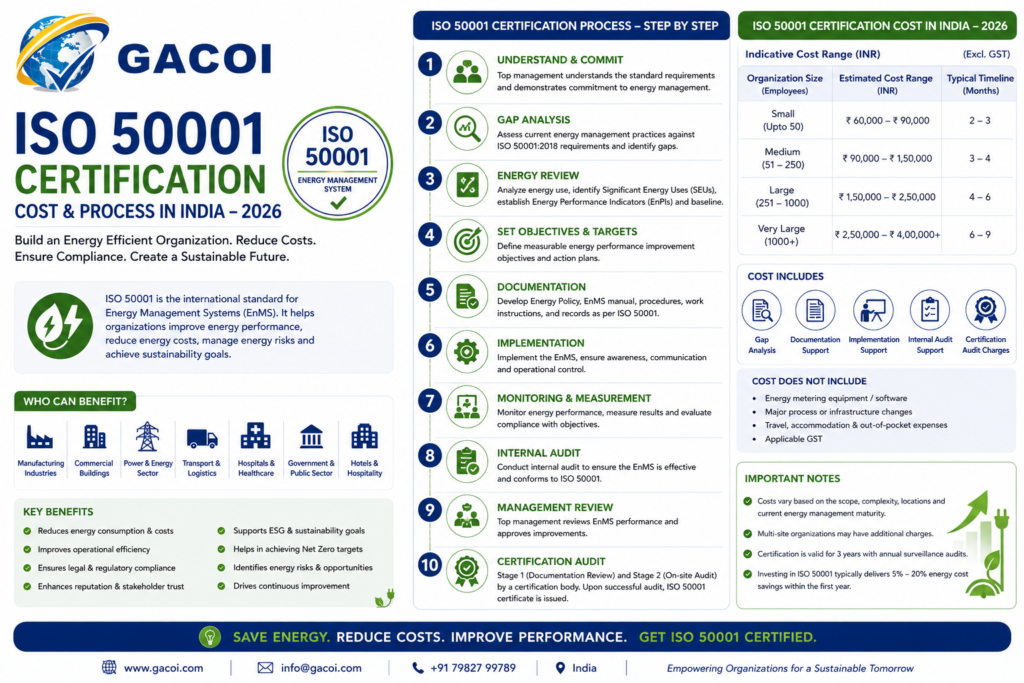
Part 6: The Complete ISO 50001 Certification Process — Step by Step
Understanding the certification process helps organizations plan timelines, allocate internal resources appropriately, and set realistic expectations for each implementation phase.
Step 1: Management Commitment and Scope Definition (Week 1–2)
The certification process begins with top management formally committing to pursue ISO 50001 certification and defining the scope — which facilities, processes, and energy sources will be included within the certified Energy Management System. This step also includes appointing a management representative or energy management team responsible for driving implementation.
Key activities:
- Formal management commitment documented in an energy policy statement
- Scope and boundary definition for the Energy Management System
- Appointment of energy management representative and core implementation team
- Initial budget allocation for certification and implementation activities
Step 2: Gap Assessment (Week 2–4)
A gap assessment — typically conducted by an external consultant or, for organizations with internal expertise, by the implementation team itself — evaluates current energy management practices against ISO 50001:2018 requirements, identifying specific gaps that must be addressed before certification readiness.
Key activities:
- Review of existing energy monitoring, documentation, and management practices
- Identification of gaps against each ISO 50001:2018 clause requirement
- Development of an implementation roadmap and timeline
Step 3: Energy Review (Week 4–10)
The energy review represents the most substantive and time-intensive implementation phase — involving systematic data collection and analysis of energy sources, historical consumption patterns, and Significant Energy Use identification.
Key activities:
- Collection of at least 12 months of historical energy consumption data across all energy sources
- Identification and prioritization of Significant Energy Uses
- Development of Energy Performance Indicators (EnPIs) for the organization and each significant energy use
- Establishment of energy baseline for future performance comparison
- Identification and prioritization of energy efficiency improvement opportunities
Step 4: Documentation Development (Week 8–14, overlapping with energy review)
Parallel to the energy review, the organization develops the documented information required under ISO 50001:2018, including the energy policy, energy objectives and targets, action plans, operational control procedures, and internal audit and management review processes.
Key documentation typically required:
- Energy policy
- Energy objectives, targets, and action plans
- Energy review report and baseline documentation
- Operational control procedures for Significant Energy Uses
- Competence and training records
- Internal audit procedure and schedule
- Management review procedure and records
Step 5: Implementation and Employee Training (Week 10–16)
With documentation in place, the organization implements the Energy Management System in daily operations, including training employees whose activities influence energy performance and establishing operational controls for identified Significant Energy Uses.
Key activities:
- Employee awareness training on energy policy and individual roles
- Implementation of operational controls and monitoring procedures
- Initial tracking of Energy Performance Indicators against baseline
Step 6: Internal Audit (Week 14–18)
Before pursuing external certification, the organization must conduct an internal audit of the Energy Management System, verifying that all ISO 50001:2018 requirements are being met and identifying any nonconformities requiring correction.
Key activities:
- Internal audit conducted by trained internal auditors, ideally independent of the areas being audited
- Documentation of findings and nonconformities
- Corrective action implementation for identified gaps
Step 7: Management Review (Week 16–18)
Top management formally reviews the Energy Management System’s performance, including energy performance trends, internal audit results, and resource adequacy, before proceeding to external certification.
Key activities:
- Formal management review meeting with documented inputs and outputs
- Decisions regarding resource allocation, objective revisions, or system improvements
Step 8: Stage 1 Certification Audit (Week 18–20)
The certification body — such as GacoiCert — conducts a Stage 1 audit, reviewing documentation and assessing the organization’s readiness for the more comprehensive Stage 2 audit.
Key activities:
- Documentation review against ISO 50001:2018 requirements
- Site visit to assess implementation readiness
- Identification of any areas requiring attention before Stage 2
Step 9: Stage 2 Certification Audit (Week 20–24)
The Stage 2 audit represents the comprehensive on-site assessment of the Energy Management System’s actual implementation and effectiveness, including verification of energy performance improvement evidence.
Key activities:
- Detailed review of energy review findings and EnPI tracking
- Verification of Significant Energy Use management and operational controls
- Employee interviews confirming awareness and competence
- Review of internal audit and management review evidence
- Identification of any nonconformities requiring closure before certificate issuance
Step 10: Certificate Issuance (Week 24–26)
Following successful completion of the Stage 2 audit and closure of any identified nonconformities, the certification body issues the ISO 50001 certificate, typically valid for three years subject to satisfactory annual surveillance audits.
Part 7: Realistic Timeline Summary by Organization Size
| Organization Size | Total Certification Timeline |
|---|---|
| Small Business | 10 – 16 weeks |
| Medium Business | 4 – 7 months |
| Large Business | 6 – 10 months |
| Very Large Business | 8 – 12 months |
Organizations that already maintain ISO 9001 or ISO 14001 certification frequently achieve certification toward the faster end of these ranges, since foundational management system elements — document control, internal audit competency, and management review processes — can be adapted rather than built new.
Part 8: Common Factors That Delay Certification
Understanding common delay factors helps organizations plan more realistic timelines and avoid unnecessary certification postponement.
Insufficient historical energy data: Organizations lacking at least 12 months of energy consumption records must either wait to accumulate sufficient data or work with the certification body on an appropriate alternative baseline approach, both of which can extend timelines.
Inadequate internal resource allocation: Organizations that treat ISO 50001 implementation as a side project without dedicated time allocation from the energy management team frequently experience significant timeline slippage.
Underestimating Significant Energy Use analysis complexity: Organizations with numerous or complex energy-consuming processes sometimes underestimate the time required for thorough Significant Energy Use identification and EnPI development.
Delayed corrective action closure: Nonconformities identified during Stage 1 or Stage 2 audits that are not promptly addressed can delay certificate issuance, particularly major nonconformities requiring verification through a follow-up audit visit.
Part 9: Integrated Certification — Reducing Cost Through Combined Audits
Organizations already holding, or simultaneously pursuing, ISO 9001 quality management or ISO 14001 environmental management certification can substantially reduce total certification cost and audit disruption through integrated management system certification.
How integrated certification reduces cost:
- Combined Stage 1 and Stage 2 audits across multiple standards reduce total audit days compared to separate certification processes
- Shared documentation infrastructure — document control procedures, internal audit processes, management review — reduces duplicate development effort
- Single surveillance audit visits covering multiple standards reduce ongoing annual maintenance disruption and cost
GacoiCert offers integrated ISO 50001, ISO 9001, and ISO 14001 certification through coordinated audit scheduling, typically delivering 15 to 25 percent total cost savings compared to pursuing each certification separately through uncoordinated processes.
Part 10: Why Choose GacoiCert for ISO 50001 Certification
Transparent, itemized pricing: GacoiCert provides complete cost breakdowns covering certification body fees, with no hidden charges added during or after the certification process.
Accredited certification: GacoiCert’s ISO 50001 certificates are issued under internationally recognized accreditation, verifiable through NABCB and IAF databases, and accepted by government procurement authorities, international buyers, BEE, and ESG investors.
Sector-specific auditor expertise: GacoiCert’s auditors bring practical energy management knowledge across manufacturing, hospitality, healthcare, data centers, and logistics sectors, ensuring audits assess genuine energy management substance rather than documentation formality alone.
Efficient timeline management: GacoiCert’s structured certification process helps organizations achieve certification within the fastest realistic timeline for their size and complexity, without compromising audit rigor.
Integrated Management System capability: For organizations pursuing multiple certifications, GacoiCert coordinates ISO 50001, ISO 9001, and ISO 14001 audits for maximum cost efficiency.
Pan-India coverage: GacoiCert serves organizations across Delhi NCR, Mumbai, Pune, Bangalore, Chennai, Hyderabad, Ahmedabad, Surat, Kolkata, and all major industrial centers.
Conclusion: Planning Your ISO 50001 Certification Investment for 2026
ISO 50001 certification cost in India varies meaningfully based on organization size, site complexity, and existing management system maturity — but across every size category, the total first-year investment is consistently and substantially outweighed by the energy cost savings certified organizations achieve within the first year or two of implementation. Combined with a clear, structured ten-step certification process typically completed within three to ten months depending on organizational scale, ISO 50001 represents one of the most financially accessible and rapidly rewarding certification investments available to Indian businesses in 2026.
GacoiCert is ready to provide your organization with a transparent, personalized ISO 50001 certification cost quotation and implementation timeline. Visit gacoicert.com today for your free consultation.
Frequently Asked Questions
What Is the ISO 50001 Certification Process?
The ISO 50001 certification process typically includes a gap analysis, development of an energy management system, documentation, implementation, employee training, internal audits, management review, and a final certification audit conducted by an accredited certification body.
How Much Does ISO 50001 Certification Cost in India?
The cost of ISO 50001 certification depends on factors such as the organization’s size, number of employees, operational locations, scope of certification, and the certification body’s audit requirements.
How Long Does It Take to Complete the ISO 50001 Certification Process?
Most organizations complete the certification process within a few months. The exact timeline depends on the organization’s readiness, documentation, and the complexity of its operations.
Which Organizations Should Apply for ISO 50001 Certification?
ISO 50001 is suitable for manufacturing companies, commercial buildings, hospitals, hotels, warehouses, educational institutions, logistics providers, data centers, and any organization aiming to improve energy performance.
What Documents Are Required for ISO 50001 Certification?
Organizations typically need an energy policy, energy objectives, energy review reports, operational procedures, energy performance records, monitoring data, internal audit reports, and management review records.
What Factors Affect the Cost of ISO 50001 Certification?
The certification cost is influenced by the organization’s size, number of sites, energy consumption, business activities, audit duration, and the complexity of the energy management system.
What Are the Benefits of ISO 50001 Certification?
ISO 50001 helps reduce energy costs, improve operational efficiency, minimize energy waste, lower carbon emissions, strengthen regulatory compliance, and demonstrate a commitment to sustainable energy management.
Can ISO 50001 Be Integrated with Other ISO Standards?
Yes. ISO 50001 can be integrated with ISO 9001, ISO 14001, and ISO 45001, allowing organizations to manage quality, environmental, occupational health and safety, and energy management through a single integrated management system.
Is ISO 50001 Certification Mandatory in India?
No. ISO 50001 certification is generally voluntary. However, many organizations choose to implement it to improve energy efficiency, meet customer expectations, and support sustainability initiatives.
How Often Does ISO 50001 Certification Need to Be Renewed?
ISO 50001 certification is generally valid for three years, subject to periodic surveillance audits. Organizations must successfully complete a recertification audit before the certificate expires to maintain their certification.
Get Expert Guidance for ISO Certification
🟡GACOI Cert provides globally recognized ISO certification, cybersecurity, privacy, AI governance, compliance, audit, and professional training services, helping startups, businesses, enterprises, laboratories, healthcare organizations, and government institutions achieve international standards and build lasting trust.
🟡For other Legal and Trademark related services Visit
👉 Money Recovery Cases
👉 Property Disputes
👉ISO Registration
👉ISO 22000 Certification
🟡 Protect Your Rights
👉 Domestic Violence Legal Support
👉 Stridhan Recovery
👉 Mutual Consent Divorce
👉 Contested Divorce Filing
📞 Call Now: +91 8595439395
🕐 Free Consultation: Monday to Saturday, 10 AM to 6 PM


