


Views: 0
Discover Who Needs ISO 50001 Certification in India — from manufacturing to hospitality, data centers to logistics, and how GacoiCert helps you get certified in 2026.
Table of Contents
- 1 Introduction: ISO 50001 Is Not Just for Big Factories
- 2 Category 1: Businesses Legally Mandated Under India’s PAT Scheme
- 3 Category 2: Listed Companies Under SEBI’s BRSR Framework
- 4 Category 3: Manufacturing Businesses of Every Size
- 5 Category 4: Commercial Buildings, Offices, and Real Estate
- 6 Category 5: Hospitality — Hotels, Resorts, and Hospitality Chains
- 7 Category 6: Data Centers and IT Infrastructure
- 8 Category 7: Cold Chain, Logistics, and Warehousing
- 9 Category 8: Hospitals and Healthcare Facilities
- 10 Category 9: Educational Institutions and Large Campuses
- 11 Category 10: Organizations Pursuing Green Financing and Sustainability-Linked Loans
- 12 Category 11: Suppliers to Multinational Corporations and Global Buyers
- 13 Who Does NOT Necessarily Need ISO 50001 — And When to Reconsider
- 14 Organization Size: Does ISO 50001 Work for Small Businesses Too?
- 15 How to Determine If Your Business Needs ISO 50001: A Practical Checklist
- 16 How GacoiCert Supports Your ISO 50001 Certification Journey
- 17 Conclusion: ISO 50001 Applicability Extends Far Beyond Heavy Industry
- 18 Frequently Asked Questions
- 19 Get Expert Guidance for ISO Certification
Introduction: ISO 50001 Is Not Just for Big Factories
One of the most common misconceptions among Indian business owners is that ISO 50001 — the international standard for Energy Management Systems — is relevant only to massive energy-intensive manufacturers like steel plants, cement factories, or chemical complexes. This misconception causes thousands of businesses that could benefit enormously from energy management certification to overlook it entirely.
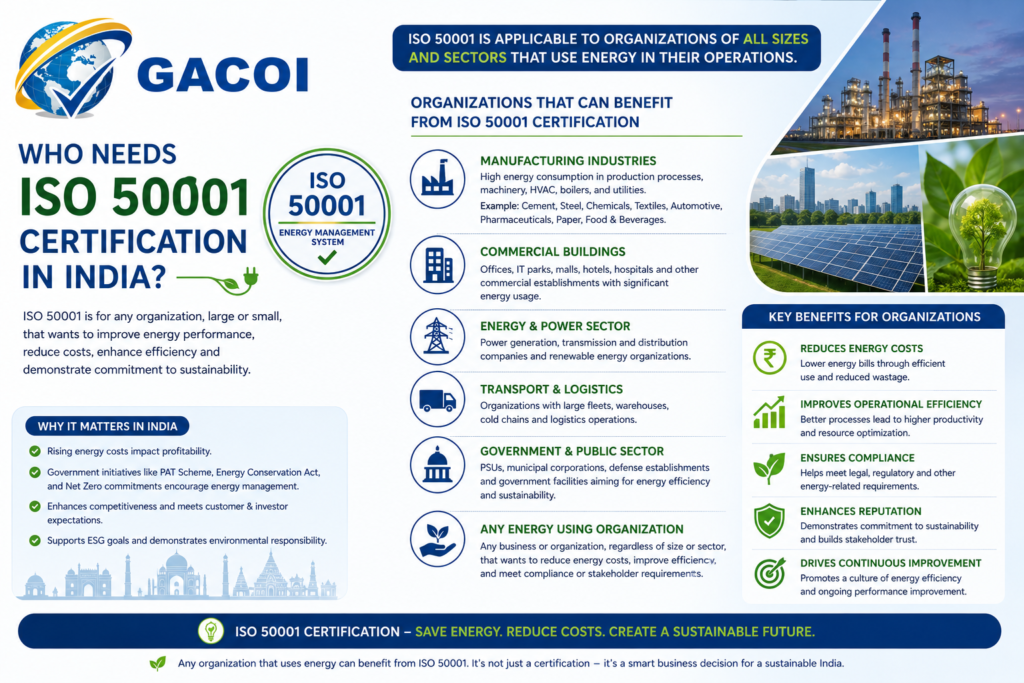
The reality is very different. ISO 50001:2018 is explicitly designed by the International Organization for Standardization to be applicable to any organization, regardless of size, sector, geographic location, or energy intensity, that consumes energy and wants to manage it more systematically. A boutique hotel in Goa, a mid-sized textile unit in Surat, a data center in Bangalore, a cold storage facility in Punjab, a hospital in Delhi, and a five-star manufacturing conglomerate in Pune can all benefit from — and pursue — ISO 50001 certification.
This guide from GacoiCert answers the question business owners across India are increasingly asking: who actually needs ISO 50001 certification? We break down applicability by industry sector, by regulatory obligation, by business driver, and by organizational size — so you can determine precisely whether your organization should pursue certification in 2026.
Category 1: Businesses Legally Mandated Under India’s PAT Scheme
The most direct and unavoidable category of ISO 50001 need in India comes from regulatory obligation under the Bureau of Energy Efficiency’s Perform, Achieve and Trade (PAT) scheme.
What the PAT scheme requires:
India’s PAT scheme, administered under the Energy Conservation Act, designates specific energy-intensive industrial sectors as “Designated Consumers” and mandates that these units achieve specific energy consumption reduction targets within defined compliance cycles. Designated Consumers who fail to achieve targets face penalties, while those who exceed targets earn tradeable Energy Saving Certificates.
Sectors currently covered under PAT:
- Thermal power plants
- Cement manufacturing
- Iron and steel production
- Fertilizer manufacturing
- Aluminium smelting
- Pulp and paper
- Textiles (specifically energy-intensive processing units)
- Chlor-alkali and petrochemicals
- Railways
- Refineries and oil and gas
- Commercial buildings and large office complexes above specified energy consumption thresholds
Why PAT-designated units need ISO 50001:
While ISO 50001 certification itself is not a legal requirement under the PAT scheme, it provides exactly the systematic energy management infrastructure — baseline establishment, energy performance indicators, documented improvement action plans, and verified savings tracking — that Designated Consumers need to demonstrably achieve their mandated targets and defend their compliance position during BEE audits and verification. Many PAT-covered companies now pursue ISO 50001 specifically as their internal compliance management framework.
If your organization has received a PAT notification or falls within a PAT-covered sector and consumption threshold, ISO 50001 is effectively a practical necessity, even without an explicit legal mandate for the certificate itself.
Category 2: Listed Companies Under SEBI’s BRSR Framework
India’s Securities and Exchange Board mandates that the top 1,000 listed companies by market capitalization file a Business Responsibility and Sustainability Report (BRSR) — which includes detailed disclosure of energy consumption, energy intensity, and renewable versus non-renewable energy mix.
Why listed companies increasingly need ISO 50001:
BRSR disclosure requires organized, auditable energy data that many companies struggle to produce reliably without a formal management system. ISO 50001 provides:
- A structured data collection and verification process for energy consumption reporting
- Independently certified evidence of energy performance that strengthens BRSR disclosure credibility
- A defensible audit trail if disclosures are questioned by regulators, auditors, or institutional investors
- Demonstrable year-on-year energy intensity improvement trends that ESG-focused investors specifically look for
If your company is listed on the BSE or NSE and falls within the top 1,000 by market capitalization — or anticipates growing into that bracket — ISO 50001 certification substantially de-risks and strengthens your sustainability reporting obligations.
Category 3: Manufacturing Businesses of Every Size
Manufacturing remains the sector where ISO 50001 delivers the most direct and measurable financial return, regardless of whether a specific business falls under PAT or BRSR obligations.
Small and medium manufacturers:
Indian MSMEs in sectors such as auto components, engineering goods, plastics, packaging, electronics assembly, and light engineering frequently operate on thin margins where energy costs of 10 to 20 percent of production cost represent a major controllable expense. For these businesses, ISO 50001 delivers:
- A structured path to identifying and eliminating energy waste without requiring specialist in-house energy expertise
- Credibility with larger corporate buyers who increasingly require supplier sustainability credentials
- Access to green financing schemes and sustainability-linked lending products now offered by Indian banks
Energy-intensive process industries:
Textiles, chemicals, pharmaceuticals, food and beverage processing, glass, ceramics, paper, and rubber manufacturing all involve continuous thermal or mechanical processes where energy represents a dominant cost category. These industries consistently report some of the highest ISO 50001 savings percentages — often 15 to 30 percent energy cost reduction within three years — because their processes involve significant, identifiable Significant Energy Uses such as boilers, furnaces, compressors, and dryers.
Export-oriented manufacturers:
Indian manufacturers exporting to the European Union, United Kingdom, and other markets implementing carbon border adjustment mechanisms and supply chain carbon disclosure requirements increasingly need documented energy performance evidence to satisfy buyer due diligence and maintain export competitiveness. ISO 50001 certification is becoming a de facto qualification requirement in several export-oriented supply chains, particularly textiles, auto components, and engineering goods destined for European buyers.
Category 4: Commercial Buildings, Offices, and Real Estate
Energy management is not only an industrial concern. Large commercial buildings — corporate headquarters, IT parks, shopping malls, and mixed-use developments — represent a significant and growing category of ISO 50001 applicability in India.
Why commercial real estate needs ISO 50001:
- HVAC systems typically represent 40 to 60 percent of total energy consumption in commercial buildings, offering substantial efficiency improvement potential through systematic management
- Facility management companies managing multiple commercial properties increasingly need ISO 50001 to demonstrate consistent energy performance across their portfolio to institutional building owners and tenants
- Green building certifications such as IGBC and LEED increasingly recognize or reward ISO 50001 implementation as evidence of operational energy management maturity beyond design-stage green building features
- Corporate tenants with their own sustainability commitments increasingly favor leasing space in ISO 50001-certified buildings to support their own carbon reduction reporting
Building owners, facility management companies, and real estate developers managing large commercial portfolios in metro cities including Delhi NCR, Mumbai, Bangalore, Pune, and Hyderabad are increasingly obtaining ISO 50001 certification as a differentiator in a competitive commercial leasing market.
Category 5: Hospitality — Hotels, Resorts, and Hospitality Chains
The hospitality sector is one of the fastest-growing categories of ISO 50001 adoption in India, and for good reason — hotels and resorts are exceptionally energy-intensive operations relative to their revenue base.
Why hotels need ISO 50001:
- Continuous HVAC operation, laundry facilities, kitchen equipment, water heating, and guest room energy use create substantial and controllable energy cost categories
- Energy typically represents 3 to 6 percent of total hotel revenue — one of the largest controllable operating expense categories after staffing and food costs
- International hotel chains and franchise brands increasingly require sustainability certifications, including energy management systems, as part of brand standards
- Guests and corporate travel booking platforms increasingly filter for sustainability-certified properties, making ISO 50001 a competitive differentiator in both leisure and corporate travel segments
Indian hospitality groups report some of the highest ISO 50001 savings percentages of any sector — commonly 15 to 35 percent energy cost reduction — because hotels typically have not previously implemented systematic energy management despite significant identifiable savings opportunities in HVAC scheduling, laundry operations, and kitchen equipment management.
Category 6: Data Centers and IT Infrastructure
India’s rapidly expanding data center sector — driven by cloud computing growth, data localization requirements, and digital economy expansion — represents one of the most energy-intensive and fastest-growing sectors in the country.
Why data centers need ISO 50001:
- Data centers operate continuously at high energy density, making Power Usage Effectiveness (PUE) one of the most scrutinized operational metrics in the industry
- Hyperscale cloud providers and enterprise clients increasingly require documented energy management credentials from data center operators as part of vendor due diligence and their own carbon reporting obligations
- Cooling systems — often the single largest energy consumer after IT load itself — offer substantial efficiency improvement potential through the systematic energy review ISO 50001 requires
- Investors and financing partners in India’s expanding data center construction pipeline increasingly favor ISO 50001-certified operators as evidence of operational maturity and risk management
Data center operators across Mumbai, Chennai, Hyderabad, Pune, and Noida — India’s primary data center hubs — are increasingly pursuing ISO 50001 certification to meet client and investor expectations.
Category 7: Cold Chain, Logistics, and Warehousing
India’s expanding cold chain and logistics infrastructure — driven by e-commerce growth, pharmaceutical distribution requirements, and food supply chain modernization — represents a significant and energy-intensive sector.
Why cold chain and logistics operators need ISO 50001:
- Refrigerated storage and transport involve continuous energy consumption where efficiency losses compound significantly over large facility networks
- Fleet fuel consumption, warehouse energy use, and refrigeration represent major controllable cost categories for logistics operators
- Pharmaceutical and food and beverage clients increasingly require documented energy and environmental management credentials from their cold chain logistics partners as part of supply chain due diligence
- Large warehousing and fulfillment operators managing extensive facility networks benefit from the standardized energy management framework ISO 50001 provides across multiple sites
Category 8: Hospitals and Healthcare Facilities
Healthcare facilities represent a growing but often overlooked category of ISO 50001 applicability in India.
Why hospitals need ISO 50001:
- Hospitals operate energy-intensive equipment continuously — HVAC systems maintaining strict environmental controls, medical imaging equipment, sterilization systems, and 24-hour operations
- Energy costs represent a significant and growing operational expense category for private hospital chains competing on operational efficiency
- Accreditation bodies and corporate health insurance partners increasingly recognize sustainability and energy management credentials as part of institutional quality assessment
- Multi-facility hospital chains benefit from the standardized energy performance framework ISO 50001 provides for comparing and improving performance across locations
Category 9: Educational Institutions and Large Campuses
Universities, engineering colleges, and large educational campuses with extensive infrastructure — hostels, laboratories, administrative buildings, and recreational facilities — represent a growing category of ISO 50001 adoption, particularly among institutions pursuing sustainability rankings and green campus recognition.
Why educational institutions pursue ISO 50001:
- Large campus infrastructure offers substantial energy efficiency improvement potential across lighting, HVAC, laboratory equipment, and hostel facilities
- Institutional rankings, including international sustainability rankings that increasingly influence student enrollment decisions, reward demonstrated energy management practices
- Government and private funding bodies increasingly favor institutions demonstrating systematic environmental and energy management
Category 10: Organizations Pursuing Green Financing and Sustainability-Linked Loans
An increasingly important driver of ISO 50001 adoption in India, cutting across all sectors, is the growing availability of green financing and sustainability-linked loan products from Indian and international banks.
Why financing considerations drive ISO 50001 need:
Indian financial institutions are developing loan products where borrowing costs are directly linked to environmental and energy performance — offering preferential interest rates to borrowers who demonstrate systematic, independently verified energy management. For any business — regardless of sector — planning capital expansion, equipment financing, or working capital facilities in the coming years, ISO 50001 certification increasingly represents a tangible cost-of-capital advantage rather than merely a compliance or operational exercise.
Category 11: Suppliers to Multinational Corporations and Global Buyers
Any Indian business — regardless of size or sector — that supplies goods or services to multinational corporations increasingly needs ISO 50001 to satisfy supply chain sustainability requirements.
Why supplier relationships drive ISO 50001 need:
Global corporations with their own carbon reduction commitments, Science Based Targets, and supply chain disclosure obligations increasingly cascade these requirements down to their Indian suppliers through vendor qualification criteria, supplier scorecards, and procurement policies. Indian businesses supplying automotive components, electronics, textiles, chemicals, and industrial equipment to multinational buyers increasingly find that energy management certification — whether formally required or informally preferred — influences vendor selection and contract renewal decisions.
Who Does NOT Necessarily Need ISO 50001 — And When to Reconsider
While ISO 50001 offers value to nearly any energy-consuming organization, it is worth being direct about situations where certification may be premature:
- Very small businesses with minimal energy consumption — such as small retail outlets or home-based service businesses — may find the certification and maintenance investment disproportionate to available savings, though even these organizations can benefit from applying ISO 50001 principles informally
- Organizations with no dedicated capacity for basic implementation — ISO 50001 requires at minimum a designated energy management representative and basic data collection discipline; organizations unable to commit this minimal capacity should build this foundation before pursuing certification
- Businesses in the middle of major operational restructuring — organizations undergoing significant facility changes, relocations, or operational discontinuity may benefit from waiting until operations stabilize before establishing energy baselines
For the vast majority of Indian businesses beyond these limited exceptions, however, ISO 50001 certification delivers a favorable return on investment.
Organization Size: Does ISO 50001 Work for Small Businesses Too?
A common question GacoiCert receives is whether ISO 50001 is realistic for small and medium enterprises, not just large corporations.
The answer is unambiguously yes. ISO 50001 is explicitly scalable by design:
| Organization Size | Typical Certification Timeline | Typical Implementation Approach |
|---|---|---|
| Small (up to 25 employees) | 10–16 weeks | Simplified energy review, single-site EnPIs, lean documentation |
| Medium (26–100 employees) | 4–7 months | Multi-department energy review, formal SEU management |
| Large (101–300 employees) | 6–10 months | Comprehensive multi-site energy management program |
| Very Large (300+ employees) | 8–12 months | Enterprise-wide EnMS with dedicated energy management team |
Small businesses frequently achieve some of the fastest returns on ISO 50001 investment precisely because they have often never conducted a rigorous energy review before — meaning the “low-hanging fruit” savings opportunities identified in the first energy review can be substantial relative to their overall energy spend.
How to Determine If Your Business Needs ISO 50001: A Practical Checklist
Ask your organization the following questions:
- Does energy represent more than 5 percent of your total operating costs?
- Have you never conducted a rigorous, systematic review of where and how your organization consumes energy?
- Are you a Designated Consumer under the BEE PAT scheme, or do you anticipate being designated in future compliance cycles?
- Is your company listed and required to file BRSR disclosures, or likely to be included in this requirement as your market capitalization grows?
- Do your corporate customers, buyers, or financing partners increasingly request sustainability or energy management credentials?
- Are you planning capital expansion or financing where sustainability-linked loan terms could reduce your cost of capital?
- Do you compete for tenders or contracts where energy management certification provides scoring advantages?
- Have you observed rising energy costs without a clear, data-driven improvement program in place to address them?
If you answered yes to two or more of these questions, your organization is a strong candidate for ISO 50001 certification in 2026.
How GacoiCert Supports Your ISO 50001 Certification Journey
Sector-specific expertise across every applicable industry: GacoiCert’s ISO 50001 auditors bring practical energy management knowledge spanning manufacturing, hospitality, healthcare, data centers, logistics, commercial real estate, and educational institutions — understanding the specific energy management challenges unique to your sector.
Right-sized implementation for your organization: Whether you are a small manufacturing unit or a large multi-site enterprise, GacoiCert scales the certification process appropriately — ensuring small businesses are not burdened with unnecessary documentation while large organizations receive the rigorous, comprehensive energy management framework their complexity requires.
Regulatory alignment for Indian compliance frameworks: GacoiCert’s auditors understand BEE PAT scheme requirements, SEBI BRSR disclosure needs, and India’s evolving green financing landscape — ensuring your ISO 50001 certification directly supports whichever regulatory or commercial driver brought you to certification.
Integrated certification options: For organizations also pursuing ISO 9001 quality management or ISO 14001 environmental management, GacoiCert offers coordinated Integrated Management System audits — delivering multiple certifications through a single, cost-efficient audit process.
Pan-India coverage: GacoiCert serves businesses across Delhi NCR, Mumbai, Pune, Bangalore, Chennai, Hyderabad, Ahmedabad, Surat, Kolkata, and all major industrial and commercial centers across India.
Conclusion: ISO 50001 Applicability Extends Far Beyond Heavy Industry
The question of who needs ISO 50001 certification in India has a far broader answer than most business owners initially assume. Beyond the PAT-designated energy-intensive industries where certification supports direct regulatory compliance, ISO 50001 delivers meaningful value for listed companies managing BRSR disclosure, manufacturers of every size seeking cost reduction, commercial building owners and hospitality operators managing major controllable expense categories, data centers and logistics operators competing on operational efficiency, healthcare and educational institutions modernizing their infrastructure management, and any business seeking preferential green financing terms or stronger positioning with sustainability-conscious corporate buyers.
If your organization consumes meaningful energy, faces rising energy costs, and has not yet implemented a systematic, data-driven approach to managing that consumption, ISO 50001 certification represents one of the most direct and financially rewarding certification investments available to Indian businesses in 2026.
GacoiCert is ready to assess your organization’s ISO 50001 certification needs. Visit gacoicert.com today for a free consultation and personalized applicability assessment.
Frequently Asked Questions
Who Should Apply for ISO 50001 Certification in India?
ISO 50001 certification is suitable for manufacturing companies, hotels, hospitals, commercial buildings, data centers, educational institutions, warehouses, logistics companies, and any organization looking to improve energy performance and reduce operating costs.
Is ISO 50001 Certification Mandatory in India?
ISO 50001 certification is generally voluntary. However, many organizations adopt it to improve energy efficiency, meet customer expectations, support sustainability goals, and strengthen their competitive position.
Can Small Businesses Get ISO 50001 Certification?
Yes. ISO 50001 is designed for organizations of all sizes, including startups, MSMEs, medium-sized businesses, and large enterprises, regardless of their industry.
Which Industries Benefit the Most from ISO 50001 Certification?
Industries such as manufacturing, food processing, pharmaceuticals, chemicals, textiles, cement, steel, hospitality, healthcare, logistics, and commercial real estate often benefit the most because of their significant energy consumption.
What Are the Main Benefits of ISO 50001 Certification?
ISO 50001 helps organizations reduce energy costs, improve energy efficiency, lower greenhouse gas emissions, strengthen regulatory compliance, and support long-term sustainability objectives.
What Documents Are Required for ISO 50001 Certification?
Organizations generally need an energy policy, energy objectives, energy review reports, operational procedures, energy performance records, monitoring data, internal audit reports, and management review documents.
How Long Does It Take to Obtain ISO 50001 Certification?
The certification timeline depends on the organization’s size, complexity, and readiness. Most businesses complete the implementation and certification process within a few months.
Can ISO 50001 Be Integrated with Other ISO Standards?
Yes. ISO 50001 can be integrated with standards such as ISO 9001, ISO 14001, and ISO 45001, allowing organizations to manage quality, environmental, occupational health and safety, and energy management through a single integrated system.
Get Expert Guidance for ISO Certification
🟡GACOI Cert provides globally recognized ISO certification, cybersecurity, privacy, AI governance, compliance, audit, and professional training services, helping startups, businesses, enterprises, laboratories, healthcare organizations, and government institutions achieve international standards and build lasting trust.
🟡For other Legal and Trademark related services Visit
👉 Money Recovery Cases
👉 Property Disputes
👉ISO Registration
👉ISO 22000 Certification
🟡 Protect Your Rights
👉 Domestic Violence Legal Support
👉 Stridhan Recovery
👉 Mutual Consent Divorce
👉 Contested Divorce Filing
📞 Call Now: +91 8595439395
🕐 Free Consultation: Monday to Saturday, 10 AM to 6 PM


