


Views: 1
Discover how ISO 50001 reduces energy costs for businesses in India — systematic energy analysis, efficiency improvements, ROI analysis, and how GacoiCert helps you get certified in 2026.
Table of Contents
- 1 Introduction: Why Energy Cost Reduction Has Become a Business Imperative in India
- 2 Understanding ISO 50001: Built to Drive Energy Cost Reduction
- 3 Energy Cost Reduction Mechanism 1: Energy Review — Understanding Where Your Energy Goes
- 4 Energy Cost Reduction Mechanism 2: Energy Performance Indicators — Measuring What Matters
- 5 Energy Cost Reduction Mechanism 3: Significant Energy Use Management — Focused Improvement Investment
- 6 Energy Cost Reduction Mechanism 4: Energy Objectives and Action Plans — Making Improvement Happen
- 7 Energy Cost Reduction Mechanism 5: Energy Procurement Optimization
- 8 Energy Cost Reduction Mechanism 6: Operational Controls and Behavioral Change
- 9 Energy Cost Reduction Mechanism 7: Management Review — Maintaining Senior Leadership Accountability
- 10 Financial Returns: What ISO 50001 Energy Cost Reduction Actually Delivers in India
- 11 Beyond Cost Reduction: Additional Business Benefits of ISO 50001
- 12 ISO 50001 Certification Cost and Timeline in India 2026
- 13 Why Choose GacoiCert for ISO 50001 Certification in India?
- 14 Conclusion: ISO 50001 Is the Most Powerful Energy Cost Reduction Tool Available to Indian Businesses
- 15 Frequently Asked Questions
- 16 Get Expert Guidance for ISO Certification
Introduction: Why Energy Cost Reduction Has Become a Business Imperative in India
Energy costs have emerged as one of the most significant and fastest-growing operational expense categories for Indian businesses across manufacturing, services, logistics, hospitality, and virtually every other sector. Rising electricity tariffs, increasing fuel prices, growing regulatory obligations under India’s energy efficiency framework, and intensifying international market pressure around carbon performance have collectively transformed energy management from a facilities concern into a strategic boardroom priority.
For Indian manufacturers alone, energy costs frequently represent 15 to 30 percent of total production costs — making energy efficiency improvement one of the highest-impact levers available for margin improvement and competitive cost positioning. For energy-intensive industries including cement, steel, glass, chemicals, textiles, food processing, and pharmaceuticals, energy costs can represent an even larger proportion of operating expenses.
Yet despite this financial significance, most Indian businesses manage energy reactively — tracking total electricity bills, implementing obvious efficiency measures when capital is available, and responding to regulatory requirements when enforcement demands it — without the systematic, data-driven energy management discipline that consistently delivers superior cost reduction outcomes.
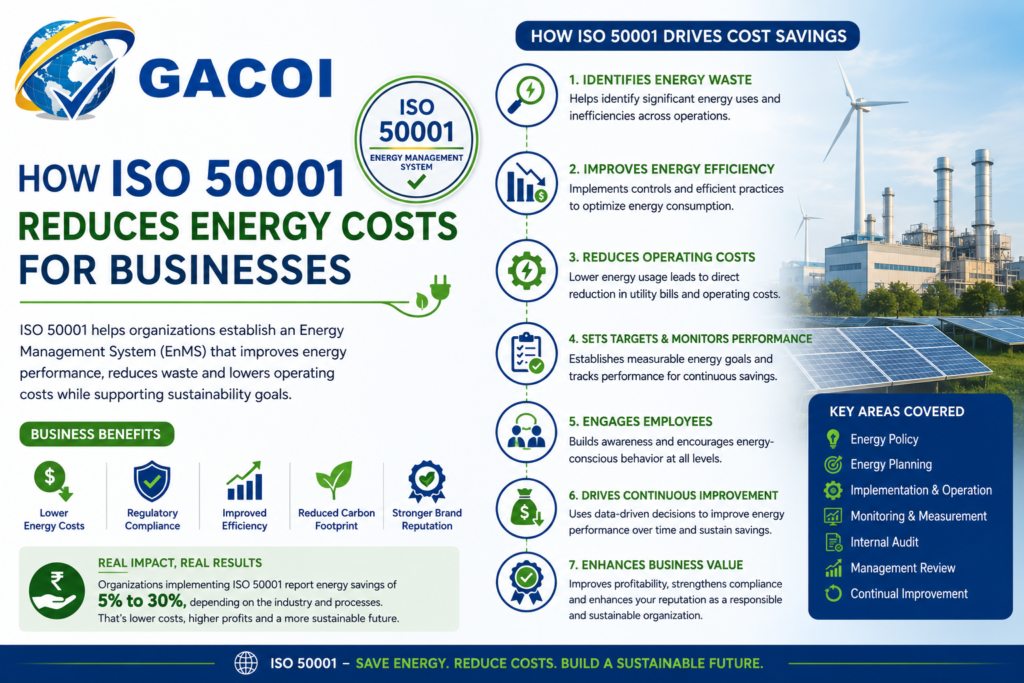
ISO 50001:2018 — the international standard for Energy Management Systems — provides businesses with precisely this systematic discipline. Through structured energy review, rigorous performance measurement, systematic energy objective setting, and continual improvement processes, ISO 50001 consistently delivers measurable, sustained energy cost reductions that informal energy management approaches simply cannot match.
This comprehensive guide from GacoiCert explains exactly how ISO 50001 reduces energy costs for businesses — covering every mechanism through which the standard drives energy savings, the specific financial returns certified organizations consistently achieve, the business and regulatory benefits that accompany cost reduction, and how GacoiCert supports your organization’s ISO 50001 certification journey.
Understanding ISO 50001: Built to Drive Energy Cost Reduction
ISO 50001:2018 is the second edition of the international Energy Management System standard, published by ISO in August 2018. It provides organizations with a systematic framework for managing energy use, improving energy performance, reducing energy consumption, and demonstrating energy management commitment to external stakeholders.
The standard’s core premise is both simple and powerful: organizations that manage energy systematically — measuring it rigorously, understanding what drives consumption, identifying improvement opportunities through structured analysis, setting improvement targets, and implementing efficiency measures with management accountability — consistently achieve superior energy performance compared to those that manage energy informally.
What distinguishes ISO 50001 from informal energy management:
Most organizations have some form of energy monitoring — tracking monthly electricity bills and fuel consumption. What ISO 50001 adds is a structured management system that transforms this monitoring into systematic performance improvement:
- Baseline energy performance establishment that enables meaningful improvement measurement
- Significant energy use identification that focuses improvement investment on highest-impact areas
- Energy performance indicators that provide real-time performance visibility
- Energy objectives and targets with defined accountability and action plans
- Management review processes that ensure energy performance receives senior leadership attention
- Continual improvement requirements that prevent the common pattern of one-time efficiency projects followed by performance plateau or regression
This systematic approach consistently delivers energy cost reductions that informal approaches fail to sustain — because it builds energy management into organizational processes rather than treating it as a periodic project.
Energy Cost Reduction Mechanism 1: Energy Review — Understanding Where Your Energy Goes
The first and foundational way ISO 50001 drives energy cost reduction is through its requirement for a comprehensive energy review — a systematic, data-driven analysis of how your organization uses energy that most businesses have never conducted rigorously.
What the ISO 50001 energy review requires:
Energy source identification: Systematically identify all energy sources used in your operations — electricity, natural gas, diesel, furnace oil, LPG, coal, compressed air, steam, and any other energy carrier. Many organizations discover during energy reviews that they have energy sources and consumption points they were not previously tracking.
Historical energy consumption analysis: Analyze past and present energy use and consumption — typically using at least 12 months of energy data. This historical analysis establishes baseline performance and identifies seasonal patterns, operational correlations, and anomalies that reveal improvement opportunities.
Significant energy use identification: Identify the facilities, equipment, processes, and systems that account for the majority of energy consumption or represent the greatest energy efficiency improvement potential — these are your Significant Energy Uses (SEUs). ISO 50001 requires focused management attention on SEUs rather than spreading improvement effort uniformly across all energy consumption.
Energy improvement opportunities identification: Systematically identify and prioritize energy efficiency improvement opportunities across all SEUs — through equipment inspection, process analysis, benchmarking against industry standards, and engineering assessment.
Why the energy review drives cost reduction:
Most organizations that conduct their first rigorous energy review under ISO 50001 are surprised by what they discover. Common findings include:
- Equipment running at full load during periods of minimal production demand
- Compressed air leaks consuming 20 to 30 percent of compressor output
- Lighting systems consuming far more energy than LED alternatives would require
- HVAC systems maintaining unnecessary temperature differentials
- Process equipment operating outside optimal efficiency parameters
- Standby losses from equipment left energized during non-production periods
- Power factor issues causing kVA demand charges beyond actual kW consumption
Each of these discoveries represents a direct energy cost reduction opportunity — and the energy review creates the systematic visibility to find them all rather than the isolated few that informal monitoring reveals.
Energy Cost Reduction Mechanism 2: Energy Performance Indicators — Measuring What Matters
ISO 50001 requires organizations to establish Energy Performance Indicators (EnPIs) — specific metrics that enable meaningful measurement and tracking of energy performance improvement over time.
What makes EnPIs different from simple energy consumption tracking:
Tracking total electricity consumption tells you how much energy you used — but not whether your energy performance is improving or deteriorating. If production volume increased by 20 percent and electricity consumption increased by 10 percent, consumption tracking suggests energy performance worsened — but the reality is that energy intensity improved significantly.
EnPIs normalize energy consumption against relevant variables — production volume, floor area, operating hours, weather conditions, product mix — to provide a meaningful measure of energy efficiency that separates genuine performance change from volume-driven fluctuation.
Common EnPIs for Indian businesses:
| Business Type | Example EnPIs |
|---|---|
| Manufacturing | Energy per unit produced (kWh/unit, kWh/kg, kWh/tonne) |
| Textiles | Energy per metre of fabric produced |
| Food Processing | Energy per tonne of product processed |
| Hotels | Energy per occupied room night |
| Data Centers | Power Usage Effectiveness (PUE) |
| Office Buildings | Energy per square metre per year |
| Logistics | Fuel per tonne-kilometre |
| Cold Chain | Energy per cubic metre of refrigerated space |
How EnPIs drive cost reduction:
EnPIs create the performance visibility that drives accountability and improvement. When energy intensity is tracked — rather than just total consumption — efficiency improvements become visible even when production volumes change. This visibility enables:
- Early detection of efficiency deterioration — catching equipment problems, process drift, or behavioral changes before they generate significant cost impact
- Benchmarking against historical performance — showing whether current performance is better or worse than established baselines
- Comparison against targets — providing the data needed to evaluate whether improvement programs are delivering expected results
- Accountability for energy performance — giving managers and operators the metrics needed to manage energy performance within their areas of responsibility
Energy Cost Reduction Mechanism 3: Significant Energy Use Management — Focused Improvement Investment
ISO 50001’s requirement to identify and systematically manage Significant Energy Uses is one of the standard’s most practically powerful cost reduction mechanisms — because it directs improvement investment toward the areas of highest energy cost impact rather than spreading effort uniformly.
What significant energy use management involves:
For each identified SEU — those processes, systems, and equipment that consume major proportions of total energy or offer substantial improvement potential — ISO 50001 requires:
- Identification of personnel whose activities influence the SEU’s energy performance
- Identification of relevant variables that affect SEU energy consumption
- Determination of current energy performance of the SEU
- Establishment of EnPIs for the SEU
- Development of action plans to improve SEU energy performance
Common Significant Energy Uses in Indian businesses:
Manufacturing facilities:
- Compressed air systems — often the largest single electricity consumer in manufacturing, with typical efficiency losses of 20 to 40 percent from leaks, inappropriate pressure settings, and system design
- HVAC and refrigeration — particularly in food processing, pharmaceutical manufacturing, and temperature-controlled production environments
- Process heating — furnaces, boilers, dryers, and other thermal processes where combustion efficiency and heat recovery opportunities are significant
- Electric motors and drives — representing 60 to 70 percent of industrial electricity consumption, with variable speed drives offering 20 to 50 percent savings on variable-load applications
- Lighting systems — where LED conversion and smart controls deliver 50 to 80 percent energy savings compared to conventional lighting
Why focusing on SEUs delivers superior cost reduction:
A compressed air system consuming 30 percent of a manufacturing facility’s electricity represents ten times more cost reduction potential from a 10 percent efficiency improvement than a lighting system consuming 3 percent of electricity — even if the lighting improvement is technically easier to achieve. ISO 50001’s SEU framework ensures improvement investment is directed toward highest-impact areas, consistently delivering superior total cost reduction per rupee of improvement investment.
Energy Cost Reduction Mechanism 4: Energy Objectives and Action Plans — Making Improvement Happen
ISO 50001 requires organizations to establish measurable energy objectives and targets — and to develop documented action plans for achieving them. This requirement transforms energy efficiency from aspiration into managed business program.
What energy objectives and action plans require:
For each energy objective — such as “reduce compressed air system energy consumption by 15 percent within 18 months” — organizations must document:
- Responsible persons — who is accountable for achieving the objective
- Resources required — capital investment, personnel time, maintenance requirements
- Timeline — when improvement actions will be completed and when the target will be achieved
- Method of verifying improvement — how achievement will be measured and confirmed
- Progress monitoring — how progress against the objective will be tracked and reviewed
The cost reduction impact of formal objectives:
Research consistently demonstrates that energy improvement initiatives with formally documented objectives, assigned accountability, defined resources, and progress monitoring achieve significantly higher and more sustained energy savings than informal improvement efforts. The discipline of formal objectives:
- Ensures improvement initiatives actually happen — rather than being continually deferred in favor of operational priorities
- Creates management accountability for energy performance outcomes
- Enables progress tracking that identifies when programs need corrective action
- Provides the documented evidence of energy performance improvement that financial reporting, regulatory submissions, and carbon disclosure requirements increasingly need
Typical energy savings from systematic ISO 50001 action plans:
Indian businesses that implement ISO 50001 systematically consistently report energy consumption reductions across a range that reflects their starting efficiency level and implementation quality:
| Business Type | Typical Energy Savings Range |
|---|---|
| Manufacturing (general) | 10 – 25 percent within 3 years |
| Chemical processing | 8 – 20 percent within 3 years |
| Food and beverage | 12 – 28 percent within 3 years |
| Textiles | 10 – 22 percent within 3 years |
| Hotels and hospitality | 15 – 35 percent within 3 years |
| Data centers | 10 – 20 percent PUE improvement |
| Cold chain logistics | 12 – 25 percent within 3 years |
Energy Cost Reduction Mechanism 5: Energy Procurement Optimization
ISO 50001 extends beyond energy consumption efficiency to encompass energy procurement — the terms, sources, and structures through which organizations purchase the energy they consume. This procurement dimension of energy cost management is frequently overlooked but can deliver significant cost reductions independent of consumption reduction.
Energy procurement elements addressed by ISO 50001:
Power factor correction: Many Indian manufacturers pay kVA-based demand charges where poor power factor — caused by inductive loads from motors, transformers, and lighting ballasts — increases billed demand above actual power consumption. Power factor correction capacitor banks systematically identified and sized through ISO 50001 energy review can reduce demand charges by 10 to 20 percent without any reduction in actual production.
Time-of-use tariff optimization: Industrial electricity tariffs in India increasingly incorporate time-of-use components where peak-hour consumption costs significantly more than off-peak consumption. ISO 50001’s energy review identifies shift scheduling, process sequencing, and load management opportunities that shift consumption from peak to off-peak periods — reducing electricity bills without reducing total consumption.
Captive renewable energy: ISO 50001’s energy review process systematically evaluates renewable energy opportunities — rooftop solar, wind energy, biomass — that could reduce grid electricity dependency and lock in lower long-term energy costs. The documented analysis that ISO 50001 requires provides the business case structure needed for renewable energy investment decisions.
Energy benchmarking and supplier negotiations: ISO 50001’s energy baseline and performance data provide the analytical foundation for energy procurement negotiations — demonstrating consumption patterns, load profiles, and performance trends that support commercial discussions with electricity distribution companies and fuel suppliers.
Energy Cost Reduction Mechanism 6: Operational Controls and Behavioral Change
ISO 50001 requires operational controls — procedures, standards, and management practices — that ensure energy efficiency is maintained in day-to-day operations rather than eroding between formal improvement programs.
Energy operational controls in practice:
Equipment startup and shutdown procedures: Documented procedures defining optimal startup sequences, minimum equipment run times, shutdown checklists, and standby mode settings — preventing the energy waste from equipment left running unnecessarily that commonly contributes 5 to 15 percent to industrial energy bills.
Production scheduling and load management: Integrating energy performance considerations into production planning — scheduling energy-intensive processes during off-peak tariff periods, optimizing batch sizes to minimize equipment startup frequency, and coordinating equipment loading to maintain efficient operating points.
Maintenance procedures with energy performance criteria: Maintenance procedures that include energy performance verification — checking compressed air leak rates, verifying heat exchanger fouling levels, testing motor efficiency, and assessing insulation integrity — ensuring that equipment performance is maintained at efficient levels rather than degrading between major maintenance interventions.
Employee energy awareness and behavior change: ISO 50001 requires that employees whose activities influence energy performance are aware of their role in energy management. This awareness, combined with visible energy performance data and management engagement, consistently produces behavioral changes — equipment shutdown practices, compressed air use discipline, lighting management — that contribute meaningfully to overall energy savings.
The behavioral change energy savings potential:
Research in industrial energy management consistently identifies behavioral and operational changes — without capital investment — as delivering 5 to 15 percent energy savings in most facilities. ISO 50001’s operational controls and employee awareness requirements systematically capture this low-cost, high-return savings category that informal energy management routinely overlooks.
Energy Cost Reduction Mechanism 7: Management Review — Maintaining Senior Leadership Accountability
ISO 50001’s management review requirement ensures that energy performance receives regular, formal attention from senior leadership — creating the organizational accountability that sustains energy cost reduction beyond initial improvement program implementation.
What ISO 50001 management review covers:
Top management must periodically review the Energy Management System — examining energy performance relative to objectives and targets, energy efficiency improvement trends, significant energy use performance, results of energy audits and assessments, status of action plans, and resource adequacy. Management review outputs must include decisions about energy performance objectives, resource allocation, and system improvements.
Why senior leadership accountability matters for sustained cost reduction:
Energy efficiency improvements that are achieved but not systematically maintained consistently regress — compressed air systems develop new leaks, HVAC systems drift from optimal settings, equipment runs longer than necessary, and behavioral energy management disciplines erode without reinforcement. ISO 50001’s management review creates the regular senior leadership visibility of energy performance that prevents this regression — ensuring that energy cost reduction is sustained year after year rather than being a one-time achievement.
Financial Returns: What ISO 50001 Energy Cost Reduction Actually Delivers in India
The energy cost reduction delivered by ISO 50001 certification translates into significant, measurable financial returns for Indian businesses. The specific magnitude depends on the organization’s size, energy intensity, starting efficiency level, and implementation quality — but the directional case is consistent:
Financial return illustration for a medium-sized Indian manufacturer:
Consider a textile manufacturer with annual energy costs of ₹2,00,00,000 — approximately ₹2 crore annually:
| Improvement Area | Energy Saving | Annual Cost Saving |
|---|---|---|
| Compressed air leak reduction | 8% of total | ₹16,00,000 |
| LED lighting conversion | 3% of total | ₹6,00,000 |
| Variable speed drives on major motors | 5% of total | ₹10,00,000 |
| Power factor correction | 4% demand reduction | ₹8,00,000 |
| Operational controls and behavior | 4% of total | ₹8,00,000 |
| Total annual energy cost saving | 24% reduction | ₹48,00,000 |
Against a total annual ISO 50001 certification and maintenance cost of approximately ₹3,00,000 to ₹5,00,000 for an organization of this size — the return on investment is immediate and overwhelming. The certification investment typically pays back within one to three months of savings realization.
Three-year financial perspective:
| Year 1 | Year 2 | Year 3 | 3-Year Total | |
|---|---|---|---|---|
| Energy savings (compounding) | ₹48,00,000 | ₹52,00,000 | ₹56,00,000 | ₹1,56,00,000 |
| Certification cost | ₹5,00,000 | ₹3,00,000 | ₹3,00,000 | ₹11,00,000 |
| Net benefit | ₹43,00,000 | ₹49,00,000 | ₹53,00,000 | ₹1,45,00,000 |
Beyond Cost Reduction: Additional Business Benefits of ISO 50001
Energy cost reduction is ISO 50001’s most direct and quantifiable benefit — but certified organizations consistently report additional benefits that compound the total value of certification:
Carbon emission reduction and climate credibility: Energy efficiency improvements directly reduce carbon emissions — enabling credible carbon reduction claims supported by measured, verified energy performance data. For Indian businesses facing international market carbon disclosure requirements, ESG investor scrutiny, or Science Based Targets commitments, ISO 50001’s documented energy performance improvement provides the verifiable carbon reduction evidence needed.
BEE PAT scheme compliance support: India’s Bureau of Energy Efficiency Perform Achieve and Trade scheme requires designated energy-intensive industries to achieve specific energy reduction targets and trade energy savings certificates. ISO 50001 provides the systematic energy management framework that helps PAT-designated Indian businesses achieve their targets with documented, verifiable evidence of compliance.
SEBI BRSR reporting support: Listed Indian companies required to disclose energy consumption, energy intensity, and energy efficiency under SEBI’s Business Responsibility and Sustainability Reporting framework benefit from ISO 50001’s structured energy data generation and management — providing the organized, verified energy performance data that BRSR disclosure requires.
Green financing and sustainability-linked loans: Indian banks and financial institutions are developing sustainability-linked loan products where borrower environmental and energy performance influences loan interest rates. ISO 50001 certification — demonstrating systematic, independently verified energy management — supports qualification for preferential green financing terms.
Competitive differentiation in export markets: Energy-intensive Indian exporters supplying to international markets facing carbon border adjustment mechanisms, supply chain carbon disclosure requirements, or buyer carbon reduction commitments benefit from ISO 50001’s documented energy efficiency credentials — demonstrating the lower-carbon manufacturing processes that international buyers increasingly require from their Indian suppliers.
Tender and procurement qualification: Government and corporate procurement processes in India’s energy, infrastructure, and manufacturing sectors increasingly include energy management criteria. ISO 50001 certification provides verifiable evidence of systematic energy management that supports tender qualification and procurement preference scoring.
ISO 50001 Certification Cost and Timeline in India 2026
Estimated Certification Body Fees:
| Organization Size | Estimated ISO 50001 Certification Fee |
|---|---|
| Small (up to 25 employees) | ₹48,000 – ₹88,000 |
| Medium (26 – 100 employees) | ₹92,000 – ₹1,52,000 |
| Large (101 – 300 employees) | ₹1,75,000 – ₹2,65,000 |
| Very Large (300+ employees) | ₹2,25,000 – ₹3,25,000 |
Total First-Year Investment Including Consultant and Training:
| Organization Size | Total Estimated First-Year Investment |
|---|---|
| Small business | ₹1,20,000 – ₹2,80,000 |
| Medium business | ₹2,80,000 – ₹5,50,000 |
| Large business | ₹5,00,000 – ₹10,00,000 |
Certification Timeline:
| Organization Size | Total Timeline |
|---|---|
| Small Business | 10 – 16 weeks |
| Medium Business | 4 – 7 months |
| Large Business | 6 – 10 months |
Why Choose GacoiCert for ISO 50001 Certification in India?
Internationally accredited: GacoiCert’s ISO 50001 certificates are issued under internationally recognized accreditation — verifiable through NABCB and IAF databases, accepted by government procurement authorities, international buyers, BEE, and ESG investors worldwide.
Energy management sector expertise: Our ISO 50001 auditors bring genuine energy management knowledge across manufacturing, hospitality, logistics, data centers, food processing, textiles, chemicals, and all other major energy-intensive Indian industries — understanding both the standard’s requirements and the practical energy management challenges of specific operational contexts.
India-specific energy regulatory knowledge: BEE regulations, PAT scheme requirements, electricity distribution company tariff structures, BRSR energy disclosure requirements — our auditors understand India’s complete energy regulatory landscape.
Integrated Management System capability: ISO 50001 combined with ISO 14001 and ISO 9001 through a single coordinated audit — delivering comprehensive certification at maximum cost efficiency for organizations needing multiple standards.
Transparent competitive pricing: Complete itemized quotations with no hidden fees covering every certification stage.
Pan-India service coverage: Delhi NCR, Mumbai, Pune, Ahmedabad, Surat, Bangalore, Chennai, Hyderabad, Kolkata, Ludhiana, and all major cities and industrial centers across India.
Long-term certification partnership: GacoiCert supports your Energy Management System through every surveillance audit and recertification cycle — providing consistent energy management certification expertise as your organization grows and your energy portfolio evolves.
Conclusion: ISO 50001 Is the Most Powerful Energy Cost Reduction Tool Available to Indian Businesses
The seven energy cost reduction mechanisms explored in this guide — comprehensive energy review, energy performance indicators, significant energy use management, energy objectives and action plans, energy procurement optimization, operational controls and behavioral change, and management review accountability — collectively create a systematic energy management framework that consistently delivers energy cost reductions of 10 to 30 percent within three years of implementation.
For Indian businesses facing escalating energy costs, strengthening regulatory requirements, and growing international market pressure around carbon performance — ISO 50001 certification delivers the systematic energy management discipline that informal approaches cannot match, the independently verified energy performance evidence that external stakeholders increasingly require, and the sustained cost reduction outcomes that improve competitiveness year after year.
The investment in ISO 50001 certification is recovered within months of energy savings realization. The long-term return — in reduced energy costs, regulatory compliance, carbon performance credibility, and market access — accumulates for years and decades as your Energy Management System drives continuous improvement in energy efficiency.
GacoiCert is ready to guide your organization through ISO 50001 certification. Visit gacoicert.com today, request your free consultation, and take the first step toward the systematic energy management that reduces your energy costs, improves your environmental performance, and strengthens your competitive position in India’s evolving business landscape.
Frequently Asked Questions
How Much Energy Cost Reduction Can Businesses Expect After ISO 50001 Certification?
Many organizations implementing ISO 50001 achieve noticeable reductions in energy consumption by improving energy efficiency, monitoring usage, and optimizing operations. The actual savings depend on the organization’s size, industry, current energy performance, and commitment to continual improvement.
How Long Does It Take to Get ISO 50001 Certification in India?
The certification timeline varies depending on the size and complexity of the organization. Small businesses may complete the process within a few months, while larger organizations with multiple facilities generally require additional time for implementation and audits.
Is ISO 50001 Suitable Only for Energy-Intensive Industries?
No. ISO 50001 is suitable for organizations of all sizes and sectors. Manufacturing companies, hotels, hospitals, commercial buildings, educational institutions, warehouses, data centers, and logistics companies can all benefit from improved energy management.
Can ISO 50001 Be Integrated with ISO 9001 and ISO 14001?
Yes. ISO 50001 follows the ISO High-Level Structure, making it easier to integrate with ISO 9001 (Quality Management) and ISO 14001 (Environmental Management) through a unified management system.
Does ISO 50001 Help Organizations Meet Energy Efficiency Requirements?
Yes. ISO 50001 provides a structured framework for monitoring energy performance, identifying opportunities for improvement, reducing energy waste, and supporting compliance with applicable energy management requirements.
How Can a Business Start the ISO 50001 Certification Process?
The process typically begins with a gap analysis, followed by developing an energy management system, implementing required controls, conducting internal audits, and completing a certification audit by an accredited certification body.
What Documents Are Required for ISO 50001 Certification?
Organizations generally need an energy policy, energy objectives, energy performance records, energy review documents, operational procedures, monitoring records, internal audit reports, and management review documentation.
What Are the Main Benefits of ISO 50001 Certification?
ISO 50001 helps organizations reduce energy costs, improve operational efficiency, enhance environmental performance, lower greenhouse gas emissions, strengthen regulatory compliance, and demonstrate a commitment to sustainable business practices.
Is ISO 50001 Certification Mandatory in India?
ISO 50001 certification is generally voluntary. However, many organizations adopt it to improve energy performance, meet customer expectations, support sustainability initiatives, and gain a competitive advantage.
How Often Does ISO 50001 Certification Need to Be Renewed?
ISO 50001 certification is typically valid for three years, subject to periodic surveillance audits. Organizations must successfully complete a recertification audit before the certificate expires to maintain their certification status.
Get Expert Guidance for ISO Certification
🟡GACOI Cert provides globally recognized ISO certification, cybersecurity, privacy, AI governance, compliance, audit, and professional training services, helping startups, businesses, enterprises, laboratories, healthcare organizations, and government institutions achieve international standards and build lasting trust.
🟡For other Legal and Trademark related services Visit
👉 Money Recovery Cases
👉 Property Disputes
👉ISO Registration
👉ISO 22000 Certification
🟡 Protect Your Rights
👉 Domestic Violence Legal Support
👉 Stridhan Recovery
👉 Mutual Consent Divorce
👉 Contested Divorce Filing
📞 Call Now: +91 8595439395
🕐 Free Consultation: Monday to Saturday, 10 AM to 6 PM


