


Views: 1
ISO 45001 vs OHSAS 18001 — complete comparison explaining all key differences in requirements, structure, worker participation, leadership, and why Indian businesses must transition to ISO 45001. Get certified with GacoiCert.
Table of Contents
- 1 Introduction: ISO 45001 vs OHSAS 18001 — Why This Comparison Still Matters in 2026
- 2 Background: Understanding OHSAS 18001 and Its Replacement
- 3 At a Glance: ISO 45001 vs OHSAS 18001 Complete Comparison
- 4 Key Difference 1: ISO Status and Global Recognition
- 5 Key Difference 2: Structure — High Level Structure Integration
- 6 Key Difference 3: Worker Participation and Consultation
- 7 Key Difference 4: Leadership and Top Management Commitment
- 8 Key Difference 5: Organizational Context and Interested Parties
- 9 Key Difference 6: Risk and Opportunity Management
- 10 Key Difference 7: Supply Chain and Contractor Safety Management
- 11 Key Difference 8: Management of Change
- 12 The Transition from OHSAS 18001 to ISO 45001: What Organizations Must Do
- 13 ISO 45001 Certification Cost and Timeline in India 2026
- 14 Why Choose GacoiCert for ISO 45001 Certification in India?
- 15 Conclusion: ISO 45001 Is Not Just an Upgrade — It Is a Fundamental Improvement in OHS Management
- 16 Frequently Asked Questions
- 17 Get Expert Guidance for ISO Certification
Introduction: ISO 45001 vs OHSAS 18001 — Why This Comparison Still Matters in 2026
In March 2021, all OHSAS 18001 certificates officially expired worldwide. The transition period from OHSAS 18001 to ISO 45001 — the international standard that replaced it — formally ended, and OHSAS 18001 ceased to exist as a valid occupational health and safety certification standard.
Yet in 2026, this comparison remains critically relevant for Indian businesses for several important reasons. Thousands of Indian companies that previously held OHSAS 18001 certification have not yet transitioned to ISO 45001 — either because they were unaware of the transition deadline, because they deprioritized it during challenging business periods, or because they simply allowed their occupational safety certification to lapse. Many of these organizations are now discovering — when they attempt to qualify for government tenders, international supply chain relationships, or corporate supplier approvals — that their outdated OHSAS 18001 credentials are rejected and that ISO 45001 certification is what buyers and procurement teams require.
Additionally, many Indian businesses that are now pursuing occupational health and safety certification for the first time encounter references to both standards in their research — and need to understand why ISO 45001 is the current and only valid standard, what specifically changed from OHSAS 18001, and what the differences mean practically for their certification journey.
This comprehensive guide from GacoiCert provides the complete, detailed comparison between ISO 45001 and OHSAS 18001 — explaining every key difference clearly, the practical implications of those differences for organizations implementing occupational health and safety management systems, and why ISO 45001 represents a genuinely superior framework for protecting workers and managing safety risk.
Background: Understanding OHSAS 18001 and Its Replacement
What Was OHSAS 18001?
OHSAS 18001 — Occupational Health and Safety Assessment Series 18001 — was an occupational health and safety management system standard developed by the British Standards Institution in 1999 as a response to industry demand for a recognized OHS management framework. It was not an ISO standard — it was developed by BSI in collaboration with a number of national standards bodies and certification bodies, but was never formally adopted by the International Organization for Standardization.
Despite its non-ISO status, OHSAS 18001 became widely adopted globally — with hundreds of thousands of organizations achieving certification over the two decades of its existence. In India, OHSAS 18001 was extensively adopted by manufacturing companies, construction organizations, and other businesses with significant workplace safety management needs.
OHSAS 18001 provided a foundational framework for occupational health and safety management — covering hazard identification, risk assessment, legal compliance, operational controls, emergency preparedness, and management system requirements. For its era, it represented a significant improvement over informal safety management approaches — but it had recognized limitations that accumulated over time as understanding of effective safety management evolved.
Why ISO 45001 Was Developed to Replace It
As OHSAS 18001 aged, several limitations became increasingly recognized by safety management professionals and researchers:
It was not an ISO standard: The lack of ISO status meant OHSAS 18001 did not integrate with other ISO management system standards through a common structure — creating complexity for organizations trying to manage multiple management systems simultaneously.
Worker participation was inadequate: OHSAS 18001 did not sufficiently emphasize worker involvement in safety decision-making — despite clear evidence that effective worker participation is essential for sustained safety performance improvement.
Leadership involvement was insufficient: The standard placed safety management responsibility primarily on safety professionals and middle management without adequately addressing top management leadership accountability for safety culture and performance.
Risk management was narrowly focused: OHSAS 18001 focused primarily on hazard-based risk assessment without addressing the broader opportunity-based thinking that modern management system frameworks incorporate.
It lacked organizational context consideration: OHSAS 18001 did not require organizations to systematically consider their broader organizational context — external factors, interested party requirements, and supply chain safety management — in designing their OHS management systems.
ISO 45001:2018 was developed through a rigorous multi-year international consensus process involving safety experts from around the world — addressing all of these limitations while building on the solid foundation that OHSAS 18001 established.
At a Glance: ISO 45001 vs OHSAS 18001 Complete Comparison
| Comparison Aspect | OHSAS 18001:2007 | ISO 45001:2018 |
|---|---|---|
| Developed By | BSI (British Standards Institution) | ISO (International Organization for Standardization) |
| Status | Withdrawn — expired March 2021 | Current — only valid OHS standard |
| Structure | OHSAS-specific structure | High Level Structure (HLS) — 10 clauses |
| Integration with Other ISO Standards | Difficult — no common structure | Seamless — shares HLS with ISO 9001, ISO 14001 |
| Organizational Context | Not required | Formally required — Clause 4 |
| Worker Participation | Limited reference | Strongly emphasized — dedicated clause |
| Leadership Requirements | Moderate | Active leadership demonstration required |
| Risk Management | Hazard-focused only | Risk AND opportunity-based |
| Supply Chain OHS | Minimal | Explicitly addressed |
| OHS Objectives | Required | Required — more specific |
| Interested Parties | Not formally addressed | Formally required |
| Management of Change | Basic | More comprehensive |
| Continual Improvement | Required | Required — more systematic |
| Global Recognition | Expired — no longer recognized | Full international recognition |
| India Regulatory Alignment | Partially aligned | Aligned with OS&H Code 2020 |
| Certification Validity | Expired March 2021 | 3 years with annual surveillance |
Key Difference 1: ISO Status and Global Recognition
This is the most fundamental and practically consequential difference between the two standards — and the one that makes the comparison ultimately straightforward in terms of which standard organizations must use.
OHSAS 18001 was never an ISO standard. It was a British Standard developed by BSI and a consortium of standards bodies and certification bodies. While it achieved widespread adoption globally, it lacked the formal ISO status that major international regulatory frameworks, procurement standards, and supply chain qualification requirements reference. More critically — OHSAS 18001 was officially withdrawn in March 2021, with all certificates issued under the standard having expired. No valid OHSAS 18001 certificate exists anywhere in the world as of 2026.
ISO 45001:2018 is the first truly international ISO standard for occupational health and safety management systems — developed through ISO’s rigorous consensus process involving safety experts and national standards bodies from around the world. It carries full ISO recognition — meaning it is referenced by international regulatory frameworks, trade agreements, procurement standards, and supply chain qualification requirements in the same way that ISO 9001 and ISO 14001 are referenced.
The practical implication for Indian businesses:
Any Indian organization presenting OHSAS 18001 certification in a tender submission, supplier qualification process, or regulatory compliance context in 2026 is presenting an expired, invalid credential. Government tender evaluation committees, corporate procurement teams, and international buyers who verify certifications — through NABCB or IAF CertSearch — will immediately identify the certificate as invalid. The consequences range from tender disqualification to supplier rejection to reputational damage.
Key Difference 2: Structure — High Level Structure Integration
One of the most practically significant improvements in ISO 45001 over OHSAS 18001 is its adoption of the High Level Structure (HLS) — the common framework used by all modern ISO management system standards including ISO 9001:2015 (Quality), ISO 14001:2015 (Environmental), and ISO 27001:2022 (Information Security).
OHSAS 18001 had its own unique structure — clause numbering, terminology, and organization that was specific to the OHSAS standard and did not align with other management system standards. Organizations implementing OHSAS 18001 alongside ISO 9001 and ISO 14001 found that the structural differences created complexity in integrated management system development — requiring separate documentation frameworks and management review processes for each standard.
ISO 45001:2018 shares the identical HLS with ISO 9001 and ISO 14001 — the same ten clause titles, the same core text for common requirements, and the same fundamental structure throughout. This structural alignment delivers substantial practical benefits for organizations implementing multiple management systems.
Benefits of HLS alignment for organizations with multiple certifications:
Integrated management system efficiency: Organizations implementing ISO 45001 alongside ISO 9001 and ISO 14001 can develop a single integrated management system with common document control, internal audit program, management review process, corrective action system, and risk management framework — applying them to all three standards simultaneously rather than maintaining separate parallel systems.
Combined audit efficiency: GacoiCert can conduct combined certification audits covering ISO 9001, ISO 14001, and ISO 45001 simultaneously — using the HLS as an integration framework. Combined audits are significantly shorter and less disruptive than three separate audits — saving time, cost, and operational disruption.
Terminology consistency: HLS alignment means that terms like “documented information,” “interested parties,” “context of the organization,” and “risk and opportunity” have the same meaning across all three standards — reducing confusion and improving integrated management system clarity.
Simpler management system maintenance: A single integrated management system with three standard-specific modules is substantially easier to maintain, update, and improve than three separate standalone management systems — reducing administrative burden and improving management system effectiveness.
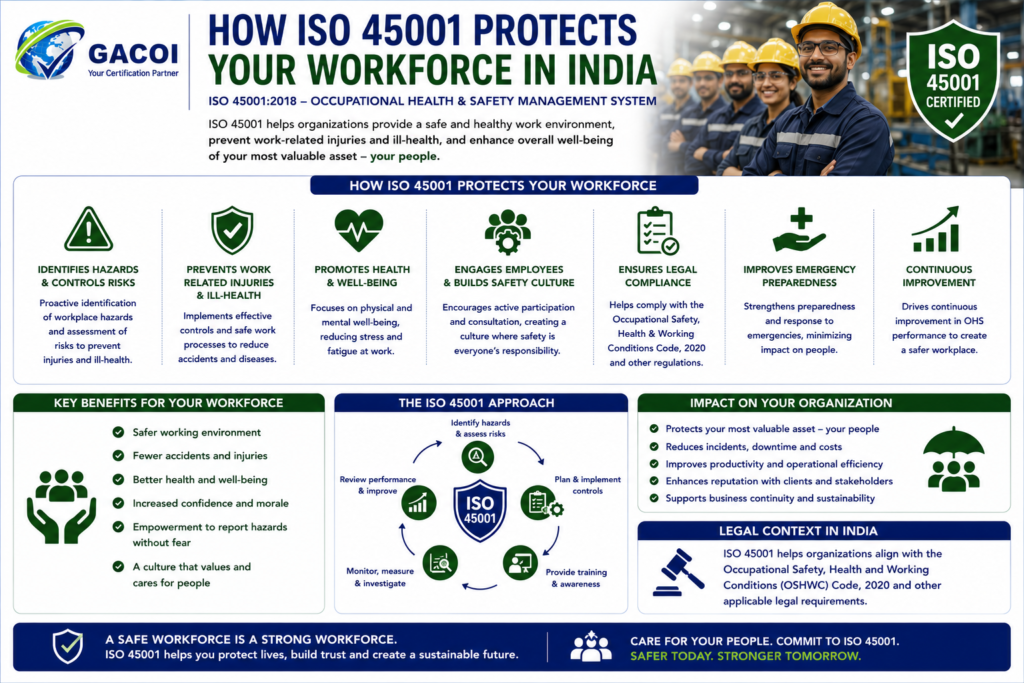
Key Difference 3: Worker Participation and Consultation
This difference represents one of the most philosophically significant improvements in ISO 45001 over OHSAS 18001 — and one that reflects the most important evidence-based insight in modern occupational safety management: workers who are genuinely involved in safety decisions make workplaces safer.
OHSAS 18001 referenced worker participation and consultation but did not treat it as a prominent or deeply developed requirement. Worker involvement was mentioned but not structured, not required to be systematic, and not emphasized as a critical element of effective safety management.
ISO 45001:2018 dedicates a specific, prominent clause to worker participation and consultation — making it one of the standard’s most distinctive and demanding requirements. The standard explicitly requires organizations to:
- Establish processes for worker participation and consultation in OHS management system development, implementation, and improvement
- Provide mechanisms, time, training, and resources necessary for participation
- Provide timely access to clear and understandable OHS information
- Determine and address barriers and obstacles to worker participation
- Emphasize participation of non-managerial workers specifically
- Involve workers in hazard identification, risk assessment, and determination of controls
- Involve workers in incident investigation
- Involve workers in development and review of OHS policies and objectives
- Involve workers in identification of training needs
Why this difference matters in practice:
Workers doing the actual work in manufacturing, construction, chemical processing, and other hazardous industries know things about their workplace hazards that managers and safety professionals often do not. Workers directly operating machinery know the ways it can fail. Workers handling chemicals know the specific conditions where exposures occur. Workers performing maintenance know the situations where standard procedures are difficult to follow.
ISO 45001’s strong worker participation requirements create formal mechanisms for this frontline safety knowledge to inform hazard identification, risk assessment, and control selection — consistently producing more comprehensive and effective safety management than top-down management-driven approaches alone.
This is not merely a philosophical improvement — research consistently demonstrates that organizations with genuine worker participation in safety management achieve significantly lower accident rates than those where safety is managed exclusively by management and safety professionals.
Key Difference 4: Leadership and Top Management Commitment
OHSAS 18001 required management commitment — but the standard’s requirements in this area were relatively general, focusing on resource provision, policy establishment, and safety objective setting without mandating specific leadership behaviors or active demonstration of commitment.
ISO 45001:2018 substantially strengthens leadership requirements — moving from “management commitment” language to “leadership and worker participation” as a dedicated top-level clause. The standard requires top management to demonstrate active, visible leadership in occupational health and safety — not merely endorse a policy document or authorize a budget.
Specific ISO 45001 leadership requirements that exceed OHSAS 18001:
Overall accountability: Top management must take overall accountability for preventing work-related injury and ill health — they cannot delegate this accountability entirely to safety professionals or middle managers.
Integration with business strategy: Top management must ensure that OHS requirements are integrated into the organization’s business processes — not treated as a separate safety compliance activity divorced from core operations.
Visible leadership behavior: Top management must demonstrate leadership and commitment with respect to OHS by actively supporting the OHS management system — not merely approving it at a distance.
Safety culture promotion: Top management must promote a culture that supports the intended outcomes of the OHS management system — actively working to create an organizational culture where safety is genuinely valued rather than merely required.
Protection from retaliation: Top management must ensure that workers can report incidents, hazards, and concerns without fear of retaliation — a requirement that reflects the critical importance of open safety reporting culture.
Why stronger leadership requirements improve safety outcomes:
Research on organizational safety consistently identifies leadership commitment as the single most important factor in safety culture development and accident rate reduction. Organizations where senior leaders actively and visibly demonstrate safety commitment — where the CEO walks the factory floor with genuine safety concern, where leadership decisions consistently prioritize safety over short-term production pressure — achieve dramatically better safety outcomes than organizations where safety responsibility is delegated exclusively to safety departments.
ISO 45001’s strengthened leadership requirements create the conditions for this top-down safety culture development that OHSAS 18001’s weaker leadership requirements did not adequately promote.
Key Difference 5: Organizational Context and Interested Parties
OHSAS 18001 required no consideration of organizational context. Organizations implementing the standard focused exclusively on their internal operations — hazards, controls, procedures — without systematically considering the broader environment in which they operated.
ISO 45001:2018 — following the HLS framework — explicitly requires organizations to understand their organizational context as a foundation for designing and implementing their OHS management system.
Context of the organization requirements in ISO 45001:
Organizations must identify external and internal issues relevant to their OHS management system — including:
External issues: Legal and regulatory requirements, industry sector OHS norms and expectations, supply chain OHS requirements from customers, community expectations and concerns, technological developments affecting workplace safety, and competitive pressures that might affect safety investment decisions.
Internal issues: Organizational culture, values, and leadership priorities, existing worker safety knowledge and competence, resource constraints, historical accident and incident data, and existing management system maturity.
Interested parties: Organizations must identify all interested parties whose needs and expectations are relevant to their OHS management system — including workers and worker representatives, customers and contractors, regulatory authorities, insurance providers, investors, and communities affected by operations.
Why organizational context matters for OHS management:
A chemical manufacturer supplying to EU markets faces different OHS management requirements than one supplying exclusively to domestic markets. A construction contractor working on government infrastructure projects faces different OHS management expectations than one working exclusively for private sector clients. A pharmaceutical manufacturer subject to CDSCO inspection faces different regulatory OHS scrutiny than a food processor.
ISO 45001’s organizational context requirement ensures that OHS management systems are designed to address the specific external environment and internal characteristics of each organization — rather than applying a generic template that may not address the most important safety management priorities for a specific business context.
Key Difference 6: Risk and Opportunity Management
OHSAS 18001 addressed risk in a relatively narrow way — focusing on hazard identification and risk assessment as the primary risk management mechanism. The concept of “opportunities” was absent from OHSAS 18001’s framework entirely.
ISO 45001:2018 introduces a significantly broader risk management framework that includes both risks — circumstances that could lead to harmful outcomes — and opportunities — circumstances that could lead to improved OHS outcomes.
OHS opportunities that ISO 45001 requires organizations to consider:
- Opportunities to improve OHS performance — through new technology, better equipment, improved materials
- Opportunities to integrate OHS management with other business processes — quality, environmental, operations
- Opportunities to eliminate hazards through process redesign rather than just controlling them
- Opportunities to improve worker health and wellbeing beyond preventing injury
- Opportunities to improve OHS management system effectiveness through better monitoring or communication
This opportunity-based thinking represents a fundamental shift from OHSAS 18001’s primarily reactive hazard-control orientation toward a more proactive approach that actively seeks out ways to improve safety performance — not merely prevent worst-case scenarios.
The practical impact of opportunity management:
Organizations implementing ISO 45001 consistently identify safety improvement opportunities that OHSAS 18001’s hazard-focused approach would not have surfaced — such as process automation opportunities that eliminate manual handling hazards entirely, ergonomic improvement opportunities that prevent musculoskeletal disorders before they develop, or mental health support opportunities that address psychosocial safety risks that physical hazard assessments routinely miss.
Key Difference 7: Supply Chain and Contractor Safety Management
OHSAS 18001 provided minimal guidance on managing safety across supply chains and contractor relationships — treating the organization’s own operations as the primary scope of OHS management without adequately addressing the safety management of contractors, subcontractors, and others working on the organization’s premises or under its control.
ISO 45001:2018 explicitly requires organizations to manage OHS risks associated with contractors, outsourced functions, and supply chain relationships. The standard requires:
- Coordination with contractors on OHS hazards and controls before work begins
- Communication of relevant OHS requirements to contractors
- Assessment of contractor OHS management capability as part of contractor selection
- Monitoring of contractor OHS performance during work execution
- Inclusion of OHS requirements in procurement and contracting documents
- Management of OHS risks from outsourced processes where the organization retains control or influence
Why supply chain OHS management matters:
In Indian manufacturing, construction, and industrial operations — where contractor and subcontractor workforces often constitute a substantial proportion of total workers on-site — contractor accidents represent a major source of workplace fatalities and serious injuries. OHSAS 18001’s limited supply chain requirements left this major risk area inadequately managed by many certified organizations.
ISO 45001’s explicit supply chain requirements close this gap — ensuring that contractors working under the organization’s control are subject to appropriate OHS management requirements and that the organization proactively manages the safety risks they represent.
Key Difference 8: Management of Change
OHSAS 18001 addressed management of change — the processes for controlling changes to operations, equipment, personnel, and procedures that could introduce new or changed hazards — but did so relatively superficially without detailed requirements for systematic change management.
ISO 45001:2018 provides more comprehensive management of change requirements — recognizing that uncontrolled organizational changes represent one of the most significant sources of new workplace hazards and serious accidents in industrial organizations.
ISO 45001 requires organizations to establish processes for implementing and controlling planned temporary and permanent changes that affect OHS performance — including changes to:
- Products, services, and processes
- Work organization, working conditions, and work environment
- Equipment, including technology
- Legal requirements and other requirements
- Knowledge, skills, and competence of workers
- Contractors and suppliers
The requirement to assess OHS implications of all significant changes before implementation — rather than discovering new hazards after changes are made — prevents the category of accidents that occur when process modifications, equipment changes, or organizational restructuring introduce hazards that existing controls do not address.
The Transition from OHSAS 18001 to ISO 45001: What Organizations Must Do
For Indian organizations that held OHSAS 18001 certification and have not yet transitioned — or that are now pursuing OHS certification for the first time — the path forward is clear:
ISO 45001:2018 is the only valid OHS management system standard. OHSAS 18001 no longer exists as a certification option. All new OHS certifications must be to ISO 45001:2018.
Gap analysis for former OHSAS 18001 holders: Organizations that previously implemented OHSAS 18001 need to conduct a gap analysis identifying what additional requirements ISO 45001 introduces — particularly organizational context, worker participation, strengthened leadership, risk and opportunity management, and supply chain requirements — and implement the additional elements needed for ISO 45001 compliance.
Organizations with mature OHSAS 18001 systems: Former OHSAS 18001 certified organizations have a significant advantage — their existing hazard identification, risk assessment, legal register, and OHS procedure infrastructure provides a foundation that reduces the implementation effort for ISO 45001. The primary transition work involves adding new elements rather than rebuilding from scratch.
GacoiCert ISO 45001 transition support: GacoiCert provides ISO 45001 certification for both organizations transitioning from OHSAS 18001 and organizations implementing OHS management systems for the first time — with efficient audit processes that recognize existing OHS management infrastructure while verifying compliance with ISO 45001’s additional requirements.
ISO 45001 Certification Cost and Timeline in India 2026
Estimated Certification Body Fees:
| Organization Size | Estimated ISO 45001 Certification Fee |
|---|---|
| Small (up to 25 employees) | ₹50,000 – ₹90,000 |
| Medium (26 – 100 employees) | ₹95,000 – ₹1,55,000 |
| Large (101 – 300 employees) | ₹1,80,000 – ₹2,70,000 |
| Very Large (300+ employees) | ₹2,30,000 – ₹3,30,000 |
Certification Timeline:
| Organization Size | Total Timeline |
|---|---|
| Small Business | 10 – 16 weeks |
| Medium Business | 4 – 7 months |
| Large Business | 6 – 10 months |
| Very Large Organization | 9 – 14 months |
Why Choose GacoiCert for ISO 45001 Certification in India?
Internationally accredited: GacoiCert’s ISO 45001 certificates are issued under internationally recognized accreditation — verifiable through NABCB and IAF databases, accepted by government procurement authorities, international buyers, corporate supply chain teams, and financial institutions worldwide.
Deep OHS expertise: Our auditors bring genuine occupational health and safety management knowledge across manufacturing, construction, healthcare, chemical processing, logistics, and all other major Indian industries — understanding both the standard’s requirements and the practical safety management challenges of specific operational contexts.
OHSAS 18001 transition experience: GacoiCert has extensive experience supporting organizations transitioning from OHSAS 18001 to ISO 45001 — providing efficient, focused transition assessments that recognize existing OHS management infrastructure while verifying ISO 45001 compliance.
India-specific regulatory knowledge: OS&H Code 2020, Factories Act provisions, CPCB interface requirements — our auditors understand India’s complete occupational safety regulatory landscape.
Integrated Management System capability: ISO 45001 combined with ISO 9001 and ISO 14001 through a single coordinated audit — maximum efficiency and minimum cost for organizations needing comprehensive certification.
Transparent competitive pricing: Complete itemized quotations with no hidden fees covering every stage of the certification process.
Pan-India coverage: Delhi NCR, Mumbai, Pune, Bangalore, Chennai, Hyderabad, Kolkata, Ahmedabad, Ludhiana, and all major industrial centers across India.
Conclusion: ISO 45001 Is Not Just an Upgrade — It Is a Fundamental Improvement in OHS Management
The comparison between ISO 45001 and OHSAS 18001 reveals not merely an updated standard with incremental improvements — but a fundamentally better framework for occupational health and safety management that reflects twenty years of accumulated evidence about what actually works to prevent workplace injuries and fatalities.
Stronger worker participation requirements, more demanding leadership accountability, organizational context consideration, risk and opportunity management, comprehensive supply chain OHS management, and the practical benefits of High Level Structure integration — collectively represent a qualitative improvement over OHSAS 18001 that delivers better safety outcomes, stronger regulatory compliance, and more credible market recognition.
For Indian organizations still operating on expired OHSAS 18001 credentials — or presenting OHSAS 18001 certificates in tender and qualification processes — the urgency of transitioning to ISO 45001 cannot be overstated. OHSAS 18001 is gone. ISO 45001 is the present and future of international OHS management certification.
GacoiCert is ready to guide your organization through ISO 45001 certification — whether transitioning from OHSAS 18001 or implementing OHS management systems for the first time. Visit gacoicert.com today, request your free consultation, and achieve the only valid international OHS certification that Indian and global markets recognize.
Frequently Asked Questions
What Is the Main Difference Between ISO 45001 and OHSAS 18001?
The main difference is that ISO 45001 is the internationally recognized occupational health and safety management standard that replaced OHSAS 18001. It places greater emphasis on leadership, worker participation, and risk-based thinking.
Why Was OHSAS 18001 Replaced by ISO 45001?
OHSAS 18001 was replaced to create a globally accepted standard that aligns with other ISO management systems, making it easier for organizations to integrate health and safety with quality and environmental management.
Is OHSAS 18001 Still Valid in 2026?
No. OHSAS 18001 has been officially withdrawn, and organizations are expected to implement ISO 45001 for occupational health and safety management.
Should Businesses Upgrade from OHSAS 18001 to ISO 45001?
Yes. Businesses using OHSAS 18001 should transition to ISO 45001 to meet current international standards and improve workplace health and safety practices.
Which Standard Is Better for Workplace Safety?
ISO 45001 is considered the better standard because it focuses on proactive risk management, employee involvement, organizational leadership, and continual improvement.
Does ISO 45001 Follow the High-Level Structure?
Yes. ISO 45001 follows the ISO High-Level Structure (HLS), allowing it to integrate easily with standards such as ISO 9001 and ISO 14001.
Can Small Businesses Implement ISO 45001?
Yes. ISO 45001 is suitable for organizations of all sizes, including startups, MSMEs, and large enterprises across different industries.
What Are the Benefits of Switching from OHSAS 18001 to ISO 45001?
Transitioning to ISO 45001 helps improve workplace safety, reduce occupational risks, strengthen legal compliance, increase employee engagement, and enhance business credibility.
Does ISO 45001 Help Companies Win More Business Opportunities?
Yes. Many government agencies, multinational companies, and private clients prefer suppliers that hold ISO 45001 certification because it demonstrates a commitment to occupational health and safety.
Is ISO 45001 Certification Mandatory in India?
ISO 45001 certification is generally voluntary, but many organizations choose it to meet customer expectations, improve compliance, and gain a competitive advantage in the market.
Get Expert Guidance for ISO Certification
🟡GACOI Cert provides globally recognized ISO certification, cybersecurity, privacy, AI governance, compliance, audit, and professional training services, helping startups, businesses, enterprises, laboratories, healthcare organizations, and government institutions achieve international standards and build lasting trust.
🟡For other Legal and Trademark related services Visit
👉 Money Recovery Cases
👉 Property Disputes
👉ISO Registration
👉ISO 22000 Certification
🟡 Protect Your Rights
👉 Domestic Violence Legal Support
👉 Stridhan Recovery
👉 Mutual Consent Divorce
👉 Contested Divorce Filing
📞 Call Now: +91 8595439395
🕐 Free Consultation: Monday to Saturday, 10 AM to 6 PM


