


Views: 1
Discover why manufacturing companies need ISO 45001 occupational health and safety certification in India 2026 — regulatory compliance, accident prevention, tender access, export markets, and how GacoiCert helps manufacturers get certified.
Table of Contents
- 1 Introduction: Why Manufacturing Companies Need ISO 45001 in India
- 2 The Manufacturing Safety Reality in India: Why the Status Quo Is Unacceptable
- 3 Reason 1: Compliance with India’s Strengthening Safety Regulatory Framework
- 4 Reason 2: Preventing Workplace Accidents and Their Devastating Costs
- 5 Reason 3: Winning Government Tenders and Public Sector Contracts
- 6 Reason 4: Accessing International Supply Chains and Export Markets
- 7 Reason 5: Reducing Insurance Costs and Financial Liability Exposure
- 8 Reason 6: Attracting and Retaining Skilled Manufacturing Workers
- 9 Reason 7: ESG Performance and Access to Sustainable Finance
- 10 Reason 8: Specific Manufacturing Sector Safety Imperatives
- 11 The ISO 45001 Certification Process for Indian Manufacturers: Overview
- 12 ISO 45001 Certification Timeline and Cost for Indian Manufacturers
- 13 Why Choose GacoiCert for ISO 45001 Certification in India?
- 14 Conclusion: ISO 45001 Is the Most Important Safety Investment an Indian Manufacturer Can Make in 2026
- 15 Frequently Asked Questions
- 16 Get Expert Guidance for ISO Certification
Introduction: Why Manufacturing Companies Need ISO 45001 in India
India’s manufacturing sector is the backbone of the national economy — contributing approximately 17 percent of GDP, employing over 57 million workers directly, and serving as the foundation of the country’s export competitiveness and industrial development ambitions. From small precision engineering workshops to large automotive assembly plants, from chemical processing facilities to textile manufacturing complexes — Indian manufacturing spans an extraordinary range of industries, processes, and operational scales.
But alongside this economic significance comes a sobering reality: India’s manufacturing sector is one of the most hazardous working environments in the country. Workplace accidents, occupational diseases, chemical exposures, machinery injuries, falls, fires, and explosions collectively cause thousands of fatalities and hundreds of thousands of serious injuries every year across Indian manufacturing facilities.
The human cost of this workplace safety failure is immeasurable. The financial cost — in medical expenses, compensation claims, regulatory penalties, production disruption, insurance premiums, legal battles, and reputational damage — runs into thousands of crores of rupees annually. And the strategic cost — in lost export contracts, failed tender qualifications, excluded supply chain relationships, and missed investment opportunities — is equally significant.
ISO 45001:2018 — the international standard for Occupational Health and Safety Management Systems — provides Indian manufacturing companies with the most comprehensive, internationally recognized framework for systematically preventing workplace injuries, managing safety risks, and demonstrating occupational health and safety commitment to employees, regulators, clients, and international partners.
In India’s manufacturing sector in 2026, ISO 45001 certification has transitioned from a voluntary quality initiative to a strategic business necessity. This comprehensive guide from GacoiCert explains exactly why — covering the regulatory landscape, commercial drivers, operational benefits, financial returns, and specific manufacturing sector considerations that make ISO 45001 certification essential for Indian manufacturers.
The Manufacturing Safety Reality in India: Why the Status Quo Is Unacceptable
Understanding why ISO 45001 matters for Indian manufacturers requires honestly confronting the workplace safety reality that makes it necessary.
Workplace accident statistics in Indian manufacturing are alarming. According to data from the Directorate General Factory Advice Service and Labour Institutes, thousands of fatal accidents occur annually in registered factories alone — with a substantially larger number occurring in unregistered and informal manufacturing operations that fall outside official reporting. Non-fatal serious injuries number in the hundreds of thousands.
The cost of workplace accidents extends far beyond immediate medical expenses:
Direct costs include medical treatment expenses, workers’ compensation payments, accident investigation costs, equipment damage and repair, production downtime during investigation and cleanup, and temporary worker replacement costs. These direct costs are significant — but indirect costs are often far larger.
Indirect costs include reduced productivity from surviving workers affected by accidents, management time spent on investigation and reporting, legal fees and court costs for compensation disputes, increased insurance premiums following claims, regulatory fine payment and compliance remediation, and the long-term reputational damage from accident publicity. Industry research consistently shows that indirect costs of workplace accidents are three to ten times higher than direct costs.
The regulatory consequence landscape is intensifying. India’s Occupational Safety, Health and Working Conditions Code 2020 — consolidating and strengthening previous factory safety legislation — has increased penalties for safety violations, expanded inspector authority, broadened the definition of employer safety obligations, and strengthened worker rights to refuse unsafe work. State labor departments are conducting more frequent factory inspections with greater technical capability. National Green Tribunal jurisdiction over industrial incidents has expanded regulatory exposure for manufacturers facing serious accidents.
For Indian manufacturing companies, maintaining the status quo on workplace safety management is not merely ethically indefensible — it is financially and commercially unsustainable.
Reason 1: Compliance with India’s Strengthening Safety Regulatory Framework
The most fundamental reason Indian manufacturing companies need ISO 45001 is systematic compliance with an increasingly demanding and rigorously enforced regulatory framework.
The Occupational Safety, Health and Working Conditions Code 2020 represents the most significant reform of Indian workplace safety legislation in decades. Consolidating the Factories Act, Mines Act, Dock Workers Act, Building and Other Construction Workers Act, and several other statutes into a single comprehensive code — the OS&H Code 2020 strengthens employer safety obligations, expands worker protections, increases penalty provisions, and broadens the scope of regulatory oversight.
Key regulatory requirements that ISO 45001 directly supports:
Hazard identification and risk assessment: OS&H Code requirements for safety committees, safety officers, and written safety statements require employers to systematically identify workplace hazards and implement controls — exactly what ISO 45001’s hazard identification and risk assessment requirements mandate.
Safety officer requirements: Factories above defined employee thresholds must appoint qualified safety officers. ISO 45001’s personnel competence requirements ensure that safety roles are defined, qualified individuals are appointed, and their competence is formally verified — supporting regulatory compliance with safety officer appointment requirements.
Worker safety committees: OS&H Code requirements for joint worker-management safety committees align directly with ISO 45001’s worker participation and consultation requirements — which explicitly require workers to be involved in hazard identification, risk assessment, and safety decision-making.
Accident investigation and reporting: Regulatory requirements for accident investigation and reporting to factory inspectorates are supported by ISO 45001’s incident investigation requirements — which mandate systematic root cause analysis and corrective action for all incidents and near misses.
CPCB and SPCB environmental safety interface: Manufacturing facilities that cause environmental incidents through accidents — chemical spills, fire suppressant discharge, accidental releases — face both safety and environmental regulatory consequences. ISO 45001’s emergency preparedness requirements address this interface systematically.
The compliance protection value of ISO 45001: Manufacturing companies that have implemented ISO 45001 and can demonstrate systematic safety management — documented hazard controls, trained personnel, verified emergency procedures, investigated incidents — are in a substantially stronger position during regulatory inspections, enforcement actions, and legal proceedings than companies relying on informal or incomplete safety practices.
Reason 2: Preventing Workplace Accidents and Their Devastating Costs
The most direct and most important benefit of ISO 45001 for Indian manufacturers is the prevention of workplace accidents — and the elimination of the catastrophic human and financial costs they cause.
ISO 45001’s systematic approach to hazard management works through a clear methodology that consistently reduces accident frequency and severity:
Comprehensive hazard identification: ISO 45001 requires systematic identification of all workplace hazards — machinery hazards, electrical hazards, chemical exposures, working at height, manual handling, confined space entry, fire and explosion risk, ergonomic hazards, extreme temperature exposure, and psychosocial hazards. This comprehensive identification ensures that no significant hazard goes unmanaged.
Rigorous risk assessment: Each identified hazard is formally assessed for both the likelihood of harm occurring and the severity of potential consequences — producing a risk rating that prioritizes control investment on highest-risk hazards.
Hierarchy of Controls: ISO 45001 requires that controls be selected following the internationally recognized hierarchy — elimination of hazards first, then substitution with less hazardous alternatives, then engineering controls such as machine guards and ventilation, then administrative controls such as safe work procedures and job rotation, with personal protective equipment only as a last resort supplementary control.
Critical control point monitoring: High-risk activities — hot work permits, confined space entry, electrical isolation procedures, crane and lifting operations — require specific operational controls with verification requirements ensuring controls are actually implemented before hazardous work begins.
Near miss investigation: ISO 45001 requires systematic investigation of near misses — incidents where harm did not occur but could have — treating them as valuable warnings of systemic hazard control failures that require correction before a serious accident occurs.
Emergency preparedness: Documented emergency response plans, trained emergency response teams, emergency equipment, and regular drills ensure that when incidents do occur, they are contained and their consequences minimized.
The accident prevention financial case:
For a medium-sized Indian manufacturer employing 200 workers, the expected cost of a single fatal workplace accident — including compensation payment, legal fees, regulatory fines, investigation costs, production disruption, and insurance impact — realistically ranges from ₹50,00,000 to ₹2,00,00,000 or more. The annual cost of maintaining ISO 45001 certification for a manufacturer of this size is typically ₹3,00,000 to ₹8,00,000. A single accident prevented by ISO 45001’s systematic hazard controls delivers a return on certification investment that is immediately and overwhelmingly positive.
Reason 3: Winning Government Tenders and Public Sector Contracts
India’s government procurement of manufacturing goods and services represents an enormous commercial opportunity for Indian manufacturers — and ISO 45001 certification is an increasingly important qualification criterion for accessing this opportunity.
How government procurement drives ISO 45001 need for manufacturers:
Infrastructure and construction manufacturing: Government infrastructure projects — national highways, railways, ports, airports, smart cities — require manufactured components, materials, and equipment from certified suppliers. Tender documents for these projects increasingly include occupational health and safety certification requirements where ISO 45001 is specifically recognized.
Defense manufacturing: India’s defense procurement program — including under Atmanirbhar Bharat and Make in India defense initiatives — requires manufacturing vendors to meet stringent quality and safety standards. Defense procurement evaluations increasingly include safety management system assessment where ISO 45001 certification provides credible evidence.
Public sector undertaking supply chains: PSUs including ONGC, BHEL, NTPC, Steel Authority of India, and Coal India operate extensive supply chains that are incorporating supplier safety management requirements. ISO 45001 certification is increasingly a qualification requirement for PSU supplier approval.
Government construction material supply: Public infrastructure construction requires materials — steel, cement, electrical components, plumbing, HVAC — from certified suppliers. Safety certification requirements in construction material procurement are growing.
Preference scoring in tender evaluation: Even where ISO 45001 is not a mandatory disqualification criterion, tender evaluation matrices increasingly award preference points to certified bidders — improving competitive positioning for ISO 45001 certified manufacturers in public procurement competitions.
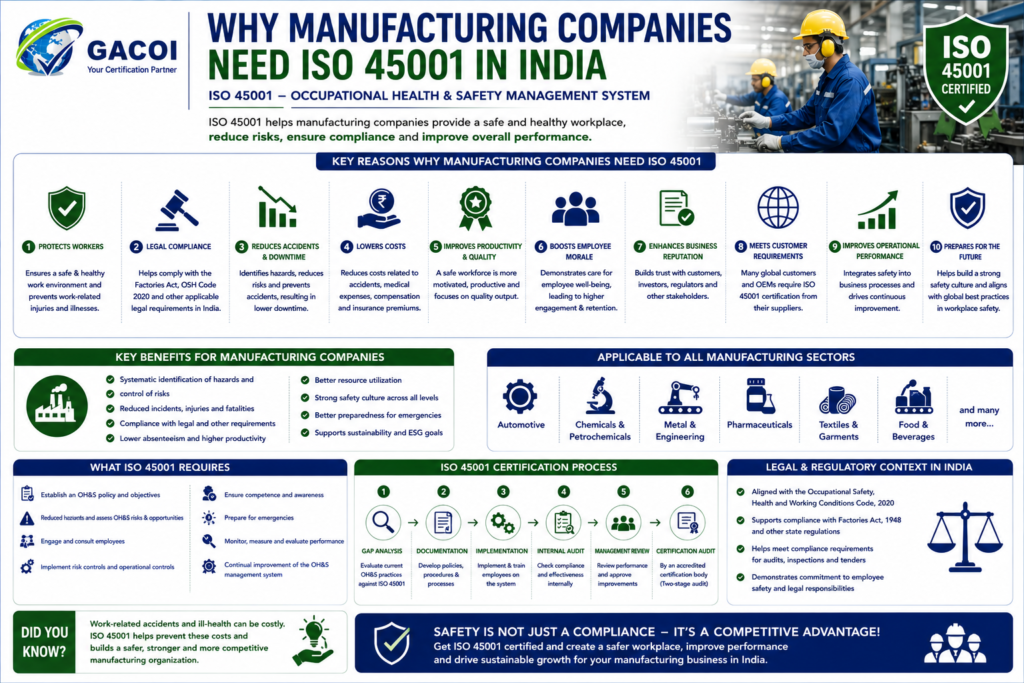
Reason 4: Accessing International Supply Chains and Export Markets
For Indian manufacturers with export ambitions — or those supplying to multinational companies operating in India — ISO 45001 certification has become a supply chain qualification requirement that directly determines market access.
International supply chain safety requirements:
Global automotive supply chains: International automotive OEMs and tier-one suppliers operating in India — from Maruti Suzuki and Hyundai to Toyota, Honda, and Volkswagen — apply global supplier qualification standards that increasingly include occupational health and safety management system requirements. ISO 45001 certification is either required or strongly preferred for supplier qualification in global automotive supply chains.
European buyer requirements: European manufacturing companies sourcing components, materials, or products from Indian suppliers face supply chain due diligence obligations under EU legislation that includes worker safety and working conditions assessment. ISO 45001 certification provides credible, independently verified evidence of safety management capability that European buyers require from Indian suppliers.
International FMCG and consumer goods companies: Global consumer goods manufacturers — Unilever, Procter and Gamble, Nestlé, Johnson and Johnson — operating ethical sourcing programs require their manufacturing suppliers to demonstrate safe working conditions. ISO 45001 certification is the most recognized mechanism for demonstrating this capability.
Pharmaceutical manufacturing supply chains: International pharmaceutical companies sourcing active pharmaceutical ingredients, intermediates, or finished dose forms from Indian manufacturers apply stringent supplier qualification requirements that include safety management system assessment.
Electronics and technology manufacturing: Global electronics OEMs sourcing manufactured components from India — applying codes of conduct aligned with international labor and safety standards — require supplier factories to demonstrate occupational health and safety management capability.
Export market regulatory recognition:
Beyond buyer requirements, some export markets have regulatory frameworks that recognize ISO 45001 certification as evidence of safety management capability — facilitating product approvals, facility approvals, and regulatory submissions in regulated international markets.
Reason 5: Reducing Insurance Costs and Financial Liability Exposure
The financial risk management benefit of ISO 45001 for Indian manufacturers is substantial — delivering direct, measurable cost savings through improved insurance terms and reduced liability exposure.
Workers’ compensation and employer liability insurance: Insurance providers underwriting workers’ compensation and employer liability policies for manufacturing facilities assess workplace safety management practices as a primary risk factor. ISO 45001 certified manufacturers — with documented, independently verified safety management systems — consistently present lower risk profiles than uncertified manufacturers. This lower risk profile translates into more favorable premium rates, higher coverage limits at equivalent premiums, and better claims handling relationships.
Property and business interruption insurance: Major workplace accidents — fires, explosions, chemical releases — can cause catastrophic property damage and business interruption losses in manufacturing facilities. ISO 45001’s emergency preparedness requirements reduce both the probability of such events and their severity when they occur — improving property and business interruption insurance risk profiles.
Product liability insurance: Unsafe manufacturing conditions can contribute to product quality failures that result in product liability claims. ISO 45001’s operational control requirements for manufacturing processes reduce process variation and quality failures — indirectly reducing product liability exposure.
Legal liability protection: When workplace accidents do occur in ISO 45001 certified manufacturers — despite systematic safety management — the documented evidence of hazard controls, risk assessments, worker training, and safety procedures provides legal protection against allegations of employer negligence. Courts and compensation tribunals consistently distinguish between employers with documented systematic safety management and those with informal or absent safety programs.
Reason 6: Attracting and Retaining Skilled Manufacturing Workers
India’s manufacturing sector faces growing challenges in attracting and retaining skilled workers — particularly in technical and specialized manufacturing roles where skill shortages are acute. ISO 45001 certification directly supports talent acquisition and retention by demonstrating genuine commitment to worker safety and wellbeing.
How ISO 45001 improves talent outcomes:
Safety reputation as recruitment advantage: Manufacturing workers increasingly consider workplace safety reputation when evaluating employment opportunities — particularly in areas with multiple competing manufacturing employers. ISO 45001 certified manufacturers can credibly communicate their safety commitment through the independent verification that certification provides — differentiating themselves from uncertified competitors in the labor market.
Reduced absenteeism: Fewer workplace injuries means fewer injury-related absences — improving productivity, reducing the operational disruption of unplanned absences, and reducing the costs of temporary replacement workers.
Improved morale and engagement: Workers who feel genuinely safe at work — who see that their employer has invested in identifying and controlling hazards systematically rather than relying on warnings and PPE — consistently demonstrate higher morale, greater organizational commitment, and stronger productivity. This engagement advantage compounds over time as organizational safety culture strengthens.
Reduced turnover: High accident rates and poor safety cultures are consistently associated with elevated worker turnover — particularly among skilled workers who have alternative employment options. ISO 45001’s systematic safety management reduces accident frequency and improves safety culture — reducing the turnover costs that represent a significant hidden expense for manufacturing companies.
Worker participation empowerment: ISO 45001 explicitly requires worker participation in hazard identification, risk assessment, and safety improvement — creating a culture where workers feel ownership of safety and actively contribute to making their workplace safer. This participation culture builds organizational loyalty and creates safety improvement contributions that management alone cannot generate.
Reason 7: ESG Performance and Access to Sustainable Finance
Environmental, Social, and Governance investing and sustainable finance have arrived in India’s manufacturing sector with significant force — creating new financial incentives for ISO 45001 certification that are increasingly important for manufacturers seeking capital.
How ISO 45001 supports ESG performance for manufacturers:
Social component of ESG: Worker safety and wellbeing are fundamental components of the Social dimension of ESG frameworks. ISO 45001 certification provides independently verified evidence of systematic worker safety management — the most credible demonstration of Social performance available to manufacturing companies.
SEBI BRSR reporting: India’s top 1,000 listed companies by market capitalization must comply with SEBI’s Business Responsibility and Sustainability Reporting framework — which requires disclosure of worker health and safety data including accident rates, safety training, and safety management system information. ISO 45001 certification generates the structured safety management data and evidence that BRSR compliance requires.
Sustainability-linked financing: Banks and financial institutions in India are developing sustainability-linked loan products where borrower ESG performance — including worker safety metrics — influences loan terms. ISO 45001 certified manufacturers may qualify for preferential interest rates under sustainability-linked financing instruments — delivering direct financial savings.
Private equity and FDI investment requirements: International private equity investors and foreign direct investors applying ESG criteria to investment decisions consistently require manufacturing investees to demonstrate systematic worker safety management. ISO 45001 certification provides the independent verification that international investors require.
Green and sustainable supply chain qualification: Global manufacturers implementing sustainable supply chain programs — covering both environmental and social performance — require supplier factories to demonstrate worker safety management as part of social compliance. ISO 45001 is the internationally recognized standard for this demonstration.
Reason 8: Specific Manufacturing Sector Safety Imperatives
Different manufacturing sub-sectors face distinct safety challenges that make ISO 45001 particularly urgent for specific industries:
Chemical manufacturing: India’s chemical manufacturing sector faces the highest workplace accident severity of any manufacturing industry — with explosion, fire, toxic release, and chemical exposure hazards capable of causing mass casualty events. ISO 45001’s process safety management integration, emergency response planning, and chemical hazard control requirements are specifically critical for chemical manufacturers.
Automotive manufacturing: Assembly line operations, stamping and pressing machinery, welding operations, paint shop chemical exposures, and materials handling present diverse and serious hazards. Global automotive supply chain qualification requirements make ISO 45001 effectively mandatory for automotive component manufacturers.
Textile and garment manufacturing: Fire hazards from fabric dust accumulation, machinery hazards from weaving and cutting equipment, chemical exposure from dyeing operations, and ergonomic hazards from repetitive production work make systematic safety management essential. International fashion brand social compliance requirements make ISO 45001 increasingly mandatory for export-oriented textile manufacturers.
Food and beverage manufacturing: Slip and fall hazards in wet production environments, knife and cutting equipment hazards, cold storage risks, cleaning chemical exposures, and heavy lifting injuries are common. ISO 45001 certification supports food safety system integration and increasingly appears in food sector supply chain qualification requirements.
Pharmaceutical manufacturing: Chemical exposure to active pharmaceutical ingredients, explosion and fire risk from solvent use, dust explosion hazards from powder handling, and ergonomic risks from laboratory work require systematic safety management. GMP regulatory frameworks increasingly align with ISO 45001 requirements.
Construction material manufacturing: Cement, steel, glass, ceramics, and brick manufacturing involve extreme heat, heavy machinery, dust exposure, and materials handling hazards. BIS certification and government construction sector supply chain requirements increasingly incorporate safety certification criteria.
The ISO 45001 Certification Process for Indian Manufacturers: Overview
Step 1: Gap Analysis and Hazard Identification
Conduct comprehensive assessment of current safety practices against ISO 45001 requirements and systematically identify all workplace hazards specific to manufacturing operations.
Step 2: Risk Assessment and Control Planning
Formally assess each identified hazard and develop control plans following the hierarchy of controls — prioritizing elimination and engineering controls over administrative controls and PPE.
Step 3: OHSMS Documentation
Develop OHS Policy, hazard register, legal register, risk assessment records, safe work procedures, emergency response plans, and all required documented information.
Step 4: Implementation and Worker Training
Implement all documented controls, train all workers on relevant hazards and procedures, establish worker participation mechanisms, and begin systematic record keeping.
Step 5: Internal Audit and Management Review
Conduct formal internal audit covering all ISO 45001 requirements. Address nonconformities. Conduct management review with full safety performance data.
Step 6: GacoiCert Certification Audit
GacoiCert conducts Stage 1 documentation review followed by Stage 2 on-site certification assessment — verifying genuine OHSMS implementation across manufacturing operations, hazard controls, worker training, and emergency preparedness.
Step 7: Certificate Issuance
ISO 45001:2018 certificate issued — valid for three years with annual surveillance audits.
ISO 45001 Certification Timeline and Cost for Indian Manufacturers
Certification Timeline:
| Manufacturer Size | Total Timeline |
|---|---|
| Small (up to 25 employees) | 10 – 16 weeks |
| Medium (26 – 100 employees) | 4 – 7 months |
| Large (101 – 300 employees) | 6 – 10 months |
| Very Large (300+ employees) | 9 – 14 months |
Estimated Total First-Year Investment:
| Manufacturer Size | Total Estimated Investment |
|---|---|
| Small manufacturer | ₹1,10,000 – ₹2,70,000 |
| Medium manufacturer | ₹2,40,000 – ₹5,30,000 |
| Large manufacturer | ₹4,65,000 – ₹9,55,000 |
| Very large manufacturer | ₹8,70,000 and above |
Why Choose GacoiCert for ISO 45001 Certification in India?
Internationally accredited: GacoiCert’s ISO 45001 certificates are globally recognized — accepted by government procurement authorities, international buyers, corporate supply chain teams, and financial institutions worldwide.
Manufacturing sector expertise: Our auditors bring genuine occupational health and safety knowledge specific to Indian manufacturing — chemical safety, machinery hazards, automotive manufacturing, textile operations, pharmaceutical production, food processing, and construction material manufacturing.
India-specific regulatory knowledge: OS&H Code 2020, Factories Act provisions, CPCB interface requirements, BEE energy safety regulations — our auditors understand India’s complete manufacturing safety regulatory landscape.
Integrated Management System capability: ISO 45001 combined with ISO 9001 and ISO 14001 through a single coordinated audit — delivering comprehensive certification at maximum cost efficiency for manufacturers needing multiple standards.
Transparent competitive pricing: Complete itemized quotations with no hidden fees — enabling accurate certification budget planning.
Pan-India manufacturing coverage: Delhi NCR, Mumbai, Pune, Ahmedabad, Surat, Ludhiana, Bangalore, Chennai, Hyderabad, Kolkata, and all major manufacturing centers across India.
Conclusion: ISO 45001 Is the Most Important Safety Investment an Indian Manufacturer Can Make in 2026
The eight reasons explored in this guide — regulatory compliance, accident prevention, government tender access, international supply chain qualification, insurance cost reduction, talent attraction and retention, ESG performance and sustainable finance, and sector-specific safety imperatives — collectively make an overwhelming case for ISO 45001 certification as an essential investment for Indian manufacturing companies.
Every year without ISO 45001, Indian manufacturers carry accident risk that costs far more than certification when incidents occur, miss tender opportunities that require safety certification, lose export contracts that demand worker safety evidence, and pay higher insurance premiums than certified competitors. The cost of not having ISO 45001 consistently exceeds the cost of having it — often dramatically.
In India’s manufacturing sector in 2026 — where regulatory enforcement is strengthening, international supply chain requirements are intensifying, ESG investment criteria are becoming standard, and worker safety expectations are rising — ISO 45001 certification is not a future consideration. It is a present business necessity.
GacoiCert is ready to guide your manufacturing company through ISO 45001 certification efficiently, affordably, and with the deep manufacturing sector expertise that makes the difference between a certificate and a genuinely effective safety management system. Visit gacoicert.com today, request your free consultation, and take the first step toward protecting your workers, your business, and your competitive future.
Frequently Asked Questions
Why Do Manufacturing Companies Need ISO 45001 Certification in India?
ISO 45001 certification helps manufacturing companies create a safer workplace by identifying occupational hazards, reducing workplace accidents, improving employee well-being, and ensuring compliance with health and safety regulations.
Is ISO 45001 Certification Mandatory for Manufacturing Companies in India?
ISO 45001 certification is not legally mandatory, but many manufacturers obtain it to meet customer requirements, qualify for tenders, and demonstrate their commitment to workplace safety.
Which Manufacturing Industries Should Get ISO 45001 Certified?
Industries such as automotive, engineering, pharmaceuticals, chemicals, textiles, food processing, steel, electronics, and heavy machinery manufacturing can benefit significantly from ISO 45001 certification.
How Does ISO 45001 Improve Workplace Safety in Manufacturing?
ISO 45001 provides a systematic approach to identifying risks, implementing safety controls, training employees, investigating incidents, and continuously improving occupational health and safety performance.
Can Small Manufacturing Businesses Apply for ISO 45001 Certification?
Yes. ISO 45001 is suitable for businesses of all sizes, including startups, MSMEs, and large manufacturing companies.
Does ISO 45001 Help Manufacturing Companies Win More Contracts?
Yes. Many government organizations, multinational companies, and private buyers prefer suppliers with ISO 45001 certification because it demonstrates a strong commitment to employee health and workplace safety.
Get Expert Guidance for ISO Certification
🟡GACOI Cert provides globally recognized ISO certification, cybersecurity, privacy, AI governance, compliance, audit, and professional training services, helping startups, businesses, enterprises, laboratories, healthcare organizations, and government institutions achieve international standards and build lasting trust.
🟡For other Legal and Trademark related services Visit
👉 Money Recovery Cases
👉 Property Disputes
👉ISO Registration
👉ISO 22000 Certification
🟡 Protect Your Rights
👉 Domestic Violence Legal Support
👉 Stridhan Recovery
👉 Mutual Consent Divorce
👉 Contested Divorce Filing
📞 Call Now: +91 8595439395
🕐 Free Consultation: Monday to Saturday, 10 AM to 6 PM


