


Views: 1
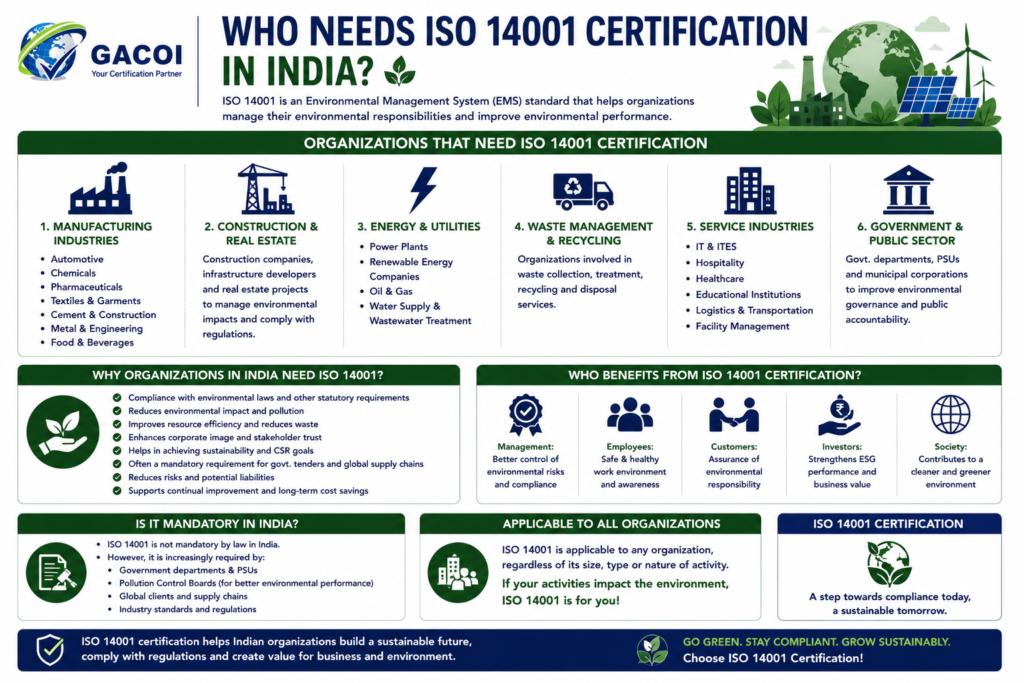
Discover who needs ISO 14001 certification in India — which industries, business types, and organizations benefit most from environmental management certification in 2026. Get certified with GacoiCert.
Table of Contents
- 1 Introduction: Does Your Business Need ISO 14001 Certification in India?
- 2 Understanding ISO 14001: What It Requires and Who It Applies To
- 3 Category 1: Manufacturing Companies — The Highest Priority Segment
- 4 Category 2: Export-Oriented Businesses — Effectively Mandatory
- 5 Category 3: Construction and Infrastructure Companies
- 6 Category 4: IT Companies and Data Center Operators
- 7 Category 5: Hospitality and Tourism Industry
- 8 Category 6: Logistics and Transportation Companies
- 9 Category 7: Healthcare Organizations
- 10 Category 8: Small and Medium Enterprises Targeting Growth
- 11 Category 9: Mining and Natural Resource Companies
- 12 Category 10: Government Bodies and Public Sector Organizations
- 13 The Simple Test: Does Your Business Need ISO 14001?
- 14 Why Choose GacoiCert for ISO 14001 Certification in India?
- 15 Conclusion: In India in 2026, More Businesses Need ISO 14001 Than Ever Before
- 16 Frequently Asked Questions
- 17 Know How to Win Tenders with ISO Certification
Introduction: Does Your Business Need ISO 14001 Certification in India?
Every Indian business owner exploring environmental certification eventually asks the same fundamental question: does my business actually need ISO 14001 certification?
It is the right question — and it deserves a complete, honest, and specific answer rather than a generic “all businesses should consider it” response. Because while ISO 14001 is genuinely applicable to organizations of every type, size, and industry — the urgency, commercial necessity, and strategic value of certification vary significantly depending on your specific business context, market, industry, and growth objectives.
ISO 14001:2015 is the internationally recognized standard for Environmental Management Systems — providing organizations with a structured framework for identifying, managing, monitoring, and continuously improving their environmental performance. In India in 2026, ISO 14001 certification has moved well beyond being a voluntary quality initiative for environmentally conscious businesses. It has become a market access requirement, a regulatory compliance support tool, a supply chain qualification necessity, and an ESG performance credential that investors, lenders, and international buyers actively require.
This comprehensive guide from GacoiCert identifies exactly who needs ISO 14001 certification in India — covering every industry, business type, and organizational context where certification delivers immediate and compelling value — and explains why each category of organization benefits from certification in its specific market and regulatory environment.
Understanding ISO 14001: What It Requires and Who It Applies To
Before identifying who needs ISO 14001, understanding what the standard requires and its applicability scope provides essential context.
ISO 14001:2015 applies to any organization that wants to establish, implement, maintain, and continually improve an Environmental Management System. The standard explicitly states that it is applicable regardless of size, type, nature, or the products and services the organization provides.
What ISO 14001 requires organizations to do:
- Understand their environmental context — what environmental issues affect and are affected by their operations
- Identify all environmental aspects — the ways their activities, products, and services interact with the environment
- Evaluate which environmental impacts are significant and require systematic management
- Identify and comply with all applicable environmental legal requirements
- Set environmental objectives and implement programs to achieve them
- Monitor and measure environmental performance systematically
- Continuously improve environmental management effectiveness
What ISO 14001 does not prescribe:
ISO 14001 does not specify particular environmental performance targets that must be achieved. It does not mandate specific emission limits, energy consumption levels, or waste generation thresholds. It requires organizations to comply with applicable legal requirements and to set improvement objectives — but the specific targets are determined by the organization based on its context and significant environmental aspects.
This flexibility makes ISO 14001 genuinely applicable to every type of organization — from a single-person consulting firm that uses paper and electricity to a large chemical manufacturing complex with complex environmental interactions across multiple media.
Category 1: Manufacturing Companies — The Highest Priority Segment
Manufacturing companies represent the most critical category of organizations that need ISO 14001 certification in India — and for manufacturers, certification has transitioned from competitive advantage to virtual necessity across most sub-sectors.
Why manufacturing companies need ISO 14001:
Indian manufacturers interact with the environment across multiple dimensions simultaneously — energy consumption, water use, raw material extraction, process emissions to air, effluent discharge to water bodies, solid and hazardous waste generation, chemical storage and handling, noise, and land use. The significance of these interactions — and the regulatory scrutiny they attract — makes systematic environmental management both legally important and commercially necessary.
Specific manufacturing categories with high ISO 14001 need:
Chemical and petrochemical manufacturers: Operating under intensive CPCB and SPCB regulatory oversight, consent condition requirements, and growing NGT scrutiny — chemical manufacturers face the highest environmental compliance burden of any manufacturing sector. ISO 14001’s systematic legal compliance management and environmental risk control framework directly addresses this regulatory exposure.
Textile and garment manufacturers: India’s textile industry faces significant environmental challenges — particularly water consumption, effluent quality, chemical use in dyeing and finishing, and energy intensity. European and North American fashion brands consistently require ISO 14001 certification from their Indian textile and garment suppliers as part of supply chain sustainability requirements.
Automotive component manufacturers: India’s automotive component industry supplies both domestic OEMs and international tier-one automotive companies. Global automotive supply chain qualification processes — particularly for European and Japanese OEM suppliers — routinely require ISO 14001 certification alongside ISO 9001 and IATF 16949.
Food and beverage manufacturers: Food processing involves significant water consumption, organic waste generation, packaging waste, and energy use. ISO 14001 certification supports FSSAI compliance, export market qualification, and modern retail supply chain requirements — all of which are increasingly important for Indian food manufacturers.
Pharmaceutical manufacturers: India’s pharmaceutical manufacturing sector — the world’s largest generic medicine producer — operates under intensive domestic and international regulatory scrutiny. Environmental management is increasingly a component of pharmaceutical facility approval processes, and ISO 14001 certification provides credible evidence of systematic environmental compliance.
Electronics and electrical equipment manufacturers: E-waste generation, chemical use in manufacturing processes, and energy consumption make ISO 14001 increasingly relevant for Indian electronics manufacturers — particularly those supplying international markets with extended producer responsibility requirements.
Steel, cement, glass, and ceramics manufacturers: Energy-intensive basic materials manufacturers face both significant environmental impacts and growing regulatory scrutiny. BEE’s Perform Achieve and Trade scheme, carbon trading mechanisms, and export market sustainability requirements all drive ISO 14001 need in these sectors.
Plastic and rubber product manufacturers: Plastic waste management obligations, EPR requirements, and international market concerns about plastic pollution make ISO 14001 certification increasingly important for Indian plastic product manufacturers.
Category 2: Export-Oriented Businesses — Effectively Mandatory
For Indian businesses targeting export markets — particularly in the European Union, United States, Japan, Australia, and Gulf Cooperation Council countries — ISO 14001 certification has effectively become mandatory in many sectors. This is one of the strongest drivers of ISO 14001 adoption in India in 2026.
Why exporters need ISO 14001:
International buyers and regulatory frameworks are creating environmental certification requirements that Indian exporters must meet to maintain market access:
EU Supply Chain Sustainability Requirements: The EU Corporate Sustainability Due Diligence Directive requires large EU companies to assess and address environmental impacts in their supply chains — including from Indian suppliers. ISO 14001 certification provides the independently verified environmental management evidence that EU buyers need from their suppliers.
EU Carbon Border Adjustment Mechanism: The CBAM is creating carbon-based trade measures that make environmental performance — including energy efficiency and emissions management — directly relevant to export economics for Indian manufacturers in affected sectors.
International Retailer Requirements: Global retail chains — Walmart, Tesco, H&M, Zara, IKEA, Carrefour — consistently require their supplier factories to demonstrate environmental management capability as part of supplier code of conduct compliance. ISO 14001 certification is the most widely recognized mechanism for demonstrating this capability.
Buyer-Specific Environmental Standards: Many international brands have their own environmental supplier requirements that reference or are equivalent to ISO 14001 — effectively making certification a prerequisite for supplier approval.
Export Documentation and Certification: Certain export product categories require environmental compliance documentation that ISO 14001 certification supports — particularly for products subject to EU REACH regulations, RoHS directives, and similar environmental product regulations.
Indian export sectors where ISO 14001 is effectively mandatory:
- Textiles and garments exported to EU and North American markets
- Leather and leather goods exported to European markets
- Seafood and food products exported to EU, USA, and Japan
- Automotive components supplied to global automotive OEMs
- Pharmaceutical products exported to regulated international markets
- Engineering goods supplied to international industrial buyers
- Chemicals and chemical products exported to environmentally regulated markets
Category 3: Construction and Infrastructure Companies
India’s construction and infrastructure sector — encompassing building construction, civil engineering, road and highway development, real estate development, electrical and mechanical contracting, and project management — has strong and growing need for ISO 14001 certification.
Why construction companies need ISO 14001:
Construction activities generate diverse and significant environmental impacts — land disturbance, dust and noise pollution, water consumption, construction waste generation, diesel consumption, chemical use, tree removal, and habitat disruption. Managing these impacts systematically is increasingly required by regulatory frameworks, client specifications, and community stakeholder expectations.
Specific drivers of ISO 14001 need in construction:
Government infrastructure tenders: Central government infrastructure projects — national highway construction, railway projects, smart city development, port and airport construction — increasingly incorporate environmental certification requirements in bid qualification criteria. Many large infrastructure tenders award preference scores to ISO 14001 certified contractors.
Environmental clearance compliance: Projects requiring environmental clearance under the Environmental Impact Assessment Notification 2006 must demonstrate ongoing environmental management capability. ISO 14001 certification provides the systematic environmental management framework that supports EIA condition compliance.
Client requirements for green buildings: Building clients pursuing LEED, IGBC Green Buildings, GRIHA, or other green building ratings require construction contractors to demonstrate environmental management capability — with ISO 14001 certification being the most recognized evidence of this capability.
Real estate developer requirements: Large real estate developers increasingly require their construction contractors and subcontractors to hold ISO 14001 certification as part of supply chain sustainability commitments — particularly for projects targeting green building ratings or ESG-conscious investors.
Community and regulatory relations: Construction projects near populated areas face community scrutiny and NGT jurisdiction over environmental complaints. ISO 14001 certification demonstrates systematic environmental management that helps prevent and defend against community complaints and regulatory actions.
Category 4: IT Companies and Data Center Operators
India’s information technology sector — the country’s most significant export earner — has growing and increasingly urgent need for ISO 14001 certification that many IT companies have not yet recognized.
Why IT companies need ISO 14001:
The common misconception that IT is an environmentally benign industry obscures the significant environmental footprint of IT operations — particularly data centers, hardware procurement and disposal, business travel, and office energy consumption.
Data centers: Data centers are among the most energy-intensive facilities per square meter of any building type. India’s rapidly growing data center sector — driven by cloud computing, digital services, and data localization requirements — faces increasing scrutiny over energy consumption and carbon emissions. ISO 14001 certification supports systematic energy and environmental management in data centers.
E-waste obligations: IT companies generating significant e-waste from hardware refresh cycles have Extended Producer Responsibility obligations under India’s E-Waste Management Rules. ISO 14001 provides the systematic framework for managing EPR compliance.
International client requirements: Indian IT companies serving international clients — particularly large enterprise clients in Europe, North America, and Japan — face supplier sustainability questionnaires and ESG requirements that ISO 14001 certification directly addresses.
ESG reporting obligations: Listed IT companies subject to SEBI’s BRSR requirements need structured environmental data — energy consumption, water use, waste generation, carbon emissions — that ISO 14001’s systematic monitoring and measurement generates.
Green IT certification requirements: Technology sector sustainability initiatives and green IT certification programs increasingly reference ISO 14001 as a foundational environmental management credential.
Category 5: Hospitality and Tourism Industry
India’s hospitality sector — hotels, resorts, restaurants, tourism operators, and related businesses — has compelling reasons to pursue ISO 14001 certification that are becoming more urgent as the industry evolves.
Why hospitality businesses need ISO 14001:
Hotels and resorts are significant consumers of energy and water — resources that represent major operating costs and environmental impacts simultaneously. Food waste, packaging waste, chemical use in housekeeping, and transportation emissions are additional significant environmental aspects.
Specific hospitality sector drivers:
International tourism certification requirements: Eco-tourism and sustainable tourism certification programs — widely used in India’s tourism sector to attract international travelers — consistently reference or require ISO 14001 as a foundational environmental management credential.
International hotel chain requirements: Global hotel management companies and franchise operators are incorporating environmental management requirements into their property standards — with ISO 14001 certification increasingly specified for affiliated properties.
Corporate travel environmental requirements: Large corporate clients booking hotel accommodation for business travel are increasingly specifying sustainability criteria — including environmental certification — in their preferred supplier agreements.
Cost reduction through resource efficiency: ISO 14001’s systematic energy and water management drives direct operational cost savings for hospitality businesses where utilities represent 5 to 10 percent of revenue — making the business case for certification compelling on financial grounds alone.
Category 6: Logistics and Transportation Companies
India’s logistics sector — road freight, cold chain logistics, warehousing, port operations, freight forwarding, and express delivery — faces growing environmental management requirements from multiple directions.
Why logistics companies need ISO 14001:
Transportation is a major source of carbon emissions, noise pollution, and fuel consumption. Warehousing involves energy consumption, waste generation, and chemical handling. Cold chain operations are particularly energy-intensive. Managing these impacts systematically is increasingly required by clients, regulators, and international trade partners.
Specific logistics sector drivers:
Shipper sustainability requirements: Large manufacturers and retailers requiring sustainable supply chains are extending environmental management requirements to their logistics service providers — with ISO 14001 certification being the most commonly specified environmental credential.
Port and terminal operator requirements: Indian port operators and terminal operators are incorporating environmental management requirements into logistics service provider qualification criteria — particularly for operators handling chemicals, petroleum products, or other environmentally sensitive cargo.
Carbon disclosure and reduction commitments: Logistics companies with carbon reduction commitments — or serving clients with Scope 3 emissions reduction targets — need ISO 14001’s systematic carbon measurement and management framework to credibly track and report environmental performance improvement.
Category 7: Healthcare Organizations
Hospitals, diagnostic laboratories, pharmaceutical manufacturers, medical device companies, and other healthcare organizations have significant and often underappreciated environmental management needs.
Why healthcare organizations need ISO 14001:
Healthcare operations generate biomedical waste, pharmaceutical waste, chemical waste from laboratory operations, energy consumption, water use, and significant regulatory compliance obligations under Biomedical Waste Management Rules, hazardous waste regulations, and water quality standards.
Hospital-specific drivers: Large hospitals generating significant biomedical waste face intensive regulatory scrutiny from CPCB, state pollution control boards, and municipal authorities. ISO 14001 provides the systematic framework for managing biomedical waste compliance, energy consumption, and water management — all of which are both regulatory requirements and significant cost drivers.
Healthcare supply chain requirements: International healthcare companies and medical device OEMs sourcing from Indian suppliers are incorporating environmental management requirements into supplier qualification processes.
Category 8: Small and Medium Enterprises Targeting Growth
Small and medium enterprises across all sectors that have growth ambitions — whether targeting larger corporate clients, government contracts, export markets, or private equity investment — need ISO 14001 certification as part of their growth enablement strategy.
Why growing SMEs need ISO 14001:
Every growth pathway for Indian SMEs in 2026 increasingly involves environmental certification requirements:
Corporate supply chain qualification: Large Indian corporations and multinational companies operating in India are extending sustainability requirements to their supplier bases — making ISO 14001 certification a qualification requirement for SME suppliers targeting corporate client relationships.
Private equity and venture capital investment: PE and VC investors in India are incorporating ESG criteria into investment decisions. ISO 14001 certification provides the independently verified environmental management evidence that ESG-conscious investors require.
Government tender qualification: Government tenders across construction, manufacturing, services, and IT are increasingly awarding preference scores to environmentally certified vendors — making ISO 14001 a competitive requirement for SMEs targeting public sector business.
Bank financing and green loans: Indian banks and financial institutions are developing green lending products where borrower environmental management practices influence lending terms. ISO 14001 certification supports qualification for these preferential financing instruments.
Category 9: Mining and Natural Resource Companies
India’s mining sector — coal, iron ore, bauxite, limestone, granite, sand, and mineral processing — faces some of the most intensive environmental regulatory scrutiny of any industry and has correspondingly urgent need for ISO 14001 certification.
Why mining companies need ISO 14001:
Mining operations generate land disturbance, dust, water contamination risk, habitat destruction, noise, vibration, and chemical use — impacts that place mining operations under continuous CPCB, SPCB, and Ministry of Environment scrutiny. Environmental clearance conditions, mining lease requirements, and NGT jurisdiction create a complex compliance environment that ISO 14001’s systematic legal management directly addresses.
Category 10: Government Bodies and Public Sector Organizations
Government departments, municipal corporations, public sector undertakings, and other public bodies have significant environmental management needs — and growing regulatory and political pressure to demonstrate environmental responsibility.
Why government bodies need ISO 14001:
Municipal corporations managing waste, water treatment, and public infrastructure have significant environmental impacts and regulatory obligations. Government manufacturing entities, defense establishments, public utilities, and infrastructure agencies similarly have environmental aspects requiring systematic management.
Government bodies implementing ISO 14001 demonstrate environmental leadership — providing credibility to their environmental enforcement activities and satisfying public accountability expectations around environmental responsibility.
The Simple Test: Does Your Business Need ISO 14001?
If you are still uncertain whether your specific business needs ISO 14001 certification, apply this simple assessment framework:
You need ISO 14001 immediately if:
- Your business exports or plans to export to EU, USA, Japan, or Gulf markets
- Government tenders are important to your business and list ISO 14001 as a requirement
- Your significant customers are large corporations with sustainability supplier requirements
- You operate under environmental consents, clearances, or permits from CPCB or SPCBs
- You are subject to EPR obligations under e-waste, plastic, or battery rules
- You are seeking PE, VC, or institutional investment where ESG criteria apply
- Your business is subject to SEBI’s BRSR reporting requirements
You benefit significantly from ISO 14001 if:
- Energy, water, or waste disposal represent significant operating costs
- Your business is growing and targeting new markets or client segments
- Your industry competitors are increasingly achieving ISO 14001 certification
- Community environmental concerns affect your operations or planning approvals
- You want to demonstrate environmental responsibility for brand differentiation
ISO 14001 adds value for your business if:
- You want to establish systematic environmental management as your business grows
- You are preparing for future regulatory or market requirements before they become mandatory
- You want to reduce environmental risk and associated liability exposure
Why Choose GacoiCert for ISO 14001 Certification in India?
Internationally accredited: GacoiCert’s ISO 14001 certificates are issued under internationally recognized accreditation — verifiable through NABCB and IAF databases, accepted by government procurement authorities, international buyers, corporate procurement teams, and ESG investors worldwide.
Deep India-specific regulatory knowledge: CPCB standards, SPCB consent conditions, NGT requirements, EPR obligations, EIA clearance conditions, BRSR framework — our auditors understand India’s complete environmental regulatory landscape across every sector.
Cross-industry environmental expertise: Manufacturing, IT, construction, hospitality, logistics, healthcare, mining — GacoiCert auditors bring genuine sector-specific environmental management knowledge to every certification engagement.
Transparent competitive pricing: Complete itemized quotations with no hidden fees covering every stage of the certification process.
Integrated Management System capability: ISO 14001 combined with ISO 9001 and ISO 45001 through a single coordinated audit — delivering multiple certifications at maximum cost efficiency.
Pan-India service coverage: Delhi NCR, Mumbai, Pune, Ahmedabad, Surat, Bangalore, Chennai, Hyderabad, Kolkata, Ludhiana, and all major cities and industrial centers across India.
Long-term certification partnership: GacoiCert’s commitment extends through every surveillance audit and recertification cycle — providing consistent environmental management certification expertise as your business evolves.
Conclusion: In India in 2026, More Businesses Need ISO 14001 Than Ever Before
The answer to “who needs ISO 14001 certification in India” in 2026 is clear and expanding: manufacturers of every type, exporters across virtually every sector, construction and infrastructure companies, IT firms and data center operators, hospitality businesses, logistics companies, healthcare organizations, growing SMEs with corporate and institutional market ambitions, mining companies, and government bodies.
The driving forces — tightening environmental regulation, export market sustainability requirements, corporate supply chain ESG demands, investor environmental criteria, government tender preferences, and genuine business benefits from resource efficiency — are collectively making ISO 14001 certification a practical necessity for an ever-broader range of Indian businesses.
For businesses that have not yet pursued ISO 14001 certification, the risk of waiting is growing. Every year that passes sees more tenders requiring it, more corporate buyers demanding it, more international markets expecting it, and more competitors achieving it. The question is no longer whether to pursue ISO 14001 — it is how quickly to achieve it.
GacoiCert is ready to guide your organization through ISO 14001 certification efficiently and affordably. Visit gacoicert.com today, request your free consultation, and discover how certification can transform your environmental compliance position, market access, and competitive standing in India’s evolving business landscape.
Frequently Asked Questions
What Are the Main Eligibility Requirements for Environmental Management Certification?
There are no strict eligibility criteria. Any organization that is willing to establish, maintain, and continually improve its environmental management practices can apply.
How Can an Environmental Management System Benefit a Company?
An environmental management system helps reduce waste, improve operational efficiency, ensure compliance with environmental laws, lower business risks, and enhance the organization’s reputation.
Is Environmental Management Certification Suitable for Small Businesses?
Yes. Small businesses and startups can implement an environmental management system based on the size and complexity of their operations, making it both practical and cost-effective.
What Documents Are Usually Needed During the Certification Process?
Businesses typically need company registration details, environmental policies, operational procedures, compliance records, and other documents that demonstrate effective environmental management.
Can This Certification Improve Business Opportunities?
Yes. Many clients, government departments, and large corporations prefer working with businesses that follow internationally recognized environmental management standards.
How Often Is the Certification Renewed?
The certification is generally valid for three years, with periodic surveillance audits conducted to ensure continued compliance and improvement.
What Factors Affect the Cost of Certification?
The overall cost depends on the size of the organization, number of employees, operational locations, business activities, and the scope of the certification audit.
Does the Certification Help with Environmental Compliance?
Yes. It provides a structured framework for identifying environmental risks, meeting legal obligations, and continuously improving environmental performance.
Know How to Win Tenders with ISO Certification
🟡GACOI Cert provides globally recognized ISO certification, cybersecurity, privacy, AI governance, compliance, audit, and professional training services, helping startups, businesses, enterprises, laboratories, healthcare organizations, and government institutions achieve international standards and build lasting trust.
🟡For other Legal and Trademark related services Visit
👉 Money Recovery Cases
👉 Property Disputes
👉ISO Registration
👉ISO 22000 Certification
🟡 Protect Your Rights
👉 Domestic Violence Legal Support
👉 Stridhan Recovery
👉 Mutual Consent Divorce
👉 Contested Divorce Filing
📞 Call Now: +91 8595439395
🕐 Free Consultation: Monday to Saturday, 10 AM to 6 PM


