


Views: 1
Discover what ISO 17025 lab accreditation is in India — requirements, benefits, process, cost, and how GacoiCert helps your laboratory achieve internationally recognized accreditation in 2026.
Table of Contents
- 1 Introduction: Why ISO 17025 Lab Accreditation Matters in India
- 2 What Is ISO/IEC 17025?
- 3 What Is NABL and How Does It Relate to ISO 17025 in India?
- 4 ISO 17025 vs ISO 9001: The Critical Difference Every Laboratory Must Understand
- 5 ISO/IEC 17025:2017 Requirements: What Your Laboratory Must Demonstrate
- 6 Benefits of ISO 17025 Accreditation for Indian Laboratories
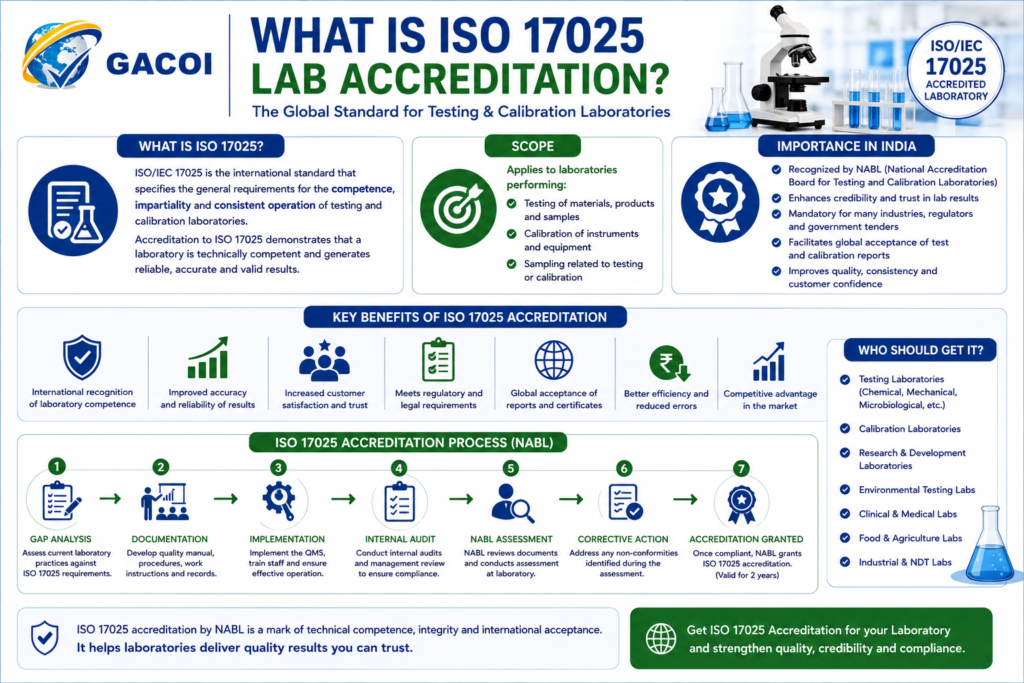
- 7 ISO 17025 Accreditation Process in India: Step-by-Step Overview
- 8 ISO 17025 Accreditation Cost in India 2026
- 9 Common Challenges in ISO 17025 Accreditation and How to Overcome Them
- 10 Why Choose GacoiCert as Your ISO 17025 Support Partner in India?
- 11 Conclusion: ISO 17025 Accreditation Is the Foundation of Laboratory Credibility in India
- 12 Frequently Asked Questions
- 13 Need ISO Certification
Introduction: Why ISO 17025 Lab Accreditation Matters in India
Every day across India, millions of test results and calibration measurements influence decisions that directly affect human health, public safety, environmental protection, and commercial integrity. Food safety test reports determine whether products reach consumers. Environmental monitoring results inform regulatory enforcement. Medical diagnostic reports guide clinical treatment decisions. Construction material certificates verify infrastructure safety. Pharmaceutical quality control results determine whether medicines are released or rejected.
The credibility and accuracy of these results depend entirely on the competence of the laboratories that produce them. And in India — as internationally — the most recognized, rigorous, and authoritative way to demonstrate laboratory competence is through ISO/IEC 17025 accreditation.
If you operate a testing laboratory, calibration laboratory, environmental monitoring lab, food testing facility, pharmaceutical quality control lab, or any other analytical laboratory in India — understanding ISO 17025 accreditation is essential. It affects your market access, regulatory compliance, client confidence, and long-term commercial sustainability.
This comprehensive guide explains everything you need to know about ISO 17025 lab accreditation in India — what it is, how it differs from ISO 9001, what its requirements are, how the accreditation process works, what benefits it delivers, and how GacoiCert supports your laboratory’s accreditation journey.
What Is ISO/IEC 17025?
ISO/IEC 17025 is the international standard that specifies the general requirements for the competence, impartiality, and consistent operation of testing and calibration laboratories. It is published jointly by the International Organization for Standardization (ISO) and the International Electrotechnical Commission (IEC).
The current version is ISO/IEC 17025:2017 — published in November 2017, replacing the previous 2005 version. Key improvements in the 2017 version include a risk-based approach aligned with modern management system thinking, strengthened impartiality requirements, updated management system options compatible with ISO 9001:2015, greater emphasis on measurement uncertainty, and stronger metrological traceability requirements.
The core purpose of ISO 17025 is to give laboratories a framework for demonstrating that they are technically competent to produce valid, reliable, and accurate test and calibration results — and that they operate with the impartiality required to generate results that can be trusted by all stakeholders.
ISO 17025 applies to all laboratory types:
- Testing laboratories — chemical, biological, microbiological, mechanical, electrical, environmental
- Calibration laboratories — dimensional, mass, electrical, temperature, pressure, flow
- Medical and clinical testing laboratories
- Sampling activities associated with subsequent testing or calibration
- Any organization performing laboratory activities regardless of size or sector
What Is NABL and How Does It Relate to ISO 17025 in India?
In India, the primary accreditation body for testing and calibration laboratories against ISO/IEC 17025 is NABL — the National Accreditation Board for Testing and Calibration Laboratories.
NABL operates under the Quality Council of India and is a signatory to the ILAC MRA — the International Laboratory Accreditation Cooperation Mutual Recognition Arrangement. This international framework means that test reports from NABL-accredited laboratories are recognized by laboratories, regulators, and buyers in all ILAC MRA signatory countries — without requiring re-testing.
NABL assesses laboratories against ISO/IEC 17025 using teams of technical assessors who are domain experts in specific disciplines and test methods. Unlike ISO 9001 certification where management system auditors assess process quality generally, NABL technical assessors specifically evaluate whether the laboratory’s personnel, equipment, methods, environment, and quality system collectively demonstrate genuine technical competence in the specific tests or calibrations being assessed.
NABL accreditation disciplines include:
- Chemical testing
- Biological and microbiological testing
- Mechanical testing
- Electrical testing
- Thermal and temperature measurement
- Radiological testing
- Non-destructive testing
- Medical and clinical testing
- Environmental monitoring
- Food and agricultural testing
- Forensic testing
- Calibration — dimensional, mass, electrical, optical, and more
ISO 17025 vs ISO 9001: The Critical Difference Every Laboratory Must Understand
This distinction is one of the most important and most frequently misunderstood concepts in India’s laboratory quality landscape.
| Comparison Aspect | ISO 17025 Accreditation | ISO 9001 Certification |
|---|---|---|
| Standard Type | Laboratory competence standard | Quality management standard |
| Issued By | Accreditation body (NABL in India) | Certification body (GacoiCert) |
| Primary Focus | Technical competence and result validity | Process quality and customer satisfaction |
| Scope | Testing and calibration laboratories only | Any organization in any sector |
| Technical Requirements | Extensive — method validation, measurement uncertainty, metrological traceability | General process and quality controls |
| Assessors | Technical experts in specific disciplines | General management system auditors |
| International Recognition | ILAC MRA — test reports accepted globally | IAF MLA — certificates recognized globally |
| India Governing Body | NABL | NABCB |
| Regulatory Status | Mandatory for many legal and regulatory testing purposes | Required for tenders and supply chains |
The fundamental difference: ISO 9001 certification demonstrates your laboratory has a quality management system. ISO 17025 accreditation demonstrates your laboratory is technically competent to produce valid, accurate, and reliable results in specific test methods and disciplines. These are complementary but distinctly different credentials — and for laboratories, ISO 17025 is the technically superior and more specifically relevant standard.
ISO/IEC 17025:2017 Requirements: What Your Laboratory Must Demonstrate
ISO 17025:2017 is structured around five major requirement sections:
Section 1: General Requirements
Impartiality: The laboratory must be impartial in conducting laboratory activities and manage conflicts of interest. Personnel must not be subject to commercial, financial, or other pressures that could compromise impartiality. This requirement is fundamental — a laboratory whose results are influenced by client expectations rather than objective measurement cannot be trusted.
Confidentiality: The laboratory must protect confidential information about clients and test results through documented policies and legally enforceable commitments. Personnel must keep all client information confidential except where legally required to disclose.
Section 2: Structural Requirements
The laboratory must be a legally identifiable entity with defined responsibility for laboratory activities. The organizational structure must be documented with clear lines of authority, responsibility, and accountability. Personnel responsible for key functions — laboratory management, technical management, quality management — must be clearly identified with defined roles.
The laboratory must have mechanisms to safeguard impartiality — including identifying risks to impartiality arising from ownership structure, management relationships, personnel, sharing of resources, finances, contracts, and marketing.
Section 3: Resource Requirements
This section covers the physical and human resources that enable laboratory competence — and represents the most technically demanding aspect of ISO 17025.
Personnel: All laboratory personnel must be competent for the activities they perform. Competence must be formally evaluated against defined criteria covering education, training, technical knowledge, skills, and experience. Training needs must be systematically identified and addressed. Personnel performing specific activities — particularly method validation and uncertainty estimation — must have demonstrated competence verified through appropriate assessment.
Facilities and Environmental Conditions: Laboratory facilities must be appropriate for the activities performed. Environmental conditions — temperature, humidity, vibration, electromagnetic interference, sterility — must be controlled, monitored, and documented to the extent they affect result validity. Access to laboratory areas must be controlled to protect result integrity.
Equipment: All equipment — instruments, measurement standards, reference materials, reagents, consumables — that influence laboratory results must be identified, verified, calibrated, and maintained. Equipment records must document identity, manufacturer, model, serial number, condition, location, calibration status, calibration results, and maintenance history. Out-of-tolerance equipment must be taken out of service and its effect on previous results assessed.
Metrological Traceability: This is one of the most technically demanding ISO 17025 requirements. All measurement results must be traceable to the International System of Units (SI) through an unbroken chain of calibrations. Reference standards used for calibration must themselves be calibrated by competent calibration laboratories — ultimately tracing back to national or international measurement standards maintained by national metrology institutes such as CSIR-NPL in India.
Externally Provided Products and Services: Suppliers of critical consumables, reference materials, calibration services, and subcontracted laboratory services must be evaluated and approved. Incoming critical supplies must be verified before use.
Section 4: Process Requirements
Review of Requests, Tenders, and Contracts: Before accepting work, laboratories must verify they have the capability, resources, and methods to meet client requirements. Any differences between client requests and laboratory capabilities must be resolved with the client before work begins.
Selection, Verification, and Validation of Methods: Laboratories must use appropriate methods for all activities. Standard methods from recognized sources — ISO, ASTM, IS, AOAC, pharmacopeias — must be verified before use to confirm the laboratory can achieve the required performance. Non-standard methods and laboratory-developed methods must be fully validated. Method validation must demonstrate fitness for purpose through evaluation of selectivity, linearity, working range, detection limits, precision, trueness, and measurement uncertainty.
Sampling: Where laboratories perform sampling before testing or calibration, sampling plans must be statistically sound and documented. Sampling procedures must address factors affecting result validity.
Handling of Test and Calibration Items: Procedures must ensure items are properly received, identified, transported, stored, handled, and disposed of to prevent deterioration, contamination, loss, or damage that could affect results.
Technical Records: All original observations, data, and calculations must be recorded at the time of observation. Records must be stored securely and retained for appropriate periods. Corrections to records must be traceable — showing what was changed, when, and by whom — with original entries remaining legible.
Evaluation of Measurement Uncertainty: This is a fundamental and technically demanding requirement. Laboratories must identify all uncertainty components, evaluate their magnitude, and combine them to produce a statement of measurement uncertainty for each test or calibration result. Uncertainty evaluation must be based on a thorough understanding of the measurement process and validated through appropriate statistical methods.
Ensuring Validity of Results: Laboratories must have quality control procedures for monitoring result validity. This typically includes regular use of certified reference materials, participation in proficiency testing schemes, repeat testing, correlation of results across different methods, and inter-laboratory comparisons. Quality control data must be analyzed using statistical techniques and monitored against defined acceptance criteria.
Reporting of Results: Test reports and calibration certificates must contain sufficient information to enable interpretation of results and be reproducible under the conditions of the laboratory. Required content includes laboratory identification, unique report identification, client information, description and condition of test items, date of receipt and testing, test methods used, results with units, measurement uncertainty, and authorized signature.
Complaints: A documented process for receiving, evaluating, and deciding on complaints must be established. Complaint handling must be objective, transparent, and free from commercial pressure.
Section 5: Management System Requirements
ISO 17025:2017 gives laboratories two options for the management system component:
Option A: Implement a management system as specified in the standard’s clauses covering documentation, control of management system documents, control of records, risk-based thinking, improvement, corrective actions, and internal audits.
Option B: Implement and maintain a management system in accordance with ISO 9001 that supports and demonstrates consistent fulfillment of ISO 17025 requirements.
Most standalone laboratories implement Option A. Laboratories that are part of larger organizations with existing ISO 9001 certification often find Option B more efficient as it builds on existing management system infrastructure.
Benefits of ISO 17025 Accreditation for Indian Laboratories
Regulatory and Legal Acceptance of Test Reports
Many Indian regulatory agencies specifically require test reports from NABL-accredited laboratories — or equivalently accredited international laboratories. These include FSSAI for food safety testing, CPCB and SPCBs for environmental monitoring, BIS for product certification testing, DCGI and CDSCO for pharmaceutical testing, DGFT for export documentation, and various state government departments for construction material testing.
Without NABL accreditation for the relevant test methods, your laboratory’s reports may simply not be accepted for regulatory submissions — regardless of the actual technical quality of your work.
International Acceptance Through ILAC MRA
NABL’s signatory status to the ILAC Mutual Recognition Arrangement means that test reports from NABL-accredited laboratories are accepted in all ILAC MRA signatory countries — covering over 100 countries including the EU, USA, Japan, Australia, and Gulf Cooperation Council countries. This eliminates the need for re-testing when Indian laboratory reports are submitted to international clients, regulators, or buyers — removing a significant barrier to export market access.
Commercial Credibility and Client Confidence
ISO 17025 accreditation is the internationally recognized proof that your laboratory is technically competent. Clients — whether government agencies, manufacturers, exporters, or research organizations — who need to rely on test results choose accredited laboratories because accreditation independently verifies the competence they cannot assess themselves. Accreditation consistently enables laboratories to win contracts from clients who require or prefer accredited testing.
Improved Laboratory Technical Quality
The process of achieving and maintaining ISO 17025 accreditation drives genuine technical improvement across every aspect of laboratory operations — personnel competence development, equipment calibration and maintenance discipline, method validation rigor, measurement uncertainty understanding, and proficiency testing participation. These improvements produce more accurate, more reliable, and more defensible results — benefiting both laboratory clients and the laboratory’s own professional reputation.
Participation in Proficiency Testing Schemes
ISO 17025 accreditation requires laboratories to regularly participate in proficiency testing — inter-laboratory comparisons that independently verify whether a laboratory produces results consistent with peer laboratories using the same or equivalent methods. This external validation is a uniquely powerful quality assurance mechanism that ISO 9001 certification alone does not provide.
Foundation for Regulatory Approvals
Many product certification schemes, export approvals, and laboratory approval processes require NABL accreditation as a prerequisite. BIS product certification, export inspection council approvals, pharmaceutical manufacturing licenses, and construction material quality certifications all involve testing by accredited laboratories. Accreditation opens access to these commercially valuable approval processes.
Price Premium and Market Positioning
Accredited laboratories consistently command higher testing fees than non-accredited competitors — because clients understand that accredited results are more reliable and carry regulatory and legal acceptance that non-accredited results do not. The price premium available to accredited laboratories typically more than covers the cost of maintaining accreditation.
ISO 17025 Accreditation Process in India: Step-by-Step Overview
Step 1: Gap Analysis and Preparation Planning
Conduct a comprehensive assessment of current laboratory practices against ISO 17025:2017 requirements — identifying gaps in personnel competence, equipment calibration status, method validation, measurement uncertainty evaluation, quality control practices, and management system documentation. The gap analysis output becomes the implementation roadmap.
Step 2: Laboratory Quality Management System Development
Develop the Quality Manual, procedures, and records covering all ISO 17025 requirements — impartiality policy, personnel competence records, equipment calibration and maintenance procedures, method validation records, measurement uncertainty procedures, proficiency testing schedule, and complaint handling procedures.
Step 3: Method Validation and Uncertainty Estimation
For each test method in the accreditation scope, conduct formal validation studies demonstrating fitness for purpose. Develop and document measurement uncertainty budgets for each method — identifying all uncertainty sources and combining them into a statement of expanded uncertainty at defined confidence level.
Step 4: Equipment Calibration and Metrological Traceability
Establish calibration schedules for all measurement equipment. Arrange calibration of critical equipment by competent calibration laboratories with traceable calibration certificates. Verify that calibration uncertainty is appropriate relative to the measurement uncertainty requirements of the methods being used.
Step 5: Proficiency Testing Participation
Enroll in appropriate proficiency testing schemes for the methods in your accreditation scope. Successfully participate in at least one round of proficiency testing for each method before accreditation assessment — demonstrating that your laboratory produces results consistent with peer laboratories.
Step 6: Internal Audit and Management Review
Conduct a comprehensive internal audit covering all ISO 17025 requirements — both technical and management system requirements. Address all nonconformities identified. Conduct management review covering laboratory performance, corrective actions, resource adequacy, and improvement opportunities.
Step 7: NABL Application Submission
Submit accreditation application to NABL covering the defined scope of accreditation — specifying the specific test methods, matrices, measurands, and measurement ranges for which accreditation is sought. NABL reviews the application and assigns a technical assessment team.
Step 8: Document Review
NABL’s assessment team reviews the laboratory’s Quality Manual, method validation records, equipment calibration records, proficiency testing results, and other documentation — assessing adequacy before scheduling the on-site assessment.
Step 9: On-Site Technical Assessment
NABL’s technical assessors visit the laboratory and conduct a thorough on-site assessment — observing test or calibration demonstrations, examining equipment and facilities, reviewing records, interviewing personnel, and verifying that the laboratory’s actual practices match documented procedures and demonstrate genuine technical competence.
Step 10: Nonconformity Resolution and Accreditation Grant
Nonconformities identified during assessment are addressed through corrective actions with supporting evidence submitted to NABL. Following satisfactory resolution, NABL grants accreditation — issuing a certificate and schedule of accreditation specifying the exact scope, methods, matrices, and measurement ranges covered. NABL accreditation is typically granted for two years with annual surveillance assessments.
ISO 17025 Accreditation Cost in India 2026
ISO 17025 accreditation cost varies significantly based on laboratory size, number of test methods in scope, discipline complexity, and number of sites.
Estimated NABL Application and Assessment Fees:
| Laboratory Size and Scope | Estimated NABL Fee |
|---|---|
| Small laboratory (limited scope, 1–5 methods) | ₹30,000 – ₹80,000 |
| Medium laboratory (moderate scope, 6–20 methods) | ₹80,000 – ₹2,00,000 |
| Large laboratory (broad scope, 20+ methods) | ₹2,00,000 – ₹5,00,000 |
| Multi-site or multi-discipline laboratory | ₹5,00,000 and above |
Additional investment components:
| Cost Component | Estimated Cost |
|---|---|
| ISO 17025 consultant fees | ₹50,000 – ₹5,00,000 |
| Equipment calibration program (annual) | ₹50,000 – ₹10,00,000 |
| Method validation studies | ₹30,000 – ₹3,00,000 per method |
| Proficiency testing participation (annual) | ₹20,000 – ₹2,00,000 |
| Reference materials and certified standards | ₹30,000 – ₹5,00,000 |
| Personnel training | ₹20,000 – ₹2,00,000 |
The total first-year investment for ISO 17025 accreditation in India ranges from approximately ₹2,00,000 for small laboratories with limited scope to ₹20,00,000 or more for large multi-discipline laboratories — with ongoing annual maintenance costs significantly lower than initial investment.
Common Challenges in ISO 17025 Accreditation and How to Overcome Them
Measurement uncertainty estimation: Many Indian laboratories struggle with developing rigorous, technically sound uncertainty budgets. Investing in specialized measurement uncertainty training and engaging consultants with metrological expertise resolves this challenge.
Metrological traceability gaps: Ensuring unbroken calibration traceability chains for all critical equipment requires systematic calibration planning and engagement with competent calibration laboratories. NABL-accredited calibration laboratories provide the traceable calibrations needed.
Method validation documentation: Comprehensive method validation studies require time, resources, and statistical expertise. Developing standardized validation protocols and building internal competence through training accelerates this process.
Proficiency testing performance: Poor proficiency testing results — z-scores outside acceptable limits — are a common finding in initial NABL assessments. Regular participation in practice rounds and rigorous internal quality control monitoring identifies and resolves bias or precision issues before formal accreditation assessment.
Personnel competence documentation: Demonstrating formal competence assessment for all personnel performing laboratory activities requires systematic competence evaluation records. Developing structured competence assessment programs covering education verification, training records, skills assessments, and performance monitoring addresses this requirement effectively.
Why Choose GacoiCert as Your ISO 17025 Support Partner in India?
While NABL is the accreditation body that grants ISO 17025 accreditation, GacoiCert provides comprehensive support to Indian laboratories preparing for and maintaining NABL accreditation — through ISO 9001 quality management certification that complements ISO 17025, specialist consulting guidance, and training programs.
ISO 9001 certification for laboratories: Many Indian laboratories pursue ISO 9001 certification alongside ISO 17025 accreditation — using ISO 9001 as the foundation management system (Option B) for their ISO 17025 quality system. GacoiCert provides internationally accredited ISO 9001 certification for laboratories across all disciplines and sizes.
ISO 17025 gap analysis and implementation support: GacoiCert’s experienced team helps laboratories understand ISO 17025 requirements, identify gaps in current practices, develop implementation plans, and prepare for NABL assessment.
Training programs: ISO 17025 awareness training, internal auditor training, measurement uncertainty workshops, and method validation training — delivered in classroom, online, and in-house formats across India.
Internationally accredited ISO 9001 certification: GacoiCert’s ISO 9001 certificates are issued under internationally recognized accreditation — verifiable through NABCB and IAF databases — providing laboratories with complementary quality management credentials alongside their NABL ISO 17025 accreditation.
Pan-India service coverage: Delhi NCR, Mumbai, Pune, Bangalore, Chennai, Hyderabad, Kolkata, Ahmedabad, and all major cities and laboratory centers across India.
Conclusion: ISO 17025 Accreditation Is the Foundation of Laboratory Credibility in India
ISO 17025 accreditation is not simply a quality certificate for laboratories — it is the internationally recognized proof of technical competence that determines whether your laboratory’s results are accepted by regulators, trusted by clients, and recognized in international markets.
For Indian laboratories in 2026 — operating in an environment of strengthening regulatory enforcement, growing export market requirements, and increasing client sophistication — ISO 17025 accreditation through NABL is the most important quality credential available. It opens regulatory submissions, enables international report acceptance, supports premium pricing, and builds the lasting client confidence that sustains laboratory commercial success.
The investment in ISO 17025 accreditation — in personnel training, equipment calibration, method validation, proficiency testing, and management system development — consistently delivers returns through regulatory acceptance, client retention, market differentiation, and improved laboratory technical quality that far exceed the cost of achieving and maintaining accreditation.
GacoiCert is ready to support your laboratory’s quality journey — through ISO 9001 certification, ISO 17025 preparation support, and specialized laboratory quality training. Visit gacoicert.com today, request your free consultation, and take the first step toward internationally recognized laboratory accreditation.
Frequently Asked Questions
1. What is ISO 17025 Lab Accreditation?
ISO 17025 Lab Accreditation is an internationally recognized accreditation for testing and calibration laboratories. It demonstrates that a laboratory is technically competent, follows standardized procedures, and produces accurate, reliable, and consistent test or calibration results.
2. Who should apply for ISO 17025 Lab Accreditation in India?
ISO 17025 Lab Accreditation is suitable for testing laboratories, calibration laboratories, research institutions, educational laboratories, pharmaceutical labs, food testing labs, environmental testing facilities, and industrial laboratories that want to demonstrate technical competence.
3. What are the requirements for ISO 17025 Lab Accreditation?
To obtain ISO 17025 Lab Accreditation, a laboratory must establish a quality management system, maintain proper documentation, ensure staff competency, calibrate equipment, validate testing methods, participate in proficiency testing where applicable, and successfully complete an accreditation assessment.
4. How long does it take to obtain ISO 17025 Lab Accreditation?
The timeline for ISO 17025 Lab Accreditation depends on the laboratory’s readiness, documentation, implementation of quality systems, and the accreditation body’s assessment schedule. The process typically takes a few weeks to several months.
5. What are the benefits of ISO 17025 Lab Accreditation?
ISO 17025 Lab Accreditation improves the credibility of laboratory results, enhances customer confidence, supports regulatory compliance, increases operational efficiency, reduces testing errors, and helps laboratories gain national and international recognition.
6. Is ISO 17025 Lab Accreditation mandatory in India?
ISO 17025 Lab Accreditation is generally voluntary. However, many regulatory authorities, government departments, and clients prefer or require accredited laboratories for testing and calibration services to ensure reliable and internationally accepted results.
7. How can a laboratory prepare for ISO 17025 Lab Accreditation?
A laboratory can prepare for ISO 17025 Lab Accreditation by implementing the required quality management system, training personnel, maintaining calibration records, documenting laboratory procedures, conducting internal audits, addressing non-conformities, and working with an experienced accreditation consultant if needed.
Need ISO Certification
🟡GACOI Cert provides globally recognized ISO certification, cybersecurity, privacy, AI governance, compliance, audit, and professional training services, helping startups, businesses, enterprises, laboratories, healthcare organizations, and government institutions achieve international standards and build lasting trust.
🟡For other Legal and Trademark related services Visit
👉 Money Recovery Cases
👉 Property Disputes
👉 Business & Licence Registrations
🟡 Protect Your Rights
👉 Domestic Violence Legal Support
👉 Stridhan Recovery
👉 Mutual Consent Divorce
👉 Contested Divorce Filing
👉 Child Custody and Maintenance
👉 Matrimonial Property Settlement
👉 NRI Divorce Services
👉 Alimony and Maintenance
📞 Call Now: +91 8595439395
🕐 Free Consultation: Monday to Saturday, 10 AM to 6 PM


