


Views: 0
Discover the complete ISO 27001 Certification Cost in India 2026 — audit fees, consultant charges, training costs, process overview, ROI analysis, and how to get certified with GacoiCert.
Table of Contents
- 1 Introduction: What Does ISO 27001 Certification Cost in India in 2026?
- 2 Why ISO 27001 Certification Is Business-Critical for Indian Organizations in 2026
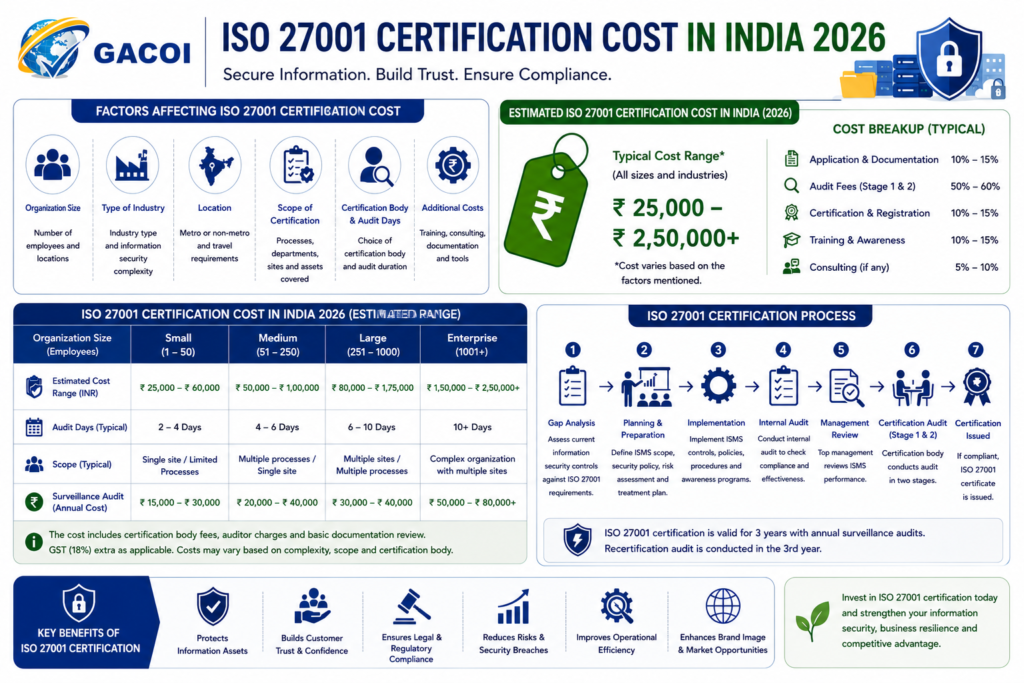
- 3 ISO 27001 Certification Cost in India 2026: Complete Component Breakdown
- 4 ISO 27001 Certification Process in India 2026: Complete Step-by-Step Overview
- 5 ISO 27001 Certification Timeline in India 2026
- 6 The Critical Warning: Fake ISO 27001 Certificates in India
- 7 Return on ISO 27001 Investment: Why the Cost Is Always Justified
- 8 Strategies to Reduce ISO 27001 Certification Cost Without Compromising Quality
- 9 Why Choose GacoiCert for ISO 27001 Certification in India?
- 10 Conclusion: ISO 27001 Certification Is Your Most Valuable Security Investment in 2026
- 11 Frequently Asked Questions
- 12 Need ISO Certification
Introduction: What Does ISO 27001 Certification Cost in India in 2026?
India’s information technology and digital economy sector has never been more dynamic — or more exposed to cyber threats. With over 1,400 cyberattacks per organization per week reported across Indian businesses, with India’s Digital Personal Data Protection Act 2023 creating new legal obligations for data security, and with international IT clients and enterprise buyers making ISO 27001 certification a standard supplier qualification requirement — the business case for ISO 27001 information security certification in India in 2026 has never been stronger or more urgent.
But when IT companies, software developers, BPO firms, financial services organizations, healthcare providers, and any business handling sensitive customer data begin exploring ISO 27001 certification, one question consistently dominates the early conversation: how much does it cost?
This comprehensive guide from GacoiCert provides a complete, transparent, and honest answer — breaking down every cost component involved in ISO 27001 certification in India in 2026, explaining what drives cost variation across different organization types and sizes, providing realistic total investment estimates, outlining the certification process, analyzing the return on investment, and explaining why genuine accredited certification from GacoiCert delivers business value that far exceeds its cost.
Whether you are a ten-person IT startup in Bangalore, a mid-sized BPO operation in Hyderabad, or a large financial services company in Mumbai — this guide gives you everything you need to plan, budget for, and successfully achieve ISO 27001 certification in 2026.
Why ISO 27001 Certification Is Business-Critical for Indian Organizations in 2026
Before examining costs, understanding why ISO 27001 has become a priority investment for Indian businesses in 2026 provides essential context.
India’s Digital Personal Data Protection Act 2023: India’s landmark data protection legislation creates significant legal obligations for organizations processing personal data — including requirements for appropriate technical and organizational security measures. ISO 27001’s systematic information security management framework directly supports DPDPA compliance. Organizations that suffer data breaches without demonstrable security management systems face significant regulatory penalties.
International client requirements: Indian IT companies, software developers, and BPO firms serving international clients — particularly in the United States, European Union, United Kingdom, and Australia — face ISO 27001 certification as a standard vendor qualification requirement. Without certification, Indian IT businesses are increasingly excluded from enterprise client procurement processes entirely.
Cyber insurance requirements: Cyber insurance providers in India and globally are incorporating ISO 27001 certification into underwriting criteria — with certified organizations receiving more favorable coverage terms and premium rates, and some insurers requiring certification for certain coverage categories.
Rising cyberattack sophistication: Ransomware, phishing, supply chain attacks, and data exfiltration incidents are increasing in frequency and severity across Indian businesses. ISO 27001’s systematic risk assessment and control framework directly reduces vulnerability to these threats — and the financial and reputational damage they cause.
Banking and financial sector requirements: RBI guidelines, SEBI cybersecurity frameworks, and IRDAI information security requirements for regulated financial entities are creating compliance environments where ISO 27001 certification provides credible evidence of security management maturity.
Government and defense procurement: Central government IT procurement, defense technology contracts, and e-governance project vendor qualifications are increasingly incorporating information security certification requirements where ISO 27001 certification is specifically recognized.
In this environment, ISO 27001 certification in India in 2026 is rapidly transitioning from competitive differentiator to market access prerequisite for any organization handling sensitive data.
ISO 27001 Certification Cost in India 2026: Complete Component Breakdown
ISO 27001 certification cost comprises multiple distinct components. Each requires separate understanding and planning for accurate total investment calculation.
Component 1: Certification Body Fees — The Core Investment
The most significant and non-negotiable cost component is the fee paid to an accredited certification body — such as GacoiCert — that independently audits your Information Security Management System (ISMS) and issues your internationally recognized ISO 27001 certificate.
Why ISO 27001 certification body fees are slightly higher than ISO 9001:
ISO 27001 audits require significantly more technical depth than standard quality or environmental management system audits. Auditors must assess the organization’s information security risk assessment methodology, evaluate the effectiveness of controls across 93 Annex A control domains covering organizational, people, physical, and technological security controls, assess vulnerability management practices, evaluate access control systems, review incident management capabilities, and verify business continuity planning — all requiring specialized cybersecurity expertise that commands premium auditor rates.
ISO 27001 Certification Body Fees in India 2026:
| Organization Size | Number of Employees | Estimated Certification Fee |
|---|---|---|
| Micro Business | 1 – 5 employees | ₹25,000 – ₹45,000 |
| Very Small Business | 6 – 15 employees | ₹40,000 – ₹70,000 |
| Small Business | 16 – 30 employees | ₹58,000 – ₹1,00,000 |
| Small-Medium Business | 31 – 60 employees | ₹85,000 – ₹1,35,000 |
| Medium Business | 61 – 100 employees | ₹1,05,000 – ₹1,70,000 |
| Medium-Large Business | 101 – 175 employees | ₹1,45,000 – ₹2,30,000 |
| Large Business | 176 – 300 employees | ₹2,00,000 – ₹3,00,000 |
| Very Large Business | 301 – 500 employees | ₹2,60,000 – ₹3,70,000 |
| Enterprise | 500+ employees | ₹3,50,000 and above |
Important scope consideration for ISO 27001: Unlike most other ISO management system standards where certification scope typically covers the entire organization, ISO 27001 allows organizations to define a specific ISMS scope — covering only certain business units, data types, services, or geographic locations. A narrower, well-defined scope reduces audit duration and therefore certification body fees — but must genuinely reflect the boundaries within which information security is managed rather than being artificially narrow to reduce costs.
Annual Surveillance Audit Fees:
ISO 27001 certificates are valid for three years with mandatory annual surveillance audits covering a subset of the ISMS scope. Surveillance audit fees are typically 50 to 67 percent of the initial certification audit fee.
| Organization Size | Estimated Annual Surveillance Fee |
|---|---|
| Micro to Very Small | ₹16,000 – ₹36,000 per year |
| Small to Small-Medium | ₹35,000 – ₹72,000 per year |
| Medium to Medium-Large | ₹65,000 – ₹1,25,000 per year |
| Large to Very Large | ₹1,20,000 – ₹2,30,000 per year |
| Enterprise | ₹2,10,000 and above per year |
Recertification Audit Fees:
At the end of the three-year certification cycle, a recertification audit is required. Recertification fees are broadly comparable to the original certification body fee — sometimes slightly reduced for organizations with a strong surveillance audit history demonstrating consistent ISMS effectiveness.
Component 2: ISO 27001 Consultant Fees
ISO 27001 implementation is technically more complex than most other ISO management system implementations — requiring specialized knowledge in information security risk assessment, control selection and implementation across 93 Annex A controls, security architecture, vulnerability management, and cybersecurity regulatory compliance.
Most organizations pursuing ISO 27001 certification — including technically sophisticated IT companies — benefit from engaging experienced ISO 27001 implementation consultants who bring dedicated ISMS implementation expertise, established risk assessment methodologies, documented control frameworks, and pre-certification audit preparation experience.
ISO 27001 Consultant Fees in India 2026:
| Organization Size | Estimated Consultant Fee |
|---|---|
| Micro to Very Small Business | ₹25,000 – ₹60,000 |
| Small Business | ₹55,000 – ₹1,20,000 |
| Medium Business | ₹1,10,000 – ₹2,40,000 |
| Large Business | ₹2,20,000 – ₹4,80,000 |
| Enterprise | ₹4,50,000 – ₹9,00,000 and above |
ISO 27001 consultant fees are consistently higher than consultant fees for other ISO management system standards at equivalent organization sizes — reflecting the specialized cybersecurity and information security expertise required for effective ISMS implementation.
Typical services included in ISO 27001 consultant engagement:
A comprehensive ISO 27001 consultant engagement covers ISMS scope definition, information security risk assessment methodology development and initial risk assessment facilitation, Statement of Applicability (SOA) development covering all 93 Annex A controls, ISMS policy and procedure documentation, security control implementation guidance, information asset register development, employee security awareness training, internal auditor training, internal audit conduct support, management review facilitation, and Stage 1 and Stage 2 audit preparation and support.
Component 3: ISO 27001 Training Costs
Effective ISO 27001 implementation requires specialized training investment across multiple levels — from top management security awareness through technical security staff competence development to internal audit capability.
ISO 27001 Training Programs and Fees in India 2026:
| Training Program | Target Audience | Typical Fee Per Person |
|---|---|---|
| ISO 27001 Foundation Training | All employees | ₹5,000 – ₹12,000 |
| Information Security Awareness Training | All employees | ₹4,000 – ₹10,000 |
| ISO 27001 Lead Implementer Training | ISMS Project Lead, IT Security Manager | ₹25,000 – ₹55,000 |
| ISO 27001 Internal Auditor Training | Internal audit team | ₹15,000 – ₹30,000 |
| Risk Assessment Methodology Training | ISMS team members | ₹12,000 – ₹25,000 per person |
| ISO 27001 Lead Auditor Training | Auditing career professionals | ₹35,000 – ₹70,000 |
Critical training investments for ISO 27001: The most important training investments are ISO 27001 Lead Implementer Training for your ISMS Project Lead — because the standard’s technical complexity demands deep implementation expertise — and ISO 27001 Internal Auditor Training to ensure genuine internal audit capability across all relevant Annex A control domains.
Employee information security awareness training is also a direct ISO 27001 control requirement — not merely a support activity — making it a mandatory cost component for all certified organizations.
GacoiCert provides ISO 27001 training programs in classroom, online, and in-house delivery formats across India at competitive, transparent pricing.
Component 4: Technology and Security Infrastructure Costs
ISO 27001 implementation frequently reveals information security control gaps that require technology investment to address. These technology costs are highly variable — depending on your current security infrastructure maturity and the specific risks identified in your information security risk assessment.
Common technology investments triggered by ISO 27001 gap analysis:
Access Control and Identity Management:
- Multi-factor authentication systems: ₹20,000 – ₹2,00,000 per year depending on user numbers
- Identity and access management platforms: ₹30,000 – ₹5,00,000 per year
- Privileged access management solutions: ₹50,000 – ₹3,00,000 per year
Security Monitoring and Detection:
- Security Information and Event Management (SIEM) systems: ₹1,00,000 – ₹10,00,000 per year
- Intrusion detection and prevention systems: ₹50,000 – ₹5,00,000 per year
- Endpoint detection and response (EDR) solutions: ₹30,000 – ₹3,00,000 per year
Data Protection:
- Data Loss Prevention (DLP) solutions: ₹50,000 – ₹5,00,000 per year
- Encryption solutions for data at rest and in transit: ₹20,000 – ₹2,00,000 per year
- Backup and recovery systems: ₹30,000 – ₹3,00,000 per year
Vulnerability Management:
- Vulnerability scanning tools: ₹30,000 – ₹3,00,000 per year
- Penetration testing (annual): ₹1,00,000 – ₹10,00,000 per engagement
- Patch management systems: ₹20,000 – ₹1,50,000 per year
Physical Security:
- Access control systems for server rooms and sensitive areas: ₹50,000 – ₹5,00,000 one-time
- CCTV systems: ₹30,000 – ₹2,00,000 one-time
- Environmental monitoring for data center areas: ₹20,000 – ₹1,50,000 one-time
Technology investment requirements vary enormously — organizations with modern, well-managed IT infrastructure may require minimal additional technology investment. Organizations with legacy systems, limited security tooling, or significant identified vulnerabilities may require substantial technology investment.
Important perspective: Many of these technology investments deliver direct business value independent of ISO 27001 certification — by genuinely reducing cyber risk, improving operational resilience, and demonstrating security commitment to clients and partners.
Component 5: Penetration Testing and Security Assessment Costs
ISO 27001 requires organizations to evaluate information security controls through testing and assessment — including penetration testing, vulnerability assessments, and security control effectiveness verification. These technical security assessments are typically conducted by specialized external security testing firms.
Security testing cost ranges in India 2026:
| Assessment Type | Estimated Cost Per Engagement |
|---|---|
| External penetration testing (web applications) | ₹50,000 – ₹3,00,000 |
| Internal network penetration testing | ₹75,000 – ₹4,00,000 |
| Mobile application security testing | ₹40,000 – ₹2,00,000 |
| Cloud security assessment | ₹60,000 – ₹3,50,000 |
| Social engineering assessment | ₹30,000 – ₹1,50,000 |
| Full comprehensive security audit | ₹2,00,000 – ₹15,00,000 |
Annual penetration testing is a widely recognized best practice for ISO 27001 certified organizations — and auditors routinely check for evidence of regular security testing as part of surveillance audits.
Component 6: Internal Resource Costs
The time invested by your ISMS Project Lead, IT security team, department managers, and other employees in ISO 27001 implementation is a genuine and significant cost component.
Estimated Internal Time Investment for ISO 27001:
| Organization Size | Estimated Total Internal Hours |
|---|---|
| Micro to Very Small | 150 – 250 hours |
| Small Business | 250 – 500 hours |
| Medium Business | 500 – 1,000 hours |
| Large Business | 1,000 – 2,000 hours |
ISO 27001 implementation typically requires more internal time than other ISO management system implementations — because the 93 Annex A controls span every function of the organization, requiring engagement from IT, HR, legal, operations, and senior management.
Total ISO 27001 Certification Cost Summary 2026
| Organization Size | Certification Fee | Consultant Fee | Training | Technology and Testing | Total Estimated First-Year Investment |
|---|---|---|---|---|---|
| Micro (1–5 employees) | ₹25,000 – ₹45,000 | ₹25,000 – ₹58,000 | ₹10,000 – ₹25,000 | ₹20,000 – ₹80,000 | ₹80,000 – ₹2,08,000 |
| Small (6–30 employees) | ₹45,000 – ₹1,00,000 | ₹52,000 – ₹1,15,000 | ₹20,000 – ₹55,000 | ₹50,000 – ₹2,00,000 | ₹1,67,000 – ₹4,70,000 |
| Medium (31–100 employees) | ₹1,00,000 – ₹1,85,000 | ₹1,10,000 – ₹2,40,000 | ₹40,000 – ₹1,00,000 | ₹1,00,000 – ₹5,00,000 | ₹3,50,000 – ₹10,25,000 |
| Large (101–300 employees) | ₹1,85,000 – ₹3,00,000 | ₹2,20,000 – ₹4,80,000 | ₹80,000 – ₹1,80,000 | ₹2,00,000 – ₹10,00,000 | ₹6,85,000 – ₹19,60,000 |
| Enterprise (300+ employees) | ₹3,50,000 and above | ₹4,50,000 and above | ₹1,50,000 and above | ₹5,00,000 and above | ₹14,50,000 and above |
ISO 27001 Certification Process in India 2026: Complete Step-by-Step Overview
Understanding the certification process is essential alongside cost planning — because how well you execute each step directly determines both the speed of certification and the quality of the security management system you achieve.
Step 1: Management Commitment and ISMS Project Initiation
Every successful ISO 27001 implementation begins with genuine top management commitment — not just a signed information security policy but active leadership involvement in security governance, resource provision, and risk decision-making.
An ISMS Project Lead is appointed — typically the IT Security Manager, CISO, or a senior technical manager with information security expertise. A cross-functional ISMS implementation team is assembled. The ISMS scope is formally defined — determining which organizational units, information assets, processes, locations, and technology systems are included within the certification boundary.
Scope definition is one of the most important early decisions: A well-defined scope that is genuinely meaningful to your business and your clients — rather than artificially narrow to minimize audit effort — is essential for certification that delivers real business value.
Duration: One to two weeks.
Step 2: ISO 27001 Training and Gap Analysis
Your ISMS implementation team undergoes ISO 27001 foundation and lead implementer training to ensure thorough understanding of the standard’s requirements before implementation begins.
A systematic gap analysis compares your current information security practices against every ISO 27001 requirement — across all management system clauses and all 93 Annex A controls. The output is a comprehensive action plan identifying what needs to be developed, what needs to be improved, and what is already adequately in place.
Common gaps found in Indian organizations:
- No formal information security risk assessment methodology
- Absence of documented information asset register
- Missing or incomplete security policies covering key Annex A control areas
- No formal access control review process
- Inadequate supplier security management
- Missing business continuity and disaster recovery planning
- No structured security incident management process
- Absence of regular security awareness training program
Duration: One to two weeks.
Step 3: Information Security Risk Assessment
This is the most technically critical and time-intensive step in ISO 27001 implementation — and the one that most fundamentally shapes the entire ISMS.
The ISMS team identifies all information assets within the defined scope — data, systems, applications, hardware, people, and processes — and assesses the information security risks associated with each asset across confidentiality, integrity, and availability dimensions.
For each identified risk, the team evaluates likelihood and impact to produce a risk rating. Risks exceeding the organization’s defined risk acceptance criteria require treatment — through implementing controls, avoiding the risk, transferring it, or formally accepting it.
The Statement of Applicability (SOA) — a mandatory ISO 27001 document — records all 93 Annex A controls, whether each is applicable to the organization, whether each is implemented, and the justification for inclusion or exclusion of each control.
Duration: Three to six weeks depending on organizational complexity.
Step 4: ISMS Policy and Procedure Documentation
Based on risk assessment findings and SOA decisions, develop the documented information that forms your ISMS framework:
Mandatory documents include:
- Information Security Policy — top management’s formal security commitment
- ISMS Scope Document — formal definition of ISMS boundaries
- Risk Assessment Methodology — documented approach to information security risk assessment
- Risk Assessment Records — results of the risk assessment for all identified assets
- Risk Treatment Plan — documented decisions on how each significant risk is treated
- Statement of Applicability — all 93 Annex A controls with applicability and implementation status
- Information Security Objectives — measurable security performance targets
Supporting policy documents typically include:
- Acceptable Use Policy
- Access Control Policy
- Clear Desk and Clear Screen Policy
- Cryptography Policy
- Information Classification and Handling Policy
- Password Policy
- Physical Security Policy
- Supplier Security Policy
- Incident Management Procedure
- Business Continuity Plan
- Backup Policy and Procedure
- Change Management Procedure
- Asset Management Procedure
Duration: Four to ten weeks depending on organization size and documentation complexity.
Step 5: Security Control Implementation
Documented controls must be physically implemented across the organization. This is where technology investments, process changes, and behavioral changes are made real.
Key implementation activities include configuring access control systems, implementing multi-factor authentication, establishing security monitoring, deploying endpoint protection, configuring backup systems, implementing data classification, establishing supplier security requirements, training employees in security awareness, establishing incident reporting channels, and implementing physical security controls.
Minimum operation period: GacoiCert and most accredited certification bodies expect at least three months of documented ISMS operation before the Stage 2 certification audit — ensuring sufficient evidence exists that the system is genuinely functioning.
Duration: Four to twelve weeks.
Step 6: Internal Audit
A formal internal audit covering all ISO 27001 clauses and applicable Annex A controls must be completed before the certification audit. Trained internal auditors conduct document reviews, employee interviews, technical system checks, and physical security inspections — identifying nonconformities that must be resolved before the Stage 2 audit.
Duration: One to two weeks including nonconformity resolution.
Step 7: Management Review
Top management conducts a formal ISMS management review — examining information security risk status, security incident trends, security objective performance, audit findings, and improvement opportunities — producing documented decisions about ISMS improvements and resource requirements.
Duration: Three to five days including preparation and documentation.
Step 8: Stage 1 Audit with GacoiCert
GacoiCert’s information security auditor conducts the Stage 1 documentation review — assessing whether ISMS documentation adequately addresses ISO 27001 requirements, whether the risk assessment methodology is sound, whether the SOA is complete and justified, and whether your organization is ready for the Stage 2 on-site assessment.
Duration: Half day to one and a half days depending on scope. Four to six weeks between Stage 1 and Stage 2.
Step 9: Stage 2 Audit with GacoiCert
The Stage 2 certification audit is the comprehensive on-site assessment. GacoiCert’s information security auditors verify that the ISMS is genuinely implemented and effective — reviewing risk assessment records, testing security controls, interviewing employees across all functions, verifying incident management processes, checking access control configurations, reviewing supplier management practices, verifying business continuity readiness, and assessing physical security controls.
Stage 2 audit duration by organization size:
| Organization Size | Typical Stage 2 Duration |
|---|---|
| Micro (1–5 employees) | 1 – 1.5 days |
| Small (6–30 employees) | 1.5 – 2.5 days |
| Medium (31–100 employees) | 2.5 – 3.5 days |
| Large (101–300 employees) | 3.5 – 5 days |
| Enterprise (300+ employees) | 5 days and above |
Step 10: Nonconformity Resolution and Certificate Issuance
Nonconformities identified during Stage 2 are addressed through root cause analysis and corrective action implementation. Following satisfactory resolution and GacoiCert’s positive certification decision, your ISO 27001:2022 certificate is issued — valid for three years with annual surveillance audits.
ISO 27001 Certification Timeline in India 2026
| Organization Size | Total Certification Timeline |
|---|---|
| Micro Business (1–5 employees) | 10 – 16 weeks |
| Small Business (6–30 employees) | 14 – 20 weeks |
| Medium Business (31–100 employees) | 5 – 8 months |
| Large Business (101–300 employees) | 7 – 11 months |
| Enterprise (300+ employees) | 10 – 15 months |
ISO 27001 timelines are typically longer than ISO 9001 timelines at equivalent organization sizes — because risk assessment depth, 93-control implementation scope, and technical security verification requirements demand more preparation and implementation time.
The Critical Warning: Fake ISO 27001 Certificates in India
India’s certification market contains non-accredited operators offering ISO 27001 certificates at prices of ₹5,000 to ₹20,000 with minimal or no genuine audit process. For information security certification specifically, fake certificates carry particularly serious consequences.
Why fake ISO 27001 certificates are especially dangerous:
International IT clients specifically verify ISO 27001 certificates through IAF CertSearch before awarding contracts. Discovery of a fake certificate during client due diligence does not just lose the contract — it damages the entire business relationship and the company’s market reputation in a sector where reputation is everything.
Enterprise clients who discover a supplier holds a fraudulent security certificate — and subsequently suffer a data breach involving that supplier — face enormously compounded legal and reputational consequences. The fraudulent certificate transforms what might have been a manageable security incident into a major legal liability.
Non-accredited ISO 27001 certificates are rejected by:
- International IT client procurement and vendor qualification teams
- Enterprise corporate supplier security assessments
- Banking and financial sector regulatory compliance reviews
- Cyber insurance underwriters
- Government IT procurement authorities
Always verify before engaging any certification body:
- NABCB accreditation status: nabcb.in
- IAF accreditation body membership: iaf.nu
- Certificate verification: iafcertsearch.org
Return on ISO 27001 Investment: Why the Cost Is Always Justified
International client contract access: For Indian IT companies, a single new international enterprise client relationship won through ISO 27001 certification — which was previously inaccessible without certification — can generate annual revenues of ₹50,00,000 to several crores. Against a total first-year certification investment of ₹1,67,000 to ₹4,70,000 for small IT businesses, the return is immediate and compelling.
Data breach cost avoidance: IBM’s 2024 Cost of a Data Breach Report places the average cost of a data breach at approximately USD 4.88 million globally — with Indian organizations averaging significantly lower but still substantial breach costs. ISO 27001’s systematic security controls dramatically reduce breach probability and the catastrophic financial consequences of serious incidents.
Cyber insurance premium reduction: ISO 27001 certified organizations consistently receive more favorable cyber insurance terms — with premium reductions of 10 to 30 percent reported by certified organizations — delivering ongoing annual savings that partially offset certification maintenance costs.
DPDPA compliance support: India’s Digital Personal Data Protection Act creates financial penalties for organizations that fail to implement appropriate data security measures. ISO 27001’s systematic security management framework directly supports DPDPA compliance — reducing regulatory penalty exposure that can reach crores of rupees for serious violations.
Competitive differentiation: In India’s crowded IT services market, ISO 27001 certification provides a credible, independently verified security credential that differentiates certified businesses from uncertified competitors — supporting premium pricing, client retention, and new business acquisition.
Three-year cost vs. benefit perspective:
| Organization Size | 3-Year Total Certification Cost | Single Client Value / Breach Avoided | Net Benefit |
|---|---|---|---|
| Small IT Business | ₹3,00,000 – ₹6,50,000 | ₹50,00,000 – ₹2,00,00,000 | Strongly positive |
| Medium IT Business | ₹6,50,000 – ₹14,00,000 | ₹1,00,00,000 – ₹5,00,00,000 | Strongly positive |
| Large IT Enterprise | ₹14,00,000 – ₹30,00,000 | ₹5,00,00,000 and above | Strongly positive |
Strategies to Reduce ISO 27001 Certification Cost Without Compromising Quality
Define a focused, meaningful ISMS scope: A well-defined scope that covers the services and systems most relevant to your clients reduces audit duration and therefore certification body fees — while still delivering the credible security certification your clients require.
Invest in thorough gap analysis upfront: Understanding precisely where security gaps exist before implementation begins focuses technology investment and consultant time on highest-priority areas — preventing wasted expenditure on unnecessary controls or missing critical ones.
Leverage cloud security tools: Cloud-based security tools — identity management, SIEM, endpoint protection — often provide enterprise-grade security capabilities at significantly lower cost than on-premise alternatives, reducing technology investment while meeting ISO 27001 control requirements.
Train internal auditors early: Investing in ISO 27001 internal auditor training before the first internal audit cycle reduces ongoing external consultant dependency and builds permanent ISMS management capability within your organization.
Combine with ISO 9001 certification: IT companies that also need ISO 9001 quality certification can pursue both standards through GacoiCert’s integrated approach — sharing common management system elements and combined audit processes that reduce total cost by 25 to 35 percent compared to separate certifications.
Schedule audit dates with GacoiCert early: Securing Stage 1 and Stage 2 audit slots early in the implementation process prevents scheduling delays that extend timelines and increase internal resource costs.
Why Choose GacoiCert for ISO 27001 Certification in India?
Internationally accredited: GacoiCert’s ISO 27001 certificates are issued under internationally recognized accreditation — verifiable through NABCB and IAF databases, accepted by international IT clients, enterprise procurement teams, financial regulators, and cyber insurance providers worldwide.
Specialized information security auditor expertise: Our ISO 27001 auditors bring genuine cybersecurity and information security management knowledge — understanding not just the standard’s requirements but the technical security controls, risk assessment methodologies, and threat landscapes relevant to Indian IT, financial services, healthcare, and other data-intensive sectors.
India-specific regulatory knowledge: DPDPA 2023 requirements, RBI cybersecurity guidelines, SEBI cyber resilience framework, CERT-In reporting obligations — our auditors understand India’s complete information security regulatory landscape.
Transparent competitive pricing: Complete itemized quotations covering every stage of the certification process with no hidden fees and no pricing surprises.
Integrated Management System capability: ISO 27001 combined with ISO 9001 through a single coordinated audit — delivering both certificates at significantly lower combined cost than separate certifications.
Pan-India IT sector coverage: Bangalore, Hyderabad, Pune, Chennai, Delhi NCR, Mumbai, Kolkata, Ahmedabad, Noida, Gurgaon — GacoiCert serves India’s major IT and technology hubs with on-site audit capability.
Long-term certification partnership: GacoiCert supports your ISMS through every surveillance audit and recertification cycle — providing consistent information security certification expertise as your business grows and your security landscape evolves.
Conclusion: ISO 27001 Certification Is Your Most Valuable Security Investment in 2026
ISO 27001 certification cost in India in 2026 ranges from approximately ₹80,000 for the smallest micro-businesses to several lakhs for large enterprises — with total investment varying based on organization size, ISMS scope, technology infrastructure maturity, consultant engagement, and training requirements.
What is consistent across every organization is the fundamental investment case: the return on genuine, accredited ISO 27001 certification — through international client access, data breach cost avoidance, cyber insurance savings, DPDPA compliance support, and competitive differentiation — far exceeds the total cost of achieving and maintaining it.
In India’s 2026 digital economy — where cyberattacks are escalating, data protection regulation is tightening, and international clients are demanding security credentials — ISO 27001 certification is not a luxury. It is a strategic business necessity that protects your organization, enables your growth, and proves your security commitment with independently verified, internationally recognized credentials.
Visit gacoicert.com today, request your free consultation, and receive a personalized ISO 27001 certification cost estimate tailored to your specific organization and ISMS scope.
Frequently Asked Questions
1. What is the ISO 27001 Certification Cost in India in 2026?
The ISO 27001 Certification Cost in India depends on factors such as the size of the organization, number of employees, business locations, scope of certification, and the certification body selected. The overall cost varies based on the organization’s requirements.
2. What factors affect the ISO 27001 Certification Cost in India?
The ISO 27001 Certification Cost in India is influenced by business size, industry type, complexity of operations, documentation requirements, implementation support, audit duration, number of sites, and the maturity of the Information Security Management System (ISMS).
3. Does the ISO 27001 Certification Cost in India include implementation and audit charges?
Not always. Some certification providers offer complete packages that include documentation, implementation, employee training, internal audits, and certification audits, while others charge separately. It is important to verify what is included in the ISO 27001 Certification Cost in India before proceeding.
4. Is the ISO 27001 Certification Cost in India different for startups and MSMEs?
Yes. The ISO 27001 Certification Cost in India is generally lower for startups and MSMEs because they usually have fewer employees, simpler business processes, and a smaller certification scope than larger organizations.
5. How long does it take to obtain ISO 27001 certification?
The certification timeline depends on the organization’s preparedness, implementation of the Information Security Management System (ISMS), documentation, and audit schedule. Most businesses complete the certification process within a few weeks to a few months.
6. Is ISO 27001 certification worth the investment?
Yes. Although the ISO 27001 Certification Cost in India requires an initial investment, the certification helps strengthen information security, improve risk management, enhance customer confidence, support regulatory compliance, and increase business credibility.
7. Are there any recurring costs after ISO 27001 certification?
Yes. Businesses may incur surveillance audit fees, recertification charges, and costs associated with maintaining and continually improving their Information Security Management System. These ongoing expenses should be considered along with the ISO 27001 Certification Cost in India.
8. How can businesses reduce the ISO 27001 Certification Cost in India?
Businesses can optimize the ISO 27001 Certification Cost in India by preparing documentation in advance, implementing an effective Information Security Management System, conducting internal audits before certification, and selecting an accredited certification body that offers transparent pricing and comprehensive support.
Need ISO Certification
🟡GACOI Cert provides globally recognized ISO certification, cybersecurity, privacy, AI governance, compliance, audit, and professional training services, helping startups, businesses, enterprises, laboratories, healthcare organizations, and government institutions achieve international standards and build lasting trust.
🟡For other Legal and Trademark related services Visit
👉 Money Recovery Cases
👉 Property Disputes
👉 Business & Licence Registrations
🟡 Protect Your Rights
👉 Domestic Violence Legal Support
👉 Stridhan Recovery
👉 Mutual Consent Divorce
👉 Contested Divorce Filing
👉 Child Custody and Maintenance
👉 Matrimonial Property Settlement
👉 NRI Divorce Services
👉 Alimony and Maintenance
📞 Call Now: +91 8595439395
🕐 Free Consultation: Monday to Saturday, 10 AM to 6 PM


