


Views: 3
Discover the complete breakdown of ISO 14001 certification cost in India 2026 — audit fees, consultant charges, training costs, hidden expenses, ROI analysis, and how to get certified affordably with GacoiCert.
Table of Contents
- 1 Introduction: What Does ISO 14001 Certification Actually Cost in India in 2026?
- 2 Why ISO 14001 Certification Cost Matters More Than Ever in 2026
- 3 The Complete ISO 14001 Certification Cost Components
- 4 Total ISO 14001 Certification Cost in India 2026 — Complete Summary
- 5 The Critical Warning: Beware of Cheap ISO 14001 Certificates in India
- 6 Factors That Determine Your Specific ISO 14001 Cost
- 7 Strategies to Reduce ISO 14001 Certification Cost Without Compromising Quality
- 8 The Return on ISO 14001 Investment: Why the Cost Is Always Justified
- 9 Why Choose GacoiCert for ISO 14001 Certification in India?
- 10 Conclusion: ISO 14001 Certification in India in 2026 Is an Investment That Pays
- 11 Frequently Asked Questions
- 12 For Experts Legal Guidance for ISO Certification
Introduction: What Does ISO 14001 Certification Actually Cost in India in 2026?
When Indian businesses begin exploring ISO 14001 Environmental Management System certification, one of the first and most practical questions they ask is simple: how much will it cost?
It is the right question to ask — and it deserves a complete, honest, transparent answer rather than a vague “it depends” response that leaves you no clearer than before.
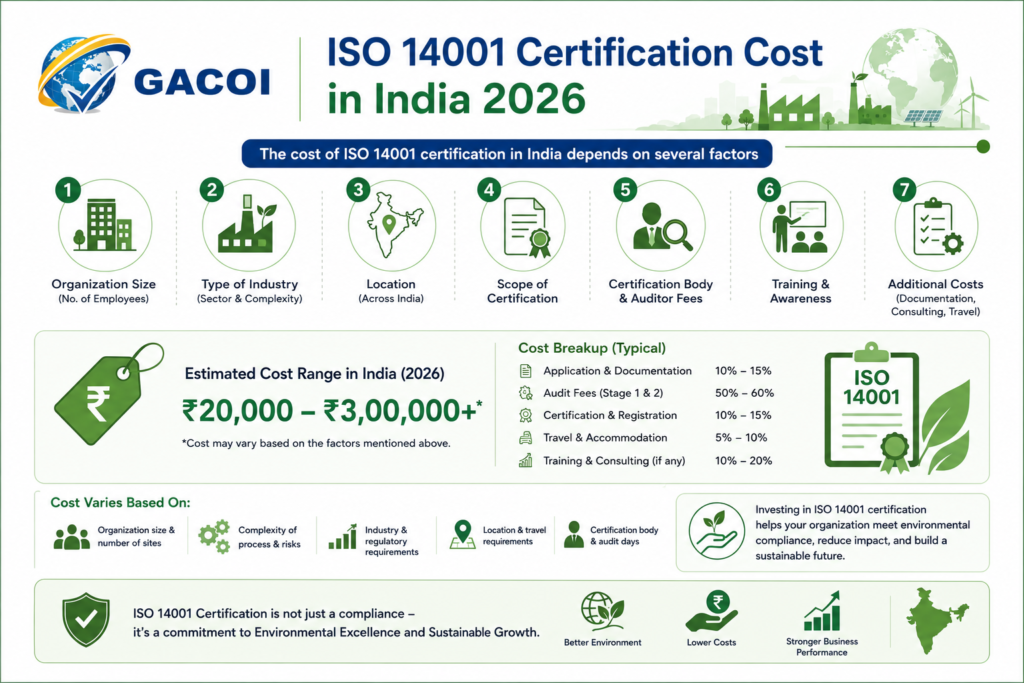
The truth is that ISO 14001 certification cost in India in 2026 varies across a meaningful range — determined by your organization’s size, operational complexity, industry type, geographic location, whether you engage external consultant support, and which accredited certification body you choose. A small manufacturing unit with twenty employees will invest a fundamentally different amount than a large chemical processing plant with five hundred workers across multiple production lines.
However, complete transparency is entirely possible. In this comprehensive guide, GacoiCert breaks down every single cost component involved in getting ISO 14001 certified in India in 2026 — from certification body audit fees and consultant charges to employee training, internal resource investment, infrastructure requirements, and ongoing annual maintenance costs.
We also explain what drives cost variation, how to reduce your total investment without compromising certificate quality, what to watch out for in India’s certification market, and why the return on ISO 14001 certification investment consistently exceeds its cost by a significant margin.
By the end of this guide, you will have a clear, realistic, and actionable picture of what ISO 14001 certification will cost your specific business in India in 2026.
Why ISO 14001 Certification Cost Matters More Than Ever in 2026
Before diving into the numbers, it is worth understanding why ISO 14001 certification has become a business-critical investment for Indian organizations in 2026 — because understanding the value helps contextualize the cost.
India’s environmental regulatory enforcement has intensified dramatically. The Central Pollution Control Board, State Pollution Control Boards, and the National Green Tribunal are imposing larger penalties, conducting more frequent inspections, and withdrawing consent for non-compliant operations with greater regularity than ever before.
Simultaneously, international buyers — particularly in the European Union, United States, and Japan — are implementing increasingly stringent supply chain environmental requirements. The EU’s Corporate Sustainability Due Diligence Directive, Carbon Border Adjustment Mechanism, and various sector-specific import regulations are creating new environmental compliance demands for Indian exporters that ISO 14001 certification directly addresses.
ESG investing has arrived in India in earnest. SEBI’s Business Responsibility and Sustainability Reporting framework requires the top 1,000 listed companies to disclose environmental performance data — and ISO 14001 directly generates the structured environmental management evidence that BRSR compliance needs.
Government tenders in infrastructure, manufacturing, and environmental services sectors are increasingly awarding preference scores to ISO 14001 certified vendors. And corporate procurement teams across India’s major industries are incorporating environmental certification into supplier qualification requirements.
In this environment, the question for Indian businesses is not whether ISO 14001 certification investment is justified — it clearly is. The question is what it costs, how to plan for it, and how to maximize the return.
The Complete ISO 14001 Certification Cost Components
ISO 14001 certification cost is not a single number. It is a combination of several distinct cost components — each of which must be understood and planned for separately.
Component 1: Certification Body Fees — The Primary Cost
The most significant and unavoidable cost component of ISO 14001 certification is the fee paid to the accredited certification body — such as GacoiCert — that independently audits your Environmental Management System and issues your internationally recognized certificate.
Certification body fees are determined primarily by audit duration — the total time required for Stage 1 documentation review, Stage 2 on-site assessment, audit report preparation, and certificate issuance. Audit duration is calculated based on the number of effective employees, the complexity of your environmental aspects, the number of sites included in scope, and your industry’s environmental risk profile.
The International Accreditation Forum’s mandatory guidelines provide the framework for audit duration calculation — ensuring that audit time is proportionate, objective, and consistent across legitimate accredited certification bodies.
ISO 14001 Certification Body Fees in India 2026:
| Organization Size | Number of Employees | Estimated Certification Fee |
|---|---|---|
| Micro Business | 1 – 5 employees | ₹20,000 – ₹38,000 |
| Very Small Business | 6 – 15 employees | ₹32,000 – ₹58,000 |
| Small Business | 16 – 25 employees | ₹48,000 – ₹85,000 |
| Small-Medium Business | 26 – 45 employees | ₹70,000 – ₹1,15,000 |
| Medium Business | 46 – 65 employees | ₹90,000 – ₹1,50,000 |
| Medium-Large Business | 66 – 125 employees | ₹1,25,000 – ₹2,00,000 |
| Large Business | 126 – 200 employees | ₹1,70,000 – ₹2,60,000 |
| Very Large Business | 201 – 300 employees | ₹2,20,000 – ₹3,20,000 |
| Enterprise | 300+ employees | ₹3,00,000 and above |
Important note on ISO 14001 vs ISO 9001 pricing: ISO 14001 certification fees are broadly comparable to ISO 9001 fees for the same organization size — with ISO 14001 sometimes slightly higher for manufacturing and industrial organizations due to the additional technical complexity of environmental aspect assessment. However, for organizations pursuing both standards together through an Integrated Management System approach, combined fees are significantly lower than two separate certifications.
What the certification body fee includes:
The certification body fee covers the complete initial certification cycle — Stage 1 documentation review audit, Stage 2 on-site certification assessment, both audit reports, certificate issuance for a three-year validity period, and registration of your certificate in the certification body’s publicly accessible database.
What the certification body fee does not include:
Certification body fees do not include external consultant fees, employee training, auditor travel and accommodation for outstation locations (charged separately), annual surveillance audits (billed annually), or the recertification audit at the end of the three-year cycle.
Annual Surveillance Audit Fees
ISO 14001 certificates are valid for three years — but annual surveillance audits are mandatory to maintain certificate validity throughout this period. Surveillance audits are typically 50 to 67 percent of the initial certification audit duration, making them meaningfully shorter and less expensive than the original audit.
Annual Surveillance Audit Fees in India 2026:
| Organization Size | Estimated Annual Surveillance Fee |
|---|---|
| Micro to Very Small | ₹13,000 – ₹30,000 per year |
| Small to Small-Medium | ₹28,000 – ₹60,000 per year |
| Medium to Medium-Large | ₹55,000 – ₹1,10,000 per year |
| Large to Very Large | ₹1,05,000 – ₹2,00,000 per year |
| Enterprise | ₹1,80,000 and above per year |
Recertification Audit Fees
At the conclusion of the three-year certification cycle, a recertification audit is required to renew your ISO 14001 certificate for the next three-year period. Recertification audit fees are generally comparable to the original certification body fee — sometimes slightly less for organizations with a strong surveillance audit history.
Component 2: ISO 14001 Consultant Fees
Many organizations pursuing ISO 14001 certification — particularly those without prior environmental management system experience — engage an external ISO 14001 consultant to guide the implementation process. A competent consultant helps with gap analysis, environmental aspects identification, legal register development, EMS documentation, employee training, internal audit support, and pre-certification audit preparation.
Consultant engagement is not mandatory. Organizations with experienced environmental managers or strong existing environmental practices can implement ISO 14001 without external support. However, for organizations new to structured environmental management, a skilled consultant significantly accelerates implementation, reduces the risk of major audit findings, and improves overall implementation quality.
ISO 14001 Consultant Fees in India 2026:
| Organization Size | Estimated Consultant Fee |
|---|---|
| Micro to Very Small Business | ₹18,000 – ₹45,000 |
| Small Business | ₹40,000 – ₹90,000 |
| Medium Business | ₹80,000 – ₹1,75,000 |
| Large Business | ₹1,50,000 – ₹3,50,000 |
| Enterprise | ₹3,00,000 – ₹7,00,000 and above |
Typical services included in consultant engagement:
A comprehensive ISO 14001 consultant engagement typically covers initial gap analysis against ISO 14001:2015 requirements, environmental aspects and impacts identification workshop, legal register development for applicable environmental laws, EMS documentation development including environmental policy, procedures, and records formats, employee awareness training, operational control procedures for significant aspects, emergency response plan development, internal auditor training, internal audit conduct support, management review facilitation, and pre-Stage 2 audit readiness review.
Critical warning about consultant and certification body combination: Legitimate accredited certification bodies are explicitly prohibited by accreditation requirements from providing consulting services to organizations they certify. Any operator offering combined consulting and certification for the same client has a fundamental conflict of interest and is almost certainly not legitimately accredited. Keep your consulting and certification relationships separate.
Component 3: ISO 14001 Training Costs
Successful ISO 14001 implementation requires investment in training — ensuring that your implementation team understands the standard’s requirements and that your employees understand the environmental management system and their roles within it.
ISO 14001 Training Programs and Fees in India 2026:
| Training Program | Target Audience | Typical Fee Per Person |
|---|---|---|
| ISO 14001 Awareness Training | All employees | ₹3,500 – ₹9,000 |
| ISO 14001 Lead Implementer Training | EMS Project Lead, Environmental Manager | ₹18,000 – ₹40,000 |
| ISO 14001 Internal Auditor Training | Internal audit team members | ₹10,000 – ₹22,000 |
| Environmental Aspects Identification Workshop | EMS team, department heads | ₹8,000 – ₹18,000 per person |
| ISO 14001 Lead Auditor Training | Those pursuing auditing careers | ₹28,000 – ₹58,000 |
The most important training investment for most organizations is the ISO 14001 Internal Auditor Training — ensuring that your team can conduct the mandatory internal audits effectively and identify real issues before the certification audit.
GacoiCert provides ISO 14001 training programs in classroom, online, and in-house formats across India — at competitive, transparent pricing that supports your overall certification budget.
Component 4: Environmental Monitoring and Testing Costs
ISO 14001 requires systematic monitoring of significant environmental aspects — energy consumption, water use, waste generation, air emissions, effluent quality, and other relevant parameters. For many Indian businesses, some environmental monitoring costs are already incurred as part of existing regulatory compliance obligations — CPCB consent conditions typically require regular stack emission testing, effluent quality analysis, and ambient air quality monitoring.
However, organizations implementing ISO 14001 may need to expand their monitoring scope beyond existing regulatory requirements to cover all significant environmental aspects identified in their EMS.
Typical environmental monitoring cost ranges:
| Monitoring Type | Estimated Annual Cost |
|---|---|
| Stack emission testing (per stack, per test) | ₹8,000 – ₹25,000 per test |
| Effluent quality analysis (per sample) | ₹3,000 – ₹12,000 per sample |
| Energy metering and monitoring systems | ₹15,000 – ₹1,50,000 (one-time setup) |
| Water consumption metering | ₹8,000 – ₹60,000 (one-time setup) |
| Waste quantity tracking systems | ₹5,000 – ₹30,000 per year |
| Third-party environmental testing laboratory fees | ₹20,000 – ₹2,00,000 per year |
For organizations in heavily regulated industries — manufacturing, chemical processing, food processing, textiles — many of these monitoring activities are already mandated by CPCB or SPCB consent conditions, meaning the incremental monitoring cost for ISO 14001 compliance may be minimal.
Component 5: Internal Resource Costs — The Most Overlooked Investment
The most consistently underestimated cost in ISO 14001 certification planning is the internal resource cost — the value of the time your employees invest in implementing and maintaining the environmental management system.
This is a genuine and significant cost. Your Environmental Manager, department heads, operations staff, and other team members will invest considerable hours in environmental aspect identification, legal register development, documentation creation, process implementation, training participation, record maintenance, and audit support activities.
Estimated Internal Time Investment for ISO 14001:
| Organization Size | Estimated Total Internal Hours |
|---|---|
| Micro to Very Small | 100 – 180 hours |
| Small Business | 180 – 350 hours |
| Medium Business | 350 – 700 hours |
| Large Business | 700 – 1,400 hours |
| Enterprise | 1,400 hours and above |
Converting these hours to rupee values based on the average salary levels of involved personnel often reveals internal resource cost as the largest single component of total ISO 14001 investment — making it essential to account for in your budget planning even though it does not appear as an external cash outflow.
Component 6: ISO 14001:2015 Standard Purchase Cost
To implement ISO 14001, your implementation team needs access to the actual standard document. The ISO 14001:2015 standard can be purchased from two primary sources in India:
Bureau of Indian Standards (BIS): The Indian adoption of ISO 14001:2015 — published as IS/ISO 14001:2015 — is available from BIS at approximately ₹5,000 to ₹8,000. This is the most cost-effective option for Indian businesses.
ISO directly: The original ISO 14001:2015 standard is available from iso.org for approximately CHF 138 — roughly ₹12,000 to ₹15,000 at current exchange rates.
Component 7: EMS Documentation and Software Tools
ISO 14001 documentation can be maintained using basic tools that most organizations already have — Microsoft Office applications, Google Workspace, or similar productivity suites. These tools are entirely adequate for small and medium businesses implementing ISO 14001.
Larger organizations, or those seeking more structured environmental data management, may invest in dedicated Environmental Management System software that provides document control, environmental performance tracking dashboards, legal register management, corrective action tracking, and audit management functionality.
Documentation and EMS software cost ranges:
| Tool Type | Approximate Annual Cost |
|---|---|
| Basic tools (Microsoft 365 or Google Workspace) | ₹0 – ₹20,000 (if not already owned) |
| Basic EMS software (cloud-based, small teams) | ₹20,000 – ₹75,000 per year |
| Mid-range EMS platform (medium organizations) | ₹75,000 – ₹2,50,000 per year |
| Enterprise EMS platforms | ₹2,50,000 and above per year |
Component 8: Infrastructure and Process Improvement Costs
In some cases, ISO 14001 implementation reveals environmental performance gaps that require physical infrastructure improvements or process changes to address. Common examples include:
- Effluent treatment plant upgrades to meet consent condition standards
- Secondary containment installation for chemical storage areas
- Energy metering equipment installation for energy monitoring
- Waste segregation infrastructure — bins, storage areas, signage
- Stack emission control equipment upgrades
- Water recycling or rainwater harvesting system installation
- Hazardous waste storage area improvements
These costs vary enormously depending on current infrastructure condition and the specific environmental aspects identified. Organizations with relatively modern, well-maintained facilities typically face minimal infrastructure costs. Organizations with aging or inadequate environmental infrastructure may face significant investment requirements — but these improvements deliver value far beyond ISO 14001 certification through improved regulatory compliance, reduced penalty risk, and resource cost savings.
Total ISO 14001 Certification Cost in India 2026 — Complete Summary
Combining all cost components, here is a realistic total investment estimate for ISO 14001 certification in India in 2026:
| Organization Size | Certification Fee | Consultant Fee | Training | Monitoring and Tools | Total Estimated Investment |
|---|---|---|---|---|---|
| Micro (1–5 employees) | ₹20,000 – ₹38,000 | ₹18,000 – ₹40,000 | ₹6,000 – ₹18,000 | ₹5,000 – ₹15,000 | ₹49,000 – ₹1,11,000 |
| Small (6–25 employees) | ₹38,000 – ₹85,000 | ₹35,000 – ₹85,000 | ₹12,000 – ₹35,000 | ₹10,000 – ₹30,000 | ₹95,000 – ₹2,35,000 |
| Medium (26–100 employees) | ₹85,000 – ₹1,70,000 | ₹80,000 – ₹1,75,000 | ₹25,000 – ₹70,000 | ₹20,000 – ₹60,000 | ₹2,10,000 – ₹4,75,000 |
| Large (101–300 employees) | ₹1,70,000 – ₹3,20,000 | ₹1,50,000 – ₹3,50,000 | ₹50,000 – ₹1,20,000 | ₹40,000 – ₹1,00,000 | ₹4,10,000 – ₹8,90,000 |
| Enterprise (300+ employees) | ₹3,00,000 and above | ₹3,00,000 and above | ₹1,00,000 and above | ₹80,000 and above | ₹7,80,000 and above |
The Critical Warning: Beware of Cheap ISO 14001 Certificates in India
This section may be the most important in this entire guide.
India’s ISO certification market contains a significant number of non-accredited and fraudulent certification bodies that offer ISO 14001 certificates at prices far below legitimate market rates — sometimes as low as ₹5,000 to ₹15,000 — with minimal or no genuine audit process.
These operators are easy to identify once you know what to look for:
Prices far below legitimate market rates: If an ISO 14001 certificate is being offered for under ₹20,000 regardless of your organization’s size, it is almost certainly from a non-accredited body.
Guaranteed certification in 7 to 30 days: Legitimate ISO 14001 certification requires a minimum period of EMS operation before the audit — making these timelines impossible for genuine certification.
Unverifiable accreditation bodies: Many fraudulent operators display logos of invented accreditation bodies — organizations with authoritative-sounding names that do not exist as legitimate accreditation bodies.
Certificates not verifiable on IAF CertSearch: Genuine certificates from accredited bodies are verifiable through iafcertsearch.org. Certificates from non-accredited bodies cannot be found in this database.
Why this matters profoundly for your business:
Certificates from non-accredited bodies are rejected by Indian government tender evaluation committees, rejected by corporate supplier qualification processes, rejected by international buyers and import authorities, and rejected by banks and financial institutions. A cheap fake certificate is not a discounted version of genuine certification — it is an entirely different and worthless product that adds zero value and creates significant risk.
Always verify accreditation status before engaging any certification body. Check NABCB’s website at nabcb.in to confirm accreditation. Check IAF’s website at iaf.nu to confirm the accreditation body’s legitimacy. Check iafcertsearch.org to verify specific certificates.
Factors That Determine Your Specific ISO 14001 Cost
Understanding what drives cost variation enables accurate planning for your specific situation:
Number of employees: Audit duration — and therefore certification body fees — increases proportionally with employee numbers. This is the primary cost driver across all organization sizes.
Environmental complexity: Organizations with multiple significant environmental aspects — diverse emissions, complex effluent streams, multiple hazardous materials, numerous operational processes with environmental interactions — require more audit time than environmentally simple operations.
Number of sites: Multi-site certifications require additional audit time at each included location. Single-site certifications are significantly more cost-effective.
Industry environmental risk profile: High environmental risk industries — chemical manufacturing, mining, tanneries, textile dyeing, electroplating, food processing — require more rigorous environmental aspect assessment and more thorough audit coverage, increasing audit time and cost.
Current environmental management maturity: Organizations with existing environmental management practices, documented monitoring programs, and established regulatory compliance systems require less consultant support and shorter implementation timelines — reducing total investment.
Geographic location: Auditor travel and accommodation costs for facilities in remote or less-accessible locations are typically charged separately and can meaningfully add to total certification cost. Facilities in major industrial centers — Pune, Chennai, Surat, Ahmedabad, Ludhiana — benefit from lower auditor travel costs.
Integrated certification opportunity: Organizations pursuing ISO 14001 alongside ISO 9001 or ISO 45001 through a combined Integrated Management System audit achieve significant cost savings — typically 25 to 40 percent reduction in combined certification fees compared to pursuing each standard separately.
Strategies to Reduce ISO 14001 Certification Cost Without Compromising Quality
Pursue integrated certification: If ISO 9001 or ISO 45001 is also on your roadmap, pursue all certifications together through GacoiCert’s Integrated Management System approach. Combined audits save substantial time and cost compared to sequential separate certifications.
Invest in thorough gap analysis upfront: A comprehensive gap analysis before implementation begins focuses resources precisely on areas requiring improvement — preventing wasted effort and consultant fees on areas already compliant with ISO 14001 requirements.
Leverage existing regulatory compliance documentation: Many Indian businesses already maintain environmental monitoring records, effluent testing reports, consent condition compliance documents, and waste manifests as part of existing CPCB or SPCB compliance obligations. These existing records provide a foundation for ISO 14001 implementation that reduces documentation development effort and cost.
Train your own internal auditors: Investing in two or three trained internal auditors reduces ongoing consulting costs for internal audit conduct — paying back through reduced external consultant fees in every subsequent audit cycle.
Schedule audit dates early: Contact GacoiCert and schedule your Stage 1 and Stage 2 audit dates early in your implementation process — securing preferred audit slots and preventing scheduling delays that extend your timeline and increase your internal resource costs.
Use appropriate documentation tools: Free or low-cost tools — Google Workspace or Microsoft 365 — are entirely sufficient for ISO 14001 documentation management in small and medium businesses. Avoid unnecessary investment in expensive EMS software at the initial certification stage.
The Return on ISO 14001 Investment: Why the Cost Is Always Justified
Every ISO 14001 certification cost discussion must be contextualized against the returns that certification delivers — because the investment case for genuine accredited certification is consistently and compellingly positive.
Regulatory penalty avoidance: The National Green Tribunal has imposed penalties of crores of rupees on organizations for environmental violations. A single serious environmental incident can cost far more in penalties, remediation, and legal fees than the total lifetime cost of maintaining ISO 14001 certification.
Export market access: A single new export customer won through ISO 14001 supplier qualification can generate annual revenues that return the entire certification investment many times over.
Government tender wins: Infrastructure, construction, and environmental sector tenders that award ISO 14001 preference points can represent contract values that dwarf the certification investment.
Resource cost savings: Systematic energy efficiency, water conservation, and waste reduction driven by ISO 14001 implementation delivers real, recurring annual savings. Many medium-sized manufacturers report annual resource cost savings of ₹5,00,000 to ₹20,00,000 or more from ISO 14001-driven efficiency improvements — returns that are multiple times the certification investment.
Insurance premium reductions: Risk-conscious insurers recognize ISO 14001 certified organizations’ lower environmental incident probability — translating into more favorable premium terms.
ESG and green financing advantages: ISO 14001 certification strengthens ESG credentials that support sustainability-linked financing at potentially lower interest rates.
Three-year total cost of ownership:
| Organization Size | 3-Year Total Certification Cost | Estimated 3-Year Resource Savings | Net Benefit |
|---|---|---|---|
| Small Business | ₹1,50,000 – ₹4,00,000 | ₹3,00,000 – ₹8,00,000 | Strongly positive |
| Medium Business | ₹4,00,000 – ₹9,00,000 | ₹8,00,000 – ₹25,00,000 | Strongly positive |
| Large Business | ₹8,00,000 – ₹18,00,000 | ₹20,00,000 – ₹60,00,000 | Strongly positive |
These figures demonstrate what certified organizations consistently report: ISO 14001 investment pays back through resource savings alone — and the additional benefits of regulatory compliance, market access, and brand value make the total return picture even more compelling.
Why Choose GacoiCert for ISO 14001 Certification in India?
When the cost of ISO 14001 certification is your planning focus, two things matter most: paying a fair, transparent price for genuinely accredited certification, and ensuring that the certificate you receive delivers the full range of business benefits that legitimate accredited certification provides.
GacoiCert delivers both.
Internationally accredited: GacoiCert’s ISO 14001 certificates are issued under internationally recognized accreditation — verifiable through NABCB and IAF databases, accepted by government procurement authorities, corporate buyers, international importers, and investors worldwide.
Transparent, competitive pricing: GacoiCert provides complete, itemized quotations covering all stages of the certification process — with no hidden fees, no surprise charges, and pricing that is calculated objectively based on your organization’s actual audit requirements.
Deep India-specific environmental regulatory knowledge: Our auditors understand India’s environmental regulatory framework in detail — CPCB standards, SPCB consent conditions, NGT requirements, EPR obligations, BRSR framework — ensuring your ISO 14001 certification genuinely supports your regulatory compliance objectives.
All major industries served: Manufacturing, IT and data centers, construction, healthcare, food processing, textiles, chemicals, logistics, hospitality — GacoiCert auditors bring genuine sector-specific environmental management expertise.
Integrated Management System capability: ISO 14001 combined with ISO 9001 and ISO 45001 through a single coordinated audit — maximizing efficiency and minimizing total certification cost.
Pan-India service coverage: Delhi NCR, Mumbai, Pune, Ahmedabad, Surat, Bangalore, Chennai, Hyderabad, Kolkata, Ludhiana, and all major cities and industrial centers across India.
Long-term certification partnership: GacoiCert’s commitment extends through every surveillance audit and recertification cycle — providing consistent, reliable certification support as your environmental management system matures.
Conclusion: ISO 14001 Certification in India in 2026 Is an Investment That Pays
ISO 14001 certification cost in India in 2026 ranges from approximately ₹49,000 for the smallest micro-businesses to several lakhs for large enterprises — with total investment varying based on organization size, environmental complexity, consultant engagement, training requirements, and infrastructure needs.
What is consistent across every organization is the fundamental investment case: the return on genuine, accredited ISO 14001 certification — through regulatory penalty avoidance, export market access, government tender success, resource cost savings, and ESG credibility — consistently and significantly exceeds the total cost of achieving and maintaining it.
The critical caveat is that these returns are only available through genuine, accredited certification. Cheap certificates from non-accredited bodies deliver none of these benefits and create significant risk. Choose your certification body with the care this important decision deserves.
GacoiCert is ready to provide your organization with internationally accredited ISO 14001 certification at transparent, competitive pricing. Visit gacoicert.com today, request your free consultation, and receive a personalized ISO 14001 cost estimate for your specific organization.
Frequently Asked Questions
1. What is the ISO 14001 Certification Cost in India in 2026?
The ISO 14001 Certification Cost in India depends on factors such as the size of the organization, number of employees, business locations, scope of certification, and the certification body selected. The overall cost varies from one organization to another.
2. What factors affect the ISO 14001 Certification Cost in India?
The ISO 14001 Certification Cost in India is influenced by business size, industry type, complexity of operations, documentation requirements, audit duration, number of sites, and whether implementation support is included.
3. Does the ISO 14001 Certification Cost in India include implementation and audit charges?
Not always. Some certification providers offer complete packages that include documentation, implementation, training, internal audits, and certification audits, while others charge separately. It is important to confirm what is included in the ISO 14001 Certification Cost in India before proceeding.
4. Is the ISO 14001 Certification Cost in India different for startups and MSMEs?
Yes. The ISO 14001 Certification Cost in India is generally lower for startups and MSMEs because they usually have fewer employees, simpler processes, and a smaller scope of certification compared to larger organizations.
5. How long does it take to obtain ISO 14001 certification?
The time required depends on the organization’s readiness, documentation, and implementation of the Environmental Management System (EMS). Most businesses can complete the certification process within a few weeks to a few months.
6. Is ISO 14001 certification worth the investment?
Yes. Although the ISO 14001 Certification Cost in India requires an initial investment, the certification can improve environmental compliance, reduce waste, enhance operational efficiency, strengthen brand credibility, and create new business opportunities.
7. Are there any recurring costs after ISO 14001 certification?
Yes. After certification, organizations may incur surveillance audit fees, recertification costs, and expenses related to maintaining and continually improving their Environmental Management System. These ongoing expenses should be considered along with the ISO 14001 Certification Cost in India.
8. How can businesses reduce the ISO 14001 Certification Cost in India?
Businesses can optimize the ISO 14001 Certification Cost in India by preparing documentation in advance, implementing an effective Environmental Management System, conducting internal audits, and selecting an accredited certification body that offers transparent and competitive pricing.
For Experts Legal Guidance for ISO Certification
🟡GACOI Cert provides globally recognized ISO certification, cybersecurity, privacy, AI governance, compliance, audit, and professional training services, helping startups, businesses, enterprises, laboratories, healthcare organizations, and government institutions achieve international standards and build lasting trust.
🟡For other Legal and Trademark related services Visit
👉 Money Recovery Cases
👉 Property Disputes
👉 Business & Licence Registrations
🟡 Protect Your Rights
👉 Domestic Violence Legal Support
👉 Stridhan Recovery
👉 Mutual Consent Divorce
👉 Contested Divorce Filing
👉 Child Custody and Maintenance
👉 Matrimonial Property Settlement
👉 NRI Divorce Services
👉 Alimony and Maintenance
📞 Call Now: +91 8595439395
🕐 Free Consultation: Monday to Saturday, 10 AM to 6 PM


