


Views: 1
Learn everything about ISO 22000 food safety certification in India — benefits, requirements, process, cost, and how GacoiCert helps your food business get certified. Apply today.
Table of Contents
- 1 Introduction: Why Food Safety Certification Is Non-Negotiable in India
- 2 What Is ISO 22000?
- 3 ISO 22000 vs HACCP vs FSSAI: Understanding the Difference
- 4 What Does ISO 22000 Cover?
- 5 ISO 22000:2018 Structure — Key Clauses
- 6 Who Needs ISO 22000 Certification in India?
- 7 ISO 22000 Certification in India: Why It Matters Specifically
- 8 Top Benefits of ISO 22000 Certification for Indian Food Businesses
- 9 Food Safety Hazards ISO 22000 Addresses
- 10 Critical Control Points (CCPs) — Practical Examples
- 11 ISO 22000 Certification Process in India: Step by Step
- 12 ISO 22000 Certification Timeline in India
- 13 ISO 22000 Certification Cost in India
- 14 ISO 22000 and FSSAI: How They Work Together
- 15 FSSC 22000: The Next Level
- 16 Key Food Safety KPIs to Track After Certification
- 17 Common Mistakes Food Businesses Make with ISO 22000
- 18 Why Choose GacoiCert for ISO 22000 Certification in India?
- 19 Frequently Asked Questions (FAQs)
- 20 Conclusion: Safe Food Is Good Business
- 21 Need ISO 22000 Certification
Introduction: Why Food Safety Certification Is Non-Negotiable in India
India duniya ka ek sabse bada food producer aur consumer hai. Hamare desh mein food industry ka scale unimaginable hai — khet se lekar kitchen tak, factory se lekar export container tak, lakhon log food supply chain mein involved hain. Lekin iske saath ek serious responsibility bhi aati hai: food safety.
Har saal contaminated food ki wajah se globally 600 million log beemar hote hain aur 420,000 log jaan gawaate hain. India mein bhi food safety incidents — adulteration, contamination, mislabeling — regularly news mein aate hain, jo consumers ka trust tod dete hain aur businesses ko financial aur legal nuksaan pahunchate hain.
Is reality mein ISO 22000 Food Safety Management System (FSMS) certification ek powerful solution hai. Yeh internationally recognized standard ensure karta hai ki aapki food business har step par — raw material sourcing se lekar final product delivery tak — safety ko systematically manage karti hai.
GacoiCert ke is comprehensive guide mein hum cover karenge ISO 22000 ka har pehlu — kya hai, India mein kyun zaroori hai, benefits kya hain, certification process kya hai, aur aap kaise shuru kar sakte hain.
What Is ISO 22000?
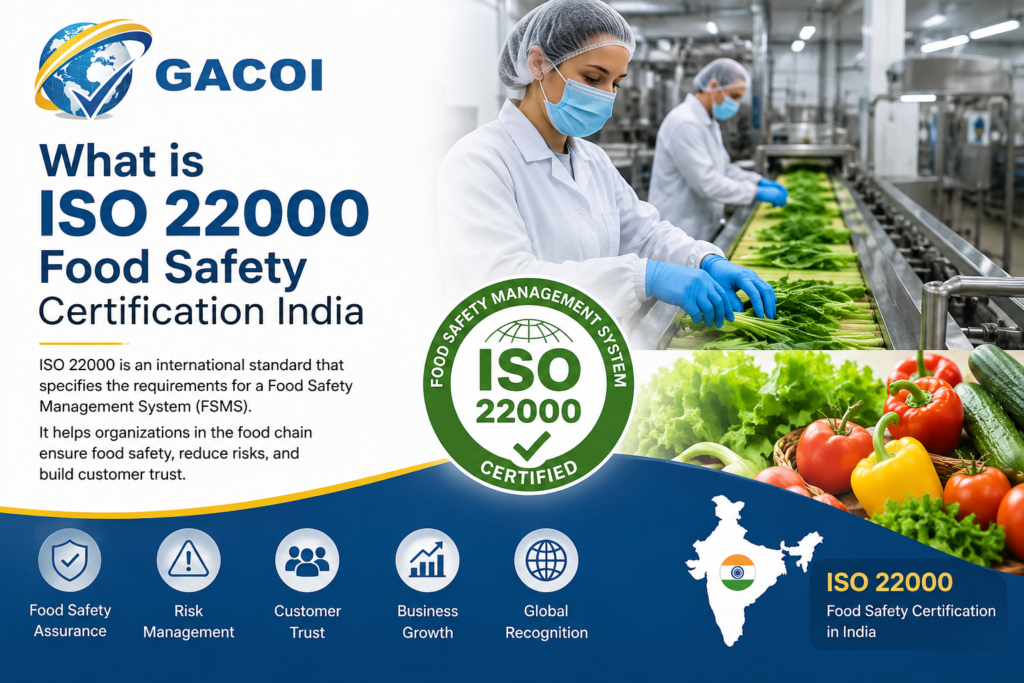
ISO 22000 ek internationally recognized standard hai jo Food Safety Management Systems (FSMS) ke liye requirements specify karta hai. Ise International Organization for Standardization (ISO) ne develop kiya hai.
ISO 22000 ek comprehensive framework provide karta hai jo ensure karta hai ki:
- Food supply chain mein sab organizations food safety hazards effectively control karein
- Safe food consistently produce aur deliver kiya jaaye
- Food safety laws aur regulations comply kiye jaayein
- Customers aur consumers ko safe food mile — har baar
Important: ISO 22000 sirf manufacturers ke liye nahi hai. Yeh food supply chain ke every link ke liye applicable hai — farmers se lekar retailers tak.
ISO 22000 Ka Latest Version
Current version ISO 22000:2018 hai, jo June 2018 mein published hua. Isme ISO 9001:2015 ke saath alignment ke liye High Level Structure (HLS) adopt ki gayi, aur risk-based thinking ko strengthen kiya gaya.
ISO 22000 vs HACCP vs FSSAI: Understanding the Difference
Bahut saare food business owners confuse hote hain ISO 22000, HACCP, aur FSSAI ke beech. Yahan clarity hai:
| Aspect | ISO 22000 | HACCP | FSSAI |
|---|---|---|---|
| Type | International Standard (ISO) | Food Safety Methodology | Indian Regulatory Requirement |
| Developed By | ISO | Codex Alimentarius | Government of India |
| Scope | Full FSMS framework | Hazard analysis & critical control points only | Indian food business licensing |
| Mandatory in India | No (but strongly preferred) | Incorporated in ISO 22000 | Yes — mandatory for all food businesses |
| Global Recognition | High | High | India-specific |
| Management System | Yes — full system | No — methodology only | No — licensing framework |
Key Point: ISO 22000 mein HACCP principles integrated hain. Agar aapke paas ISO 22000 certification hai, toh aap HACCP requirements ko bhi meet karte hain. FSSAI compliance alag requirement hai jo sabhi Indian food businesses ke liye mandatory hai — ISO 22000 FSSAI compliance demonstrate karne mein help karta hai lekin iska substitute nahi hai.
What Does ISO 22000 Cover?
ISO 22000 ek complete Food Safety Management System define karta hai jo include karta hai:
Interactive Communication
Food safety chain ke sab links — suppliers, manufacturers, distributors, retailers, consumers — ke beech effective communication. Food safety hazards sirf tab effectively controlled hote hain jab information poori supply chain mein freely flow kare.
System Management
ISO 9001 jaise management system principles apply karna food safety ke liye — documentation, planning, resource management, continuous improvement.
Prerequisite Programs (PRPs)
Basic hygienic conditions aur practices jo safe food production ke liye necessary hain. PRPs hazard introduction ko prevent karte hain ya unhe acceptable levels par maintain karte hain. Examples:
- Infrastructure aur equipment maintenance
- Cleaning aur disinfection procedures
- Pest control programs
- Personnel hygiene requirements
- Supplier aur raw material management
- Cross-contamination prevention
- Water aur air quality management
- Temperature control
- Allergen management
- Waste management
HACCP Principles
Hazard Analysis and Critical Control Points (HACCP) ISO 22000 ka core element hai:
- Hazard Analysis: Sab potential food safety hazards identify karna — biological, chemical, physical, aur allergen hazards
- Critical Control Points (CCPs): Those process steps identify karna jahan hazards ko prevent ya eliminate kiya ja sakta hai
- Critical Limits: Har CCP ke liye acceptable parameters define karna (temperature, pH, time, etc.)
- Monitoring: CCPs ko systematically monitor karna
- Corrective Actions: Jab critical limits exceed hon tab kya karna
- Verification: HACCP system effectively kaam kar raha hai ki nahi confirm karna
- Documentation: Har cheez properly record karna
ISO 22000:2018 Structure — Key Clauses
ISO 22000:2018 ISO ka High Level Structure (HLS) follow karta hai:
Clause 4: Context of the Organization
Food business kis environment mein operate karta hai — regulatory landscape, market conditions, consumer expectations, supply chain complexity. Interested parties kaun hain — regulators, customers, consumers, industry associations.
Clause 5: Leadership
Top management ka food safety ke liye genuine commitment. Food Safety Policy establish karna. Food Safety Team Leader appoint karna. Resources provide karna.
Clause 6: Planning
Food safety risks aur opportunities identify karna. Food Safety Management System ke objectives set karna. Change management plan karna.
Clause 7: Support
Resources, competence (especially technical food safety knowledge), awareness, communication (internal aur external), aur documented information manage karna.
Clause 8: Operation
Yeh sabse comprehensive clause hai:
- Prerequisite Programs (PRPs) plan aur implement karna
- Traceability system establish karna
- Emergency preparedness aur response (product recalls, food safety incidents)
- Hazard analysis conduct karna
- HACCP plan develop aur implement karna
- Monitoring of CCPs
- Corrective actions
Clause 9: Performance Evaluation
Food safety monitoring, measurement, analysis, aur evaluation. Internal audits. Management review.
Clause 10: Improvement
Nonconformities aur corrective actions. Continual improvement of FSMS.
Who Needs ISO 22000 Certification in India?
ISO 22000 food supply chain ke every segment par applicable hai:
Primary Producers:
- Farms aur agricultural producers
- Livestock farmers
- Fisheries aur aquaculture
- Dairy farms
Food Processors aur Manufacturers:
- Packaged food manufacturers
- Beverage companies
- Snack food producers
- Bakeries aur confectionery
- Meat aur poultry processing
- Seafood processing
- Dairy product manufacturers
- Edible oil producers
- Spice aur condiment manufacturers
- Ready-to-eat food companies
Food Service aur Catering:
- Restaurants aur hotel kitchens
- Catering companies
- Canteens aur institutional food service
- Cloud kitchens aur food delivery businesses
- Fast food chains
Food Distribution aur Logistics:
- Cold chain logistics companies
- Food warehousing aur storage
- Food distributors aur wholesalers
- Import/export companies dealing in food
Food Retail:
- Supermarkets aur grocery chains
- Specialty food retailers
Food Ingredient aur Additive Suppliers:
- Food ingredient manufacturers
- Food additive aur preservative suppliers
- Packaging material manufacturers (food contact materials)
Support Service Providers:
- Food testing laboratories
- Pest control companies serving food industry
- Cleaning service companies for food facilities
Agar aapka business food se kisi bhi tarah connected hai — aapko ISO 22000 consider karna chahiye.
ISO 22000 Certification in India: Why It Matters Specifically
India ke context mein ISO 22000 certification ki special relevance hai:
FSSAI Compliance Alignment
Food Safety and Standards Authority of India (FSSAI) India mein food safety regulate karta hai. FSSAI ke Food Safety and Standards Regulations ISO 22000 ke principles ke saath strongly aligned hain. ISO 22000 certification aapko FSSAI requirements effectively meet karne mein help karta hai.
Export Opportunities
India ek major food exporter hai — basmati rice, spices, seafood, processed foods, fresh produce. European Union, USA, Middle East, aur Japan jaise major export markets mein buyers ISO 22000 certified suppliers ko strongly prefer ya require karte hain. APEDA (Agricultural and Processed Food Products Export Development Authority) registered exporters ke liye ISO 22000 especially valuable hai.
Retail aur Modern Trade Requirements
India ke growing modern retail sector — D-Mart, Reliance Smart, Big Bazaar, Flipkart, Amazon — mein listing ke liye food safety certification increasingly important ho rahi hai.
Food Delivery aur Cloud Kitchen Boom
India ka food delivery market explosive growth mein hai. Swiggy, Zomato, aur similar platforms par listed businesses ke liye food safety certification ek strong differentiator hai.
Consumer Awareness
Indian consumers zyada educated aur aware ho rahe hain — they actively look for food safety certifications when making purchasing decisions, especially in packaged foods.
Institutional Buyers
Hospitals, schools, government canteens, corporate cafeterias — sab ke sab vendors se food safety certification require karne lagte hain.
Investor aur Funding Requirements
Agri-food startups jo VC funding ya private equity investment chahte hain, unhe often investors ki taraf se food safety certification requirement milti hai.
Top Benefits of ISO 22000 Certification for Indian Food Businesses
1. Comprehensive Food Safety Hazard Control
ISO 22000 ensure karta hai ki biological (bacteria, viruses, parasites), chemical (pesticides, heavy metals, food additives), physical (glass, metal, bone), aur allergen hazards systematically identified aur controlled hon — throughout your entire food production process.
2. Legal aur Regulatory Compliance
FSSAI regulations, Export Inspection Council (EIC) requirements, aur international food safety regulations — ISO 22000 ka structured approach aapko sab ke saath compliant rehne mein help karta hai.
3. Export Market Access
ISO 22000 certification aapke food products ke liye international markets ke doors kholta hai. EU, USA, Japan, aur Gulf Cooperation Council (GCC) countries ke importers ISO 22000 certified suppliers ko prefer karte hain.
4. Reduced Food Safety Incidents aur Recalls
Systematic hazard control aur monitoring se contaminated products aur costly product recalls dramatically reduce hote hain. Ek single food safety recall aapki company ki reputation aur finances dono ko seriously damage kar sakta hai.
5. Enhanced Consumer Trust and Brand Reputation
ISO 22000 certificate consumers ko assure karta hai ki aapka food safe hai. Yeh ek powerful marketing tool hai — especially premium aur health-conscious consumer segments mein.
6. Better Supply Chain Management
ISO 22000 require karta hai ki aap apne suppliers ko bhi manage karein — raw materials, ingredients, packaging materials. Yeh poori supply chain mein food safety standards raise karta hai.
7. Improved Traceability
ISO 22000 require karta hai ki aapke paas robust traceability system ho — raw material origin se lekar finished product distribution tak. Agar koi issue arise ho, toh affected products quickly identify aur recall kiye ja saken.
8. Competitive Advantage
Jab do similar food businesses compete karte hain, ISO 22000 certified business ko buyers, retailers, aur institutional customers consistently prefer karte hain.
9. Cost Savings
Food waste reduction, rework minimization, recall avoidance, aur regulatory penalty prevention — yeh sab milke significant cost savings dete hain jo certification cost se kahin zyada hoti hain.
10. Employee Food Safety Culture
ISO 22000 implementation se employees food safety practices ke importance ko genuinely samajhte hain — jo better hygiene practices, fewer mistakes, aur stronger food safety culture create karta hai.
11. Integration with Other ISO Standards
ISO 22000:2018 ISO 9001:2015 (Quality) ke saath seamlessly integrate hota hai — ek Integrated Management System banane ke liye jo overall business excellence drive karta hai.
12. Premium Pricing Opportunity
ISO 22000 certified food products often premium pricing command kar sakte hain — especially B2B sales mein aur export markets mein.
Food Safety Hazards ISO 22000 Addresses
Biological Hazards
Sab commonly encountered food safety hazards:
- Bacteria: Salmonella, E. coli, Listeria monocytogenes, Staphylococcus aureus, Clostridium botulinum, Campylobacter
- Viruses: Norovirus, Hepatitis A, Rotavirus
- Parasites: Cryptosporidium, Giardia, Trichinella, tapeworms
- Fungi/Molds: Aspergillus (aflatoxin producer), Penicillium
Chemical Hazards
- Pesticide residues (especially relevant for Indian agriculture)
- Heavy metals (lead, mercury, arsenic, cadmium)
- Food additives used at unsafe levels
- Veterinary drug residues (antibiotics in meat/dairy)
- Cleaning chemical contamination
- Naturally occurring toxins (aflatoxins, mycotoxins)
- Allergens (peanuts, tree nuts, milk, eggs, wheat, soy, fish, shellfish)
- Migration from packaging materials
Physical Hazards
- Glass fragments
- Metal pieces
- Bone fragments
- Plastic pieces
- Wood splinters
- Stones aur foreign objects
- Personal belongings (jewelry, hair)
Allergen Management
India mein allergen awareness grow ho rahi hai. ISO 22000 require karta hai ki:
- Allergens identified aur labelled hon
- Cross-contamination prevented ho
- Staff trained ho allergen management par
Critical Control Points (CCPs) — Practical Examples
Pasteurization (Dairy Industry)
- Hazard: Pathogenic bacteria (Listeria, Salmonella)
- CCP: Pasteurization temperature aur time
- Critical Limit: 72°C for 15 seconds (HTST) ya 63°C for 30 minutes (LTLT)
- Monitoring: Continuous temperature recording
Metal Detection (Packaged Food)
- Hazard: Metal fragments
- CCP: Metal detector at end of production line
- Critical Limit: No metal detected above specified sensitivity
- Monitoring: Hourly test pieces
Cold Storage (Meat/Seafood)
- Hazard: Pathogen growth
- CCP: Storage temperature
- Critical Limit: Below 4°C for chilled, below -18°C for frozen
- Monitoring: Continuous temperature logging
Cooking Temperature (Ready-to-Eat Foods)
- Hazard: Surviving pathogens
- CCP: Internal product temperature
- Critical Limit: 75°C internal temperature minimum
- Monitoring: Temperature probe readings logged
pH Control (Fermented Foods/Pickles)
- Hazard: Pathogen survival
- CCP: Final product pH
- Critical Limit: pH below 4.6
- Monitoring: Regular pH testing
ISO 22000 Certification Process in India: Step by Step
Step 1: Management Commitment
Top management ka genuine commitment food safety ke liye — resources provide karna, Food Safety Policy establish karna, aur food safety ko business priority banana.
Step 2: Appoint a Food Safety Team Leader (FSTL)
ISO 22000 require karta hai ki ek qualified Food Safety Team Leader appoint kiya jaaye jo FSMS implementation aur maintenance lead kare. FSTL ko food safety science aur HACCP mein technical knowledge hona chahiye.
Step 3: Assemble Food Safety Team
Cross-functional team banayein — production, quality, procurement, engineering, aur other relevant functions se — jo collectively food safety hazards identify aur control kar sake.
Step 4: Preliminary Steps — Product Description aur Process Flow Diagrams
- Har product ya product category ki detailed description (ingredients, composition, pH, water activity, intended consumers, intended use)
- Step-by-step process flow diagrams banayein — raw material receipt se lekar finished product dispatch tak
- Process flow ko physically verify karein factory floor par
Step 5: Hazard Analysis
Har process step par potential food safety hazards identify karein — biological, chemical, physical, allergen. Har hazard ki severity aur likelihood assess karein. Significant hazards determine karein jo controls require karte hain.
Step 6: Prerequisite Programs (PRPs) Establish Karein
Basic hygienic conditions ensure karein:
- Facility design aur layout (zone separation, traffic flow)
- Cleaning aur sanitation procedures
- Pest management program
- Personal hygiene procedures aur policies
- Temperature control systems
- Water safety
- Waste management
- Supplier qualification program
- Allergen management program
Step 7: HACCP Plan Develop Karein
- Critical Control Points (CCPs) identify karein
- Critical Limits establish karein
- Monitoring procedures define karein
- Corrective actions plan karein
- Verification procedures establish karein
- Record-keeping system set up karein
Step 8: FSMS Documentation Complete Karein
- Food Safety Policy
- Food Safety Objectives
- Food Safety Manual
- Process Flow Diagrams
- Hazard Analysis Records
- HACCP Plan
- PRP Procedures
- Corrective Action Procedures
- Traceability Procedure
- Product Recall Procedure
- Internal Audit Procedure
Step 9: Implementation
Documented system ko actually implement karein:
- Sab staff ko train karein
- PRPs physically implement karein
- CCP monitoring shuru karein
- Records maintain karna start karein
- Traceability system activate karein
Step 10: Internal Audit
Formal internal audit conduct karein verify karne ke liye ki:
- FSMS ISO 22000 requirements meet karta hai
- Effectively implemented hai
- Records properly maintained hain
Step 11: Management Review
Top management review kare:
- Food safety performance data
- Customer complaints related to food safety
- Audit findings
- Regulatory compliance status
- Objectives achievement
- Improvement opportunities
Step 12: Select GacoiCert as Certification Body
GacoiCert ko certification body choose karein — accredited, experienced, aur India-specific food industry knowledge rakhne wale auditors ke saath.
Step 13: Stage 1 Audit (Document Review)
GacoiCert auditors aapke FSMS documentation review karte hain — verify karne ke liye ki documented system ISO 22000 requirements adequately address karta hai.
Step 14: Stage 2 Audit (On-site Assessment)
Auditors aapki food facility physically visit karte hain:
- Production areas inspect karte hain
- Hygiene aur GMP practices observe karte hain
- CCP monitoring records review karte hain
- Staff se food safety practices ke baare mein interview karte hain
- Traceability exercises conduct karte hain
- Temperature records verify karte hain
- Cleaning aur sanitation practices check karte hain
Step 15: Certification Issuance
Successful audit ke baad ISO 22000:2018 certificate issue hota hai — 3 saal ke liye valid, annual surveillance audits ke saath.
ISO 22000 Certification Timeline in India
| Business Type | Approximate Timeline |
|---|---|
| Small Food Business (single product, simple process) | 2 – 4 months |
| Medium Food Manufacturer (multiple products) | 4 – 8 months |
| Large Food Company (complex operations, multiple sites) | 8 – 14 months |
| Food Service/Restaurant Chain | 3 – 6 months |
| Export-Oriented Food Business | 3 – 6 months |
GacoiCert ka experienced food industry team aapki certification journey efficiently guide karta hai — unnecessary delays ke bina.
ISO 22000 Certification Cost in India
Cost depend karta hai:
Business Size aur Complexity: Zyada products, zyada production lines, larger facility — zyada audit time aur cost.
Number of Sites: Multi-location businesses mein certification cost zyada hoti hai.
Certification Body Fees: GacoiCert competitive aur transparent pricing offer karta hai.
Consultant Fees: Agar aap external FSMS consultant hire karte hain — jo especially small businesses ke liye helpful hota hai.
Training Investment: Staff food safety aur HACCP training.
Lab Testing: Raw materials aur finished products ki food safety testing.
Infrastructure Improvements: Agar facility upgrades needed hain PRPs ke liye.
ROI Perspective: ISO 22000 certification mein investment ek single food safety incident, product recall, ya regulatory fine ki cost se kahin kam hoti hai. Long-term mein, better market access aur premium pricing jo certification enable karta hai investment ko clearly justify karta hai.
ISO 22000 and FSSAI: How They Work Together
Indian food businesses ke liye, FSSAI compliance mandatory hai aur ISO 22000 certification voluntary lekin highly beneficial hai. Dono milke kaam karte hain:
FSSAI: India mein food business operate karne ke liye legal requirement. License/registration mandatory hai.
ISO 22000: International food safety management standard jo demonstrate karta hai ki aapka business food safety systematically manage karta hai.
How they complement each other:
- ISO 22000 implementation aapko FSSAI Schedule 4 requirements (GMP/GHP) effectively meet karne mein help karta hai
- FSSAI Hazard Analysis aur HACCP requirements ISO 22000 ke principles ke saath aligned hain
- ISO 22000 certified businesses FSSAI audits mein typically better perform karte hain
- Export-oriented businesses ke liye, ISO 22000 aur valid FSSAI license dono typically required hote hain
GacoiCert ke auditors India ke regulatory landscape ko deeply samajhte hain aur aapko dono requirements simultaneously address karne mein guide kar sakte hain.
FSSC 22000: The Next Level
FSSC 22000 (Food Safety System Certification 22000) ISO 22000 par based ek advanced food safety certification scheme hai jo GFSI (Global Food Safety Initiative) recognized hai.
FSSC 22000 = ISO 22000 + ISO/TS 22002 sector-specific PRPs + Additional FSSC requirements
Kab FSSC 22000 consider karein:
- Agar aap global retail chains (Walmart, Tesco, Carrefour) ko supply karna chahte hain
- Agar aapke international buyers specifically GFSI-recognized certification require karte hain
- Agar aap ISO 22000 ke baad next level par jaana chahte hain
GacoiCert ISO 22000 aur FSSC 22000 dono ke liye certification provide karta hai.
Key Food Safety KPIs to Track After Certification
Product Safety Indicators:
- Microbiological non-compliance rate (finished product testing)
- Chemical non-compliance rate
- Physical contamination incidents
- Customer complaints related to food safety
- Product recall frequency (target: zero)
Process Indicators:
- CCP monitoring compliance rate (target: 100%)
- PRP audit scores
- Corrective action closure rate aur timeliness
- Supplier non-conformance rate
System Indicators:
- Internal audit findings (major aur minor non-conformances)
- Training completion rate
- FSSAI compliance score
- Traceability exercise success rate
Financial Impact Indicators:
- Cost of food safety incidents
- Waste aur rework costs (food safety related)
- Insurance premium trends
Common Mistakes Food Businesses Make with ISO 22000
Mistake 1: Superficial Hazard Analysis
Hazard analysis copy-paste karna ya generic templates use karna — bina actually apne specific products aur processes analyze kiye. Effective hazard analysis product-specific aur site-specific honi chahiye.
Mistake 2: Wrong CCP Identification
Har process step ko CCP banana ya actual CCPs miss karna — dono serious mistakes hain. CCP identification science-based decision process hai.
Mistake 3: PRPs Ko Sirf Paper Par Rakhna
PRPs document mein likhna aur actually implement na karna. ISO 22000 require karta hai ki PRPs actually functioning hon.
Mistake 4: Poor Traceability System
Jab auditor traceability exercise kare aur aap raw material batch ko finished product aur distribution tak trace na kar sako — yeh major failure hai.
Mistake 5: Ignoring Allergen Management
India mein allergen awareness grow ho rahi hai. Allergen cross-contamination control ko seriously na lena — especially agar aap multiple products manufacture karte hain — ek critical gap hai.
Mistake 6: Inadequate Staff Training
Production staff jo actual food handling karte hain unhe sirf basic hygiene training dena aur food safety hazards ke baare mein proper understanding na dena.
Mistake 7: Reactive Rather Than Preventive Approach
Sirf problems solve karna jab wo occur hon — rather than proactively hazards control karna. ISO 22000 ka core philosophy prevention hai.
Why Choose GacoiCert for ISO 22000 Certification in India?
Food Industry Expertise: Hamare auditors India ke food industry ko deeply samajhte hain — dairy, spices, seafood, packaged foods, beverages, restaurants — sab sectors ka experience.
Accredited Status: Internationally recognized accreditation se — aapka certificate global markets mein accepted hoga.
India-Specific Knowledge: FSSAI regulations, APEDA requirements, Export Inspection Council (EIC) standards — haare auditors sab samajhte hain.
Practical Guidance: Sirf compliance check karna nahi — haare auditors genuine food safety improvement partners hain.
Streamlined Process: Efficient certification journey jo aapka time respect kare.
Export Market Support: Agar aapka goal export markets access karna hai, haare experts specific buyer requirements guide karenge.
Transparent Pricing: Pehle se clear, koi hidden charges nahi.
Multi-Standard Capability: ISO 22000, FSSC 22000, ISO 9001 — combined certification ki expertise.
Post-Certification Support: Certificate ke baad bhi haari team available hai.
Frequently Asked Questions (FAQs)
Q1: Kya ISO 22000 India mein mandatory hai?
ISO 22000 mandatory nahi hai, lekin FSSAI compliance mandatory hai. ISO 22000 export markets, modern retail, aur institutional buyers ke liye practically essential hai.
Q2: ISO 22000 aur FSSAI mein kya difference hai?
FSSAI ek Indian government regulatory requirement hai jo sab food businesses ke liye mandatory hai. ISO 22000 ek voluntary international standard hai jo demonstrate karta hai ki aapka food safety management system world-class hai.
Q3: Kya restaurants aur cloud kitchens ISO 22000 le sakte hain?
Bilkul. ISO 22000 food service sector ke liye fully applicable hai — restaurants, catering, cloud kitchens sab le sakte hain.
Q4: ISO 22000 certificate kitne saal ke liye valid hai?
3 saal ke liye valid, annual surveillance audits ke saath aur 3 saal baad recertification audit.
Q5: ISO 22000 aur FSSC 22000 mein kya choose karein?
Agar aap Indian market aur standard export ke liye hain — ISO 22000 excellent choice hai. Agar aap global retail chains supply karna chahte hain jo GFSI-recognized certification require karte hain — FSSC 22000 better choice hai. GacoiCert dono ke liye aapko guide kar sakta hai.
Q6: GacoiCert se ISO 22000 certification kaise shuru karein?
Gacoicert.com par visit karein, inquiry submit karein — haari food safety experts team aapse contact karengi aur aapki specific food business ke liye customized certification plan taiyaar karengi.
Conclusion: Safe Food Is Good Business
ISO 22000 certification sirf ek compliance requirement nahi hai — yeh ek business growth strategy hai. Yeh demonstrate karta hai ki aapki food business genuinely consumer safety ke liye committed hai — aur yeh commitment aapke liye markets kholti hai, customers attract karti hai, aur aapke brand ko protect karti hai.
India ka food industry ek transformative phase mein hai — consumers zyada aware hain, regulations zyada strict hain, aur export opportunities massive hain. Is environment mein, ISO 22000 certified businesses clearly ahead hain — aur wo businesses jo certification nahi leti hain, wo increasingly left behind hoti ja rahi hain.
Aapki food business ka future safe food par depend karta hai. GacoiCert ke saath ISO 22000 certification journey aaj hi shuru karein — apne consumers ko protect karein, apne brand ko strengthen karein, aur apne business ko next level par le jaayein.
Need ISO 22000 Certification
🟡GACOI Cert provides globally recognized ISO certification, cybersecurity, privacy, AI governance, compliance, audit, and professional training services, helping startups, businesses, enterprises, laboratories, healthcare organizations, and government institutions achieve international standards and build lasting trust.
🟡For other Legal and Trademark related services Visit
👉 Money Recovery Cases
👉 Property Disputes
👉 Business & Licence Registrations
🟡 Protect Your Rights
👉 Domestic Violence Legal Support
👉 Stridhan Recovery
👉 Mutual Consent Divorce
👉 Contested Divorce Filing
👉 Child Custody and Maintenance
👉 Matrimonial Property Settlement
👉 NRI Divorce Services
👉 Alimony and Maintenance
📞 Call Now: +91 8595439395
🕐 Free Consultation: Monday to Saturday, 10 AM to 6 PM


